Worktree-Based Parallel Development with Codex CLI
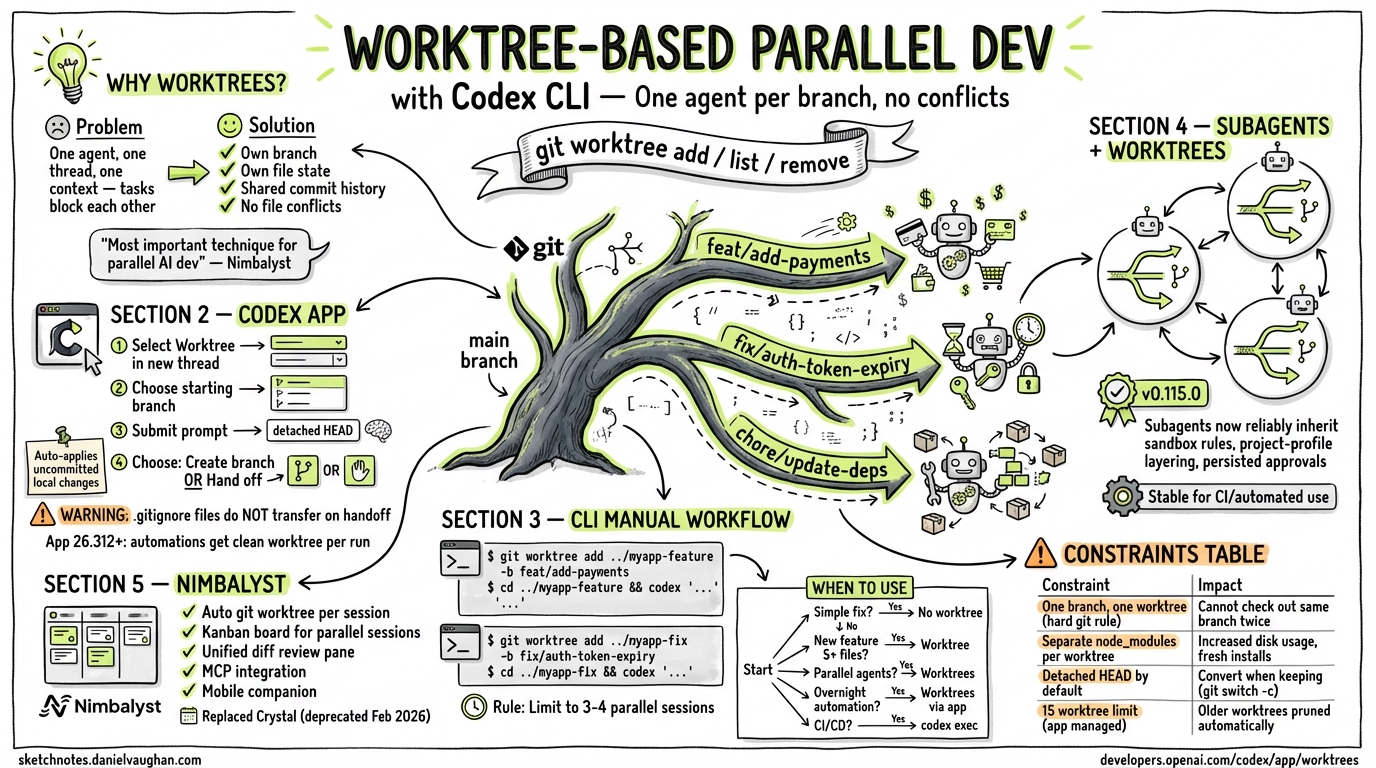
Worktree-Based Parallel Development with Codex CLI
| *Published 2026-03-26 | Sources: developers.openai.com/codex/app/worktrees, nimbalyst.com, github.com/openai/codex* |
Why Worktrees?
The core limitation of sequential AI agent workflows: one agent, one thread, one context. Every task blocks the next. When Codex is investigating a bug, you can’t also be writing a new feature in the same directory — the agent would interfere with itself.
Git worktrees solve this. A worktree is a second (or third, or fourth) working directory linked to the same git repository.1 Each worktree has its own branch, its own index, and its own file state — but all share the same commit history.1 This makes them ideal for parallel agent execution:
- No file conflicts between agents running simultaneously
- Clean branch isolation — each agent works on its own feature branch
- Easy merge review — each worktree produces a discrete diff
“Git worktrees are the single most important technique for parallel AI agent development.” — Nimbalyst2
Worktrees in the Codex App vs CLI
Codex App (built-in support)
The Codex desktop app has first-class worktree support built in.3 When starting a new thread:
- Select “Worktree” in the new thread view3
- Choose the starting branch (main, feature branch, or current branch with local changes)3
- Submit your prompt — Codex creates the worktree in detached HEAD state (prevents branch pollution while supporting multiple parallel worktrees)3
- Codex applies any uncommitted local changes to the worktree automatically3
Two paths forward:
- Path A — Exclusive Worktree Development: Click “Create branch here” to convert the detached worktree into a named branch. Commit, push, and open PRs directly from the app.3
- Path B — Handoff to Local: Click “Hand off” in the thread header to bring work back to your main checkout. Best when you need your dev server, IDE, or specific local env.3
Automations with worktrees (App 26.312+)4: When configuring automations, choose “Worktree” execution per automation. Each scheduled run gets a clean isolated worktree — no cross-contamination between automation runs.4
Codex CLI (manual worktree management)
The CLI does not yet have a --worktree flag in stable release (GitHub issues #131205 and #128626 track this). Until it ships, manage worktrees manually:
# Create a new worktree with a new branch for a parallel agent task
git worktree add ../myapp-feature -b feat/add-payments

# Start Codex in that worktree
cd ../myapp-feature && codex "Implement Stripe checkout integration per the spec in docs/payments.md"

# In another terminal — start a second agent on a different task
git worktree add ../myapp-bugfix -b fix/auth-token-expiry
cd ../myapp-bugfix && codex "Investigate and fix the token expiry bug in src/auth/session.ts"

# Check all active worktrees
git worktree list

# Clean up after merging
git worktree remove ../myapp-feature
Rule of thumb: Limit to 3-4 parallel CLI sessions. Review and merge become the bottleneck beyond that.
Subagents and Worktree Isolation
When Codex spawns subagents, each agent works in its own isolated environment — often a git worktree created automatically by the subagent runtime. This is key to how parallel subagent workflows avoid file conflicts.
As of v0.115.0 (March 16, 2026)7, spawned subagents now reliably inherit:
- Sandbox and network rules from the parent session7
- Project-profile layering (
.codex/config.tomlprofiles)7 - Persisted host approvals7
- Symlinked writable roots7
This means subagent-driven parallel execution is now stable for automated/CI use cases.
Agentic Pod Pattern with Worktrees
A typical multi-agent pattern for Daniel’s agentic pod:
Orchestrator (main thread, main checkout)
├── Agent 1 — worktree: feat/api-endpoints    (new feature)
├── Agent 2 — worktree: fix/perf-regression   (bug fix)
└── Agent 3 — worktree: chore/update-deps     (dependency update)
Each agent runs independently. The orchestrator reviews and merges when complete.
Key Constraints and Gotchas
| Constraint | Detail |
|---|---|
| One branch, one worktree | Git prevents the same branch from being checked out in more than one worktree — hard git rule, not Codex limitation1 |
| No .gitignore files | Files in .gitignore do NOT transfer during app Handoff — not git-tracked3 |
| Separate node_modules | Each worktree needs its own npm install / uv sync |
| Detached HEAD by default | Codex app uses detached HEAD to allow parallel worktrees on the same starting branch — convert to a named branch when you want to keep the work3 |
| 15 worktree limit | Codex app defaults to retaining 15 recent managed worktrees; permanent worktrees are never auto-deleted3 |
Nimbalyst: Visual Worktree Management
Nimbalyst (nimbalyst.com)8 is the primary GUI tool for visual worktree-based parallel development with Codex and Claude Code. It replaces the deprecated Crystal (Feb 2026)9.
What it automates:
- Creates a git worktree per session automatically (no manual
git worktree add)8 - Kanban board for managing parallel sessions8
- Unified diff review pane for all agent file changes8
- MCP integration (Linear, GitHub, Slack, databases)8
- Mobile companion for monitoring + voice input8 ⚠️ [unverified: voice input specifically not confirmed in official docs]
- Race condition hardening: mutex locks, session validation, database transactions ⚠️ [unverified]
Why it matters for the agentic pod: Nimbalyst is essentially a Codex session manager with git worktrees as the primary isolation primitive. It’s the tool that makes the “parallel agents on parallel branches” workflow tractable at scale.
Reference: nimbalyst.com/blog/git-worktrees-for-ai-coding-agents-complete-guide2
AGENTS.md for Worktree Workflows
Add this to your repo’s AGENTS.md to help Codex understand the worktree context:
## Parallel Development Notes
This repo uses git worktrees for parallel agent development.
- Each agent task runs in its own worktree with its own branch
- Never push directly to main — always open a PR
- Run `npm install` (or `uv sync`) at the start of any new worktree session
- Branch naming: feat/<slug>, fix/<slug>, chore/<slug>
- After completing work, run the full test suite before handing off for review
CI/CD Integration
Worktrees pair naturally with codex exec for CI:
# In CI: create isolated worktree, run agent, clean up
git worktree add /tmp/codex-ci-run -b ci/auto-fix-$(date +%s)
cd /tmp/codex-ci-run
codex exec --profile ci "Fix all failing tests and summarize changes"
# Review output, open PR if successful
git worktree remove /tmp/codex-ci-run
For GitHub Actions, see openai/codex-action10 — the official action already handles sandbox isolation, so explicit worktree management is optional in that context.
When to Use Worktrees vs Single-Thread
| Scenario | Approach |
|---|---|
| Simple bug fix in one file | Single thread, no worktree needed |
| New feature spanning 5+ files | Worktree — isolates changes |
| Parallel feature development by multiple agents | Worktrees — one per agent |
| Overnight automation runs | Worktrees via automations (App 26.312+)4 |
| Exploring two implementation approaches | Two worktrees — compare diffs, merge the winner |
| CI/CD automated task | codex exec — sandbox handles isolation |
This article corresponds to backlog item #11.
Citations
-
Git worktree documentation — commands, constraints, and one-branch-per-worktree rule: https://git-scm.com/docs/git-worktree ↩ ↩2 ↩3
-
Nimbalyst blog — “Git Worktrees for AI Coding Agents: A Complete Guide” (source of the quoted statement): https://nimbalyst.com/blog/git-worktrees-for-ai-coding-agents-complete-guide/ ↩ ↩2
-
Official Codex app worktrees documentation — detached HEAD, handoff, .gitignore limitation, 15 worktree limit: https://developers.openai.com/codex/app/worktrees ↩ ↩2 ↩3 ↩4 ↩5 ↩6 ↩7 ↩8 ↩9 ↩10
-
Codex developer changelog — App version 26.312 (March 12, 2026) introducing worktree-per-automation option: https://developers.openai.com/codex/changelog ↩ ↩2 ↩3
-
GitHub issue #13120 — “Git worktrees with codex” (closed as duplicate of #12862): https://github.com/openai/codex/issues/13120 ↩
-
GitHub issue #12862 — “CLI: add –worktree and –tmux flags for one-command isolated sessions” (open): https://github.com/openai/codex/issues/12862 ↩
-
GitHub release rust-v0.115.0 (March 16, 2026) — subagent sandbox/network inheritance, project-profile layering, persisted host approvals, symlinked writable roots: https://github.com/openai/codex/releases/tag/rust-v0.115.0 ↩ ↩2 ↩3 ↩4 ↩5
-
Nimbalyst homepage — visual workspace for Claude Code and Codex with kanban, diff review, MCP integration, mobile app: https://nimbalyst.com/ ↩ ↩2 ↩3 ↩4 ↩5 ↩6
-
Crystal (stravu/crystal) deprecated and replaced by Nimbalyst as of February 2026: https://github.com/stravu/crystal ↩
-
openai/codex-action — official GitHub Actions action for running Codex CLI in CI with sandbox isolation: https://github.com/openai/codex-action ↩