Codex CLI for Python Teams: Configuration, Conventions and Automation
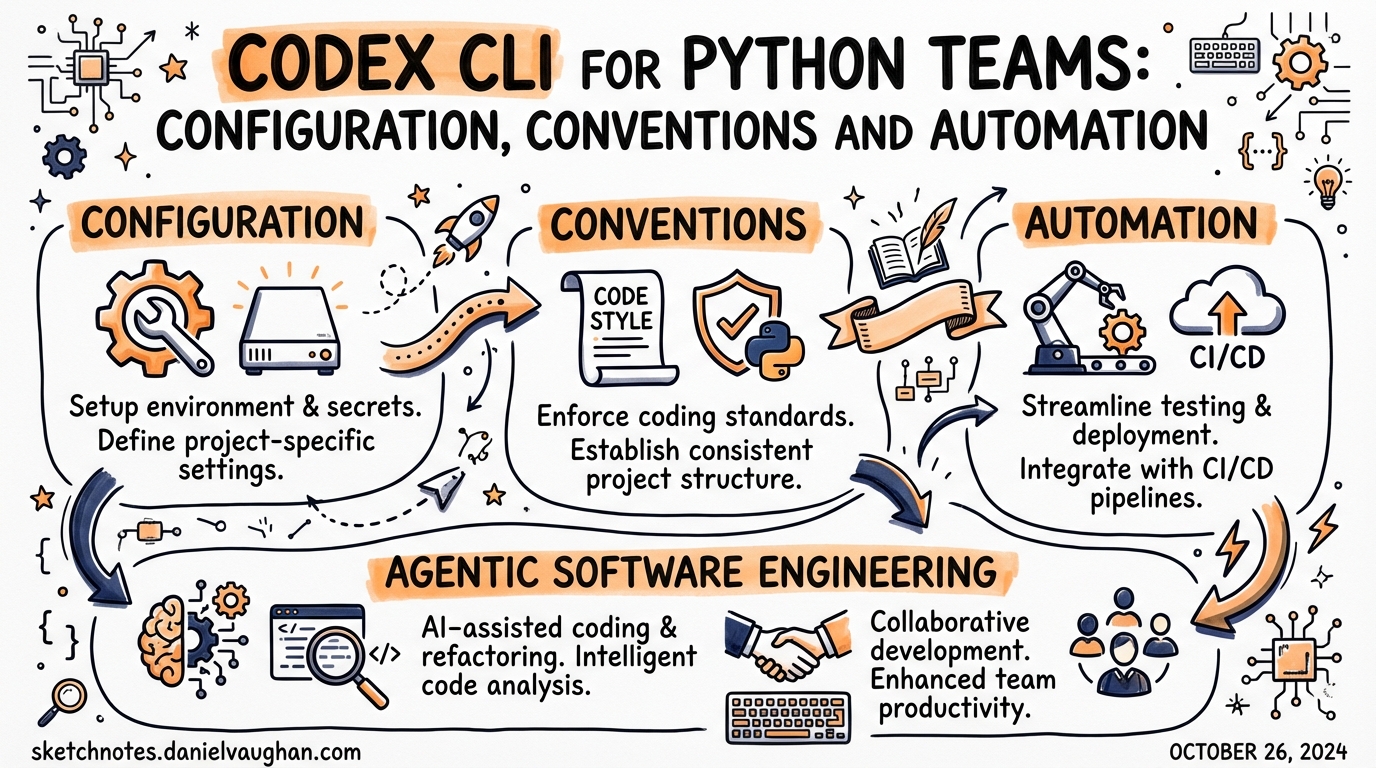
Codex CLI for Python Teams: Configuration, Conventions and Automation
Overview
Python teams adopting Codex CLI face a familiar problem: out-of-the-box, the agent will reach for pip, pytest directly, and whatever Python binary is on the PATH. Left unconfigured, that means inconsistent environments, the wrong package manager, and test commands that diverge from your CI baseline. This article covers the full configuration surface — AGENTS.md, pyproject.toml, hooks, and CI integration — so Codex operates as a well-behaved member of a modern Python team from the first commit.
There is also a timely piece of context: in March 2026, OpenAI announced it is acquiring Astral, the company behind uv, Ruff, and ty.1 The acquisition places the most widely-adopted Python toolchain directly inside the Codex organisation — expect deeper first-class integration over the coming months. For now, the configuration patterns below work today and will only get smoother as that integration matures.
The Modern Python Toolchain
Before looking at Codex-specific configuration, it is worth establishing the canonical toolchain this article targets:
| Tool | Replaces | What it does |
|---|---|---|
| uv | pip, venv, pyenv, pipx, poetry | Package manager, resolver, environment manager — written in Rust2 |
| Ruff | flake8, black, isort, pyupgrade, + 800 others | Linter and formatter, sub-second on large codebases3 |
| ty | mypy | Static type checker from Astral, also Rust-based |
| pytest | — | Test runner; invoked via uv run pytest |
The key discipline: every tool invocation goes through uv run. This guarantees the project’s virtual environment is up-to-date before any tool runs, eliminates version drift between developers, and produces a lockfile (uv.lock) that CI can pin to.4
Configuring AGENTS.md for Python
Codex reads AGENTS.md files up the directory hierarchy, with deeper files taking precedence.5 For a Python project, the root AGENTS.md should encode the full workflow so that Codex never guesses.
Minimal starter
# AGENTS.md

## Environment
- Python package manager: **uv** — never use `pip` directly
- All tool invocations must go through `uv run` (e.g. `uv run pytest`, `uv run ruff`)
- To add a dependency: `uv add <package>`; for dev deps: `uv add --dev <package>`
- Python version: 3.12 (see `.python-version` or `pyproject.toml`)

## Testing
- Run tests: `uv run pytest tests/ -v`
- Run a single test file: `uv run pytest tests/test_foo.py -v`
- Run with coverage: `uv run pytest --cov=src --cov-report=term-missing`
- All new code must have pytest coverage — no exceptions

## Linting and formatting
- Lint: `uv run ruff check . --fix`
- Format: `uv run ruff format .`
- Type check: `uv run ty check` (or `uv run mypy src/`)
- Run all checks before marking a task done: lint → format → type check → tests

## Commit conventions
- Conventional Commits: `feat:`, `fix:`, `refactor:`, `test:`, `docs:`
- Do not commit `uv.lock` changes unless dependency versions were intentionally updated
Monorepo variant
In a monorepo with multiple services, place a root AGENTS.md for shared conventions and per-service AGENTS.md files for service-specific overrides. Codex merges them in scope order.5
# services/payments/AGENTS.md

## Service-specific overrides
- This service uses FastAPI; models live in `src/payments/models/`
- Integration tests require a running Postgres instance: `docker compose up -d db`
- Run integration tests: `uv run pytest tests/integration/ -m integration`
- Unit tests only: `uv run pytest tests/unit/`
pyproject.toml: The Single Source of Truth
All tool configuration should live in pyproject.toml — no .flake8, no setup.cfg, no mypy.ini. Ruff reads [tool.ruff], pytest reads [tool.pytest.ini_options], and uv reads [tool.uv].6
[project]
name = "my-service"
version = "0.1.0"
requires-python = ">=3.12"
dependencies = [
    "fastapi>=0.115",
    "pydantic>=2.9",
]

[tool.uv]
dev-dependencies = [
    "pytest>=8.3",
    "pytest-cov>=6.0",
    "pytest-asyncio>=0.24",
    "ruff>=0.9",
    "mypy>=1.13",
]

[tool.pytest.ini_options]
testpaths = ["tests"]
asyncio_mode = "auto"
addopts = "--tb=short -q"

[tool.ruff]
target-version = "py312"
line-length = 100

[tool.ruff.lint]
select = [
    "E",   # pycodestyle errors
    "F",   # pyflakes
    "I",   # isort
    "UP",  # pyupgrade
    "B",   # flake8-bugbear
    "SIM", # flake8-simplify
]
ignore = ["E501"]

[tool.ruff.lint.isort]
known-first-party = ["my_service"]

[tool.ruff.format]
quote-style = "double"
indent-style = "space"

[tool.mypy]
strict = true
ignore_missing_imports = true
With this in place, Codex can discover your complete project conventions from a single file.
Codex Hooks for Python Enforcement
Codex CLI’s hooks system7 lets you intercept and validate tool use at the session level. For Python teams the most valuable hooks are:
PostToolUse: auto-lint after writes
Fire Ruff after every file write to keep the working tree clean. Create .codex/hooks.toml:
[[hooks]]
event = "PostToolUse"
tool_names = ["write_file", "edit_file", "patch_file"]
command = "uv run ruff check ${file} --fix --quiet && uv run ruff format ${file} --quiet"
run_in_background = true
SessionStop: run full test suite before exit
[[hooks]]
event = "SessionStop"
command = "uv run pytest tests/ -q --tb=short"
blocking = true
on_failure = "warn"
This makes the test gate explicit — Codex is reminded to leave the suite green before finishing a session.
userpromptsubmit: enforce uv discipline
[[hooks]]
event = "userpromptsubmit"
match_text = ["pip install", "pip add", "python -m pytest", "python -m ruff"]
command = """
echo "⚠️  Use uv for all Python operations: 'uv add <pkg>', 'uv run pytest', 'uv run ruff'"
exit 1
"""
This blocks prompts that contain legacy invocations before Codex ever processes them.8
Workflow Architecture
A well-configured Python session flows like this:
flowchart TD
    A[User prompt] --> B{userpromptsubmit hook}
    B -- blocked: pip/legacy cmds --> C[Hook: warn & reject]
    B -- passes --> D[Codex reads AGENTS.md + pyproject.toml]
    D --> E[Codex writes/edits Python files]
    E --> F{PostToolUse hook}
    F --> G[uv run ruff check --fix]
    G --> H[uv run ruff format]
    H --> I[Codex runs tests]
    I --> J[uv run pytest tests/ -v]
    J --> K{Tests pass?}
    K -- no --> L[Codex diagnoses and fixes]
    L --> E
    K -- yes --> M{SessionStop hook}
    M --> N[Final full-suite run]
    N --> O[Session complete]
pytest Patterns Worth Encoding in AGENTS.md
Several pytest conventions are non-obvious to an agent without explicit guidance:
Fixture discovery
Tell Codex where fixtures live to avoid duplication:
## pytest conventions
- Shared fixtures are in `tests/conftest.py` — check there before creating new ones
- Per-service fixtures live in `tests/<service>/conftest.py`
- Use `pytest-asyncio` with `asyncio_mode = "auto"` — no manual `@pytest.mark.asyncio` needed
- HTTP client fixtures use `httpx.AsyncClient` with ASGI transport, not `requests`
Coverage thresholds
## Coverage
- Minimum coverage: 90% overall, 100% for `src/payments/`
- Coverage command: `uv run pytest --cov=src --cov-report=term-missing --cov-fail-under=90`
- Do not add `# pragma: no cover` without a comment explaining why
Test categorisation
## Test markers
- `@pytest.mark.unit` — no I/O, runs in CI on every push
- `@pytest.mark.integration` — requires Docker services, runs in CI on PR only
- `@pytest.mark.slow` — long-running, skip with `-m "not slow"` locally
- Default local command: `uv run pytest -m "unit" -q`
CI/CD Integration
A GitHub Actions workflow that mirrors the AGENTS.md conventions exactly:
name: ci

on: [push, pull_request]

jobs:
  quality:
    runs-on: ubuntu-latest
    steps:
      - uses: actions/checkout@v4

      - name: Install uv
        uses: astral-sh/setup-uv@v5
        with:
          version: "latest"
          enable-cache: true

      - name: Set up Python
        run: uv python install

      - name: Install dependencies
        run: uv sync --frozen --all-extras

      - name: Lint
        run: uv run ruff check . --output-format=github

      - name: Format check
        run: uv run ruff format --check .

      - name: Type check
        run: uv run mypy src/

      - name: Test
        run: uv run pytest tests/ -q --cov=src --cov-report=xml --cov-fail-under=90

      - name: Upload coverage
        uses: codecov/codecov-action@v4
The key discipline: use uv sync --frozen in CI, not uv sync. The --frozen flag prevents uv from updating uv.lock mid-run, ensuring the locked versions in the repository are exactly what runs.2
The Astral Acquisition: What It Means Now
OpenAI’s acquisition of Astral (announced 19 March 2026, subject to regulatory approval) brings the uv, Ruff, and ty teams inside the Codex organisation.1 The stated goal is to let Codex “interact more directly with the tools developers already use” across the full development lifecycle.9
In practical terms, today the integration is at the configuration level — AGENTS.md, hooks, and pyproject.toml as described above. The roadmap hints at:
- Ruff as a built-in Codex step — generated code linted and formatted before it is presented to the user
- uv-aware dependency resolution — Codex understanding
uv.lockconstraints when suggesting new packages - ty integration — type errors surfaced as first-class agent feedback rather than a separate tool invocation
None of this changes what you should configure today. The patterns above are stable and will only get deeper toolchain support as the integration progresses.
Quick-Start Checklist
For a team setting up Codex CLI against an existing Python project:
- Install uv —
curl -LsSf https://astral.sh/uv/install.sh | sh2 - Migrate tooling config into
pyproject.tomlusing the template above - Add
AGENTS.mdat the repo root with environment, testing, and lint conventions - Create
.codex/hooks.tomlwith PostToolUse ruff enforcement and SessionStop test gate - Add per-service
AGENTS.mdfiles for any service with non-standard test commands - Update CI to use
astral-sh/setup-uvanduv sync --frozen - Run
/initin Codex to let it audit your existingAGENTS.mdagainst the actual project structure
The single most impactful change is step 3: an AGENTS.md that clearly states uv run pytest and uv run ruff eliminates the majority of “wrong tool” mistakes before they happen.