Multi-Agent Orchestration Patterns: Sequential, Parallel and Wave-Based
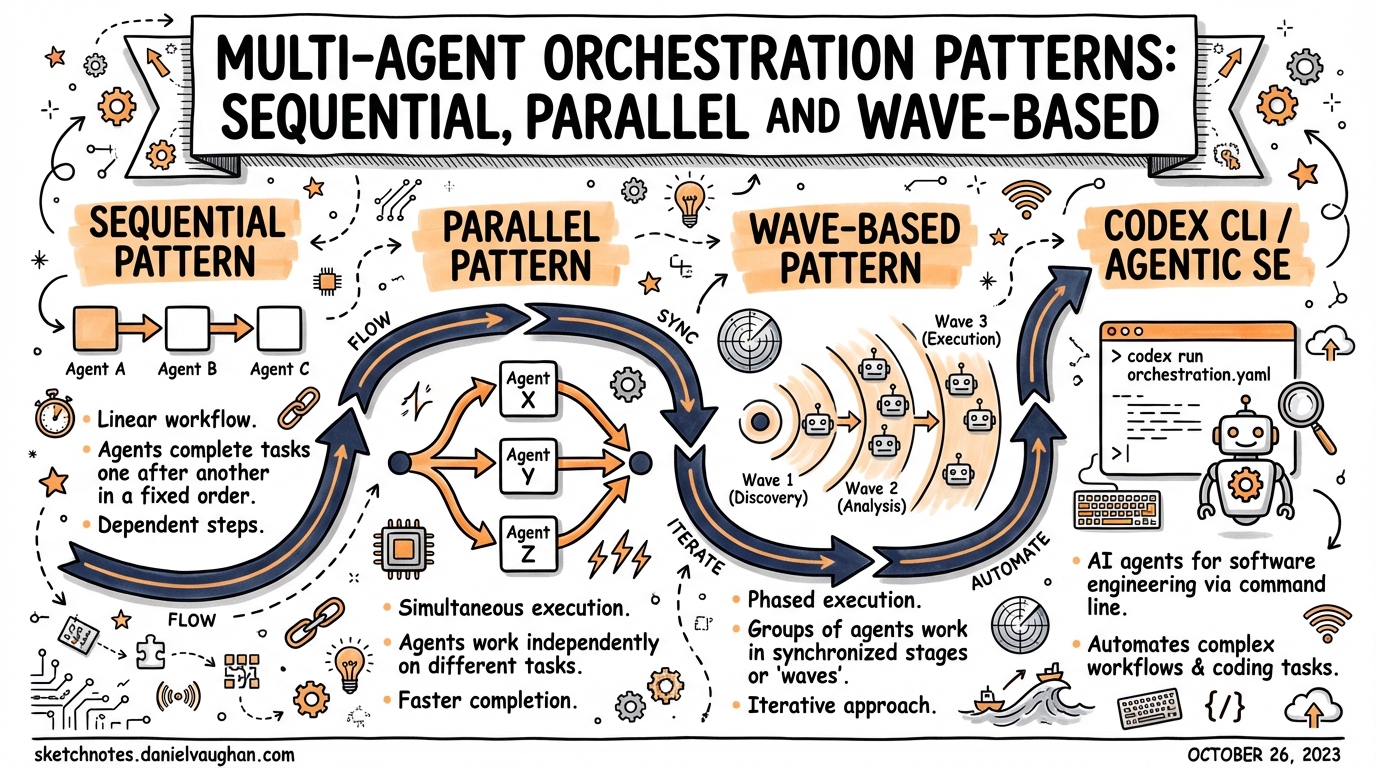
Multi-Agent Orchestration Patterns: Sequential, Parallel and Wave-Based
Codex CLI subagents became GA in March 2026. Now the real design question is: which pattern to use? Sequential gating for auditability, parallel swarms for throughput, or wave-based hybrids for complex feature tracks. This article covers all three, when to apply each, and how to configure them.
The Core Question
Subagents are not a “more is better” tool. Spawning parallel agents burns tokens across every thread — there is no free parallelism. Each child runs its own model inference and tool calls. The design decision is: does the time saved or quality gained justify the token cost?
The answer depends on structure. Three patterns cover almost every real-world case.
Pattern 1: Sequential (Gated Chain)
Use when: tasks have hard dependencies — later work requires earlier output. Auditability and correctness matter more than throughput.
Architecture
User Prompt
    ↓
[Manager Agent]
    ↓
[Agent A: Planner] → artefact_a
    ↓ (gate: artefact_a exists and passes validation)
[Agent B: Implementer] → artefact_b
    ↓ (gate: tests pass)
[Agent C: Reviewer] → review_report
    ↓
Consolidated response
The manager enforces each gate before handing off to the next agent. A gate might be:
- A file exists (
.ralph/plan.mdwritten by A) - A command succeeds (
npm testreturns 0) - A human approval step
Config
# .codex/config.toml

[agents]
max_threads = 3    # at most one active at a time in pure sequential; set to number of chain links
max_depth   = 1    # root spawns children; children don't spawn further

[features]
multi_agent = true
Prompt pattern
You are an orchestrator. Complete this task in three sequential phases:

Phase 1: Spawn an explorer agent. Ask it to read all files in src/ and write a migration plan to .codex/plan.md. Wait for it to finish and confirm the file exists.
Phase 2: Only after plan.md exists — spawn an implementer agent with that plan as context. Ask it to apply the migration. Wait for tests to pass before proceeding.
Phase 3: Spawn a reviewer agent. Ask it to review the git diff and write .codex/review.md. Return its findings.
When sequential wins
- Enterprise compliance workflows (audit trail of each step)
- Long refactors where later code depends on earlier changes
- PRD → spec → implementation → review pipelines
- Security sign-off before deployment
Pattern 2: Parallel (Worker Swarm)
Use when: tasks are independent. Same work repeated across many items. Throughput matters more than auditability.
Architecture
User Prompt
    ↓
[Manager Agent]
    ├──────────────────────────────────────┐
    ↓                ↓                     ↓
[Worker A]       [Worker B]           [Worker C]
src/auth/        src/api/              src/ui/
    ↓                ↓                     ↓
report_a.json    report_b.json        report_c.json
    └──────────────────────────────────────┘
                       ↓
             [Manager: consolidate]
                       ↓
              Unified results
All workers run simultaneously. The manager waits for all to complete, then synthesises.
spawn_agents_on_csv for large batches
For 10+ similar items, the purpose-built spawn_agents_on_csv tool is the right approach:
# Inside your AGENTS.md or skill instruction block:
spawn_agents_on_csv:
  csv_path: .codex/tasks.csv
  instruction: "Review {file_path} for {issue_type}. Return JSON via report_agent_job_result"
  output_schema:
    file: string
    severity: string
    fix: string
  output_csv_path: .codex/reports/batch-results.csv
  max_concurrency: 6
tasks.csv example:
file_path,issue_type
src/auth/login.ts,sql_injection
src/api/user.ts,missing_auth
src/ui/form.tsx,xss_vulnerability
Codex spawns up to max_concurrency workers at once, tracks progress, provides ETA estimates, and writes all results to output_csv_path.
Timeout: agents.job_max_runtime_seconds governs the per-worker timeout (default: 1800 seconds). For large codebases, increase this.
Prompt pattern for ad-hoc parallel
Spawn 3 worker agents simultaneously:
- Worker 1: analyse src/frontend/** for accessibility issues → write to .codex/a11y-frontend.md
- Worker 2: analyse src/backend/** for missing error handling → write to .codex/errors-backend.md
- Worker 3: analyse src/shared/** for type safety gaps → write to .codex/types-shared.md

Wait for all three to finish, then summarise findings into .codex/audit-summary.md.
Config
[agents]
max_threads = 6    # allows up to 6 concurrent workers
max_depth   = 1    # workers don't spawn further workers
job_max_runtime_seconds = 900   # per-worker timeout for CSV jobs
When parallel wins
- Batch code review across many files or modules
- Audit runs (security, accessibility, type safety) across a codebase
- Parallel exploration of competing implementation approaches
- Migration tasks (same transformation across 100+ files)
- Benchmark comparison runs
Pattern 3: Wave-Based (Hybrid)
Use when: tasks have partial independence. Some work is parallel; other work depends on the parallel results. Think: feature tracks with a shared merge step.
Architecture
                    Wave 1 (parallel)
User Prompt ──→ [Manager]
                    ├─→ [Explorer A: frontend module]  → a.md
                    ├─→ [Explorer B: backend module]   → b.md
                    └─→ [Explorer C: database module]  → c.md
                              ↓ (all complete)
                    Wave 2 (sequential)
                    [Planner: read a.md + b.md + c.md → plan.md]
                              ↓
                    Wave 3 (parallel again)
                    ├─→ [Implementer A: frontend changes]
                    ├─→ [Implementer B: backend changes]
                    └─→ [Implementer C: database migration]
                              ↓ (all complete + tests pass)
                    Wave 4 (sequential)
                    [Reviewer: unified diff → review.md]
Why three waves?
- Wave 1 (parallel): independent exploration — fastest way to gather context
- Wave 2 (sequential): planning requires all Wave 1 context — can’t parallelise
- Wave 3 (parallel): implementation tasks are independent once planned
- Wave 4 (sequential): final review needs the whole picture
Practical limits
| Resource | Limit |
|---|---|
| Concurrent agents on a laptop | 5–7 max before rate limits and review bottlenecks hit |
| Min task size worth parallelising | 15–30 minutes sequential equivalent |
| Max nesting depth (default) | 1 (workers can’t spawn workers) |
| Practical max_threads | 6 (default) |
Example: Feature delivery pipeline
# .codex/agents/explorer.toml
name = "explorer"
description = "Reads code and writes analysis reports. Does not modify files."
model_reasoning_effort = "low"   # cheap: just reading
sandbox_mode = "network-disabled"

# .codex/agents/implementer.toml
name = "implementer"
description = "Applies code changes based on a written plan. Runs tests after each change."
model_reasoning_effort = "high"
sandbox_mode = "workspace-only"

# .codex/agents/reviewer.toml
name = "reviewer"
description = "Reviews diffs for correctness, security, and style. Writes structured reports."
model_reasoning_effort = "medium"
sandbox_mode = "network-disabled"
Orchestrator prompt:
You are a software delivery pipeline. Complete in four waves:

WAVE 1 — Parallel exploration (spawn simultaneously):
  - explorer A → analyse src/frontend/ → write .codex/explore/frontend.md
  - explorer B → analyse src/backend/ → write .codex/explore/backend.md
  - explorer C → analyse migrations/ → write .codex/explore/db.md
  Wait for all three.

WAVE 2 — Planning (single agent):
  - planner → read all .codex/explore/*.md → write detailed implementation plan to .codex/plan.md
  Wait for plan.md.

WAVE 3 — Parallel implementation (spawn simultaneously):
  - implementer A → apply frontend changes from plan.md
  - implementer B → apply backend changes from plan.md
  - implementer C → run database migration from plan.md
  Wait for all three AND confirm tests pass.

WAVE 4 — Review (single agent):
  - reviewer → review full git diff → write .codex/review.md
  Return the review summary.
Decision Guide
| Question | Sequential | Parallel | Wave |
|---|---|---|---|
| Tasks depend on each other? | ✅ | ❌ | ✅ (between waves) |
| Same work across many items? | ❌ | ✅ | Sometimes |
| Auditability required? | ✅ | ❌ | Partially |
| Throughput is priority? | ❌ | ✅ | ✅ |
| Complex multi-module feature? | ❌ | ❌ | ✅ |
| Token budget is tight? | ✅ | ❌ | Consider |
Operator Patterns (Path-Based Addressing, v0.117.0+)
From v0.117.0, subagents use readable path-based addresses: /root/agent_a, /root/agent_b. This makes orchestration configs readable and version-controllable:
# Reference agents by path in AGENTS.md or skills
# Parent agent lives at: /root
# First child spawned: /root/agent_0
# Named child: /root/security-reviewer
Combined with spawn_agents_on_csv, path-based addressing makes it possible to route specific results back to specific parent threads without ambiguity.
Common Mistakes
- ❌ Using parallel for sequential tasks — if B needs A’s output, spawning them simultaneously will fail silently (B works with empty/wrong context)
- ❌ Over-nesting —
max_depth > 1multiplies token cost exponentially and makes approval chains unmanageable - ❌ No timeouts — always set
job_max_runtime_secondsfor CSV batch jobs in CI environments - ❌ Not writing intermediate artefacts — agents must write results to files; they can’t pass structured data back purely through text
- ❌ Parallelising tiny tasks — context setup overhead exceeds gains for tasks < 10 min sequential equivalent