Codex CLI Multi-Agent Patterns in Production: Real-World Case Studies
Codex CLI Multi-Agent Patterns in Production: Real-World Case Studies
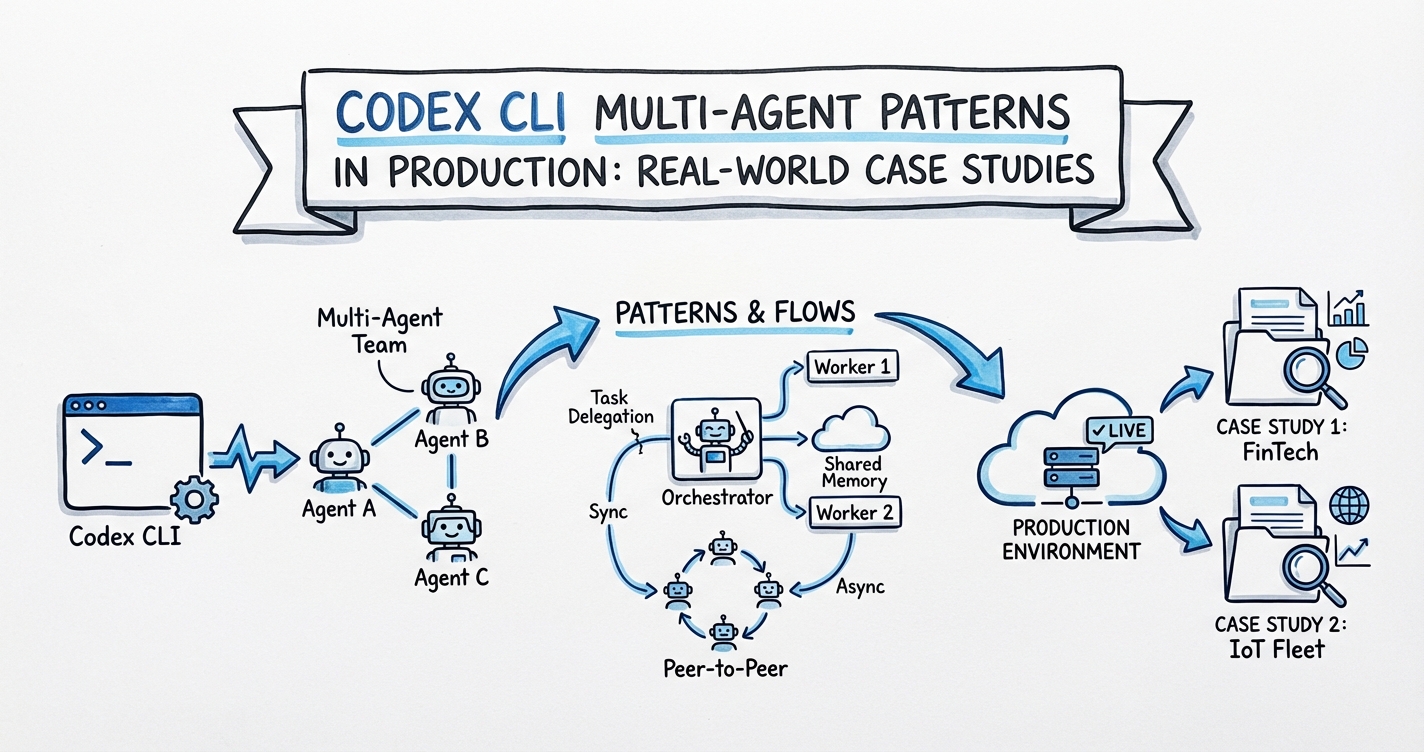
Sub-agents reached general availability in Codex CLI v0.115.0 (16 March 2026)1 and gained readable path-based addressing in v0.117.0 (26 March 2026)2. With the scaffolding now stable, production teams have started publishing their actual topologies. This article walks through three patterns — parallel feature development with wave-based phase gating, a continuous review-and-fix swarm for legacy codebases, and an event-driven incident response agent — with complete TOML configurations, cost models, OTel integration, and documented failure modes.
Prerequisites
Sub-agents are enabled by default from v0.115.0 onwards; no feature flag is required1. You’ll need:
- Codex CLI ≥ v0.117.0 for path-based addressing2
- Custom agent TOML files in
.codex/agents/(project-scoped) or~/.codex/agents/(global)3 - The
[agents]section in yourconfig.tomlto set thread limits and depth
# .codex/config.toml
[agents]
max_threads = 8
max_depth   = 1
Keep max_depth = 1 unless you explicitly need recursive fan-out; uncapped depth dramatically inflates token usage3.
Case Study 1: Parallel Feature Development with Wave-Based Phase Gating
Topology
A three-phase wave model with a hard gate between each phase. Phase one is always sequential — the planner runs alone and produces a SPEC.md. Phases two and three spawn parallel workers from that spec.
flowchart TD
    A[Orchestrator] --> B[Phase 1: Planner\n/root/planner]
    B --> C{Spec approved?}
    C -- yes --> D[Phase 2: Parallel Implementers\n/root/impl_a /root/impl_b]
    C -- no --> B
    D --> E[Phase 3: Parallel Reviewers\n/root/reviewer_a /root/reviewer_b]
    E --> F[Orchestrator collects results]
Agent TOML Definitions
# .codex/agents/planner.toml
name                  = "planner"
description           = "Reads requirements and writes SPEC.md. Read-only except for SPEC.md."
model                 = "gpt-5.4"
model_reasoning_effort = "high"
sandbox_mode          = "workspace-write"

[instructions]
text = """
Your only output is SPEC.md in the project root.
Write: goals, interface contracts, data model, test acceptance criteria.
Do not write implementation code.
"""
# .codex/agents/implementer.toml
name                  = "implementer"
description           = "Implements one module from SPEC.md. Writes tests alongside code."
model                 = "gpt-5.4"
model_reasoning_effort = "medium"
sandbox_mode          = "workspace-write"
nickname_candidates   = ["Atlas", "Bruno", "Clio", "Dora"]

[instructions]
text = """
Read SPEC.md. Implement only the module you are assigned.
Write unit tests. Do not touch modules owned by other implementers.
"""
# .codex/agents/reviewer.toml
name                  = "reviewer"
description           = "Reviews correctness, security, and test coverage for an assigned module."
model                 = "gpt-5.4"
model_reasoning_effort = "medium"
sandbox_mode          = "read-only"
nickname_candidates   = ["Athena", "Bora"]

[instructions]
text = """
Review the assigned module. Return a structured JSON report via report_agent_job_result:
{ "module": string, "risks": string[], "passed": boolean, "comments": string }
"""
Orchestrator Prompt Pattern
Phase 1 spawns the planner and waits for SPEC.md. Phase 2 reads the spec, extracts module list, and spawns one implementer per module in parallel. Phase 3 spawns one reviewer per module; any passed=false result triggers a targeted re-implementation loop for that module only.
Cost Model
For a five-module feature: ~$0.24 (planner) + 5×$0.30 (implementers) + 5×$0.12 (reviewers) = ~$2.34. Iteration loops are the main cost multiplier — target first-pass review pass rates ≥70% to keep total cost under $5.4
Failure Modes
- Spec drift: If implementers read SPEC.md at different clock times and it’s edited mid-run, their outputs diverge. Mitigation: generate a SHA-256 of SPEC.md in the orchestrator and include it as a context seed for each implementer.
- Module ownership collision: Two implementers writing the same file. Mitigation: make module boundaries explicit file paths in SPEC.md, not just logical names.
Case Study 2: Continuous Review-and-Fix Swarm for Legacy Codebases
This pattern uses spawn_agents_on_csv (merged PR #10935, 24 February 2026)5 to batch-audit every file in a legacy codebase and optionally apply fixes.
flowchart LR
    A[Generate audit.csv\nfile_path, owner, priority] --> B[spawn_agents_on_csv]
    B --> C[Worker 1\n/root/worker_0]
    B --> D[Worker 2\n/root/worker_1]
    B --> E[Worker N\n/root/worker_n]
    C --> F[results.csv]
    D --> F
    E --> F
    F --> G[Orchestrator filters\nhigh-risk rows]
    G --> H[Targeted fix agents]
Orchestrator Prompt
Call spawn_agents_on_csv with:
  csv_path:        "./audit.csv"
  output_csv_path: "./results.csv"
  instruction: >
    Review {file_path} owned by {owner}.
    Check for: security vulnerabilities, missing tests, dead code, outdated dependencies.
    Call report_agent_job_result exactly once with JSON:
    { "file_path": string, "risk": "high"|"medium"|"low", "summary": string, "fix_required": boolean }
  max_concurrency: 8
  max_runtime_seconds: 300
Global Config
# .codex/config.toml
[agents]
max_threads              = 16
job_max_runtime_seconds  = 300

[features]
sqlite = true
The sqlite feature flag is required for spawn_agents_on_csv state persistence5.
Post-Processing: Targeted Fix Pass
After the swarm completes, filter results.csv for fix_required=true, risk=high rows and spawn a second wave of implementer agents — this time with sandbox_mode = "workspace-write" — to apply fixes:
codex exec --full-auto --profile fix-swarm \
  "Read results.csv. Filter rows where fix_required is true and risk is high.
   For each, spawn an implementer agent to apply the minimum safe fix to that file.
   Commit each fix with a message referencing the file path."
OTel Monitoring
Wire up the [otel] section to export spans and metrics for swarm health6:
[otel]
endpoint     = "http://localhost:4318"
service_name = "codex-audit-swarm"
export_spans   = true
export_metrics = true
Spans emit under codex.agent_job; use codex_agent_job_completions_total and codex_agent_job_duration_seconds_bucket in your metrics dashboard for per-worker completion rates and P95 latency.
Failure Modes
- Workers timing out silently: A worker that exits without calling
report_agent_job_resultis markedfailedin the output CSV — the batch continues, but those rows are silently skipped5. Always cross-referenceresults.csvrow count againstaudit.csv. - SQLite contention at high concurrency: Above
max_threads = 16, write contention on the SQLite state file causes intermittentSQLITE_BUSYerrors. Keep concurrency ≤ 12 until the upstream locking fix ships. ⚠️
Case Study 3: Event-Driven Incident Response Agent
Architecture
A webhook receiver (external to Codex) writes an incident descriptor to a JSONL queue file. A scheduled codex exec job polls the queue, spawns agents per incident, and produces a draft PR for human review.
flowchart TD
    A[PagerDuty/Opsgenie\nwebhook] --> B[incident-queue.jsonl]
    B --> C[codex exec\nincident-dispatcher]
    C --> D[log-retriever\n/root/log_retriever\nread-only MCP]
    C --> E[analyser\n/root/analyser\nhigh-reasoning]
    D --> F[Structured log summary]
    E --> F
    F --> G[patch-writer\n/root/patch_writer\nworkspace-write]
    G --> H[Draft PR\ngit push --draft]
Agent Definitions
# .codex/agents/log-retriever.toml
name        = "log-retriever"
description = "Fetches structured logs for a given service and time window via MCP."
model       = "gpt-5.4-mini"
sandbox_mode = "read-only"

[[mcp_servers]]
name    = "datadog"
command = "npx"
args    = ["-y", "@datadog/codex-mcp-server"]
env     = { DD_API_KEY = "${DD_API_KEY}", DD_APP_KEY = "${DD_APP_KEY}" }
# .codex/agents/analyser.toml
name                  = "analyser"
description           = "Performs root cause analysis from log summary and codebase context."
model                 = "gpt-5.4"
model_reasoning_effort = "high"
sandbox_mode          = "read-only"

[instructions]
text = """
You receive a log summary and a service name.
Identify the most probable root cause. Cross-reference against the codebase.
Output a structured JSON: { "service": string, "root_cause": string, "affected_files": string[], "confidence": number }
"""
# .codex/agents/patch-writer.toml
name        = "patch-writer"
description = "Writes a minimal targeted patch for a diagnosed incident."
model       = "gpt-5.4"
model_reasoning_effort = "medium"
sandbox_mode = "workspace-write"

[instructions]
text = """
You receive root cause analysis JSON. Apply the minimum safe patch.
Write or update tests. Do not touch files not in affected_files.
Create a branch named incident/<timestamp>. Push as a draft PR.
"""
Dispatcher Prompt (codex exec)
codex exec --full-auto --profile incident-response --max-turns 40 \
  "Read incident-queue.jsonl. For each pending entry:
   spawn log-retriever for the last 30 minutes of logs.
   Spawn analyser with the log summary.
   If confidence > 0.7, spawn patch-writer to create a draft PR.
   Mark entry as processed. Write summary to incident-report.md."
Safety Guardrails
Always require human approval before any git push: set approval_policy = "unless-allow-listed" in the patch-writer profile. Add a PostTaskComplete hook that runs gh pr checks --watch and stashes changes if CI fails — this prevents an automated fix from landing a broken branch.
At roughly $0.72 per incident (log retrieval ~$0.04, analysis ~$0.30, patching ~$0.38), 20 incidents per month costs ~$14.40 — negligible compared with on-call engineer time.
Failure Modes
- Log retriever MCP timeout: The Datadog MCP server has a default 30-second timeout. If logs are large, the retriever silently returns an empty summary. Mitigation: set
max_runtime_seconds = 120for the log-retriever agent and add an explicit check in the dispatcher prompt. - Analyser confidence below threshold: Set a minimum confidence of 0.7 before proceeding to patching; below that, file the incident as
needs-human-reviewin the queue rather than attempting an automated patch.
Cross-Cutting Observations
Path addressing changed the debugging experience. Before v0.117.0, agent threads showed opaque UUIDs in the picker. Now addresses like /root/log_retriever appear in the TUI; pressing /agent cycles through running threads2. This makes production multi-agent debugging tractable.
Sandbox inheritance is a gotcha. Sub-agents inherit the parent session’s live sandbox override, not the value in their TOML3. Opening a session with --yolo grants all children write access regardless of their agent file. Always start batch and incident-response sessions without --yolo.
OTel is the only reliable per-agent cost source. The TUI shows aggregate token usage; granular per-child accounting requires the [otel] section pointing at a metrics backend6.
Citations
-
Sub-agents reach GA in Codex CLI v0.115.0 — OpenAI Developers changelog, March 2026 ↩ ↩2
-
Path-based addressing in v0.117.0 — GitHub openai/codex Releases, March 26 2026 ↩ ↩2 ↩3
-
PR #10935 — spawn_agents_on_csv — openai/codex, February 24 2026 ↩ ↩2 ↩3
-
OpenTelemetry support in Codex CLI — OpenAI Developers changelog ↩ ↩2