GPT-5.1-Codex-Max: Long-Horizon Tasks, Native Compaction and 24-Hour Sessions
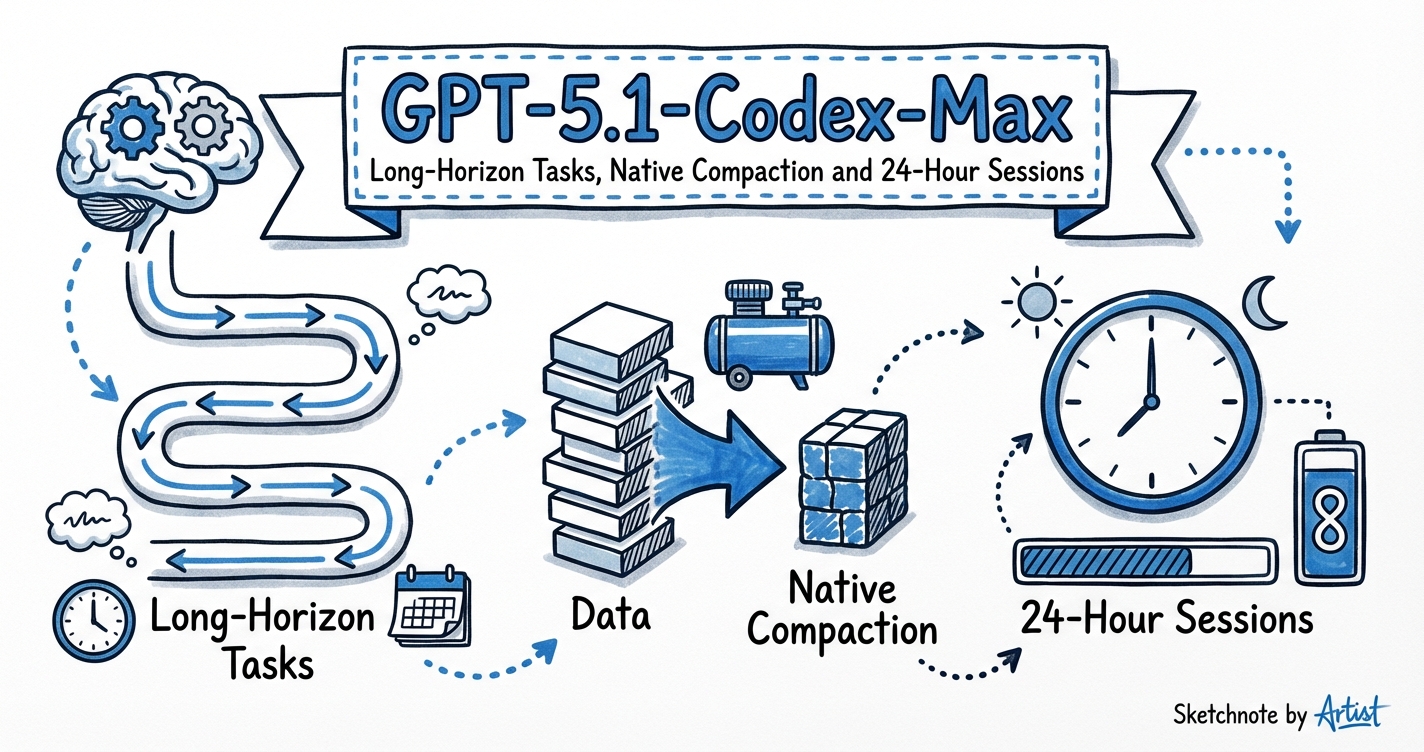
GPT-5.1-Codex-Max: Long-Horizon Tasks, Native Compaction and 24-Hour Sessions
Most Codex tasks complete in minutes. But some tasks — a full microservice migration, a large-scale refactor across 50+ files, a days-long debugging session — run into context limits before they finish. GPT-5.1-Codex-Max was built specifically for these long-horizon scenarios.
What Makes GPT-5.1-Codex-Max Different
GPT-5.1-Codex-Max is the first Codex model trained to operate natively across multiple context windows. This matters because earlier compaction strategies used external scaffolding (the harness summarising older turns and injecting a summary) — the model wasn’t trained to expect those summaries, leading to coherence failures on very long tasks.
With Codex-Max, compaction is trained into the model itself:
- As the session approaches its context limit, the model summarises essential state: variable names, architectural decisions, outstanding bugs, pending steps
- It carries that summary into a fresh context window and continues seamlessly
- This process repeats as many times as needed
Result: OpenAI has observed GPT-5.1-Codex-Max working autonomously for more than 24 hours on a single task — persistently iterating on implementation, fixing test failures, and ultimately delivering a working result.
When to Use Codex-Max
GPT-5.1-Codex-Max is the right choice when:
- The task is likely to exceed a single context window (large refactors, migrations, multi-file audits)
- You want to fire-and-forget an overnight or weekend-length job
- The task requires sustained coherence across many decision points
- You’re working in a regulated environment where you want complete audit continuity
For everyday tasks — fix this bug, write this feature, review this PR — gpt-5-codex or gpt-5.3-codex are faster and more cost-effective.
Benchmarks: The SWE-Lancer IC SWE Result
GPT-5.1-Codex-Max scores 79.9% on SWE-Lancer IC SWE — a significant jump from GPT-5.1-Codex’s 66.3%.
What is SWE-Lancer?
SWE-Lancer is an OpenAI benchmark of 1,488 real freelance software engineering tasks sourced from Upwork and Expensify, worth $1 million USD in real-world payouts. Tasks range from $50 bug fixes to $32,000 feature implementations. End-to-end tests are triple-verified by experienced engineers.
Why it’s more meaningful than SWE-Bench Verified: it uses real economic value as the scoring unit. A 79.9% result on SWE-Lancer IC SWE means the model can complete the equivalent of ~$798K worth of freelance IC software engineering tasks — compared to 26.2% (Claude 3.5 Sonnet) and 8.6% (GPT-4o) when the benchmark launched in early 2025.
Other benchmark scores (all with compaction + xhigh reasoning):
| Benchmark | GPT-5.1-Codex-Max | GPT-5.1-Codex | Notes |
|---|---|---|---|
| SWE-Lancer IC SWE | 79.9% | 66.3% | Real freelance tasks |
| SWE-Bench Verified (n=500) | 77.9% | 73.7% | Standard synthetic benchmark |
| Terminal-Bench 2.0 (n=89) | 58.1% | 52.8% | Terminal-native task sequences |
The xhigh Reasoning Effort Level
GPT-5.1-Codex-Max introduced a new reasoning effort level: xhigh. This is above high — the model “thinks for an even longer period” before responding.
# .codex/config.toml — for long-horizon overnight tasks
model = "gpt-5.1-codex-max"
model_reasoning_effort = "xhigh"
Key data point: GPT-5.1-Codex-Max at medium reasoning effort already outperforms GPT-5.1-Codex at medium, while using 30% fewer thinking tokens. Use xhigh for:
- Hard algorithmic problems
- Security audits requiring deep analysis
- Tasks where quality matters more than speed
- Long-horizon runs (the extra thinking pays off over a 24h session)
Cost note: xhigh carries a significant token multiplier (~8–15× vs minimal). For long-horizon tasks, this is usually justified — the model is less likely to go off-track, reducing expensive restarts.
30% Token Efficiency Gain
GPT-5.1-Codex-Max completes equivalent tasks using roughly 30% fewer tokens than its predecessor. For long-horizon runs where you’re burning credits over hours, this is significant.
Combined with cached input pricing (the model reuses previous context where possible), the effective cost of a 24-hour session can be lower than you’d expect from a frontier model.
Windows Support
GPT-5.1-Codex-Max is the first Codex model explicitly trained for Windows environments. If your team includes Windows developers or your CI runs on Windows-hosted runners, this matters for reliability.
Practical Configuration for Long-Horizon Jobs
# .codex/agents/overnight-worker.toml
name = "overnight-worker"
model = "gpt-5.1-codex-max"
reasoning_effort = "xhigh"
developer_instructions = """
You are a long-horizon agent. Your task may span many context windows.
At each compaction boundary:
1. Summarise the current state in a structured note
2. List: completed steps, current blocker, next 3 steps
3. Preserve all variable names, file paths, and architectural decisions verbatim

Never truncate work. If you hit a context limit, compact and continue.
"""
Fire it off via codex exec:
codex exec \
  --agent overnight-worker \
  --dangerously-bypass-approvals-and-sandbox \
  "Migrate the payments service from Stripe v7 to v8 API. All tests must pass. File a PR when complete."
Monitor via the Codex app sidebar — the thread will show compaction events as the session progresses.
When NOT to Use Codex-Max
- Short, bounded tasks: The model’s compaction overhead adds latency on tasks that would finish in a single context window anyway. Use
gpt-5-codexorgpt-5.3-codex-sparkfor these. - Subagent workers: Use
gpt-5.4-miniorgpt-5-codexfor parallel worker subagents in your agentic pod. Reserve Codex-Max for the orchestrator or for standalone long-running jobs. See Subagent Model Routing: Mini for Workers. - Interactive sessions: If you’re steering the agent in real time, shorter context windows keep you in the loop. Codex-Max’s strength is autonomous long-horizon runs.
Model Lineage Context
GPT-5.1-Codex-Max’s place in the lineage:
gpt-5-codex (current recommended)
    ↑ gpt-5.3-codex (better tool reliability, Tau2-bench)
        ↑ gpt-5.2-codex (native compaction, context rollup)
            ↑ gpt-5.1-codex-max (24h sessions, SWE-Lancer 79.9%)
It has been succeeded by gpt-5.2-codex (better native compaction) and gpt-5.3-codex (current recommended for most tasks). But for the specific use case of fire-and-forget long-horizon jobs, Codex-Max remains a valid choice — particularly for teams already optimised around its benchmark characteristics.
Citations
- GPT-5.1-Codex-Max System Card — safety mitigations, cybersecurity capability assessment
- SWE-Lancer Benchmark (OpenAI, Feb 2025) — 1,488 Upwork tasks, $1M valuation, arXiv:2502.12115
- Building more with GPT-5.1-Codex-Max — official announcement with benchmark data
- VentureBeat: 24-hour task evaluation — reporting on internal evaluation sessions