OpenAI's Superapp Pivot: What the ChatGPT + Codex + Atlas Merger Means for Practitioners
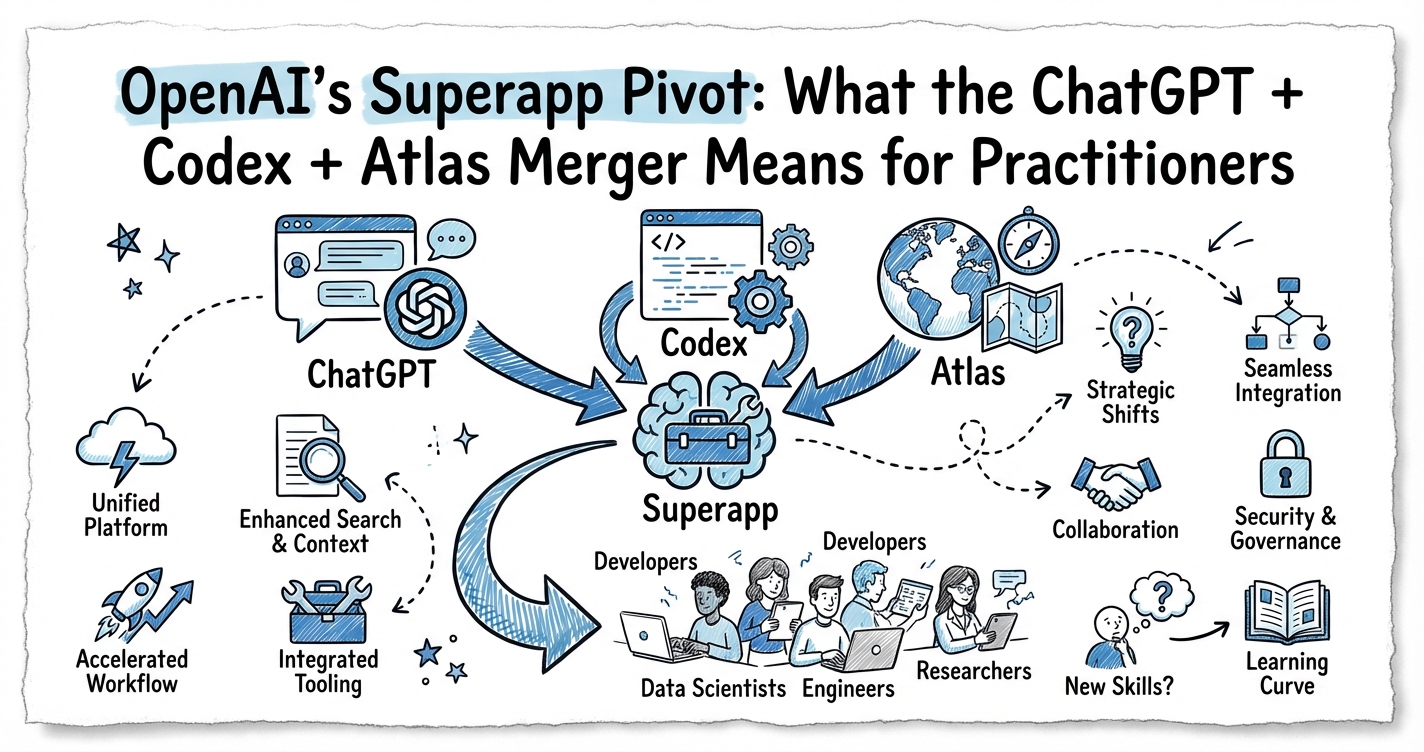
OpenAI’s Superapp Pivot: What the ChatGPT + Codex + Atlas Merger Means for Practitioners
On March 19, 2026, The Wall Street Journal published details from an internal OpenAI memo written by Fidji Simo (CEO of Applications) announcing a major strategic consolidation: OpenAI plans to merge ChatGPT, Codex, and its Atlas browser into a single desktop “superapp.” This is the biggest signal yet about where Codex is heading — and it has concrete implications for how practitioners should think about their investment in Codex workflows.
What the Memo Said
Simo’s internal note to employees (March 19, 2026):
“We realised we were spreading our efforts across too many apps and stacks, and that we need to simplify our efforts. That fragmentation has been slowing us down and making it harder to hit the quality bar we want.”
The consolidation plan:
- Near term: Codex app gains new “agentic” capabilities for productivity tasks beyond coding
- Later: ChatGPT and Atlas browser merge into the Codex app as a unified superapp
- Mobile ChatGPT remains a separate standalone application
The move was directly attributed to competitive pressure from Anthropic, which by March 2026 was capturing 73% of all spending among companies buying AI tools for the first time (OpenAI: ~27%), and where Claude overtook ChatGPT as the most-downloaded US app in March 2026.
Context: Codex’s Growth Trajectory
Before this announcement, the numbers already told a compelling story:
| Metric | Value | Notes |
|---|---|---|
| Weekly active users (March 2026) | 2 million+ | Up from <500K before Feb 2026 |
| Desktop app downloads | 1M+ | Since Feb 2026 launch |
| Weekly token usage growth | 5× | Since GPT-5.3-Codex launch |
| Enterprise adopters | Cisco, Nvidia, Ramp, Rakuten, Harvey | Confirmed by OpenAI |
Sam Altman described the Codex growth as “crazy,” noting the user base had grown 50% in a single week during the GPT-5.3-Codex launch period.
What This Means for Codex CLI Practitioners
1. Codex is becoming OpenAI’s primary agentic surface
Sottiaux has been explicit: Codex is intended to become “the standard agent” — initially for developers, but progressively for non-technical workers. The CLI is the power-user entry point; the superapp is the mass-market delivery. Your CLI expertise puts you at the sharp end of this transition.
2. The Atlas browser integration is significant for agentic workflows
The Atlas browser being folded into the Codex environment means browser automation becomes a first-class capability in the Codex ecosystem — not an add-on via MCP. For web scraping, form automation, and research agents, this reduces reliance on third-party Playwright/browser MCP servers.
3. Plugin ecosystem investment is sound
The plugin format (.codex-plugin/plugin.json, skills + MCP + app integrations) is the consolidation vehicle. Third-party plugins for Box, Figma, Linear, Notion, Sentry, Slack will accelerate as the superapp grows its user base. Building plugins now is building for the platform OpenAI is creating.
4. Short-term: CLI stability is unaffected
The CLI remains the developer-first interface. The superapp roadmap is months away. v0.117.0 is stable; v0.118 alpha is tracking well. There is no indication the CLI is being deprecated — it’s the engine room of the superapp.
5. Competitive pressure benefits users
OpenAI is moving faster because Anthropic is winning enterprise deals. Every Sottiaux tweet asking “what would you like us to fix?” is Anthropic pressure made visible. Daniel’s agentic pod work sits at the exact intersection OpenAI is racing to capture.
The Anthropic Dynamic
Claude overtaking ChatGPT as the most downloaded US app in March 2026 is an inflection point. Anthropic’s advantage: Claude Code’s “explorer” personality resonates with developers who want a collaborator, not just an executor. OpenAI’s response is consolidation — make Codex so capable and ubiquitous that the comparison becomes irrelevant.
For practitioners using both tools (see Using Claude Code and Codex Together): this dynamic means both tools are improving faster than they would in isolation. The bidirectional MCP architecture described in Claude Code ↔ Codex Bidirectional MCP will only become more relevant as both ecosystems mature.
Timeline (Best-Guess)
| Milestone | Estimated |
|---|---|
| Codex app adds productivity/non-coding agentic features | Q2 2026 |
| Atlas browser integration into Codex app | Q3 2026 |
| ChatGPT + Codex superapp unified surface | Q4 2026 or early 2027 |
| CLI continues as developer interface throughout | Ongoing |
Update: Sources.news Interview (April 3, 2026)
Alex Heath’s Sources newsletter published a detailed follow-up with both Embiricos and Sottiaux:
- Embiricos on seamless integration: “No modes for us. That is the goal.” — The Codex-to-ChatGPT integration should be invisible. Users won’t consciously switch between coding and non-coding modes; agent capabilities should feel native.
- Sottiaux on the 6-month timeline: AI-transformed engineering workflows will apply across all knowledge work domains within six months. He noted personal productivity gains already, without writing code directly.
- Sora shutdown confirmed: OpenAI is shutting down “side bets” (including Sora) to consolidate resources around Codex as the central platform.
- Strategic contrast with Anthropic: OpenAI’s approach (invisible integration, capabilities feel native) deliberately differentiates from Anthropic’s Claude Cowork (which abstracts coding complexity for non-technical users via a separate interface).
This confirms the superapp is not just a product consolidation — it’s a philosophical bet that agent capabilities should dissolve into the user’s workflow rather than requiring a dedicated surface.
Added 2026-04-06.