Codex CLI for Go Teams: Skills, AGENTS.md and Go 1.26 Workflows
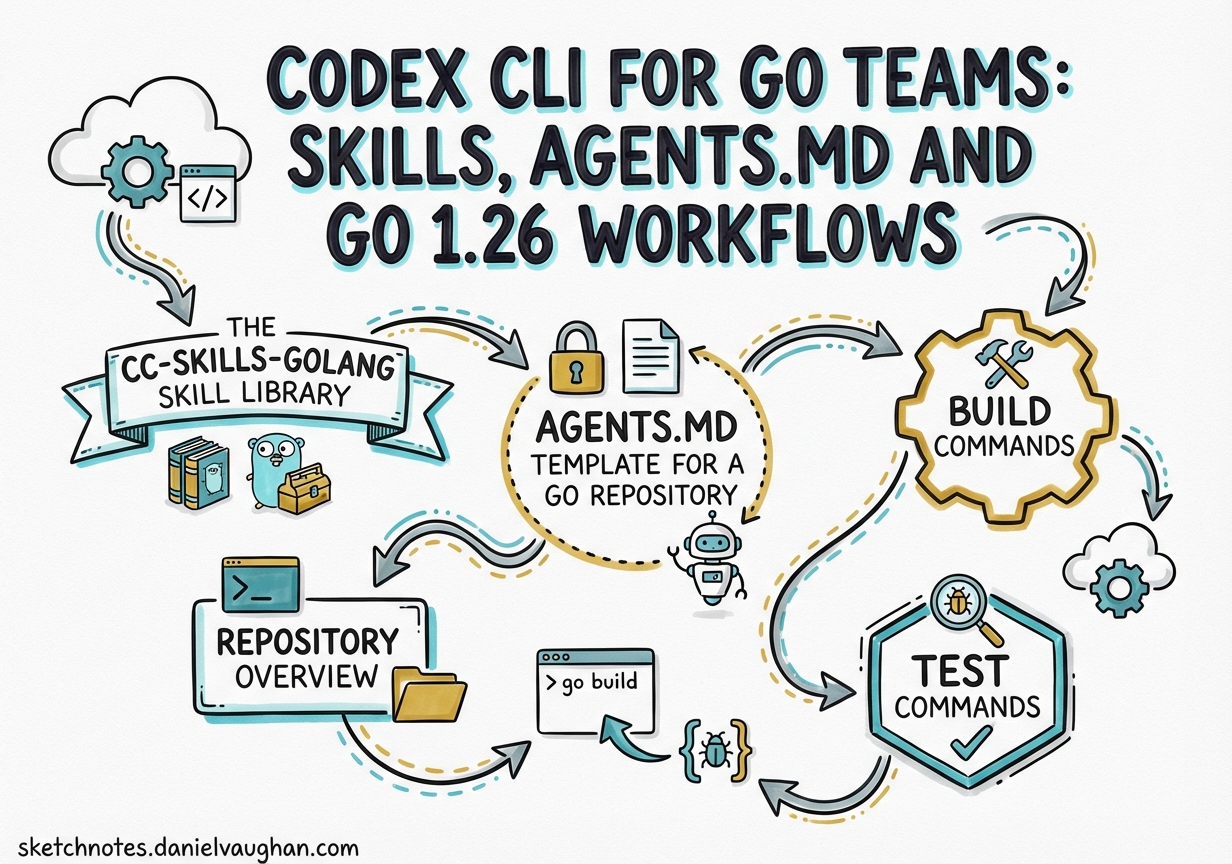
Codex CLI for Go Teams: Skills, AGENTS.md and Go 1.26 Workflows
Go’s explicit error handling, strict formatting conventions, and idiomatic concurrency model make it both an ideal and a demanding language for agentic workflows. The agent needs to know your module path, your test tag conventions, your linter configuration, and the single-handling rule — none of which it can infer from the code alone. This article covers how to configure Codex CLI precisely for Go development: the cc-skills-golang skill library, a production-grade AGENTS.md template updated for Go 1.261, and CI/CD patterns that keep generated code clean.
The cc-skills-golang Skill Library
The cc-skills-golang repository by Samuel Berthe provides 20+ production-ready Codex skills for Go development.2 Skills load on demand, keeping context windows lean — the lazy-loading model means the full skill body is only injected when the agent invokes the skill by name.
Available Skills
The core set for most services:
| Skill | What It Enforces |
|---|---|
golang-code-style |
gofmt conventions, import ordering, comment style |
golang-concurrency |
Goroutine ownership, channel rules, leak prevention, time.NewTimer vs time.After |
golang-context |
Context propagation, deadline patterns, cancellation hierarchies |
golang-error-handling |
%w wrapping, sentinel vs typed errors, single-handling rule, slog structured logging |
golang-testing |
Table-driven tests, t.Parallel(), goleak, integration build tags, fuzz targets |
golang-security |
gosec, govulncheck, injection prevention, crypto/rand vs math/rand |
golang-observability |
log/slog structured attributes, OpenTelemetry patterns |
golang-modernize |
Applies Go 1.26 modernizers via go fix ./... |
golang-performance |
Profile-first methodology, allocation reduction, benchstat |
golang-naming |
Package naming, receiver conventions, exported vs unexported identifiers |
golang-stretchr-testify |
Testify assert/require/mock/suite usage patterns |
golang-grpc |
gRPC interceptors, streaming patterns, status codes |
The golang-security and golang-error-handling skills both expose an audit mode that deploys multiple parallel sub-agents, each covering a distinct attack surface or error pattern.2
Installation
# Install all skills via npx
npx skills add https://github.com/samber/cc-skills-golang --skill '*'

# Or via Codex plugin command
codex plugin install cc-skills-golang@samber
Skills are discovered from .agents/skills/ in the working directory, parent directories up to the Git root, and ~/.agents/skills/ for user-level installs.3
Disable skills that don’t apply to your stack in .codex/config.toml at the repo root:
# .codex/config.toml
[[skills.config]]
path = "/home/user/.agents/skills/cc-skills-golang/skills/golang-grpc/SKILL.md"
enabled = false
AGENTS.md Template for a Go Repository
AGENTS.md is now stewarded by the Agentic AI Foundation under the Linux Foundation as an open standard.4 Codex loads it from outermost to innermost (global → container root → repo root → subdirectory), merging with closer files taking precedence. The active prompt always wins.
Root AGENTS.md
# AGENTS.md

## Repository Overview
Go 1.26+ service. Module path: `github.com/your-org/your-service`.
Production code under `internal/`. Public packages under `pkg/`.
`cmd/` holds only `main.go` entrypoints with minimal logic.

## Build Commands
```bash
go build ./...
go fix ./...        # Apply Go 1.26 modernizers before any PR
Test Commands
# Unit tests (always run with race detector)
go test -race ./...

# With coverage
go test -race -coverprofile=coverage.out -covermode=atomic ./...

# Short mode (skip integration tests)
go test -short ./...

# Integration tests (require //go:build integration tag)
go test -race -tags=integration ./...
Lint Commands
go vet ./...
golangci-lint run ./...
gosec ./...
govulncheck ./...
Verification Sequence
Before any commit, run in order:
go mod tidygo fmt ./...go fix ./...go vet ./...golangci-lint run ./...go test -race ./...
Code Style
- Error messages: lowercase, no trailing punctuation
- Wrap with context:
fmt.Errorf("connecting to database: %w", err) - Use
%winside error chains;%vonly at top-level boundaries - Never discard errors with
_ - Use
errors.Is()/errors.As()for inspection - Use
errors.AsType[T]()(Go 1.26) for type-safe unwrapping in new code - Log with
log/slogusing structured attributes, neverfmt.Println
Testing Standards
- Table-driven tests with
t.Runand namednamefields - Mark independent tests
t.Parallel() - Tag integration tests:
//go:build integrationat the top of the file - Use
require(testify) for fatal assertions;assertfor non-fatal - Use
goleak.VerifyTestMainin any package that spawns goroutines
Concurrency Rules
- Every goroutine must have a defined exit strategy before it is spawned
- Only the sender closes a channel
- Always include
ctx.Done()in select statements - Never use
time.Afterin loops — usetime.NewTimerwithReset - Use channels for ownership transfer;
sync.Mutexfor shared struct state
Module Rules
- Run
go mod tidyand commit bothgo.modandgo.sumafter any import change - Manage tool dependencies with
go get -tool(Go 1.24+) - Use
go.workfor local multi-module development; do not commit unless this is a monorepo
Go 1.26 Specifics
- Use
new(expr)for pointer initialisation when the value fits a single expression - Use
errors.AsType[T]()for type-safe error unwrapping in new code - Run
go fix ./...as part of the pre-PR workflow go tool docis removed — usego docdirectly
For a high-trust subdirectory (e.g., a payments service), layer a subdirectory `AGENTS.md` override:

```markdown
# services/payments/AGENTS.md

## Security Requirements (override root)
All changes must pass `gosec -severity high ./services/payments/...`.
Treat medium-severity findings as blocking for new code.
Run `govulncheck ./services/payments/...` and fail on any known vulnerability.
Go 1.26 and Its Impact on Generated Code
Go 1.26 shipped on 10 February 2026.1 Three language changes directly affect what the agent generates:
new() accepts expressions. The golang-modernize skill will suggest this for pointer fields in JSON/Protobuf structs:
// Before Go 1.26
x := yearsSince(born)
person.Age = &x

// Go 1.26
person.Age = new(yearsSince(born))
errors.AsType[E]() provides compile-time type safety over the reflection-based errors.As():
// Old
var e *MyError
if errors.As(err, &e) { ... }

// Go 1.26
if e, ok := errors.AsType[*MyError](err); ok { ... }
The golang-error-handling skill references this pattern. Add your team’s preference to AGENTS.md so the agent applies it consistently.
Revamped go fix. go fix ./... is now the home of Go’s modernizer suite, running on the same analysis framework as go vet.1 Add it to your verification sequence — and add a git diff --exit-code check in CI to catch any uncommitted modernizer output.
The Green Tea GC is now the default, delivering 10–40% lower GC overhead without code changes.5 The new goroutineleak pprof profile type complements goleak in tests by detecting permanently blocked goroutines at runtime.
CI/CD Integration
golangci-lint v2.11.4 is the current stable release (22 March 2026).6 Install it as a go get -tool dependency to keep versions pinned in go.mod:
go get -tool github.com/golangci/golangci-lint/cmd/golangci-lint@v2.11.4
go tool golangci-lint run ./...
A minimal .golangci.yml for Go 1.26 projects:
version: "2"

run:
  timeout: 5m

linters:
  default: standard
  enable:
    - errcheck
    - errorlint      # error wrapping correctness
    - gosec
    - staticcheck
    - wrapcheck      # errors from external packages must be wrapped
    - noctx          # HTTP requests without context

linters-settings:
  gosec:
    severity: medium
    confidence: medium
  errorlint:
    errorf: true
    asserts: true

issues:
  exclude-rules:
    - path: "_test\\.go"
      linters: [gosec, errcheck]
For GitHub Actions, use golangci/golangci-lint-action@v6 and govulncheck in a dedicated security job:
- name: govulncheck
  run: |
    go install golang.org/x/vuln/cmd/govulncheck@latest
    govulncheck ./...

- name: golangci-lint
  uses: golangci/golangci-lint-action@v6
  with:
    version: v2.11.4
    args: --timeout=5m
For non-interactive Codex tasks in CI, the ci profile with approval_policy = "never" is the appropriate default:7
# .codex/config.toml
[profiles.ci]
model = "gpt-5.4"
approval_policy = "never"
sandbox_mode = "workspace-write"
model_reasoning_effort = "medium"
# Run a CI fix pass non-interactively
codex exec --profile ci "Fix all golangci-lint errors in ./internal/payments/..."
Subagent Audit Patterns
When multi_agent = true is enabled in config.toml,8 the golang-security and golang-error-handling skills can deploy parallel sub-agents covering distinct concerns. Triggering a security audit:
# In an interactive Codex session
$golang-security audit ./...
This spawns five parallel sub-agents covering injection vulnerabilities, cryptographic operations, web security, authentication flows, and concurrency race conditions — each scoped to a specific attack surface rather than doing a single serial pass.
The golang-testing skill provides four modes: write (generates table-driven tests via gotests then adds edge cases), review (checks PR test changes for coverage regressions), audit (parallel sub-agents for unit quality, integration isolation, and race conditions), and debug (reproduces failing assertions with a minimal reproduction case).2
The Single-Handling Rule
The most common Go anti-pattern that agents reproduce is logging an error and returning it — causing it to be logged twice at the caller. Embed the rule explicitly in AGENTS.md and the golang-error-handling skill will reinforce it:
// Wrong: error logged AND propagated
if err := validate(id); err != nil {
    slog.Error("validation failed", "err", err) // logged here
    return err                                   // AND propagated — double log
}

// Correct: propagate with context; log once at the top-level boundary
if err := validate(id); err != nil {
    return fmt.Errorf("processing order %s: %w", id, err)
}
At the HTTP handler boundary, log once:
func (h *Handler) CreateOrder(w http.ResponseWriter, r *http.Request) {
    if err := h.svc.processOrder(r.Context(), id); err != nil {
        slog.Error("create order failed", "order_id", id, "err", err)
        http.Error(w, "internal error", http.StatusInternalServerError)
    }
}
Summary
The combination of a well-structured AGENTS.md, the cc-skills-golang skill library, and a config.toml ci profile gives Go teams a repeatable, tool-aware agentic workflow. AGENTS.md carries the conventions Codex cannot infer; skills provide the idiomatic depth (concurrency, error handling, security) that generic prompts miss; and the ci profile makes non-interactive execution safe enough to run in pull-request pipelines.
Citations
-
Go 1.26 Release Notes — https://go.dev/doc/go1.26 ↩ ↩2 ↩3
-
cc-skills-golang repository — https://github.com/samber/cc-skills-golang ↩ ↩2 ↩3
-
Codex CLI Skills Documentation — https://developers.openai.com/codex/skills ↩
-
AGENTS.md Open Standard (Agentic AI Foundation / Linux Foundation) — https://agents.md/ ↩
-
Go 1.26 Release Blog — https://go.dev/blog/go1.26 ↩
-
golangci-lint v2.11.4 Release — https://github.com/golangci/golangci-lint/releases ↩
-
Codex CLI Non-Interactive Mode Reference — https://developers.openai.com/codex/noninteractive ↩
-
Codex CLI Features Reference — https://developers.openai.com/codex/cli/features ↩