The Codex Python SDK: Embedding Agents in Python Applications
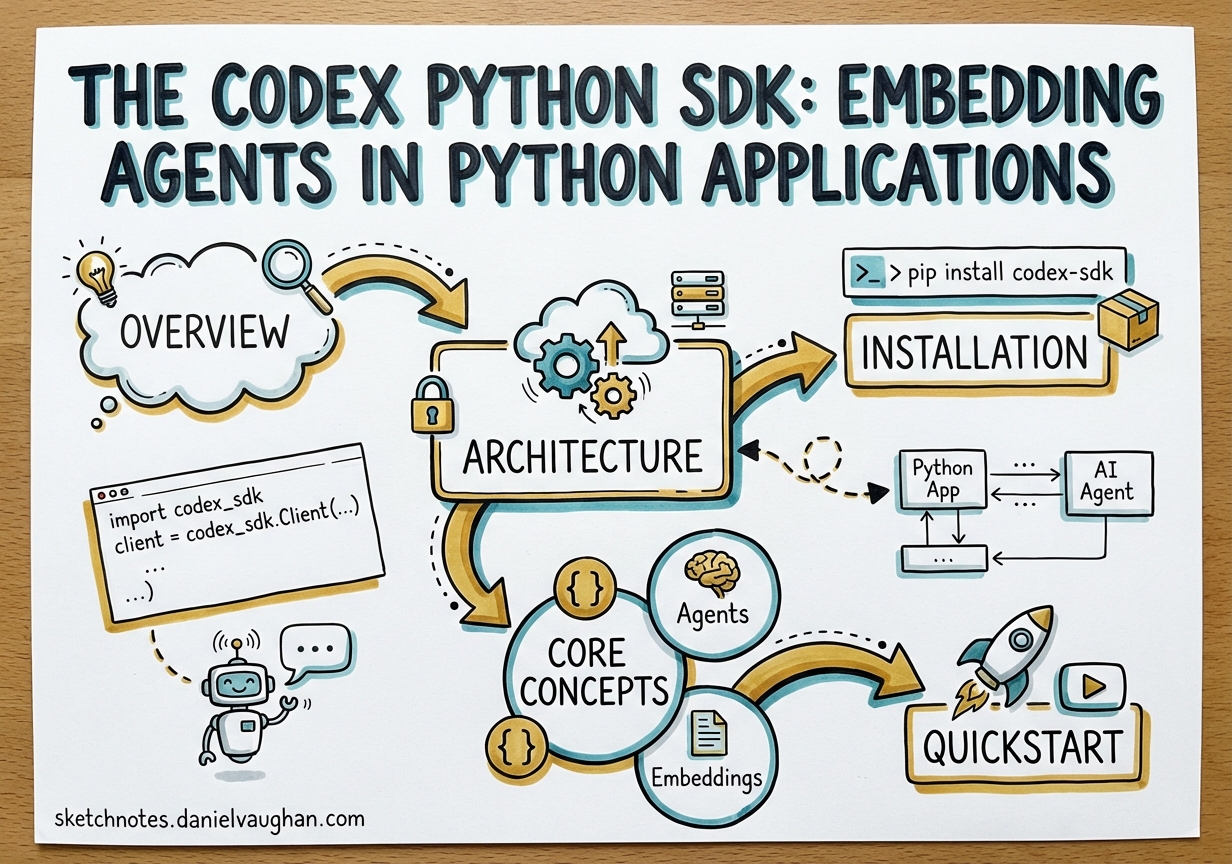
The Codex Python SDK: Embedding Agents in Python Applications
Overview
The Codex CLI ships with an official Python SDK — codex_app_server — that lets you drive the agent programmatically from Python scripts, pipelines, and applications.1 It wraps the codex app-server process over JSON-RPC 2.0, exposing a clean, typed surface with synchronous and asynchronous variants. Version 0.2.0 requires Python ≥ 3.10 and bundles the platform-specific CLI binary via codex-cli-bin.2
This is the right layer when you need:
- Background automation that invokes Codex without a terminal
- Multi-step pipelines where you steer the agent mid-turn
- Structured output schemas extracted from agent results
- Async fan-out over many threads in parallel
- Integration with FastAPI, Celery, or other Python service stacks
If the interactive TUI is the cockpit, the Python SDK is the autopilot API.
Architecture
The SDK does not call the OpenAI REST API directly. Instead, it starts codex app-server as a subprocess and communicates over its JSON-RPC 2.0 protocol.3 Your Python code becomes the client; the Codex binary is the server.
graph LR
    subgraph Python process
        A["Your code\n(Codex / AsyncCodex)"]
    end
    subgraph Subprocess
        B["codex app-server\n(Rust binary)"]
    end
    subgraph OpenAI
        C["gpt-5.4 / gpt-5.4-mini\n(model API)"]
    end
    A -- "JSON-RPC 2.0\nover stdio" --> B
    B -- "HTTPS" --> C
    B -- "tool calls" --> D["Local filesystem\nsandbox"]
This means the SDK inherits all sandbox policies, domain allowlists, and approval configurations from your codex.toml.4 Nothing in the SDK bypasses the security model — it is simply a typed client for a protocol the CLI was already speaking.
Installation
From PyPI (published builds)
pip install codex-app-server-sdk
Published wheels bundle the matching codex-cli-bin runtime package, which carries the platform binary. No separate CLI installation is required.5
From source (development)
git clone https://github.com/openai/codex.git
cd codex/sdk/python
python -m pip install -e .
For local development against a custom-built binary, pass the path explicitly via AppServerConfig:
from codex_app_server import Codex, AppServerConfig

config = AppServerConfig(codex_bin="/usr/local/bin/codex-dev")
with Codex(config=config) as codex:
    ...
Core Concepts
Codex and AsyncCodex
Codex is the synchronous entry point; AsyncCodex is the async mirror with an identical public shape.6 Both are context managers that handle subprocess startup and shutdown.
Codex() is eager — it starts the subprocess and performs the initialize handshake in __init__. Always use a context manager to guarantee clean shutdown:
# Correct — subprocess is cleaned up on exit
with Codex() as codex:
    ...

# Avoid — close() may not be called on error
codex = Codex()
Threads and Turns
The SDK exposes the same primitives as the app-server protocol:7
| Primitive | Description |
|---|---|
| Thread | A persistent conversation. Survives process restarts; resumed by ID. |
| Turn | One request/response cycle within a thread. Unit of interruption. |
| Item | An atomic output within a turn: message delta, command, file edit, reasoning note. |
Create a new thread with thread_start(). Pick a model and set reasoning effort here:
thread = codex.thread_start(
    model="gpt-5.4",
    config={"model_reasoning_effort": "high"},
)
run() vs turn()
thread.run() is the high-level convenience method. It blocks until the turn completes and returns a RunResult:8
result = thread.run("Add docstrings to every public function in src/utils.py")
print(result.final_response)   # final assistant message, or None
print(len(result.items))       # total items emitted during the turn
thread.turn() is the low-level method. It returns a TurnHandle that you can stream, steer, or interrupt:9
handle = thread.turn(input="Refactor this class for better cohesion.")
for notification in handle.stream():
    if notification.method == "item/agentMessage/delta":
        print(notification.params["delta"], end="", flush=True)
Use run() for background scripts and pipelines. Use turn() when you need live progress output, mid-turn steering, or timeout handling.
Quickstart
from codex_app_server import Codex

with Codex() as codex:
    thread = codex.thread_start(model="gpt-5.4")
    result = thread.run("Explain Rust's borrow checker in three bullets.")
    print(result.final_response)
The final_response field returns None when the turn completes without a final-answer message — common when Codex executes commands but produces no assistant text.10
Multi-Turn Conversations
Call run() repeatedly on the same thread object. Context is maintained automatically:
with Codex() as codex:
    thread = codex.thread_start(model="gpt-5.4")

    thread.run("Write a Python function that validates an ISO 8601 date string.")
    thread.run("Now add property-based tests using Hypothesis.")
    result = thread.run("Run the tests and fix any failures.")
    print(result.final_response)
Each call is a separate turn; the thread accumulates history between them. Codex uses prior turns for context when handling subsequent requests.11
Resuming Existing Threads
Reconnect to a previous session using its thread ID. The ID is stable across process restarts:
with Codex() as codex:
    thread = codex.thread_resume("thr_abc123")
    result = thread.run("What did you change in the last turn?")
    print(result.final_response)
List all available threads:
threads = codex.thread_list()
for t in threads:
    print(t.id, t.name, t.created_at)
Streaming
For interactive progress, stream notifications from TurnHandle:
from codex_app_server import Codex

with Codex() as codex:
    thread = codex.thread_start(model="gpt-5.4")
    handle = thread.turn("Summarise the AGENTS.md in this repo.")

    for notification in handle.stream():
        method = notification.method
        if method == "item/agentMessage/delta":
            print(notification.params.get("delta", ""), end="", flush=True)
        elif method == "turn/completed":
            print(f"\n[done — status: {notification.params.get('status')}]")
            break
stream() and run() are mutually exclusive per TurnHandle instance. Choose one per turn.12
Async Patterns
AsyncCodex provides identical methods returning coroutines. Prefer it inside FastAPI handlers, async workers, or when driving multiple threads concurrently:
import asyncio
from codex_app_server import AsyncCodex

async def review_file(path: str) -> str:
    async with AsyncCodex() as codex:
        thread = await codex.thread_start(model="gpt-5.4-mini")
        result = await thread.run(f"Review {path} for obvious bugs. Return a JSON list.")
        return result.final_response or ""

async def batch_review(paths: list[str]) -> list[str]:
    return await asyncio.gather(*(review_file(p) for p in paths))
AsyncCodex initialises lazily — the transport is opened on async with entry or the first awaited call.13
Structured Output
Pass output_schema to constrain the response to a JSON schema. Codex instructs the model to return a structured object matching the schema:
schema = {
    "type": "object",
    "properties": {
        "issues": {
            "type": "array",
            "items": {
                "type": "object",
                "properties": {
                    "file": {"type": "string"},
                    "line": {"type": "integer"},
                    "severity": {"type": "string"},
                    "message": {"type": "string"},
                },
                "required": ["file", "severity", "message"],
            },
        }
    },
    "required": ["issues"],
}

result = thread.run(
    "Audit the src/ directory for security issues.",
    output_schema=schema,
)
import json
issues = json.loads(result.final_response or "[]")
Note: output_schema is passed as a turn() parameter. The public API uses snake_case throughout; camelCase keys are handled internally.14
Error Handling and Retries
The SDK defines a hierarchy of typed exceptions:15
| Exception | When it fires |
|---|---|
ServerBusyError |
Transient overload — safe to retry |
JsonRpcError |
Base class for all RPC errors |
MethodNotFoundError |
SDK/server version mismatch |
InvalidParamsError |
Bad input — fix the call, don’t retry |
Use retry_on_overload for backoff on transient failures:
from codex_app_server import Codex
from codex_app_server.retry import retry_on_overload

@retry_on_overload(max_attempts=5, base_delay=1.0)
def run_with_retry(thread, prompt: str):
    return thread.run(prompt)

with Codex() as codex:
    thread = codex.thread_start(model="gpt-5.4")
    result = run_with_retry(thread, "Generate a migration plan for moving to PostgreSQL.")
    print(result.final_response)
Never retry InvalidParamsError or MethodNotFoundError in a loop — these require fixing the call or updating the SDK.16
Approval Policies and Sandbox Configuration
Pass sandbox and approval policies when starting a turn. All public kwargs are snake_case:
result = thread.run(
    "Run the full test suite and fix any failures.",
    approval_policy="auto",          # or "suggest", "full-auto"
    sandbox_policy="workspace-only", # confine file access to cwd
    developer_instructions="Use uv run pytest. Never modify pyproject.toml.",
)
In CI contexts, set approval_policy="full-auto" so the agent never blocks on approval prompts. The developer_instructions key is injected as a system-level constraint on the turn.17
Deployment Patterns
flowchart TD
    A["Trigger\n(webhook / cron / queue)"] --> B["Python service"]
    B --> C["Codex() context manager"]
    C --> D{"Task type"}
    D -- "one-shot script" --> E["thread.run(prompt)\nresult.final_response"]
    D -- "streamed output" --> F["thread.turn()\nhandle.stream()"]
    D -- "long-running CI" --> G["AsyncCodex\nasyncio.gather(tasks)"]
    E --> H["Return result"]
    F --> H
    G --> H
CI integration example
# review_pr.py — called from GitHub Actions
import sys
from codex_app_server import Codex

def main(pr_diff_path: str) -> int:
    diff = open(pr_diff_path).read()
    with Codex() as codex:
        thread = codex.thread_start(
            model="gpt-5.4-mini",
            config={"model_reasoning_effort": "medium"},
        )
        result = thread.run(
            f"Review this PR diff and return a JSON array of issues:\n\n{diff}",
            approval_policy="full-auto",
        )
    print(result.final_response)
    return 0

if __name__ == "__main__":
    sys.exit(main(sys.argv[1]))
Common Pitfalls
Creating a new thread per prompt. Threads maintain history — re-use them for multi-turn tasks. Only call thread_start() for genuinely new conversations.
Not using context managers. Codex() starts a subprocess in __init__. Skipping with means the process may outlive your script.
Retrying InvalidParamsError. This is a programming error, not a transient failure. Log it and fix the call.
Mixing run() and stream() on the same handle. They are mutually exclusive. stream() and run() share the same underlying event consumer.18
Passing camelCase kwargs. The public API is strictly snake_case (output_schema, not outputSchema). Passing camelCase silently produces InvalidParamsError in some server versions.19
Summary
| Use case | API |
|---|---|
| One-shot script | Codex() + thread.run() |
| Live progress in terminal | Codex() + thread.turn() + handle.stream() |
| FastAPI / async service | AsyncCodex() + await thread.run() |
| Concurrent file reviews | AsyncCodex() + asyncio.gather() |
| CI pipeline | Codex() + approval_policy="full-auto" |
| Structured data extraction | thread.run() + output_schema=… |
The Python SDK is still marked experimental in places, but it is stable enough for production automation — it is the same protocol layer the Codex web app and VS Code extension rely on.20 The API surface is intentionally narrow: understand thread.run(), know when to reach for thread.turn(), and handle ServerBusyError with backoff. That covers 95% of real use cases.
Citations
-
Codex Python SDK source — github.com/openai/codex/tree/main/sdk/python ↩
-
SDK version and Python requirements — sdk/python/README.md ↩
-
App-server architecture overview — developers.openai.com/codex/app-server ↩
-
Codex app-server README — codex-rs/app-server/README.md ↩
-
Published PyPI package — libraries.io/pypi/codex-app-server-sdk ↩
-
CodexandAsyncCodexclass reference — sdk/python/docs/api-reference.md ↩ -
Thread/Turn/Item model — developers.openai.com/codex/app-server ↩
-
thread.run()API — sdk/python/docs/faq.md ↩ -
thread.turn()API — sdk/python/docs/faq.md ↩ -
final_responsebehaviour — sdk/python/docs/getting-started.md ↩ -
Multi-turn conversation pattern — sdk/python/examples/README.md ↩
-
stream()andrun()exclusivity — sdk/python/docs/api-reference.md ↩ -
AsyncCodexlazy init — sdk/python/docs/faq.md ↩ -
Structured output and snake_case kwargs — sdk/python/docs/faq.md ↩
-
Exception hierarchy — sdk/python/docs/api-reference.md ↩
-
Error handling guidance — sdk/python/docs/faq.md ↩
-
Approval and sandbox policies — developers.openai.com/codex/cli/features ↩
-
stream()/run()mutual exclusivity — sdk/python/docs/api-reference.md ↩ -
snake_case migration guide — sdk/python/docs/faq.md ↩
-
App-server as shared infrastructure — developers.openai.com/codex/app-server ↩