GPT-5.3-Codex-Spark: Cerebras-Powered Real-Time Coding at 1,000 Tokens/Second
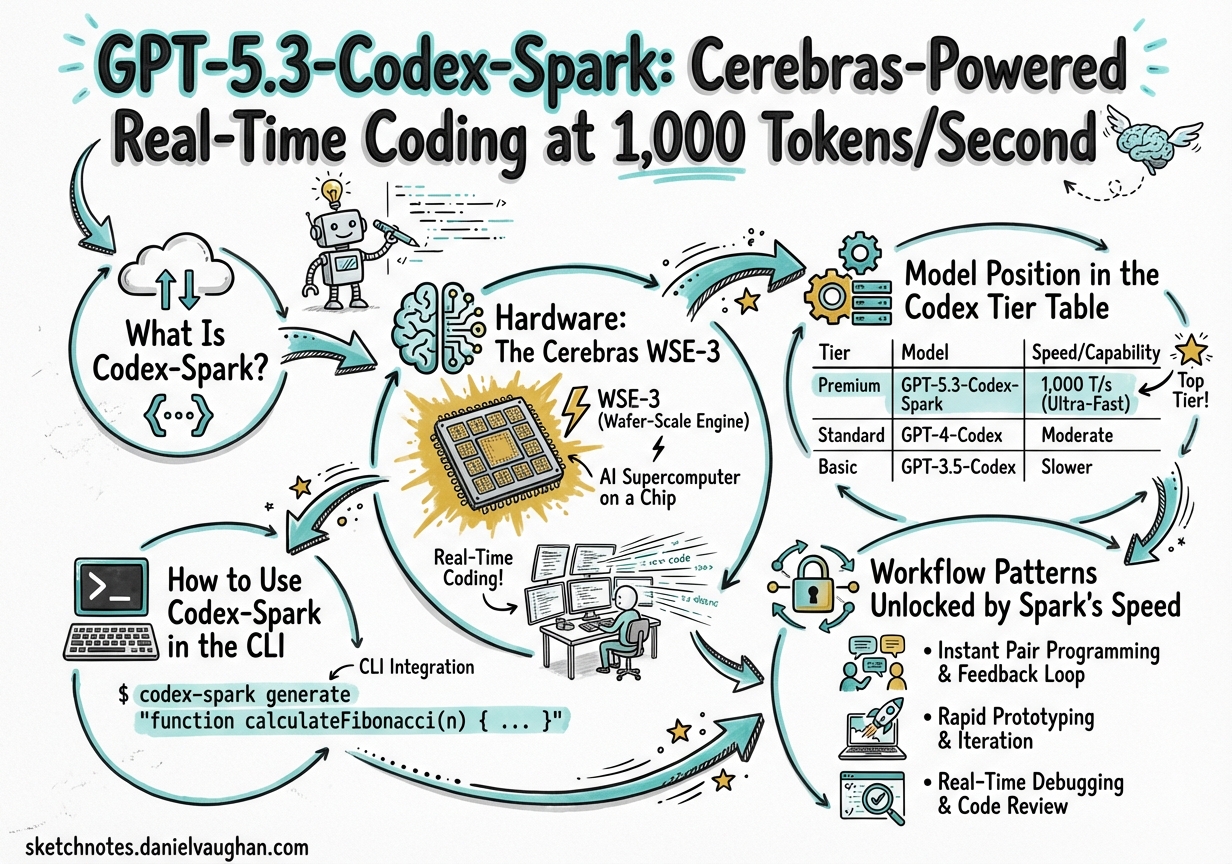
GPT-5.3-Codex-Spark: Cerebras-Powered Real-Time Coding at 1,000 Tokens/Second
What Is Codex-Spark?
On 12 February 2026, OpenAI shipped a research preview of gpt-5.3-codex-spark — an inference-optimised distillate of GPT-5.3-Codex that runs on Cerebras Wafer-Scale Engine 3 (WSE-3) silicon rather than Nvidia GPU clusters.1 The headline number is eye-catching: over 1,000 tokens per second, roughly 15× faster than the standard GPT-5.3-Codex at its x-high reasoning setting.2
This is the first production deployment of a commercially-released OpenAI model on non-Nvidia hardware, and the first visible milestone of the multi-year, $10B+ OpenAI–Cerebras partnership announced on 14 January 2026.34 It represents a genuine workflow paradigm shift for interactive coding: instead of committing to a single implementation path and waiting for a deep reasoning pass, you can generate and compare multiple approaches in the time a single standard-model response would have taken.
Hardware: The Cerebras WSE-3
Understanding why Spark is fast requires a quick look at the hardware it runs on.
A conventional GPU cluster for inference strings together thousands of discrete chips over high-speed interconnects (NVLink, InfiniBand). Latency is bounded by the inter-chip fabric. Cerebras WSE-3 eliminates that bottleneck by etching the equivalent of a cluster onto a single wafer: 4 trillion transistors, hundreds of thousands of AI cores, and an enormous pool of on-chip SRAM — all reachable at memory-bus speed with no inter-chip hops.5
The practical result for inference:
- No serialisation penalty crossing chip boundaries
- Massive on-chip bandwidth reduces time-to-first-token (TTFT)
- Fixed chip count eliminates cluster scheduling variance
OpenAI shipped infrastructure improvements alongside Spark that benefit all models but are enabled by default for Spark:6
| Improvement | Reduction |
|---|---|
| Per-client round-trip overhead | 80% |
| Per-token processing overhead | 30% |
| Time-to-first-token | 50% |
The mechanism is a persistent WebSocket connection replacing stateless HTTP for each Responses API call. This alone accounts for a large fraction of the perceived speed improvement on short completions.
Model Position in the Codex Tier Table
Spark is not a replacement for the flagship Codex models. It occupies a deliberate tier: faster than anything else, but with a smaller reasoning budget and a reduced context window.
| Model | SWE-Bench Pro | Token Speed | Context Window |
|---|---|---|---|
| gpt-5.3-codex | ~72% | ~65–70 tok/sec | 400k+ tokens |
| gpt-5.3-codex-spark | ~56% | 1,000+ tok/sec | 128k tokens |
| gpt-5.1-codex-mini | ~44% | ~200 tok/sec | 200k tokens |
Cerebras confirmed Spark “produces more capable responses than GPT-5.1-Codex-mini on SWE-Bench Pro and Terminal-Bench 2.0.”7 In practical terms: it replaces mini as the right choice for rapid iteration, whilst still being meaningfully behind the flagship on complex multi-step work.
The capability ceiling is real. Independent testing found the model “drifts after 6–8 reasoning steps” versus 12+ for GPT-5.3-Codex.8 In one snake game implementation task, Spark completed in 50 seconds (vs. 6 minutes for Codex 5.3), but the output contained a collision detection bug and a memory leak that required corrective passes — making the total wall-clock advantage less dramatic than the tokens-per-second headline suggests.8
How to Use Codex-Spark in the CLI
Interactive TUI
codex --model gpt-5.3-codex-spark
Inside an active session you can switch mid-thread with the model picker:
/model
Select Spark from the list. The switch takes effect immediately on the next turn.
The Case-Sensitivity Footgun
The model identifier must be all-lowercase. The label shown in the UI (“GPT-5.3-Codex-Spark”) is display text only. Using the capitalised form in codex exec throws:9
Error: The 'GPT-5.3-Codex-Spark' model is not supported when using Codex with a ChatGPT account
Use the lowercase form in all config and flags:
codex exec --model "gpt-5.3-codex-spark" "write unit tests for src/parser.ts"
Pinning to Spark via a Profile
Create a spark profile in ~/.codex/config.toml to avoid repeating the flag:
[profiles.spark]
model = "gpt-5.3-codex-spark"
reasoning_effort = "high"

[profiles.spark.approvals]
mode = "auto"
Then invoke with:
codex --profile spark
The codex exec Limitation
During the research preview, codex exec (non-interactive automation mode) only works with Spark when authenticating via an API key. ChatGPT Pro account login (OAuth) does not support Spark in exec mode — only interactive TUI mode works.9
# ~/.codex/config.toml — required for exec mode with Spark
[auth]
api_key_env_var = "OPENAI_API_KEY"
Workflow Patterns Unlocked by Spark’s Speed
The 15× throughput difference is not just cosmetic. It changes what’s practical to attempt interactively.
Rapid Multi-Implementation Comparison
flowchart LR
    P[Problem] --> S1["Spark: Approach A\n~8 seconds"]
    P --> S2["Spark: Approach B\n~8 seconds"]
    P --> S3["Spark: Approach C\n~8 seconds"]
    S1 & S2 & S3 --> R[Review & pick best]
    R --> F["Flagship: Refine winner\n(full reasoning)"]
Use Spark to generate three candidate implementations in the time a single flagship response would take, then promote the best candidate to a flagship refinement pass. This is qualitatively different from the traditional “draft then revise” loop — you’re choosing between complete implementations rather than iterating on one.
Exploration Before Depth
flowchart TD
    A[New codebase / unknown problem] --> B["Spark: rapid exploration\n(read, summarise, Q&A)"]
    B --> C{Understand enough?}
    C -- Yes --> D["Spark: implement\nstraightforward tasks"]
    C -- No --> E["Switch: gpt-5-codex\nor flagship\nfor deep analysis"]
Spark is well-suited to the exploration phase of a task — reading files, understanding API shapes, summarising existing code — where token throughput matters more than reasoning depth. Switch to the flagship only when the task genuinely requires extended multi-step planning.
Rejection Sampling via Rapid Iteration
For tasks where correctness can be verified cheaply (tests pass/fail, compiler errors, linter output), Spark enables a tight iteration loop:
# Profile tuned for test-and-fix cycles
[profiles.spark-tdd]
model = "gpt-5.3-codex-spark"
reasoning_effort = "medium"

[profiles.spark-tdd.approvals]
mode = "auto"
Generate → test → fix in rapid succession without the per-turn latency overhead that makes this painful with slower models.
Limitations and When Not to Use Spark
Context window: 128k tokens versus 400k+ for the standard model.10 Any task requiring large codebase ingestion — full-repo analysis, large refactors, or sessions that accumulate substantial history — will hit this ceiling. The flagship remains the only option for context-heavy work.
Reasoning depth ceiling: As noted above, the model drifts on tasks requiring more than 6–8 sequential planning steps.8 Architecture design, complex debugging of subtle concurrency bugs, or extended autonomous agents running dozens of sub-tasks should use the flagship.
Text-only input: Spark does not accept image input in the research preview. The -i/--image CLI flag is silently ignored.2
Preparedness Framework tier: Spark does not meet OpenAI’s “High” cybersecurity capability threshold under their Preparedness Framework — a consequence of being a smaller, inference-optimised model. This means it is not suitable as the model underpinning security-sensitive autonomous agent tasks.11
exec + ChatGPT account: Non-interactive codex exec requires API key auth during the research preview.9
Rate limits: Spark has separate rate limits during the research preview — usage does not count against standard ChatGPT Pro quotas. This is a temporary benefit; limits are subject to change as the model exits preview.1
Availability
- Who: ChatGPT Pro subscribers (research preview). Rolling out to API design partners.
- Platforms: Codex CLI, Codex app (web + desktop), VS Code extension.
- API: Responses API only (not the legacy Chat Completions endpoint).2
- Roadmap: OpenAI described this as “the first in a family of ultra-fast models,” with longer context windows and multimodal input planned.1
Summary: Pick Your Model by Task Shape
| Task shape | Recommended model |
|---|---|
| Rapid exploration, summarisation, Q&A | gpt-5.3-codex-spark |
| Test-and-fix iteration loops | gpt-5.3-codex-spark |
| Multi-implementation comparison | gpt-5.3-codex-spark × N |
| Straightforward, well-scoped tasks | gpt-5.3-codex-spark |
| Complex multi-step architecture design | gpt-5.3-codex or gpt-5-codex |
| Full-repo context required (>128k) | gpt-5.3-codex or gpt-5-codex |
| Long-horizon autonomous agent sessions | gpt-5.1-codex-max |
| Subagent delegation (many parallel tasks) | gpt-5.4-mini or gpt-5.4-nano |
Spark does not displace the flagship — it expands the useful range of interactive coding by making rapid exploration and iteration economically sensible in wall-clock time.
Citations
-
OpenAI Codex-Spark Achieves Ultra-Fast Coding Speeds on Cerebras Hardware — InfoQ ↩ ↩2 ↩3
-
A new version of OpenAI’s Codex is powered by a new dedicated chip — TechCrunch ↩
-
OpenAI launches GPT-5.3-Codex-Spark on Cerebras chips — Tom’s Hardware ↩
-
Introducing OpenAI GPT-5.3-Codex-Spark Powered by Cerebras — Cerebras Blog ↩
-
Introducing OpenAI GPT-5.3-Codex-Spark Powered by Cerebras — Cerebras Blog ↩
-
Codex 5.3 vs. Codex Spark: Speed vs. Intelligence — Turing College ↩ ↩2 ↩3
-
GitHub Issue #12235 — codex exec not supported with GPT-5.3-Codex-Spark via ChatGPT account ↩ ↩2 ↩3
-
OpenAI Releases GPT-5.3-Codex-Spark Research Preview — MarkTechPost ↩