gpt-5-codex: The New Codex Flagship and What It Means for Your Workflow
gpt-5-codex: The New Codex Flagship and What It Means for Your Workflow
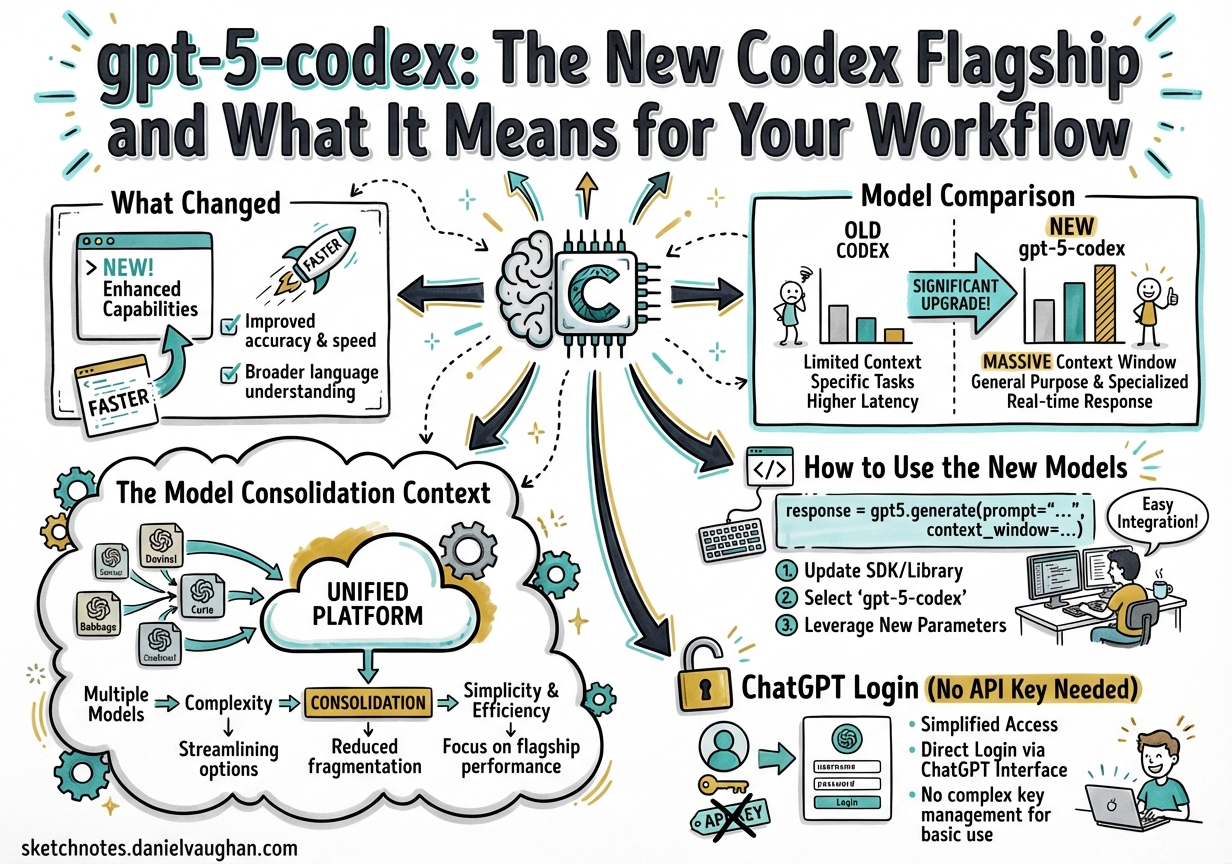
In late March 2026, OpenAI shipped two new models — gpt-5-codex and gpt-5-codex-mini — announced by @thsottiaux. The naming is deliberate: these are not “gpt-5.4 Codex” variants but a distinct model tier with a simplified name, representing a consolidation of the Codex model line.
This article explains what changed, what the new models are best at, and how to migrate your configuration.
What Changed
Until this launch, the Codex model lineup was a numbered sequence: gpt-5.1-codex-max → gpt-5.2-codex → gpt-5.3-codex, plus the general-purpose gpt-5.4 family available across Codex surfaces.
The arrival of gpt-5-codex introduces a cleaner naming convention that drops the sub-version number. @thsottiaux’s announcement framed it directly:
“gpt-5-codex — fast for small things, working hard when it matters — solid jump in produced code quality”
The key signals:
- “Fast for small things” — smarter routing of effort. Small fixes and lookups get fast responses without burning reasoning budget
- “Working hard when it matters” — automatic effort calibration for complex tasks (no manual
reasoning_efforttuning required for most workflows) - “Solid jump in code quality” — the phrasing @thsottiaux has not used for any previous model update
Meanwhile, gpt-5-codex-mini ships with a compelling economics story for Plus, Edu, and Team plan users: up to 4x more included usage than GPT-5.4-mini, plus a 50% increase in overall usage limits for those plans. Pro users get priority processing.
The Model Consolidation Context
Simon Willison observed on March 5 that GPT-5.4 “beats coding specialist GPT-5.3-Codex on all relevant benchmarks”, and wondered: “I wonder if we’ll get a 5.4 Codex or if that model line has now been merged into main?”1
The answer from late March is: neither exactly. Instead of a “gpt-5.4-codex”, OpenAI shipped gpt-5-codex — a model name that drops version numbers entirely. This is consistent with the platform trajectory: as the frontier general-purpose model absorbs coding capabilities previously requiring specialist fine-tuning, the naming can simplify. The Codex product line retains its branding while the model underneath becomes increasingly frontier-general.
What this means practically:
- If you were on
gpt-5.3-codexfor coding tasks, migrate togpt-5-codex - If you were on
gpt-5.4for Codex work, also migrate togpt-5-codex— it’s the better choice for Codex-specific workflows - The
-minivariant replacesgpt-5.4-minias the subagent workhorse, with significantly better economics for most plans
Model Comparison
| Model | Best for | Notes |
|---|---|---|
gpt-5-codex |
Main tasks, complex code changes, architecture work | 🆕 New flagship |
gpt-5-codex-mini |
Exploration, large-file review, subagent delegation | 🆕 4x usage (Plus/Edu/Team) |
gpt-5.4 |
Non-Codex surfaces (API, ChatGPT), computer use workflows | Still valid; gpt-5-codex is preferred within Codex |
gpt-5.4-mini |
Superseded by gpt-5-codex-mini for most uses | Remains available |
gpt-5.3-codex |
Previous flagship | Keep for reproducibility; not recommended for new work |
gpt-5.3-codex-spark |
Real-time coding (Pro only, 128k, text-only) | Cerebras hardware; distinct use case |
How to Use the New Models
Interactive CLI
codex -m gpt-5-codex
codex -m gpt-5-codex-mini
config.toml
model = "gpt-5-codex"

# For agents that do exploration/review work:
[agents.explorer]
model = "gpt-5-codex-mini"
description = "Large-file search and codebase exploration"
Subagent delegation pattern
# config.toml — tiered topology with the new models
model = "gpt-5-codex"

[agents.reviewer]
model = "gpt-5-codex-mini"
description = "Review output from implementer agents"

[agents.implementer]
model = "gpt-5-codex"
description = "Complex implementation tasks"

[agents.explorer]
model = "gpt-5-codex-mini"
description = "Codebase search, large-file review"
Use gpt-5-codex-mini where you’d previously use gpt-5.4-mini — the economics are significantly better on Plus/Edu/Team plans.
ChatGPT Login (No API Key Needed)
Alongside the model launch, OpenAI confirmed ChatGPT Plus/Pro login now works natively in the Codex CLI — no separate API key setup required:
brew install codex
codex        # opens onboarding, lets you log in with ChatGPT credentials
This makes gpt-5-codex accessible to anyone on the ChatGPT Plus or Pro plan without touching the API dashboard. For Enterprise users, existing SCIM/SSO flows remain unchanged.
API Availability
gpt-5-codex is available in the Responses API directly (not the legacy chat/completions endpoint, which was removed in February 2026):
# Using the OpenAI Responses API
from openai import OpenAI

client = OpenAI()
response = client.responses.create(
    model="gpt-5-codex",
    input="Review this diff and identify any security issues..."
)
In config.toml, ensure you’re on the Responses API:
wire_api = "responses"
model = "gpt-5-codex"
Note: gpt-5-codex is not available in ChatGPT (it’s a Codex-surface and Responses API model). For ChatGPT-based workflows, gpt-5.4 remains the appropriate choice.
Migration Checklist
If you’re moving from earlier models:
- Update
modelin~/.codex/config.tomltogpt-5-codex - Update subagent configs: replace
gpt-5.4-miniwithgpt-5-codex-miniin.codex/agents/*.toml - Update any hardcoded model names in
codex execscripts - If on Plus/Edu/Team: verify usage limits increased 50% in account settings
- For CI/CD pipelines: update
--modelflags in GitHub Actions / CI scripts
Related Notes
- Model lineup overview — full benchmark data and version history
- GPT-5.4 mini subagent delegation — tiered inference architecture (still relevant; mini variant now replaced by gpt-5-codex-mini)
- Model selection guide — decision framework (update model names as above)
-
Simon Willison, “Introducing GPT-5.4” (March 5, 2026) — https://simonwillison.net/2026/Mar/5/introducing-gpt54/ ↩