GPT-5.4 mini in Codex CLI: Subagent Delegation, Model Routing and the Tiered Inference Architecture
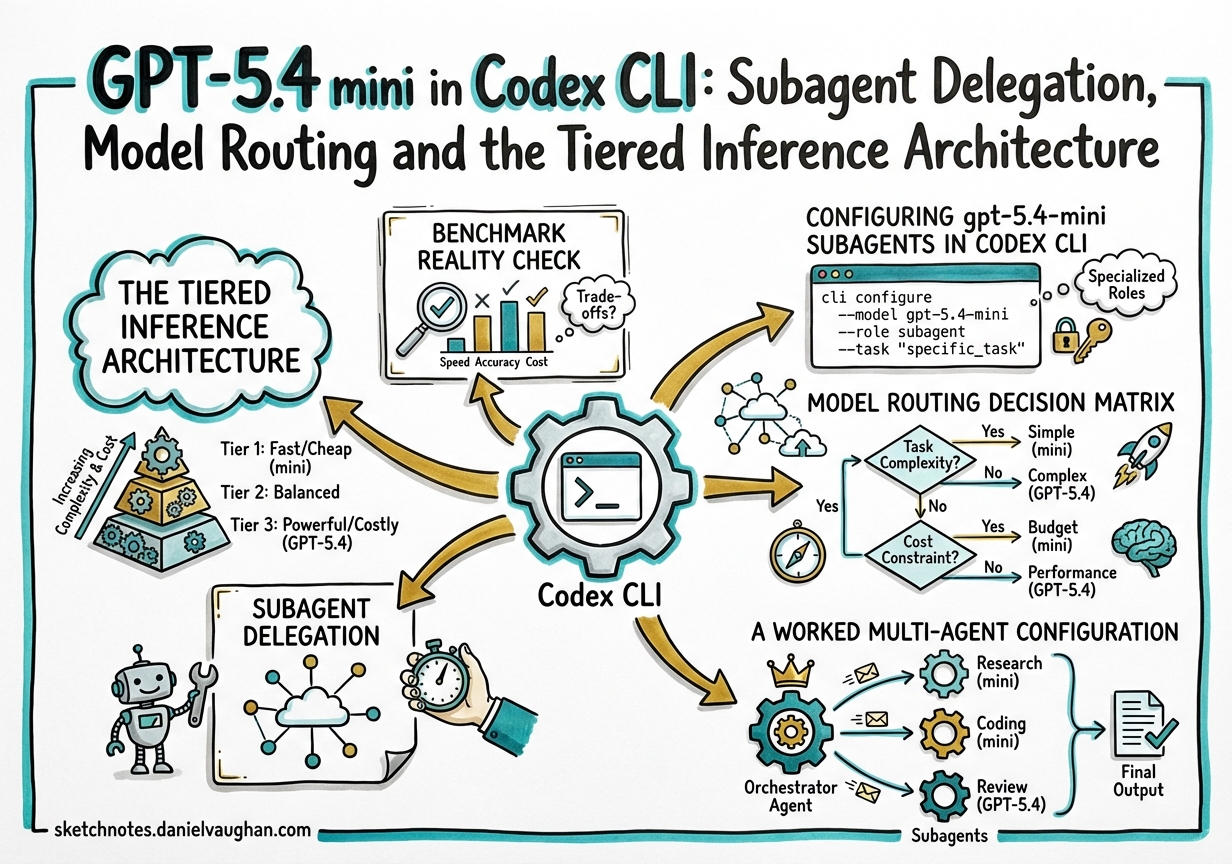
GPT-5.4 mini in Codex CLI: Subagent Delegation, Model Routing and the Tiered Inference Architecture
OpenAI released GPT-5.4 mini and GPT-5.4 nano on 17 March 20261, and they represent something more significant than two incremental model updates. They are, explicitly, the first models OpenAI has framed as purpose-built subagent models — designed to be orchestrated by a larger, more capable model rather than used as standalone all-purpose inferencing endpoints. For Codex CLI users, this arrival materially changes how you should think about multi-agent topologies, cost management, and the TOML configuration that governs them.
This article covers the technical specifics: what these models are, where they sit in the benchmark landscape, how to wire them into Codex CLI via custom agent TOML files and config.toml profiles, and the routing heuristics that will save you real money without sacrificing quality where it matters.
The Tiered Inference Architecture
The framing from OpenAI is deliberate: GPT-5.4 handles “planning, coordination, and final judgment”, while GPT-5.4 mini subagents handle “narrower subtasks in parallel — like searching a codebase, reviewing a large file, or processing supporting documents”2. This is not a vague aspiration; the token-cost ratios make it concrete.
In Codex, GPT-5.4 mini consumes 30% of the included-limit quota compared to GPT-5.43. On the raw API, input tokens cost $0.75/M versus $2.50/M for the flagship4. Running a six-subagent codebase exploration job through mini rather than full GPT-5.4 drops the cost by roughly 3.3×.
GPT-5.4 nano goes further still: $0.20/M input tokens4. Nano is API-only — it is not available in the Codex app, CLI, or IDE extension at time of writing — so it sits outside the Codex credit system. For teams building their own orchestration layers on top of the Responses API, nano becomes the logical choice for classification, routing decisions, and pattern-matching passes that feed into a Codex agent.
graph TD
    User([User Task]) --> Orch[GPT-5.4 Orchestrator<br/>Planning · Coordination · Judgment]
    Orch --> A[gpt-5.4-mini<br/>Codebase search]
    Orch --> B[gpt-5.4-mini<br/>Large file review]
    Orch --> C[gpt-5.4-mini<br/>Docs processing]
    A --> Orch
    B --> Orch
    C --> Orch
    Orch --> Result([Consolidated result])
Benchmark Reality Check
Before reaching for mini everywhere, the benchmark picture needs to be honest.
| Benchmark | GPT-5.4 | GPT-5.4 mini | GPT-5 mini (prior) |
|---|---|---|---|
| SWE-Bench Pro | 57.7% | 54.4% | 45.7% |
| OSWorld-Verified | 75.0% | 72.1% | 42.0% |
| τ²-bench Telecom | 98.9% | 93.4% | 74.1% |
| MCP Atlas | — | 57.7% | 47.6% |
| MRCR v2 (long-context, 128k) | 86.0% | 47.7% | — |
Sources: OpenAI blog1, DataCamp analysis5.
The headline numbers are encouraging: on SWE-Bench Pro, mini closes to within 3.3 points of the flagship while costing 3.3× less5. The τ²-bench tool-use result (93.4%) is particularly relevant for Codex workflows where reliable shell-command generation and tool invocation are the bottleneck.
The number to watch is that MRCR v2 long-context score: 47.7% versus 86.0%5. When a subagent needs to reason across a dense 128k+ context — holding many interrelated facts simultaneously — mini underperforms significantly. This is the signal for when to route to the orchestrator model rather than delegating.
Configuring gpt-5.4-mini Subagents in Codex CLI
The custom agent TOML approach
Since v0.117.0, the recommended way to configure a model-specific subagent is a standalone TOML file placed under ~/.codex/agents/ (user-scoped) or .codex/agents/ (repository-scoped)6. The file name becomes the agent’s type identifier.
# .codex/agents/reviewer.toml
nickname_candidates = ["reviewer", "rev"]
description = "PR reviewer: correctness, security, and missing tests"
model = "gpt-5.4-mini"
model_reasoning_effort = "medium"
sandbox_mode = "read-only"
# .codex/agents/explorer.toml
nickname_candidates = ["explorer", "exp"]
description = "Fast codebase explorer — searches, reads, never edits"
model = "gpt-5.4-mini"
model_reasoning_effort = "low"
sandbox_mode = "read-only"
Any field omitted in an agent TOML inherits from the parent session’s configuration6. This means mcp_servers, skills.config, and model_provider do not need to be repeated if they are already set in config.toml.
Global subagent settings in config.toml
# ~/.codex/config.toml
model = "gpt-5.4"
model_reasoning_effort = "high"

[agents]
max_threads = 8        # max parallel subagents; default 6
max_depth   = 1        # allow one level of child agents; default 1

[features]
multi_agent = true
max_depth = 1 allows the root session to spawn children but prevents children spawning grandchildren. This is the safest default for controlled delegation — increase it only when you have a deliberate recursive pattern and have accounted for the exponential token cost6.
Profiles for quick model switching
Profiles (experimental7) let you name and switch between configurations:
# ~/.codex/config.toml

profile = "standard"

[profiles.standard]
model = "gpt-5.4"
model_reasoning_effort = "medium"

[profiles.economy]
model = "gpt-5.4-mini"
model_reasoning_effort = "medium"

[profiles.deep]
model = "gpt-5.4"
model_reasoning_effort = "high"
Switch at launch with codex --profile economy or in-session with /config profile economy. Profiles do not yet cascade into spawned subagents — subagents use the agent TOML or inherit the root session model, not the active profile7. ⚠️
Model Routing Decision Matrix
The goal is to answer: for a given subtask, which model should execute it?
flowchart TD
    Start([Subtask arrives]) --> Q1{Requires cross-file<br/>reasoning >64k tokens?}
    Q1 -- Yes --> Q2{Requires planning<br/>or architectural judgment?}
    Q2 -- Yes --> Full[gpt-5.4<br/>high reasoning]
    Q2 -- No --> Full2[gpt-5.4<br/>medium reasoning]
    Q1 -- No --> Q3{Tool-heavy:<br/>shell, file ops, API calls?}
    Q3 -- Yes --> Mini1[gpt-5.4-mini<br/>medium reasoning]
    Q3 -- No --> Q4{Read-only exploration<br/>or pattern search?}
    Q4 -- Yes --> Mini2[gpt-5.4-mini<br/>low reasoning]
    Q4 -- No --> Mini3[gpt-5.4-mini<br/>medium reasoning]
Practical rules of thumb:
- Use gpt-5.4-mini for: codebase search, large-file review, documentation generation, test scaffolding, linting passes, diff summaries, and any task that primarily involves reading and pattern matching rather than designing.
- Keep gpt-5.4 for: architectural decisions, multi-file refactors where coherence across many interdependencies matters, final review passes, and anything that reads more than 64k tokens of dense, interrelated context.
- Route to gpt-5.4 when mini’s MRCR drops matter: if your subagent needs to track more than ~20 distinct facts or constraints simultaneously across a large codebase context, the 47.7% long-context score is a real liability5.
A Worked Multi-Agent Configuration
The following AGENTS.md and config.toml together describe a feature-development workflow where an orchestrator delegates to two mini subagents:
# .codex/agents/implementer.toml
nickname_candidates = ["implementer"]
description = "Writes code changes as directed by the orchestrator"
model = "gpt-5.4-mini"
model_reasoning_effort = "medium"
sandbox_mode = "full-access"
# .codex/agents/tester.toml
nickname_candidates = ["tester"]
description = "Writes and runs tests for changes produced by the implementer"
model = "gpt-5.4-mini"
model_reasoning_effort = "low"
sandbox_mode = "full-access"
# .codex/config.toml
model = "gpt-5.4"
model_reasoning_effort = "high"

[agents]
max_threads = 4
max_depth   = 1

[features]
multi_agent = true
<!-- AGENTS.md (excerpt) -->
## Multi-agent task protocol

For feature tickets, use this pattern:
1. You (gpt-5.4) plan the changes and identify affected files
2. Spawn `implementer` to write the code
3. Spawn `tester` to write and run tests against the changes
4. Review implementer and tester output before committing

Never delegate final code-review judgment to subagents.
The sub-agent addresses use the path scheme introduced in v0.117.0: /root/implementer, /root/tester8. Remote sessions surface these as names rather than UUIDs since the same release.
GPT-5.4 nano: API-Only, Ultra-Cheap
Nano ($0.20/M input, $1.25/M output4) is not available in the Codex CLI or app at launch. It exists in the raw Responses API. This makes it relevant for teams who:
- Build their own agent harnesses using the
codex-sdkPython package and want a cheap routing/classification layer - Run pre-processing pipelines (tokenisation checks, language detection, intent classification) before forwarding to a Codex session
- Use the app-server WebSocket transport and manage their own scheduling logic
For pure Codex CLI users, nano is not a configuration option today. It is worth monitoring the [model_providers] section of config.toml for when a direct API provider targeting the nano endpoint becomes the supported path7. ⚠️
Cost Modelling
For a Codex Pro subscription team, the credit ratio is what drives practical decisions. OpenAI states mini consumes 30% of GPT-5.4’s quota3. A rough model for a typical feature-development session:
Orchestrator (gpt-5.4): 1 planning turn × 1.0 credit unit
Implementer (gpt-5.4-mini): 3 code-writing turns × 0.30 credit units = 0.90
Tester (gpt-5.4-mini): 2 test-writing turns × 0.30 credit units = 0.60

Total: 2.50 credit units

vs. all-gpt-5.4: 6 turns × 1.0 = 6.0 credit units
Saving: ~58%
The actual multiplier depends on session length and context compaction behaviour. The key insight is that the savings compound: every exploration or documentation subtask you route to mini rather than the flagship extends your included limits by a factor of ~3.3 for that work.
What Has Not Changed
GPT-5.4 mini is a new model, but the Codex CLI machinery around it is the same:
AGENTS.mdinstructions still govern all sessions — both orchestrator and subagents read the applicableAGENTS.mdhierarchy6- Sandbox modes, MCP server access, and skill configurations all apply identically to mini sessions
- The approval policy (
suggest,auto-edit,full-auto) is set at the session level and is not per-agent in the current implementation ⚠️ - Hooks (experimental) fire on both orchestrator and subagent turns; hook scripts receive
modelin the JSON stdin, enabling model-aware logging
Summary
GPT-5.4 mini is not a compromise option for developers who can’t afford the flagship — it is a purpose-designed subagent model that scores within 3.3 points of GPT-5.4 on SWE-Bench Pro, runs 2× faster, and costs 3.3× less in the Codex credit system13. The clear failure mode is long-context reasoning (MRCR v2: 47.7% vs 86.0%), which gives a clean routing heuristic: keep the orchestrator on GPT-5.4 for anything requiring deep cross-file coherence, and delegate the rest to mini.
The custom agent TOML pattern introduced in v0.117.0 makes this wiring explicit and version-controllable. Commit your .codex/agents/ directory alongside your AGENTS.md and treat the tiered inference topology as part of the project’s technical design.
Citations
-
OpenAI, “Introducing GPT-5.4 mini and nano”, March 17 2026. https://openai.com/index/introducing-gpt-5-4-mini-and-nano/ ↩ ↩2 ↩3
-
OpenAI Codex models page. https://developers.openai.com/codex/models ↩
-
Augment Code, “OpenAI Codex CLI ships v0.116.0 with enterprise features”. https://www.augmentcode.com/learn/openai-codex-cli-enterprise ↩ ↩2 ↩3
-
AI Free API, “GPT-5.4 mini vs GPT-5.4 nano pricing and routing logic”. https://www.aifreeapi.com/en/posts/gpt-5-4-mini-vs-gpt-5-4-nano ↩ ↩2 ↩3
-
DataCamp, “GPT-5.4 mini and nano: Benchmarks, Access, and Reactions”. https://www.datacamp.com/blog/gpt-5-4-mini-nano ↩ ↩2 ↩3 ↩4
-
OpenAI Codex subagents documentation. https://developers.openai.com/codex/subagents ↩ ↩2 ↩3 ↩4
-
OpenAI Codex advanced configuration reference. https://developers.openai.com/codex/config-advanced ↩ ↩2 ↩3
-
OpenAI Codex CLI v0.117.0 release notes. https://github.com/openai/codex/releases/tag/v0.117.0 ↩