Codex CLI Custom Model Providers: Azure, Vercel, Local LLMs and Dynamic Bearer Tokens
Codex CLI Custom Model Providers: Azure, Vercel, Local LLMs and Dynamic Bearer Tokens
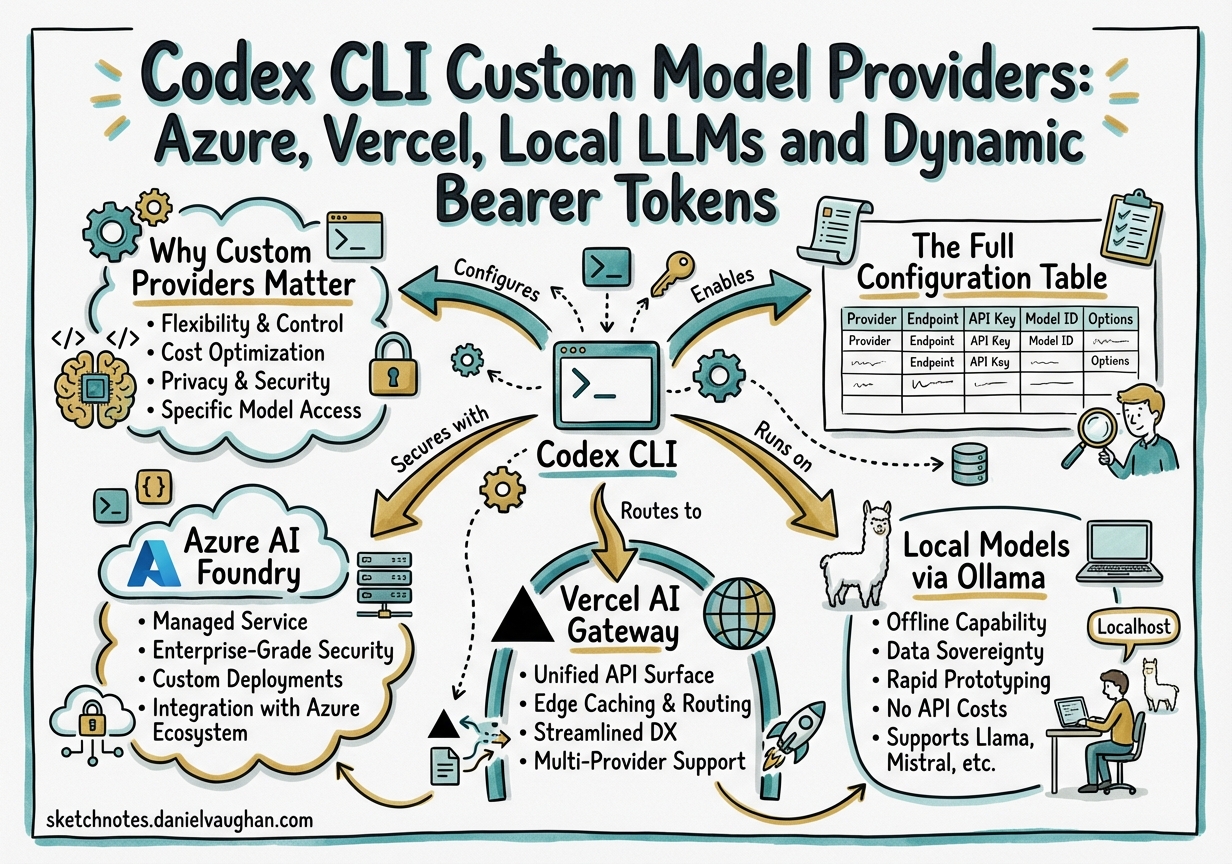
Codex CLI ships wired to OpenAI’s hosted models, but the [model_providers] configuration table lets you point it at any OpenAI-compatible endpoint — Azure AI Foundry, the Vercel AI Gateway, a self-hosted Ollama instance, or any private inference cluster your organisation runs. This article documents the full provider config surface as of v0.117.0, covers practical setup for the most common alternatives, and tracks the enterprise authentication gap that the team is actively closing.
Why Custom Providers Matter
Three scenarios drive the majority of custom-provider setups:
-
Data residency — regulated industries (finance, healthcare, government) require code and prompts to stay in-region. Azure AI Foundry routes all traffic through your Azure subscription and never egresses to OpenAI’s infrastructure.
-
Provider redundancy / cost control — the Vercel AI Gateway routes requests to OpenAI, Anthropic, Google, or 100+ other endpoints from a single Codex config. Teams running Codex at scale use this to A/B test models or fall back gracefully when one provider has an outage.
-
Local models — developers in air-gapped environments, or those who want zero-cost iteration on private code, run
gpt-5-codexfine-tunes or other compatible models via Ollama or llama.cpp’s OpenAI-compatible server.
The Full Configuration Table
The [model_providers.<id>] table in ~/.codex/config.toml (or .codex/config.toml for project-scoped overrides) accepts these fields:1
| Field | Type | Required | Notes |
|---|---|---|---|
name |
string | No | Display name shown in the TUI |
base_url |
string | Yes | API endpoint — must be OpenAI-compatible (Responses API) |
env_key |
string | Recommended | Env var holding the API key. Preferred over experimental_bearer_token |
env_key_instructions |
string | No | Message shown in the TUI if the env var is missing |
experimental_bearer_token |
string | Discouraged | Hardcoded token — avoid in shared configs |
http_headers |
map | No | Static headers sent with every request |
env_http_headers |
map | No | Headers populated from environment variables at runtime |
query_params |
map | No | Query string params appended to every request |
requires_openai_auth |
bool | No | Set true only for requires_openai_auth-based providers. Default: false |
wire_api |
string | For non-OpenAI | Must be "responses" (Responses API — currently the only supported value) |
request_max_retries |
number | No | HTTP-level retry count. Default: 4 |
stream_idle_timeout_ms |
number | No | SSE stream idle timeout. Default: 300 000 ms |
stream_max_retries |
number | No | Retry count on stream interruptions. Default: 5 |
supports_websockets |
bool | No | Enable WebSocket transport for Responses API streaming |
Activate a provider with the top-level model_provider = "<id>" key. To switch providers per workflow, use profiles:
model_provider = "openai"   # default

[profiles.azure]
model_provider = "azure"
model = "gpt-5-codex"

[profiles.local]
model_provider = "local-ollama"
model = "codex-local-7b"
⚠️
model_providers,mcp_servers, and[otel]blocks are not profile-overridable — they must be defined at the top level and are available to all profiles.
Azure AI Foundry
The most commonly deployed enterprise provider. Full details are in notes/codex-azure-openai.md, but the canonical config is:
[model_providers.azure]
name = "Azure AI Foundry"
base_url = "https://<your-resource>.openai.azure.com/openai/deployments/<your-deployment>"
env_key = "AZURE_OPENAI_API_KEY"
env_key_instructions = "Set AZURE_OPENAI_API_KEY to your Azure AI Foundry key"
wire_api = "responses"
requires_openai_auth = false

[model_providers.azure.http_headers]
"api-version" = "2026-02-01"

model_provider = "azure"
model = "gpt-5-codex"          # Must match your Azure deployment name
Key constraint: Azure requires api-version as a query param or header. Use http_headers as shown — query_params also works (query_params = { "api-version" = "2026-02-01" }), but headers are cleaner with proxies.
Entra ID limitation: Azure AD SSO (Managed Identity / Entra tokens) is not supported as of v0.117.0. API key auth only. Watch issue #13241 for updates.
Vercel AI Gateway
Vercel’s AI Gateway acts as a single-endpoint proxy that multiplexes across OpenAI, Anthropic, Google, and 100+ other providers. Codex treats it as one custom provider; you switch models by changing the model string, not the endpoint.
[model_providers.vercel]
name = "Vercel AI Gateway"
base_url = "https://ai-gateway.vercel.sh/v1"
env_key = "VERCEL_OIDC_TOKEN"    # rotates automatically via Vercel's CI
wire_api = "responses"

model_provider = "vercel"
model = "openai/gpt-5-codex"     # or "anthropic/claude-sonnet-4-5", "google/gemini-3-flash", etc.
Model strings follow the <provider>/<model-id> convention. See the Vercel AI Gateway docs for the full catalogue.
The Vercel plugin (38 skills, 3 specialist agents) is a separate install and works regardless of which provider backend you use — see articles/2026-03-30-codex-cli-vercel-ai-gateway-skills-plugin.md.
Local Models via Ollama
For fully offline or air-gapped setups, Ollama exposes an OpenAI-compatible endpoint at localhost:11434. Any model in the Ollama library can be used, subject to capability limitations (Codex’s agentic loop works best with models that reliably produce tool calls in the correct schema).
# Pull a code-focused model
ollama pull qwen2.5-coder:14b
[model_providers.local-ollama]
name = "Ollama (local)"
base_url = "http://localhost:11434/v1"
env_key = "OLLAMA_API_KEY"      # Ollama accepts any non-empty string here
wire_api = "responses"
stream_idle_timeout_ms = 120000  # local models are slower — increase the idle timeout

model_provider = "local-ollama"
model = "qwen2.5-coder:14b"
Practical caveats:
- Context compaction’s OpenAI fast path (
POST /v1/responses/compact) is not available with non-OpenAI providers. Codex falls back to the local compaction path — a_summaryuser message. Sessions still compact, but you lose the encrypted opaque blob and pay full summarisation token cost. - Multi-agent v2 and the
spawn_agents_on_csvfan-out pattern work, but local models are significantly slower at following the TOML subagent protocol compared to the hosted Codex models. - Image input/output workflows require multimodal model support — check your model’s capabilities first.
Bearer Token Authentication (New in v0.117.0+)
PR #16277 (merged 2026-03-30) generalised the external auth token system. ExternalAuthTokens now carries an access_token plus optional ExternalAuthChatgptMetadata rather than always requiring ChatGPT account data. This means bearer-only sources — providers that issue tokens outside OpenAI’s auth flow — can now use the full refresher infrastructure rather than static experimental_bearer_token.
What this enables in practice: Providers that issue access tokens via OAuth2 client credentials flow (common in enterprise Azure AD and internal IdPs) can use the requires_openai_auth = false path with a command-backed bearer refresher in the upcoming follow-on PR.
The Dynamic Token Refresh Gap (Issue #15189)
Current state: Codex supports two ways to supply API keys to custom providers — env_key (environment variable at process start) and experimental_bearer_token (hardcoded). Both are static. Neither handles tokens that expire mid-session.
Enterprise problem: Many corporate auth systems (including Azure Managed Identity and on-prem OAuth2 IdPs) issue short-lived bearer tokens (often 5–15 minutes). A Codex session running a 45-minute agentic task will hit HTTP 401 mid-run.
Proposed configuration (Issue #15189):
[model_providers.enterprise-internal]
name = "Internal Inference Cluster"
base_url = "https://ai.internal.example.com/v1"
wire_api = "responses"

# Proposed — not yet shipped (watch for v0.118.x)
auth_token_command = "/usr/local/bin/generate-ai-token"
auth_token_refresh_interval_ms = 300000   # cache for 5 minutes
auth_token_refresh_on_401 = true          # force-refresh on HTTP 401
auth_token_command_timeout_ms = 5000      # fail fast if token command hangs
Workaround until the feature ships: Run a wrapper script that periodically writes a fresh token to the env var Codex reads, then launch Codex as a child process. Not elegant, but it works for CI environments where you control the wrapper.
#!/usr/bin/env bash
# token-refresh-wrapper.sh
while true; do
  export MY_PROVIDER_TOKEN=$(generate-ai-token)
  sleep 240  # refresh every 4 minutes (before the 5-minute expiry)
done &
REFRESH_PID=$!
trap "kill $REFRESH_PID" EXIT
codex "$@"
PR #16277’s generalised bearer auth architecture is the foundation needed to build this feature. The team described the PR as enabling “a follow-on provider-auth PR” that implements the command-backed refresher directly.
Static Header Auth (API Keys as Headers)
Some providers (LiteLLM, internal proxies) use X-API-Key or similar custom headers rather than Authorization: Bearer <token>. Use env_http_headers:
[model_providers.litellm-proxy]
name = "LiteLLM Proxy"
base_url = "https://litellm.internal.example.com/v1"
wire_api = "responses"

[model_providers.litellm-proxy.env_http_headers]
"X-API-Key" = "LITELLM_API_KEY"   # reads from LITELLM_API_KEY env var
Validation Checklist
Before using a custom provider in production:
# 1. Verify the provider connection
CUSTOM_API_KEY=xxx codex --profile my-provider --no-interactive \
  "Respond with 'Provider connected' and nothing else"

# 2. Confirm model availability
codex --profile my-provider model list

# 3. Test compaction (important for long sessions)
codex --profile my-provider
> /compact
# If it fails with 404, the provider doesn't support the fast path —
# that's OK, local compaction will kick in automatically

# 4. Test subagent spawn (if using multi-agent workflows)
# Ensure multi_agent feature is enabled
codex --profile my-provider features list
What’s Not Overridable Per Profile
A common mistake: defining [model_providers] inside a profile block. This silently fails. All provider definitions must be at the top level of config.toml:
# ✅ Correct — top-level provider definition
[model_providers.azure]
base_url = "..."

# ✅ Profile switches which provider to use
[profiles.azure-review]
model_provider = "azure"
model = "gpt-5-codex"
model_reasoning_effort = "high"

# ❌ Wrong — model_providers inside a profile is ignored
[profiles.azure-review.model_providers.azure]
base_url = "..."
-
Source: developers.openai.com/codex/config-reference — verified 2026-03-31. ↩