Codex CLI Python SDK and v2 App-Server Filesystem RPCs
Codex CLI Python SDK and v2 App-Server Filesystem RPCs
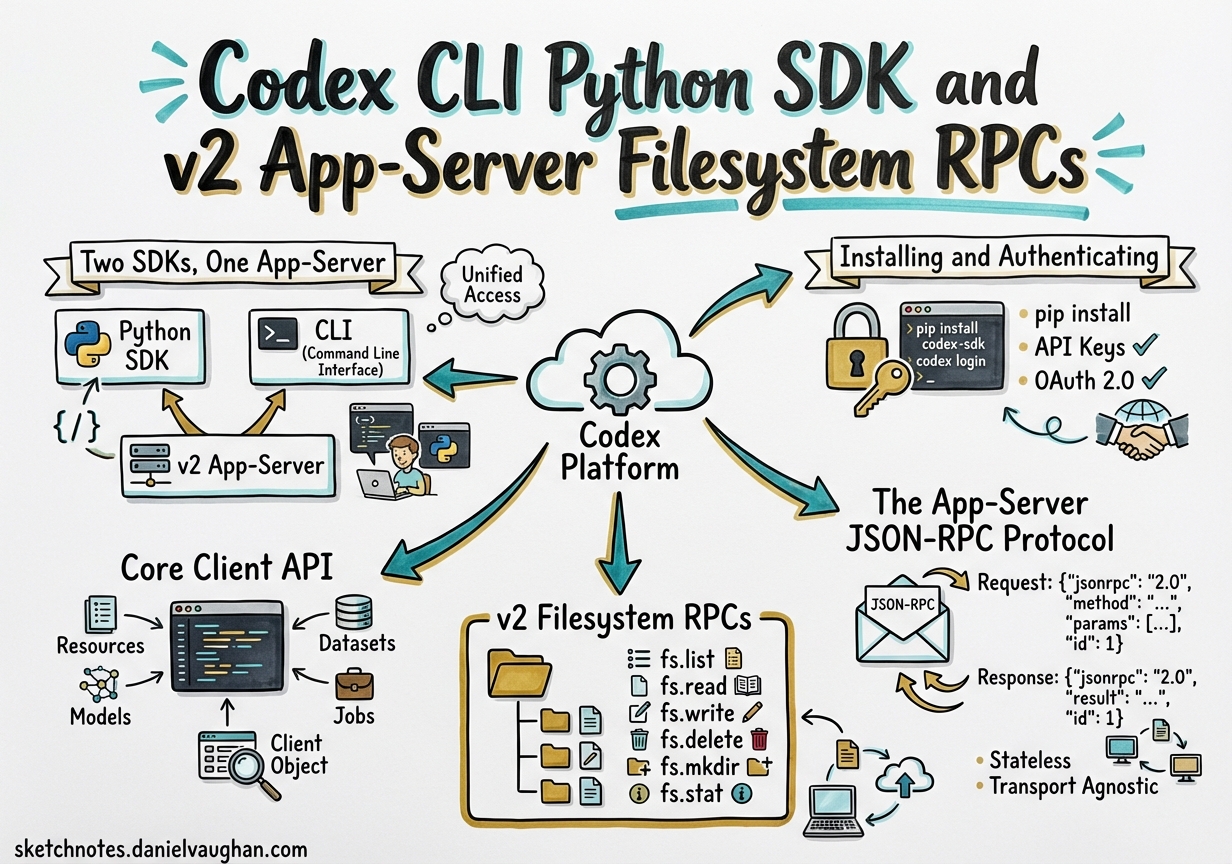
The v0.115.0 release of Codex CLI introduced two major primitives for programmatic control: an experimental Python SDK and a set of v2 filesystem RPCs exposed through the app-server JSON-RPC protocol.1 Together they turn Codex CLI from an interactive TUI into a scriptable, embeddable agent runtime that can be orchestrated from Python pipelines, notebooks, or custom tooling.
This article covers both SDK surfaces — their distinct purposes, the wire protocol underneath them, and patterns for putting them to work in real codebases.
Two SDKs, One App-Server
Two Python packages exist and they are frequently confused:2
| Package | Transport | Primary use |
|---|---|---|
openai-codex-sdk (PyPI) |
JSONL events over stdin/stdout | Wrapping the Codex CLI binary from Python scripts |
codex_app_server (GitHub sdk/python) |
JSON-RPC v2 over stdio or WebSocket | Direct interaction with the app-server JSON-RPC protocol |
The openai-codex-sdk package spawns the Codex CLI process and exchanges JSONL-formatted event messages with it — it does not ship the binary itself. The codex_app_server package implements the full JSON-RPC protocol surface and is the foundation the Codex App itself uses.
Both packages are explicitly marked experimental as of March 2026. Treat their APIs as unstable.3
Installing and Authenticating
# CLI wrapper (PyPI)
pip install openai-codex-sdk   # Python 3.10+

# App-server SDK (GitHub)
git clone https://github.com/openai/codex
cd codex/sdk/python
pip install -e .
The CLI wrapper SDK supports three authentication flows:4
from openai_codex_sdk import Codex

# 1. Environment variable (CI-friendly)
#    Set CODEX_AUTH_JSON before running
Codex.login_with_auth_json(overwrite=True)

# 2. Device-code flow (interactive terminal or Codex App onboarding)
Codex().login_with_device_code()

# 3. Direct API key
from openai_codex_sdk import Codex, CodexOptions
codex = Codex(CodexOptions(api_key="sk-..."))
Device-code authentication in the app-server TUI was added in v0.116.0, making ChatGPT-based login viable in enterprise environments where direct browser sign-in is blocked.5
Core Client API
Starting and Running Threads
import asyncio
from openai_codex_sdk import Codex

async def main():
    codex = Codex()
    thread = codex.start_thread()

    # Buffered: waits for full turn completion
    turn = await thread.run(
        "Audit this repo for unused dependencies and list them",
        options={"working_directory": "/path/to/repo"}
    )
    print(turn.final_response)
    print(turn.usage)  # input_tokens, cached_input_tokens, output_tokens

asyncio.run(main())
turn.final_response is None when no agent_message item completes the turn — for example when Codex performs only tool calls. Check turn.items in that case.6
To resume an existing session across process restarts:
# Resume the most recently active thread
thread = codex.resume_last_thread()  # reads CODEX_HOME env var

# Resume by explicit thread ID
thread = codex.resume_thread("0199a213-81c0-7800-8aa1-bbab2a035a53")
Streaming Events
async def review_with_streaming():
    codex = Codex()
    thread = codex.start_thread()
    streamed = await thread.run_streamed("Review the last commit for security issues")

    async for event in streamed.events:
        match event.type:
            case "item.started":
                print(f"→ {event.item.type}")
            case "item.agentMessage.delta":
                print(event.delta, end="", flush=True)
            case "item.completed":
                if event.item.type == "command_execution":
                    print(f"\nRan: {event.item.command}")
            case "turn.completed":
                print(f"\nTokens: {event.usage}")

    # turn.final_response available after events exhausted
    result = await streamed.result
The eight event types are: thread.started, turn.started, item.started, item.completed, item.agentMessage.delta, turn.completed, turn.failed, and thread.tokenUsage.updated.7
Structured Output
schema = {
    "type": "object",
    "properties": {
        "files": {"type": "array", "items": {"type": "string"}},
        "verdict": {"type": "string", "enum": ["pass", "fail", "warn"]}
    },
    "required": ["files", "verdict"]
}

turn = await thread.run(
    "Check for hardcoded secrets in the repo",
    options={"output_schema": schema}
)
import json
result = json.loads(turn.final_response)
The App-Server JSON-RPC Protocol
The app-server is the process behind both the Codex App and the codex mcp-server command. It speaks a JSON-RPC 2.0 variant — notably without the "jsonrpc":"2.0" envelope field — over newline-delimited JSON (JSONL) on stdio, or one message per WebSocket text frame.8
Session Initialisation
Every connection must complete a three-step handshake before issuing any other RPC:9
sequenceDiagram
    participant C as Client
    participant S as App-Server

    C->>S: initialize {clientInfo, capabilities}
    S-->>C: {userAgent, codexHome, platformFamily}
    C->>S: initialized (notification, no id)
    Note over C,S: Connection ready for RPCs
    C->>S: thread/start {model, ...}
    S-->>C: {threadId}
    S-)C: turn/started (notification)
    S-)C: item/started (notification)
    S-)C: item/agentMessage/delta (notification stream)
    S-)C: item/completed (notification)
    S-)C: turn/completed (notification)
The clientInfo.name field is logged to OpenAI’s Compliance Logs Platform — enterprise teams can register known client names by contacting OpenAI.10
Use capabilities.optOutNotificationMethods to suppress high-volume notifications (e.g. item/agentMessage/delta) when you only need final items:
{
  "method": "initialize",
  "id": 0,
  "params": {
    "clientInfo": {"name": "my-pipeline", "title": "Deploy Pipeline", "version": "1.0.0"},
    "capabilities": {
      "experimentalApi": true,
      "optOutNotificationMethods": ["item/agentMessage/delta"]
    }
  }
}
v2 Filesystem RPCs
The nine fs/* methods introduced in v0.115.0 give a connected client direct read/write access to the host filesystem through the app-server process.11 All paths must be absolute. File content is base64-encoded on the wire.
Read and Write
// Read a file
{"method": "fs/readFile", "id": 1, "params": {"path": "/project/src/main.py"}}
// → {"id": 1, "result": {"dataBase64": "aW1wb3J0IG9z..."}}

// Write a file (base64-encode your content first)
{"method": "fs/writeFile", "id": 2, "params": {
  "path": "/project/output/report.json",
  "dataBase64": "eyJzdGF0dXMiOiAib2sifQ=="
}}
Directory Operations
// List directory contents with metadata
{"method": "fs/readDirectory", "id": 3, "params": {"path": "/project/src"}}

// Create a directory tree (recursive by default)
{"method": "fs/createDirectory", "id": 4, "params": {"path": "/project/output/2026/03"}}

// Copy a directory tree
{"method": "fs/copy", "id": 5, "params": {
  "sourcePath": "/project/src",
  "destinationPath": "/project/backup/src",
  "recursive": true
}}

// Delete a file or directory tree
{"method": "fs/remove", "id": 6, "params": {"path": "/project/tmp"}}
Filesystem Watching
// Subscribe to changes on a path
{"method": "fs/watch", "id": 7, "params": {"path": "/project/src"}}
// → {"id": 7, "result": {"watchId": "a3f9...", "canonicalPath": "/project/src"}}

// Server pushes fs/changed notifications as files are modified:
// {"method": "fs/changed", "params": {"watchId": "a3f9...", "path": "/project/src/app.py", "kind": "modify"}}

// Unsubscribe
{"method": "fs/unwatch", "id": 8, "params": {"watchId": "a3f9..."}}
Watching a file (rather than a directory) correctly tracks updates delivered via atomic rename operations — relevant to editors like Vim that write via a temp-file-and-rename pattern.12
WebSocket Transport and Health Checks
The WebSocket listener is experimental but useful for container-hosted deployments where stdio is impractical:13
# Local only (no auth required)
codex app-server --listen ws://127.0.0.1:8765

# Non-loopback with capability-token auth
codex app-server --listen ws://0.0.0.0:8765 \
  --ws-auth capability-token \
  --ws-token-file /run/secrets/codex-token
Two health probe endpoints are available on the same port once the server starts (added in v0.114.0):14
| Endpoint | Returns 200 when… |
|---|---|
GET /readyz |
Listener is accepting new connections |
GET /healthz |
Request has no Origin header (CSRF guard) |
The /healthz Origin restriction means Kubernetes liveness probes work correctly (no Origin header), while browser-initiated requests are rejected.
For signed-bearer-token auth (JWS/JWT), configure the shared secret and optional issuer/audience claims:
codex app-server --listen ws://0.0.0.0:8765 \
  --ws-auth signed-bearer-token \
  --ws-shared-secret-file /run/secrets/codex-secret \
  --ws-issuer "my-org" \
  --ws-audience "codex-prod" \
  --ws-clock-skew-seconds 30
Practical Patterns
CI Pipeline: Automated PR Review
import asyncio, base64, json
from openai_codex_sdk import Codex, CodexOptions

async def review_pr(repo_path: str, base_branch: str) -> dict:
    codex = Codex(CodexOptions(api_key=os.environ["CODEX_API_KEY"]))
    thread = codex.start_thread()

    schema = {
        "type": "object",
        "properties": {
            "severity": {"type": "string", "enum": ["low", "medium", "high", "critical"]},
            "findings": {"type": "array", "items": {"type": "string"}},
            "approved": {"type": "boolean"}
        },
        "required": ["severity", "findings", "approved"]
    }

    turn = await thread.run(
        f"Review changes against {base_branch} for security and correctness issues.",
        options={
            "working_directory": repo_path,
            "output_schema": schema,
            "skip_git_repo_check": False
        }
    )
    return json.loads(turn.final_response)
pydantic-ai Integration
The SDK ships a codex_handoff_tool helper that bridges a pydantic-ai Agent to a Codex thread:15
from openai_codex_sdk import codex_handoff_tool, ThreadOptions
from pydantic_ai import Agent

orchestrator = Agent(
    "openai:gpt-5",
    tools=[
        codex_handoff_tool(ThreadOptions(
            working_directory="/project",
            approval_policy="auto-edit"
        ))
    ]
)

result = await orchestrator.run(
    "Investigate the failing tests, propose a fix, and generate a patch"
)
MCP Server Injection
from openai_codex_sdk import Codex, CodexOptions

codex = Codex(CodexOptions(
    mcp_servers=[{
        "name": "datadog",
        "command": "npx",
        "args": ["-y", "@datadog/mcp-server"]
    }]
))
thread = codex.start_thread()
turn = await thread.run("Query last hour of error logs from the payment service")
Error Handling
The server returns JSON-RPC error objects with two notable codes:
| Code | Meaning | Action |
|---|---|---|
-32001 |
Server overloaded | Retry with exponential backoff and jitter |
| Standard | Not initialized / Already initialized |
Fix handshake sequencing |
| Standard | <X> requires experimentalApi |
Add experimentalApi: true to initialize capabilities |
Keep the openai-codex-sdk package and the installed Codex CLI binary versions aligned — published SDK releases pin an exact codex-cli-bin version. Mismatches cause silent wire-format incompatibilities.16
Summary
The Codex CLI Python SDK surfaces two distinct integration points: a JSONL-over-stdio wrapper (openai-codex-sdk) for straightforward automation scripts, and a full JSON-RPC protocol implementation (codex_app_server) for deep integration with the app-server’s complete method inventory. The v2 filesystem RPCs added in v0.115.0 extend this to include remote read/write/watch operations, making the app-server a capable building block for IDE extensions, notebook kernels, and custom CI tooling — all without reinventing the agent loop.
Both surfaces remain experimental. Treat the APIs as a moving target and pin versions aggressively until stabilisation is announced.
Citations
-
OpenAI Codex CLI v0.115.0 release notes — filesystem RPCs and Python SDK: https://github.com/openai/codex/releases/tag/rust-v0.115.0 ↩
-
Codex CLI SDK documentation distinguishing the two Python packages: https://developers.openai.com/codex/sdk ↩
-
OpenAI Codex app-server README marking WebSocket and Python SDK as experimental: https://github.com/openai/codex/blob/main/codex-rs/app-server/README.md ↩
-
openai-codex-sdkPyPI package authentication API: https://pypi.org/project/openai-codex-sdk/ ↩ -
OpenAI Codex CLI v0.116.0 release notes — device-code ChatGPT sign-in: https://developers.openai.com/codex/changelog ↩
-
Codex CLI SDK
Turnobject documentation —final_responsesemantics: https://developers.openai.com/codex/sdk ↩ -
Codex CLI JSONL event stream format and the eight event types: https://developers.openai.com/codex/sdk ↩
-
Codex app-server JSON-RPC v2 wire format (no
jsonrpcenvelope): https://github.com/openai/codex/blob/main/codex-rs/app-server/README.md ↩ -
App-server initialisation handshake three-step flow: https://github.com/openai/codex/blob/main/codex-rs/app-server/README.md ↩
-
clientInfo.namecompliance logging and enterprise registration note: https://github.com/openai/codex/blob/main/codex-rs/app-server/README.md ↩ -
v2 filesystem RPC methods introduced in v0.115.0 (PRs #14245, #14435): https://github.com/openai/codex/releases/tag/rust-v0.115.0 ↩
-
fs/watchhandling of atomic rename-based file writes: https://github.com/openai/codex/blob/main/codex-rs/app-server/README.md ↩ -
WebSocket transport documentation and auth flag reference: https://github.com/openai/codex/blob/main/codex-rs/app-server/README.md ↩
-
Health check endpoints
/readyzand/healthzadded in v0.114.0 (PR #13782): https://github.com/openai/codex/releases/tag/rust-v0.114.0 ↩ -
codex_handoff_toolpydantic-ai integration helper: https://developers.openai.com/codex/sdk ↩ -
SDK and CLI binary version pinning requirement: https://pypi.org/project/openai-codex-sdk/ ↩