Embedding AI Agents in SaaS: Codex CLI vs OpenCode vs Pi for Multi-Tenant Harnesses
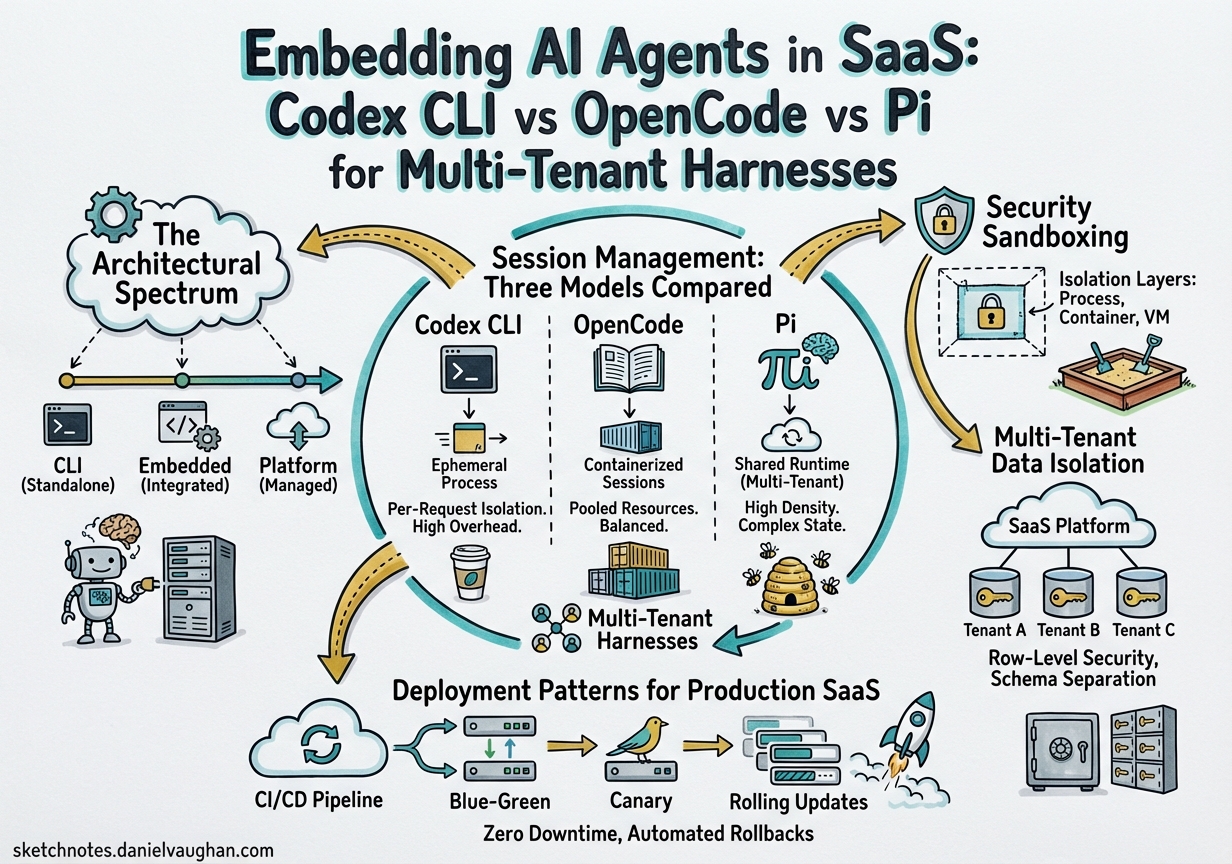
Embedding AI Agents in SaaS: Codex CLI vs OpenCode vs Pi for Multi-Tenant Harnesses
The conversation around AI coding agents has shifted decisively from “which agent is smartest” to “which agent can I embed in my product.” Kleinloog’s Q2 2026 landscape analysis of CLI-based agents1 frames the core question: if you’re building a multi-tenant SaaS that needs an embedded coding agent, which runtime architecture best fits your constraints?
This article compares the three most architecturally distinct candidates — OpenAI’s Codex CLI, Anomaly’s OpenCode, and OpenClaw’s Pi — across the dimensions that matter for production SaaS: orchestrability, session isolation, security sandboxing, and deployment flexibility.
The Architectural Spectrum
Each tool occupies a fundamentally different position on the embedding spectrum:
graph LR
    subgraph "Embedding Approaches"
        A["Codex CLI<br/>Rust Monolith<br/>JSON-RPC App Server"] -->|"subprocess or<br/>WebSocket"| D["Your SaaS"]
        B["OpenCode<br/>Go Binary<br/>HTTP/OpenAPI Server"] -->|"REST API<br/>+ SSE"| D
        C["Pi (OpenClaw)<br/>TypeScript SDK<br/>In-Process Import"] -->|"direct function<br/>call"| D
    end
- Codex CLI exposes a JSON-RPC app-server over stdio or WebSocket2. Your harness spawns or connects to a Codex process, communicates via bidirectional JSONL, and relies on OS-level sandboxing for isolation.
- OpenCode runs a headless HTTP server with a full OpenAPI 3.1 specification3. Clients interact via REST endpoints and server-sent events (SSE), with SQLite-backed session persistence4.
- Pi is designed for direct in-process embedding via
createAgentSession()5. No IPC, no HTTP — your application imports the SDK and drives the agent loop programmatically.
Session Management: Three Models Compared
Session management is where these architectures diverge most sharply for multi-tenant use cases.
Codex CLI: Thread-per-Tenant via App Server
The Codex app-server’s thread manager spins up one core session per thread2. For multi-tenant isolation, you set a per-tenant CODEX_HOME environment variable to segregate configuration and state directories6:
# Isolate tenant state via CODEX_HOME
CODEX_HOME=/data/tenants/acme codex --app-server
The Python SDK wraps both the codex exec JSONL path and the persistent app-server JSON-RPC path7, giving you two integration modes:
from codex_sdk import CodexAppServer

server = CodexAppServer(
    codex_home="/data/tenants/acme",
    model="o3"
)
response = await server.send_message("Refactor the auth module")
Session state lives on the filesystem as JSON, with the app-server managing lifecycle. This is robust but requires process-per-tenant or careful CODEX_HOME partitioning.
OpenCode: SQLite + HTTP = Stateless Orchestration
OpenCode’s opencode serve command starts a headless server on port 4096 by default3, exposing session CRUD, messaging, and file operations via REST:
opencode serve --port 4096 --hostname 0.0.0.0
The TypeScript SDK provides typed access to all operations8:
import { createOpencode } from "@opencode-ai/sdk";

const { client } = await createOpencode({ port: 4096 });
const session = await client.session.create({});
await client.session.message(session.id, {
  prompt: "Add rate limiting to the API gateway"
});
All sessions share a single SQLite database using WAL mode4, with session forking via Session.fork() that clones messages with new ULIDs whilst preserving parent relationships9. This is particularly powerful for multi-tenant SaaS: fork a base configuration session per tenant, then branch conversations independently.
The dual-layer storage architecture — SQLite for structured data, file-based storage for large blobs — keeps the database lean whilst handling large code contexts4.
Pi: Zero-IPC In-Memory Sessions
Pi eliminates the network boundary entirely. OpenClaw’s integration calls createAgentSession() directly5:
import { createAgentSession } from "pi-coding-agent";

const { session } = await createAgentSession({
  cwd: "/workspace/tenant-acme",
  model: "claude-sonnet-4-20250514",
  tools: tenantToolSet,
  customTools: [auditLogger, complianceChecker],
  sessionManager,
  settingsManager
});

await session.prompt("Implement the billing webhook handler", {
  images: screenshots
});
Events flow through subscribeEmbeddedPiSession(), dispatching message_start, message_update, message_end, and tool execution events without polling5. Sessions persist as JSONL files with tree structure, and auto-compaction triggers on context overflow10.
For edge deployment — Raspberry Pi, Mac mini appliances, containerised microservices — this zero-IPC architecture eliminates subprocess management overhead entirely11.
Security Sandboxing
Codex CLI: OS-Level Isolation
Codex CLI’s sandbox is its strongest differentiator for SaaS embedding. On Linux, it combines Landlock LSM for filesystem access control with seccomp-BPF for syscall filtering12. Since v0.115.0, the default Linux sandbox uses bubblewrap (bwrap) with a managed proxy that enables controlled network access whilst blocking Unix socket creation to prevent sandbox escape12.
graph TB
    subgraph "Codex Sandbox Architecture"
        A["Agent Command"] --> B["bubblewrap Container"]
        B --> C["Landlock: Write whitelist"]
        B --> D["seccomp: Syscall filter"]
        B --> E["Network Proxy: Allowlist"]
        C --> F["Tenant Workspace Only"]
        D --> G["No socket/socketpair"]
        E --> H["Approved Domains Only"]
    end
On macOS, Apple’s Seatbelt framework provides equivalent kernel-level restrictions12. This is genuine OS-level isolation without the overhead of full containerisation — critical when you need per-tenant sandboxing at scale.
OpenCode: Application-Level Trust
OpenCode relies on application-level controls rather than OS sandboxing. The server supports HTTP Basic authentication via OPENCODE_SERVER_PASSWORD3, and file operations are scoped to the project directory. However, there’s no Landlock-equivalent syscall filtering — the agent process has the same filesystem access as the user running it.
For multi-tenant SaaS, you’d need to layer your own containerisation (Docker, Firecracker) around each OpenCode instance, or run one server per tenant with appropriate OS-level isolation.
Pi: Inherited from Host
Pi inherits whatever isolation its host process provides. Since it runs in-process, sandboxing is your responsibility. OpenClaw manages this through custom tool injection per channel and auth profile rotation5, but filesystem and network isolation must come from the container or VM layer.
Multi-Tenant Data Isolation
| Dimension | Codex CLI | OpenCode | Pi (OpenClaw) |
|---|---|---|---|
| Session storage | JSON files per CODEX_HOME |
Shared SQLite (WAL mode) | JSONL files with tree structure |
| Tenant isolation | CODEX_HOME env var |
Session-level within shared DB | In-memory, per-instantiation |
| State forking | Not native | Session.fork() with ULID mapping |
Manual via SessionManager |
| Concurrent tenants | Process-per-tenant or env isolation | Single server, many sessions | Many AgentSession instances |
| Air-gap capable | Yes (local models via proxy) | Yes (local providers) | Yes (edge-optimised) |
| SDK language | Python, Elixir13 | TypeScript8 | TypeScript5 |
Deployment Patterns for Production SaaS
Pattern 1: Codex CLI as Managed Subprocess
Best for platforms requiring strict security boundaries per tenant. Spawn a Codex app-server per tenant with isolated CODEX_HOME, communicate via JSON-RPC over stdio, and rely on Landlock/seccomp for filesystem and syscall isolation.
Trade-offs: Higher memory footprint per tenant (~150-200 MB per process), but strongest isolation guarantees. The Rust monolith architecture means predictable resource usage without GC pauses14.
Pattern 2: OpenCode as Shared HTTP Service
Best for platforms where session isolation (not OS-level sandboxing) suffices. Run one or a few OpenCode servers behind a load balancer, use session IDs to partition tenant conversations, and leverage SQLite’s WAL mode for concurrent access.
Trade-offs: Lower per-tenant overhead, excellent session management primitives (forking, branching), but you own the sandboxing layer. The 139K GitHub stars and active community15 mean rapid issue resolution.
Pattern 3: Pi as Embedded Runtime
Best for edge deployments, desktop applications, or architectures where subprocess spawning is constrained (serverless, WebAssembly). Import the SDK, instantiate AgentSession per request, and handle lifecycle in-process.
Trade-offs: Lowest latency (no IPC overhead), most flexible tool injection, but you inherit all security responsibility. Ideal for scenarios where the host environment is already sandboxed11.
graph TD
    subgraph "Decision Tree"
        Q1{"Need OS-level<br/>sandbox?"} -->|Yes| CODEX["Codex CLI<br/>App Server"]
        Q1 -->|No| Q2{"Need HTTP<br/>API surface?"}
        Q2 -->|Yes| OC["OpenCode<br/>Headless Server"]
        Q2 -->|No| Q3{"Edge or<br/>in-process?"}
        Q3 -->|Yes| PI["Pi / OpenClaw<br/>Embedded SDK"]
        Q3 -->|No| OC
    end
Air-Gap Deployment
All three support air-gapped environments, but through different mechanisms:
- Codex CLI routes through its network proxy allowlist, supporting custom CA certificates via
SSL_CERT_FILEfor enterprise proxy chains14. - OpenCode supports local model providers natively — point it at an on-premises vLLM or Ollama instance and it works without internet access3.
- Pi/OpenClaw implements stale cache offline fallback, gracefully degrading when cloud providers are unreachable16. The embedded architecture means the orchestration layer runs entirely locally; only the LLM inference requires network access (or a local model).
Recommendations
Choose Codex CLI when your SaaS handles untrusted code execution and you need per-tenant security guarantees without managing containers. The Landlock/seccomp sandbox is production-hardened and the JSON-RPC protocol is designed for backward compatibility2.
Choose OpenCode when you need the richest session management primitives — forking, branching, concurrent access — and can provide your own containerisation layer. The OpenAPI surface makes it trivially integrable with any HTTP client in any language.
Choose Pi when you’re building for the edge, embedding in desktop apps, or operating in environments where subprocess spawning is impractical. The zero-IPC architecture delivers the lowest latency and most flexible tool injection, at the cost of inheriting all isolation responsibility.
The 2026 agent harness landscape17 has moved beyond “can we embed an agent?” to “which embedding architecture matches our operational constraints?” These three tools represent genuinely different answers to that question.
Citations
-
Kleinloog, “The Complete Landscape of CLI-Based AI Coding Agents,” Q2 2026. https://www.kleinloog.ch/articles/the-5-ai-coding-agents-worth-embedding-in-your-saas/the-complete-landscape-of-cli-based-ai-coding-agents.pdf ↩
-
OpenAI, “App Server – Codex CLI,” OpenAI Developers, 2026. https://developers.openai.com/codex/app-server ↩ ↩2 ↩3
-
OpenCode, “Server Documentation,” opencode.ai, 2026. https://opencode.ai/docs/server/ ↩ ↩2 ↩3 ↩4
-
DeepWiki, “Storage and Database – sst/opencode,” 2026. https://deepwiki.com/sst/opencode/2.9-storage-and-database ↩ ↩2 ↩3
-
OpenClaw, “Pi Integration Architecture,” docs.openclaw.ai, 2026. https://docs.openclaw.ai/pi ↩ ↩2 ↩3 ↩4 ↩5
-
InfoQ, “OpenAI Publishes Codex App Server Architecture for Unifying AI Agent Surfaces,” February 2026. https://www.infoq.com/news/2026/02/opanai-codex-app-server/ ↩
-
PyPI, “codex-sdk-python,” 2026. https://pypi.org/project/codex-sdk-python/ ↩
-
OpenCode, “SDK Documentation,” opencode.ai, 2026. https://opencode.ai/docs/sdk/ ↩ ↩2
-
BSWEN, “OpenCode CLI Features That Claude Code Doesn’t Have: Forking, Reverting, and Session Copying,” April 2026. https://docs.bswen.com/blog/2026-04-04-opencode-session-features/ ↩
-
Armin Ronacher, “Pi: The Minimal Agent Within OpenClaw,” lucumr.pocoo.org, January 2026. https://lucumr.pocoo.org/2026/1/31/pi/ ↩
-
Raspberry Pi, “Turn your Raspberry Pi into an AI agent with OpenClaw,” raspberrypi.com, 2026. https://www.raspberrypi.com/news/turn-your-raspberry-pi-into-an-ai-agent-with-openclaw/ ↩ ↩2
-
Pierce Freeman, “A deep dive on agent sandboxes,” pierce.dev, 2026. https://pierce.dev/notes/a-deep-dive-on-agent-sandboxes ↩ ↩2 ↩3
-
nshkrdotcom, “OpenAI Codex SDK written in Elixir,” GitHub, 2026. https://github.com/nshkrdotcom/codex_sdk ↩
-
Augment Code, “OpenAI Codex CLI ships v0.116.0 with enterprise features,” March 2026. https://www.augmentcode.com/learn/openai-codex-cli-enterprise ↩ ↩2
-
GitHub, “opencode-ai/opencode,” April 2026. https://github.com/opencode-ai/opencode ↩
-
OpenClaw Blog, “Beyond the Cloud: Running OpenClaw on Mac mini, Raspberry Pi, and Intel AI PCs,” 2026. https://openclaws.io/blog/openclaw-hardware-ecosystem-2026 ↩
-
Philipp Schmid, “The importance of Agent Harness in 2026,” philschmid.de, 2026. https://www.philschmid.de/agent-harness-2026 ↩