Sourcegraph Amp: The Multi-Repo AI Orchestrator Codex CLI Doesn't Compete With (Yet)
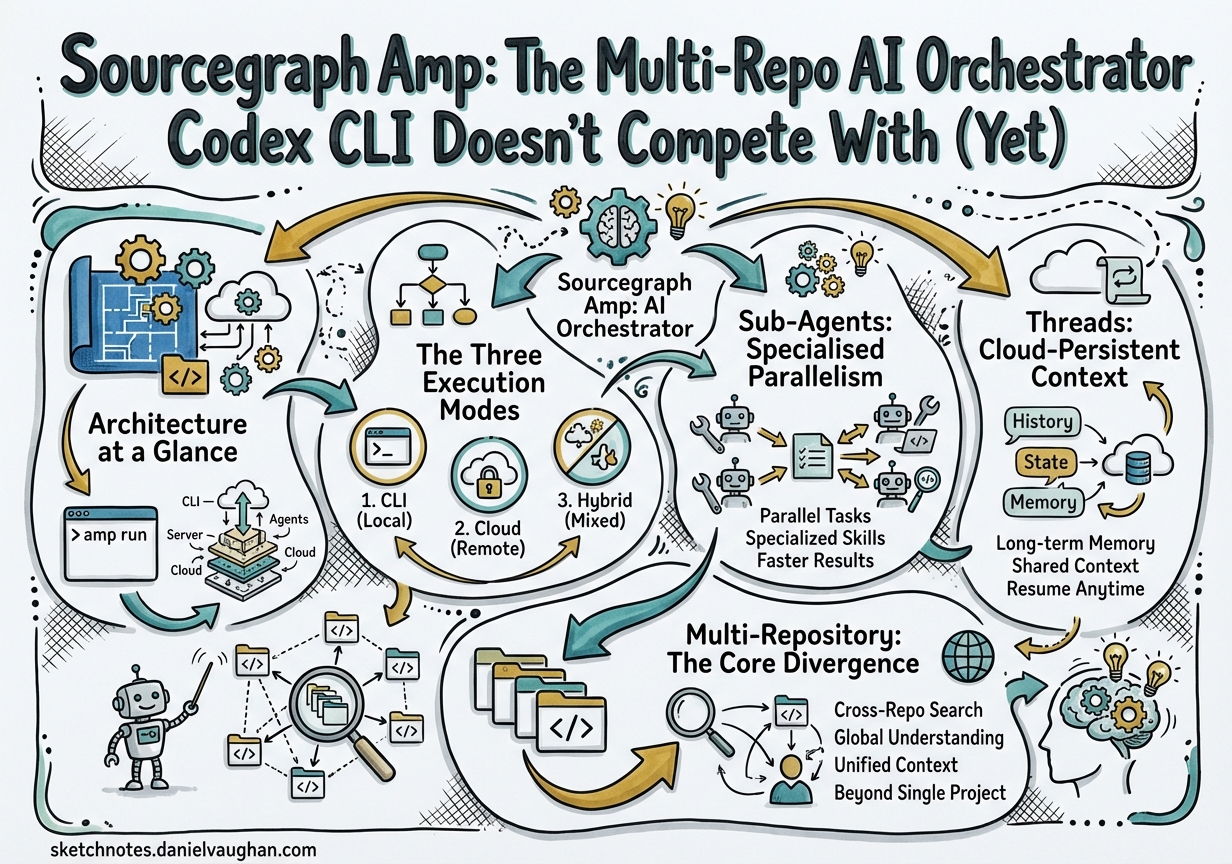
Sourcegraph Amp: The Multi-Repo AI Orchestrator Codex CLI Doesn’t Compete With (Yet)
In December 2025, Sourcegraph spun Amp out as a fully independent company, with co-founder Quinn Slack taking the CEO role at Amp Inc.1 Less than a year after its May 2025 launch, the tool had attracted enough traction — and enough differentiation from Sourcegraph’s code-search platform — to warrant its own entity backed by Craft, Redpoint, Sequoia, Goldcrest, and a16z1. The strategic rationale was stark: Sourcegraph is “mission-critical AI infrastructure” for enterprises; Amp needs to “remain on the frontier, exploring what’s possible with models and tools and agents”1.
What makes Amp interesting to Codex CLI practitioners is not that it’s a rival — it isn’t, architecturally — but that it has built several capabilities around multi-repository awareness, persistent cloud threads, and automatic model routing that Codex CLI is only beginning to approach via worktrees and sub-agents. This article dissects where Amp excels, where Codex CLI is stronger, and what each camp can learn from the other.
Architecture at a Glance
Amp is a TypeScript-based agent distributed as an npm package (@sourcegraph/amp)2 with first-class CLI and editor integrations (VS Code, Cursor, Windsurf, JetBrains, Neovim, Zed)3. Configuration follows a workspace-then-user hierarchy through .amp/settings.json files, with enterprise managed settings at system-level paths3.
Codex CLI, by contrast, is a Rust monolith with a Python SDK, using Landlock/Seatbelt/ACL sandboxing and a JSON-RPC app-server protocol4. Its configuration lives in ~/.codex/config.toml and project-level codex.toml.
graph TB
    subgraph Amp["Amp Architecture"]
        A1[CLI / Editor Plugin] --> A2[Main Agent<br/>Claude Opus 4.6]
        A2 --> A3[Oracle Sub-agent<br/>GPT-5.4]
        A2 --> A4[Librarian Sub-agent<br/>GitHub Code Search]
        A2 --> A5[Painter Tool<br/>Gemini 3 Pro]
        A2 --> A6[Course Correction Agent]
        A2 --> A7[Cloud Thread Store]
    end

    subgraph Codex["Codex CLI Architecture"]
        C1[CLI / App] --> C2[Main Agent<br/>o3 / o4-mini]
        C2 --> C3[Sub-agents<br/>Path-addressed]
        C2 --> C4[Worktrees<br/>Git Isolation]
        C2 --> C5[MCP Servers]
        C2 --> C6[Local Rollout<br/>JSONL]
    end
The Three Execution Modes
Amp routes work through three modes, each tuned for a different cost-latency-quality tradeoff3:
| Mode | Primary Model | Use Case |
|---|---|---|
| Smart | Claude Opus 4.6 (up to 300k input tokens) | Unconstrained state-of-the-art reasoning |
| Rush | Faster, cheaper models | Well-defined, small-scope tasks |
| Deep | GPT-5.4 with extended thinking (deep², deep³) | Complex multi-step architectural problems |
Switching between modes is a keystroke away (Ctrl+S or Ctrl+O command palette)3. A hidden large mode also exists for power users3.
Codex CLI offers a simpler model: you choose your model (o3, o4-mini, or a compatible provider) and your approval mode (suggest, auto-edit, full-auto). There’s no automatic model routing — you’re the router.
Sub-Agents: Specialised Parallelism
Amp’s sub-agent architecture is where it pulls ahead of most CLI agents. Three specialist agents run alongside the main Claude Opus 4.6 thread35:
Oracle — powered by GPT-5.4, handles architectural analysis, debugging guidance, and code review. The main agent can invoke Oracle autonomously when it detects a complex decision point, or you can explicitly request it (“ask the Oracle”)5.
Librarian — a code-search agent backed by Sourcegraph’s proprietary index. It can search and read files across all public GitHub repositories and, with OAuth configuration, your private repos3. This is Amp’s killer feature: cross-repository research without leaving your session.
Painter — uses Gemini 3 Pro Image for generating UI mockups, icons, and image editing, accepting up to three reference images via @-mentions3.
A Course Correction Agent monitors the main agent’s progress in parallel, validating adherence to the original plan and preventing task divergence5.
sequenceDiagram
    participant U as Developer
    participant M as Main Agent (Opus 4.6)
    participant O as Oracle (GPT-5.4)
    participant L as Librarian (Code Search)
    participant CC as Course Correction

    U->>M: "Refactor auth across services"
    M->>L: Search auth patterns in 3 repos
    M->>O: Review proposed architecture
    L-->>M: Code snippets from repos A, B, C
    O-->>M: Architecture recommendation
    CC-->>M: ✓ On track with original plan
    M->>U: Proposed refactoring with cross-repo context
Codex CLI’s sub-agents, by contrast, are general-purpose. Since early 2026, they use readable path-based addresses like /root/agent_a with structured inter-agent messaging6. But they share the same model, lack specialisation, and — critically — cannot search across repositories. Each sub-agent operates in isolation with its own context window6.
Threads: Cloud-Persistent Context
Amp’s thread system is architecturally distinct from anything in the Codex CLI ecosystem. Every conversation is a Thread that syncs to ampcode.com, with visibility controls ranging from private to public-searchable3. Threads record:
- All prompts and file modifications with diff statistics
- Tool usage metrics
- Execution metadata
- Model costs
The handoff command transitions work to a new focused thread while preserving context linkage3. Threads can be referenced by URL (https://ampcode.com/threads/T-{id}) or by ID (@T-{id}) within other sessions3. For teams, this means a senior developer can debug a colleague’s thread asynchronously — a workflow Codex CLI simply cannot replicate with its local JSONL rollouts.
Codex CLI’s thread model is fundamentally local. The Codex App introduced worktree-based threads where each thread gets an isolated Git worktree7, but session state doesn’t persist to the cloud or support team-wide sharing.
Multi-Repository: The Core Divergence
This is where the philosophical gap is widest.
Amp’s approach: The Librarian sub-agent provides seamless cross-repo code search and file reading without leaving the current session3. It leverages Sourcegraph’s code intelligence infrastructure — the same technology that powers enterprise-scale code search across thousands of repositories. You configure GitHub OAuth in settings, and the Librarian can search your entire organisation’s codebase3. Bitbucket Enterprise is also supported via personal access tokens3.
Codex CLI’s approach: Multi-repo support remains an open feature request (GitHub issue #11956)8. The current workaround is worktrees for parallel work within a single repo, or manually opening separate projects. The sub-agent v2 architecture provides path-based addressing and structured messaging6, but there’s no built-in mechanism for agents to search or read files from other repositories.
graph LR
    subgraph Amp["Amp: Native Multi-Repo"]
        A[Session] --> B[Repo A]
        A --> C[Repo B]
        A --> D[Repo C]
        A --> E[Public GitHub]
        B & C & D & E --> F[Librarian Index]
    end

    subgraph Codex["Codex CLI: Single-Repo + Worktrees"]
        G[Session] --> H[Main Worktree]
        G --> I[Worktree Branch A]
        G --> J[Worktree Branch B]
        K[Separate Session] --> L[Different Repo]
    end
AGENTS.md: Convergent Configuration
Both tools have converged on AGENTS.md as the repository-level instruction file, though Amp calls it out more explicitly. Amp searches for AGENTS.md, AGENT.md, or CLAUDE.md (as fallback) in the working directory and parent directories up to $HOME3. It supports YAML frontmatter with glob patterns for file-type-specific guidance:
---
globs:
  - '**/*.ts'
  - '**/*.tsx'
---
Follow these TypeScript conventions...
File @-mentions within AGENTS.md pull in additional context: See @doc/style.md and @specs/**/*.md3.
Codex CLI’s AGENTS.md support follows the same broad pattern, reinforcing the cross-platform convergence tracked by the agentskills.io initiative9.
Permission Models Compared
Amp’s permission system is notably granular. Rules use tool-name and argument matching with four action types: allow, reject, ask, and delegate3. The delegate action is unique — it consults an external programme via environment variables, enabling enterprise policy engines:
{
  "tool": "Bash",
  "matches": { "cmd": "*rm -rf*" },
  "action": "reject"
}
Codex CLI’s approval modes (suggest, auto-edit, full-auto) are coarser-grained but backed by OS-level sandboxing (Landlock on Linux, Seatbelt on macOS)4, which Amp lacks entirely.
Where Codex CLI Is Stronger
It would be a mistake to read this as a case for switching. Codex CLI retains significant advantages:
- OS-level sandboxing — Landlock/Seatbelt/ACL provides defence-in-depth that Amp’s permission rules cannot match4.
- Air-gap deployment — Codex CLI works offline with local models; Amp requires cloud connectivity for threads, Librarian, and model routing3.
- Open source — Apache 2.0 licence with full source visibility. Amp is proprietary1.
- Cost transparency — Codex CLI uses your own API keys with no platform markup. Amp claims “no markup” but enterprise pricing carries a 50% premium3.
- Deterministic execution — Single-model, single-agent simplicity makes Codex CLI sessions easier to reason about and debug.
Where Amp Excels
- Cross-repository intelligence — The Librarian’s ability to search and read across repositories is genuinely transformative for microservice architectures.
- Team collaboration — Cloud-persistent, shareable threads with visibility controls enable asynchronous code review workflows.
- Automatic model routing — Smart/Rush/Deep modes with specialised sub-agents (Oracle, Librarian, Painter) remove model-selection cognitive load.
- Streaming JSON output — The
--stream-jsonflag with stdin/stdout JSON messaging enables sophisticated CI/CD pipeline integration3. - Skills and Toolboxes — Amp’s skills system (SKILL.md with MCP bundles) and Toolboxes (simple scripts instead of full MCP servers) lower the extensibility barrier3.
What Codex CLI Could Learn
The gap most worth closing is multi-repo awareness. Codex CLI’s MCP architecture already provides the extension point — a dedicated MCP server wrapping Sourcegraph’s code search API (or a simpler git clone + index approach) could provide Librarian-like capabilities without architectural changes.
Cloud-persistent threads are a harder lift, requiring infrastructure Codex CLI deliberately avoids. But a middle ground — exporting session state to a shared store (S3, Git, or a team server) — would unlock the async collaboration patterns that make Amp’s threads valuable.
Automatic model routing is achievable today via wrapper scripts, but first-class support for “use model X for reasoning, model Y for code generation” would reduce the manual overhead that Codex CLI’s single-model approach demands.
The Strategic Picture
Amp and Codex CLI are not competing for the same users today. Amp targets teams that want managed, cloud-connected, multi-model orchestration with enterprise compliance. Codex CLI targets developers who want local-first, open-source, sandbox-hardened autonomy with full control over their model provider.
The convergence point is multi-repo orchestration. When Codex CLI ships native cross-repository support — and the open feature request suggests it’s a matter of when, not if8 — the comparison will shift from “different categories” to “different philosophies.” Until then, Amp occupies a capability niche that no open-source CLI agent has filled.
Citations
-
Sourcegraph Blog, “Why Sourcegraph and Amp Are Becoming Independent Companies,” December 2025. https://sourcegraph.com/blog/why-sourcegraph-and-amp-are-becoming-independent-companies ↩ ↩2 ↩3 ↩4
-
npm, “@sourcegraph/amp.” https://www.npmjs.com/package/@sourcegraph/amp ↩
-
Amp, “Owner’s Manual,” 2026. https://ampcode.com/manual ↩ ↩2 ↩3 ↩4 ↩5 ↩6 ↩7 ↩8 ↩9 ↩10 ↩11 ↩12 ↩13 ↩14 ↩15 ↩16 ↩17 ↩18 ↩19 ↩20 ↩21
-
OpenAI Developers, “Codex CLI.” https://developers.openai.com/codex/cli ↩ ↩2 ↩3
-
Amp, “Coding Agent Platform,” 2026. https://ampcode.com/ ↩ ↩2 ↩3
-
OpenAI Developers, “Codex Subagents.” https://developers.openai.com/codex/subagents ↩ ↩2 ↩3
-
OpenAI Developers, “Codex App Worktrees.” https://developers.openai.com/codex/app/worktrees ↩
-
GitHub, “Multi-repo support · Issue #11956 · openai/codex.” https://github.com/openai/codex/issues/11956 ↩ ↩2
-
agentskills.io, “Cross-Platform Agent Portability.” ⚠️ No direct URL confirmed; based on community reports of AGENTS.md convergence across tools. ↩