The Codex CLI Ecosystem Map: Navigating 245+ Community Tools, Skills and Subagents
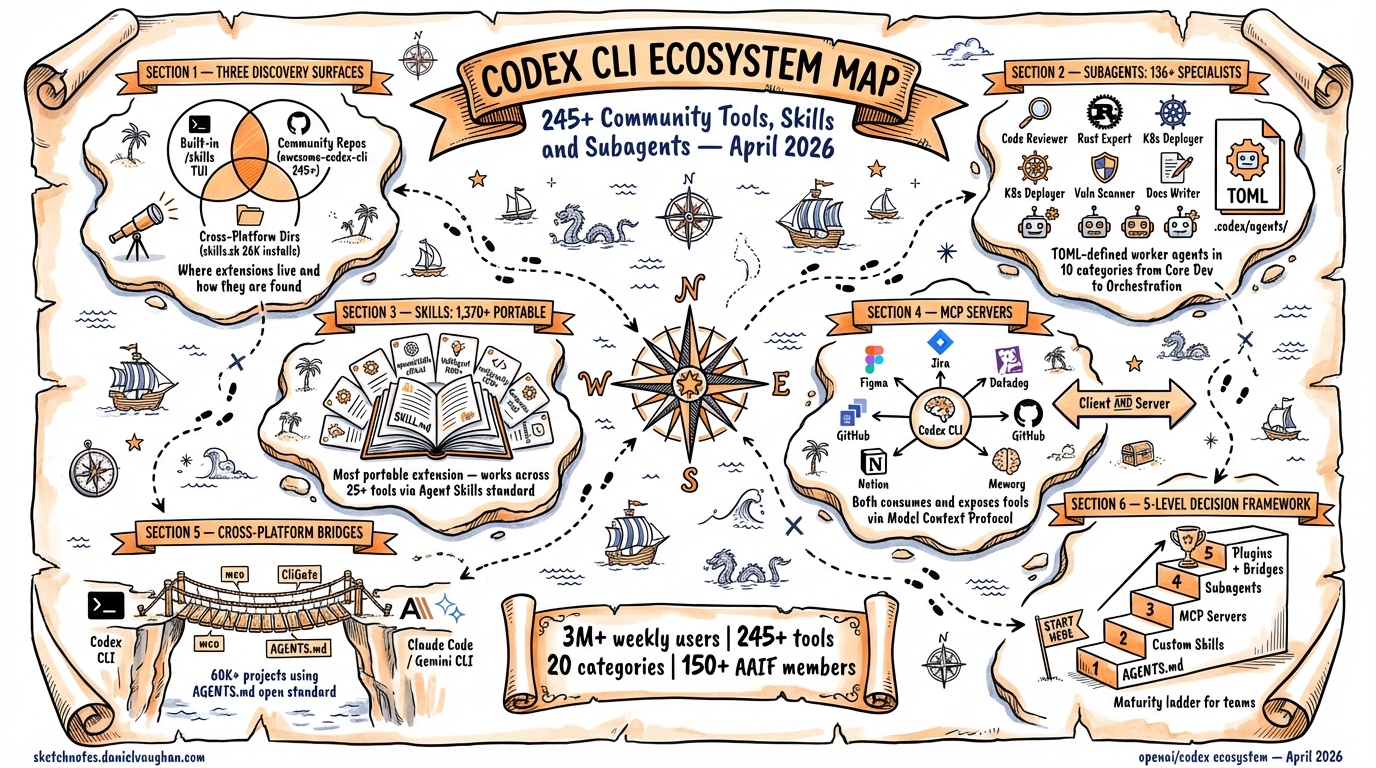
The Codex CLI Ecosystem Map: Navigating 245+ Community Tools, Skills and Subagents
Why This Matters
Twelve months ago, Codex CLI was a single binary with a handful of configuration options. Today, a curated list on the official OpenAI Codex GitHub Discussions page catalogues over 245 community-built tools across 20 categories — subagents, skills, plugins, MCP servers, IDE integrations, GUI wrappers, session managers and more1. The ecosystem has exploded, but discoverability remains the bottleneck. This article maps the landscape, highlights the most impactful tools in each category, and provides a decision framework for which layer to invest in first.
The Three Discovery Surfaces
Before diving into individual tools, it helps to understand where Codex CLI extensions live and how they are discovered.
graph TD
    A[Extension Discovery] --> B[Built-in]
    A --> C[Community Repos]
    A --> D[Cross-Platform Directories]

    B --> B1["openai/skills<br/>Official Skills Catalog"]
    B --> B2["/skills, /plugins<br/>TUI Commands"]
    B --> B3["developers.openai.com/codex/skills<br/>Docs"]

    C --> C1["RoggeOhta/awesome-codex-cli<br/>245+ tools"]
    C --> C2["VoltAgent/awesome-codex-subagents<br/>136+ agents"]
    C --> C3["ComposioHQ/awesome-codex-skills<br/>38 skills"]

    D --> D1["awesomeskills.dev<br/>Cross-Platform Atlas"]
    D --> D2["VoltAgent/awesome-agent-skills<br/>1,000+ skills"]
    D --> D3["skills.sh<br/>Vercel Package Manager"]
Built-in discovery uses the /skills and /plugins slash commands within the TUI, backed by OpenAI’s official openai/skills GitHub repository2. This is the curated, first-party surface — reliable but deliberately conservative.
Community repositories aggregate everything the official catalog does not include. The canonical hub is RoggeOhta’s awesome-codex-cli list, pinned in GitHub Discussion #16329 on the openai/codex repository1. It is actively maintained, with contributions from dozens of authors.
Cross-platform directories serve skills that work across Codex CLI, Claude Code, Gemini CLI, Cursor, GitHub Copilot, and other tools adopting the SKILL.md standard. The largest is VoltAgent’s awesome-agent-skills with over 1,000 entries3, alongside Vercel’s skills.sh CLI package manager which has accumulated over 26,000 installs since its January 2026 launch4.
Subagents: 136+ Specialist Workers
Subagents are TOML-defined worker agents that Codex spawns within a session. The community has produced an extraordinary number of pre-built subagent definitions.
VoltAgent/awesome-codex-subagents
The largest single collection, with 136+ agents organised into ten categories5:
| Category | Examples | Use Case |
|---|---|---|
| Core Dev | code-reviewer, test-writer, refactorer |
Daily coding workflows |
| Language Specialists | rust-expert, go-expert, python-expert |
Language-idiomatic patterns |
| Infrastructure | terraform-agent, k8s-deployer, docker-builder |
IaC and DevOps |
| Security | vuln-scanner, secret-detector, compliance-checker |
Security auditing |
| Data/AI | data-pipeline, ml-trainer, notebook-helper |
Data engineering and ML |
| DX | docs-writer, changelog-generator, onboarding-guide |
Developer experience |
| Domains | fintech-agent, healthcare-agent, edtech-agent |
Industry-specific patterns |
| Business | proposal-writer, metrics-dashboard |
Non-coding business tasks |
| Meta | agent-debugger, prompt-optimizer |
Agent self-improvement |
| Orchestration | dispatcher, wave-controller, fan-out-manager |
Multi-agent coordination |
To use any of these, drop the .toml file into .codex/agents/ in your project root and reference it in your session:
# .codex/agents/security-scanner.toml
[agent]
name = "security-scanner"
model = "gpt-5.4-mini"
instructions = "You are a security specialist. Scan for OWASP Top 10 vulnerabilities..."

[agent.sandbox]
mode = "read-only"
Enterprise and Specialised Packs
Beyond the VoltAgent mega-collection, several targeted packs stand out:
- betterup/codex-cli-subagents — enterprise-focused agents for code review, migration and compliance auditing1
- leonardsellem/codex-specialized-subagents — accessibility, internationalisation and performance profiling agents1
- waltstephen/ArgusBot — a 24/7 supervisor agent for autonomous task completion with watchdog monitoring1
- basilisk-labs/codex-swarm — swarm intelligence patterns for large-scale refactoring operations1
Multi-Agent Orchestrators
The orchestration layer above subagents has also matured:
- ComposioHQ/agent-orchestrator — plans tasks, spawns agents, and handles CI failures autonomously1
- mco-org/mco — a neutral orchestration layer supporting Codex CLI, Claude Code, Gemini CLI, OpenCode and Qwen Code simultaneously1
- hcom (aannoo) — hierarchical communication framework with context preservation across agent boundaries1
Skills: From 38 to 1,370+
Skills are the most portable extension mechanism in Codex CLI — a SKILL.md file with YAML frontmatter and natural-language instructions2. Unlike subagents (which are Codex-specific TOML), skills follow the open Agent Skills standard adopted by over 25 tools under the Linux Foundation’s Agentic AI Foundation6.
Key Skill Collections
| Collection | Scale | Differentiator |
|---|---|---|
openai/skills |
Official catalog | Curated, first-party quality |
ComposioHQ/awesome-codex-skills |
38 skills | SaaS integration via Composio (Slack, GitHub, Notion, 1,000+ apps)7 |
VoltAgent/awesome-agent-skills |
1,000+ skills | Largest cross-platform directory3 |
sickn33/antigravity-awesome-skills |
1,370+ skills | Includes CLI installer and bundle system1 |
huggingface/upskill |
ML/AI focus | Official Hugging Face workflow pack1 |
affaan-m/everything-claude-code |
147 skills + 36 agents | Performance-optimised system1 |
Noteworthy Specialist Skills
Several specialist skills deserve attention for their depth:
- Understand-Anything (Lum1104) — converts entire codebases into interactive knowledge graphs, useful for onboarding to unfamiliar projects1
- ARIS (wanshuiyin) — autonomous ML research that runs while you sleep, with cross-model review built in1
- bug-hunter (codexstar69) — adversarial AI security scanner with automatic fix generation via multi-agent pipeline1
- ctf-skills (ljagiello) — capture-the-flag challenge skills covering web exploitation, binary analysis, cryptography, reverse engineering and OSINT1
- Skywork-Skills (SkyworkAI) — AI office suite covering presentations, documents, spreadsheets, image generation and music1
Installing Skills
Skills can be installed globally or per-project:
# Global installation (available in all sessions)
mkdir -p ~/.codex/skills/my-skill
cp SKILL.md ~/.codex/skills/my-skill/

# Project-local installation (committed to repo)
mkdir -p .agents/skills/my-skill
cp SKILL.md .agents/skills/my-skill/

# Via Vercel's skills.sh package manager
npx skills add composiohq/awesome-codex-skills
Plugins: Bundling Skills, MCP and Apps
Plugins are the highest-level extension unit — a bundle of skills, MCP server configurations and app connectors packaged for distribution8. The plugin system became first-class in v0.117.0 (March 2026), and the ecosystem is still young compared to skills and subagents.
Key plugin resources:
- codex-plugin-cc — cross-model code review delegation between Codex and Claude Code1
- claude-review-loop — automated Stop Hook plugin that triggers cross-model review after every Codex session1
- $plugin-creator — the built-in scaffolding skill for generating new plugin directory structures8
MCP Servers: Both Client and Server
Codex CLI acts as both an MCP client (consuming external tool servers) and an MCP server (exposing its agent capabilities to other tools)9. The community has built MCP servers for virtually every major developer service.
graph LR
    subgraph "Codex as MCP Client"
        C[Codex CLI] --> M1[Figma MCP]
        C --> M2[Jira/Atlassian MCP]
        C --> M3[Datadog MCP]
        C --> M4[GitHub MCP]
        C --> M5[Notion MCP]
        C --> M6[Memory MCP Servers]
    end

    subgraph "Codex as MCP Server"
        O1[Claude Code] --> S[codex mcp-server]
        O2[Agents SDK] --> S
        O3[Custom Harness] --> S
    end
The MCP server landscape is extensively documented in the official docs9, but community contributions worth noting include:
- AgentMemory — 41 MCP tools with triple-stream retrieval (BM25 + vector + knowledge graph)1
- codebase-memory-mcp — Tree-Sitter AST-based code understanding across 66 languages1
- codex-mcp-code-review (Szpadel) — clean-context review subagent pattern via MCP1
Cross-Platform Bridges
One of the most active ecosystem niches is tools that bridge between Codex CLI and competing agents:
- shinpr/sub-agents-skills — route tasks to Codex, Claude Code, Cursor or Gemini from any compatible tool10
- mco — neutral orchestration layer across five CLI agents1
- CliGate — local gateway proxy unifying authentication and billing across Codex CLI, Claude Code and Gemini CLI1
The cross-platform story is strengthened by the AGENTS.md open standard, now adopted by over 60,000 projects under the Agentic AI Foundation (AAIF)6. A single AGENTS.md file works across Codex CLI, Claude Code (via symlink workaround), Gemini CLI, Cursor, Copilot, Amp and dozens more.
IDE and GUI Integrations
Beyond the terminal, the community has built graphical interfaces:
- Nimbalyst — macOS GUI for managing parallel Codex sessions with git worktree isolation1
- CC Pocket — iOS app for remote session management via WebSocket bridge1
- cmux — Ghostty-based terminal with agent notification system and PR-aware tabs1
- codex-replay — HTML visualiser for JSONL session rollout files1
The Decision Framework: Where to Invest First
With 245+ tools available, the natural question is: where do you start? Here is a decision framework based on team maturity with Codex CLI.
flowchart TD
    START[New to Codex CLI?] -->|Yes| L1[Level 1: AGENTS.md + Official Skills]
    START -->|No| Q1{Pain point?}

    Q1 -->|Repetitive tasks| L2[Level 2: Custom Skills]
    Q1 -->|Need external data| L3[Level 3: MCP Servers]
    Q1 -->|Complex workflows| L4[Level 4: Subagents]
    Q1 -->|Cross-tool teams| L5[Level 5: Plugins + Bridges]

    L1 -->|"Start here"| A1["Write AGENTS.md<br/>Browse openai/skills<br/>Use /skills in TUI"]
    L2 --> A2["Write SKILL.md files<br/>Install via skills.sh<br/>Browse awesomeskills.dev"]
    L3 --> A3["Configure config.toml<br/>[mcp_servers] section<br/>Add Figma, Jira, Datadog"]
    L4 --> A4["Create .codex/agents/*.toml<br/>Browse VoltAgent collection<br/>Start with 2-3 agents"]
    L5 --> A5["Evaluate CliGate, mco<br/>Build plugin bundles<br/>Use AGENTS.md as shared base"]
Level 1: AGENTS.md and official skills
If you are just getting started, write an AGENTS.md file for your project and browse the official openai/skills catalog. This costs nothing and delivers immediate productivity gains.
Level 2: Custom skills
When you find yourself repeating the same instructions across sessions, extract them into a SKILL.md. Check awesomeskills.dev and skills.sh before writing from scratch — someone has likely solved your problem already4.
Level 3: MCP servers
When your agent needs external data (Jira tickets, Figma designs, Datadog metrics, documentation), add MCP servers to your config.toml. Each server adds roughly 3–4K tokens of schema overhead to your context window9, so be selective.
Level 4: Subagents
For complex workflows requiring parallel execution or specialist knowledge, define subagent TOML files. The VoltAgent collection provides battle-tested starting points5. Start with two or three agents before scaling to larger swarms.
Level 5: Plugins and cross-tool bridges
For teams running multiple AI coding tools (Codex + Claude Code is the most common pairing), invest in plugins and bridges that unify configuration and enable cross-model review loops.
Ecosystem Health Metrics
The Codex CLI ecosystem shows strong vital signs as of April 2026:
- 245+ tools catalogued across 20 categories1
- 1,370+ cross-platform skills available via community installers1
- 136+ pre-built subagents in the largest single collection5
- 3M+ weekly active Codex CLI users as of 8 April 202611
- 150+ members of the Agentic AI Foundation backing the AGENTS.md standard6
The ecosystem’s growth rate — from a handful of tools in Q4 2025 to 245+ in Q1 2026 — mirrors the trajectory that npm saw in its early years. The key difference is that agent skills are inherently more portable: a well-written SKILL.md works across Codex, Claude Code, Gemini CLI and a dozen other tools without modification6.
What to Watch
Three trends are shaping the ecosystem’s near-term direction:
-
Consolidation around
skills.sh— Vercel’s package manager is becoming the de facto distribution channel, and its install counts increasingly influence which skills gain traction4. -
Cross-model orchestration — Tools like mco and CliGate that abstract across multiple AI coding agents are gaining adoption as teams realise no single tool wins at everything1.
-
Enterprise plugin registries — The plugin system’s
marketplace.jsonformat supports private, organisation-scoped registries8. Enterprise teams are beginning to build internal plugin directories that bundle approved skills, MCP configurations and subagent definitions for their specific technology stacks.
Citations
-
RoggeOhta, “Awesome Codex CLI — curated list of 150+ ecosystem tools”, GitHub Discussion #16329, openai/codex, April 2026. https://github.com/openai/codex/discussions/16329 ↩ ↩2 ↩3 ↩4 ↩5 ↩6 ↩7 ↩8 ↩9 ↩10 ↩11 ↩12 ↩13 ↩14 ↩15 ↩16 ↩17 ↩18 ↩19 ↩20 ↩21 ↩22 ↩23 ↩24 ↩25 ↩26 ↩27 ↩28 ↩29 ↩30 ↩31
-
OpenAI, “Agent Skills – Codex”, developers.openai.com, 2026. https://developers.openai.com/codex/skills ↩ ↩2
-
VoltAgent, “awesome-agent-skills: 1,000+ agent skills from official dev teams and the community”, GitHub, 2026. https://github.com/VoltAgent/awesome-agent-skills ↩ ↩2
-
awesomeskills.dev, “Awesome Agent Skills — Claude Code, Codex & Cursor Skill Directory”, 2026. https://www.awesomeskills.dev/en ↩ ↩2 ↩3
-
VoltAgent, “awesome-codex-subagents: 130+ specialized Codex subagents”, GitHub, 2026. https://github.com/VoltAgent/awesome-codex-subagents ↩ ↩2 ↩3
-
Agentic AI Foundation (AAIF), “AGENTS.md Open Standard”, Linux Foundation, 2025-2026. https://github.com/agentsmd/agents.md ↩ ↩2 ↩3 ↩4
-
ComposioHQ, “awesome-codex-skills: practical Codex skills for automating workflows”, GitHub, 2026. https://github.com/ComposioHQ/awesome-codex-skills ↩
-
OpenAI, “Plugins – Codex CLI”, developers.openai.com, 2026. https://developers.openai.com/codex/plugins ↩ ↩2 ↩3
-
OpenAI, “Model Context Protocol – Codex”, developers.openai.com, 2026. https://developers.openai.com/codex/mcp ↩ ↩2 ↩3
-
shinpr, “sub-agents-skills: Cross-LLM sub-agent orchestration as Agent Skills”, GitHub, 2026. https://github.com/shinpr/sub-agents-skills ↩
-
Sam Altman, “Codex crosses 3M weekly active users”, OpenAI announcement, 8 April 2026. https://openai.com/index/introducing-upgrades-to-codex/ ↩