The codex-core Crate Extraction: How v0.119.0 Modularised the Rust Heart of Codex CLI
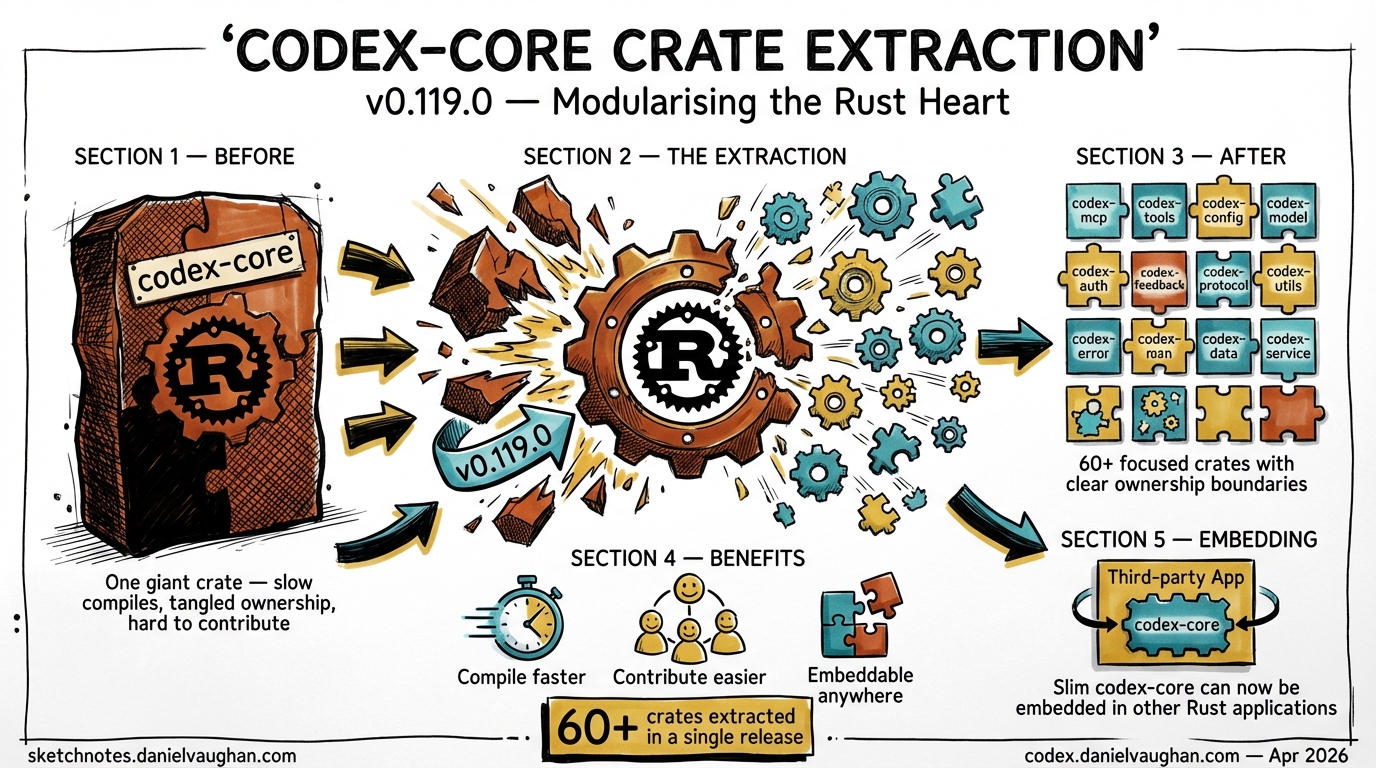
The codex-core Crate Extraction: How v0.119.0 Modularised the Rust Heart of Codex CLI
Why This Matters
When OpenAI released Codex CLI v0.119.0 on 10 April 2026, the headline features were WebRTC voice sessions, expanded MCP Apps support, and the experimental codex exec-server subcommand1. Buried in the release notes, however, was a line that matters far more to anyone building on Codex CLI’s internals:
codex-core was slimmed down through major crate extractions for MCP, tools, config, model management, auth, feedback, protocol, and related ownership boundaries.1
This single sentence describes the most significant architectural refactoring since the original TypeScript-to-Rust rewrite2. It transforms codex-core from a monolithic library containing all business logic into a thin orchestration layer that delegates to purpose-built crates. For contributors, embedding teams, and anyone running custom harnesses, the implications are substantial.
The Problem: A Growing Monolith
The codex-rs workspace started as roughly 70 crates when the Rust rewrite shipped in late 20252. The core crate — codex-core — handled session management, model interaction, tool execution, configuration parsing, MCP coordination, authentication, feedback collection, and protocol serialisation. It was, by design, the heart of the system: every UI surface (TUI, exec, app-server) depended on it3.
This architecture had two consequences:
-
Compile time bloat. Any change to
codex-coretriggered a full rebuild of everything downstream. With the crate pulling in MCP client libraries, authentication flows, and model provider logic, incremental builds became painfully slow. -
Coupling. Teams building custom integrations via the Python SDK or TypeScript SDK had to accept all of
codex-core’s transitive dependencies even when they only needed, say, the tool schema parser or the configuration resolver.
graph TD
    A[codex-tui] --> C[codex-core<br/>monolithic]
    B[codex-exec] --> C
    D[codex-app-server] --> C
    C --> E[codex-protocol]
    C --> F[codex-apply-patch]
    C --> G[codex-execpolicy]
    style C fill:#f96,stroke:#333,stroke-width:2px
The Extraction: What Moved Where
The v0.119.0 extraction was executed across five primary pull requests (#15919, #16379, #16508, #16523, #16962)1 plus supporting changes like the features split (#15253)4 and the MCP schema adapter extraction (#15928)5. The workspace now contains approximately 90 member crates3, up from around 69 in early March 20266.
Here is the mapping of extracted domains to their new crates:
| Domain | New Crate | What Moved |
|---|---|---|
| Feature flags | codex-features |
Feature system, unstable-feature warnings, config resolution4 |
| Tool schemas | codex-tools |
MCP schema adapters (ParsedMcpTool, parse_mcp_tool()), shared tool input model5 |
| Configuration | codex-config |
TOML parsing, layer merging, precedence resolution3 |
| Authentication | codex-auth |
OAuth PKCE, device-code flow, API key handling, credential store1 |
| Model management | codex-model |
Provider routing, model selection, reasoning effort config1 |
| MCP coordination | codex-mcp |
MCP client lifecycle, server startup, resource reads, tool-call metadata1 |
| Feedback | codex-feedback |
User feedback collection, /feedback command backend1 |
| Protocol | codex-protocol |
Agent instructions, system templates, wire format types3 |
After extraction, codex-core retains the orchestration spine: ThreadManager, CodexThread, the submission/event queue protocol (the Op/EventMsg pattern), and the top-level session lifecycle3. Everything else is imported as a dependency.
graph TD
    A[codex-tui] --> C[codex-core<br/>orchestration]
    B[codex-exec] --> C
    D[codex-app-server] --> C
    C --> E[codex-protocol]
    C --> F[codex-tools]
    C --> G[codex-config]
    C --> H[codex-auth]
    C --> I[codex-model]
    C --> J[codex-mcp]
    C --> K[codex-features]
    C --> L[codex-feedback]
    style C fill:#6b9,stroke:#333,stroke-width:2px
The Compile Time Dividend
The crate extraction was paired with two targeted compile-time optimisations in PRs #16630 and #166311. These replaced the async-trait crate’s macro expansion on the ToolHandler and SessionTask hot paths with native async trait implementations — a pattern now viable since Rust stabilised async fn in traits in version 1.757.
The async-trait crate works by transforming every async method into a Pin<Box<dyn Future + Send + 'async_trait>> return type8. For traits invoked on every tool call and every session task, this generated substantial macro expansion that the compiler had to process on every rebuild.
The combined effect:
| PR | Target | Build Time Reduction |
|---|---|---|
| #16630 | ToolHandler native async |
63%1 |
| #16631 | SessionTask native async |
48%1 |
These numbers apply to codex-core specifically. Because the crate extraction simultaneously reduced codex-core’s surface area, downstream crates that previously depended on codex-core for a single feature now compile against a smaller, faster dependency.
The Rust CI guardrails were also tightened: new crate features are blocked by default, and routine --all-features test runs were dropped to prevent feature-flag explosion from reintroducing the combinatorial build overhead1.
What This Means for Embedding Teams
If you are building a custom harness using the Codex Python SDK (codex_app_server) or the TypeScript SDK (@openai/codex-sdk), the crate extraction does not change your API surface — both SDKs communicate via JSON-RPC and are insulated from internal crate boundaries9.
However, if you are embedding Codex at the Rust level — linking codex-core directly, or forking the workspace to build a custom agent loop — the modular structure offers new options:
-
Selective dependency. Need only the tool schema parser for an MCP bridge? Depend on
codex-toolswithout pulling in auth, feedback, or model routing. -
Independent versioning. As the workspace matures, extracted crates can stabilise their APIs independently. A stable
codex-configAPI, for example, would let configuration tooling (like Ruler or caliber10) integrate without trackingcodex-corechurn. -
Contribution isolation. A PR touching only
codex-authno longer triggers a fullcodex-corerebuild in CI, reducing feedback loop time for contributors.
The Broader Pattern: Modular Agent Architectures
The codex-rs crate extraction mirrors a broader trend across the 2026 agentic coding landscape. Claude Code’s 512K-line TypeScript monolith11 stands at the opposite end of the spectrum — a single-package architecture where query-engine.ts owns the entire agent loop12. OpenCode (120K+ stars) took the Go approach with a client/server split and SQLite session forking13. Goose by Block uses a Rust/TypeScript hybrid (58%/34%)14.
Codex CLI’s direction is clear: decompose the monolith into domain crates with well-defined boundaries, then expose those boundaries as stable interfaces. This is the Cargo workspace pattern at its most disciplined — and it is how you build a platform that others can extend without forking.
Practical Implications
For most Codex CLI users, the v0.119.0 crate extraction is invisible. Your config.toml does not change. Your AGENTS.md files work exactly as before. Your MCP servers connect the same way.
What you will notice:
- Faster updates. Smaller crates mean smaller diffs per release, which means
npm install -g @openai/codex@latestpulls fewer changed binaries. - Better error messages. Domain-specific crates can provide domain-specific diagnostics. Auth failures come from
codex-authwith auth-specific context, not from a genericcodex-coreerror path. - Faster CI. If you run Codex CLI in GitHub Actions via
openai/codex-action, the 48–63% compile-time reduction incodex-corepropagates to faster action startup when building from source.
Looking Ahead
The extraction is not complete. The v0.119.0 release notes reference “related ownership boundaries” as an ongoing concern1. ResponsesApiTool assembly still lives in codex-core5, and the sandboxing subsystem (codex-linux-sandbox, codex-process-hardening) remains a separate cluster that could benefit from tighter integration with the extracted codex-config crate for sandbox mode resolution.
⚠️ The workspace is not yet publishing individual crates to crates.io — all 90 crates are workspace-internal. Whether OpenAI will publish stable Rust crate APIs remains an open question. For now, the extraction serves internal build performance and contributor experience.
The trajectory is clear, though. A modular codex-rs is a prerequisite for a genuinely extensible Codex platform — one where third-party tools can link against codex-tools or codex-config without adopting the entire agent runtime. Whether that happens in v0.120 or v0.130, the architectural foundation is now in place.
Citations
-
OpenAI, “Codex CLI v0.119.0 Release Notes,” GitHub Releases, 10 April 2026. https://github.com/openai/codex/releases ↩ ↩2 ↩3 ↩4 ↩5 ↩6 ↩7 ↩8 ↩9 ↩10 ↩11 ↩12
-
OpenAI, “Codex CLI: Lightweight coding agent that runs in your terminal,” GitHub Repository. https://github.com/openai/codex ↩ ↩2
-
DeepWiki, “openai/codex Architecture Overview,” April 2026. https://deepwiki.com/openai/codex ↩ ↩2 ↩3 ↩4 ↩5
-
Ahmed Ibrahim, “Split features into codex-features crate,” PR #15253, merged 20 March 2026. https://github.com/openai/codex/pull/15253 ↩ ↩2
-
Michael Bolin, “codex-tools: extract MCP schema adapters,” PR #15928, merged 27 March 2026. https://github.com/openai/codex/pull/15928 ↩ ↩2 ↩3
-
Mintlify, “Rust Workspace Structure — Codex CLI,” 2026. https://mintlify.wiki/openai/codex/architecture/rust-crates ↩
-
Rust Blog, “Stabilizing async fn in traits,” May 2023. https://blog.rust-lang.org/inside-rust/2023/05/03/stabilizing-async-fn-in-trait.html ↩
-
David Tolnay, “async-trait: Type erasure for async trait methods,” GitHub. https://github.com/dtolnay/async-trait ↩
-
OpenAI, “Codex CLI Features,” OpenAI Developers. https://developers.openai.com/codex/cli/features ↩
-
OpenAI, “Codex Changelog,” OpenAI Developers. https://developers.openai.com/codex/changelog ↩
-
ForrestKnight, “Claude Code Open Source Analysis,” YouTube, 2026. Referenced in community discussion. ↩
-
ForrestKnight, “query-engine.ts walkthrough,” YouTube, 2026. Referenced in community discussion. ↩
-
SST/terminal.shop, “OpenCode,” GitHub, 2026. Referenced in competitive analysis. ↩
-
Block, “Goose Agent,” GitHub, 2026. Referenced in competitive analysis. ↩