The Code Agent Orchestra — Key Insights from Addy Osmani
The Code Agent Orchestra — Key Insights from Addy Osmani
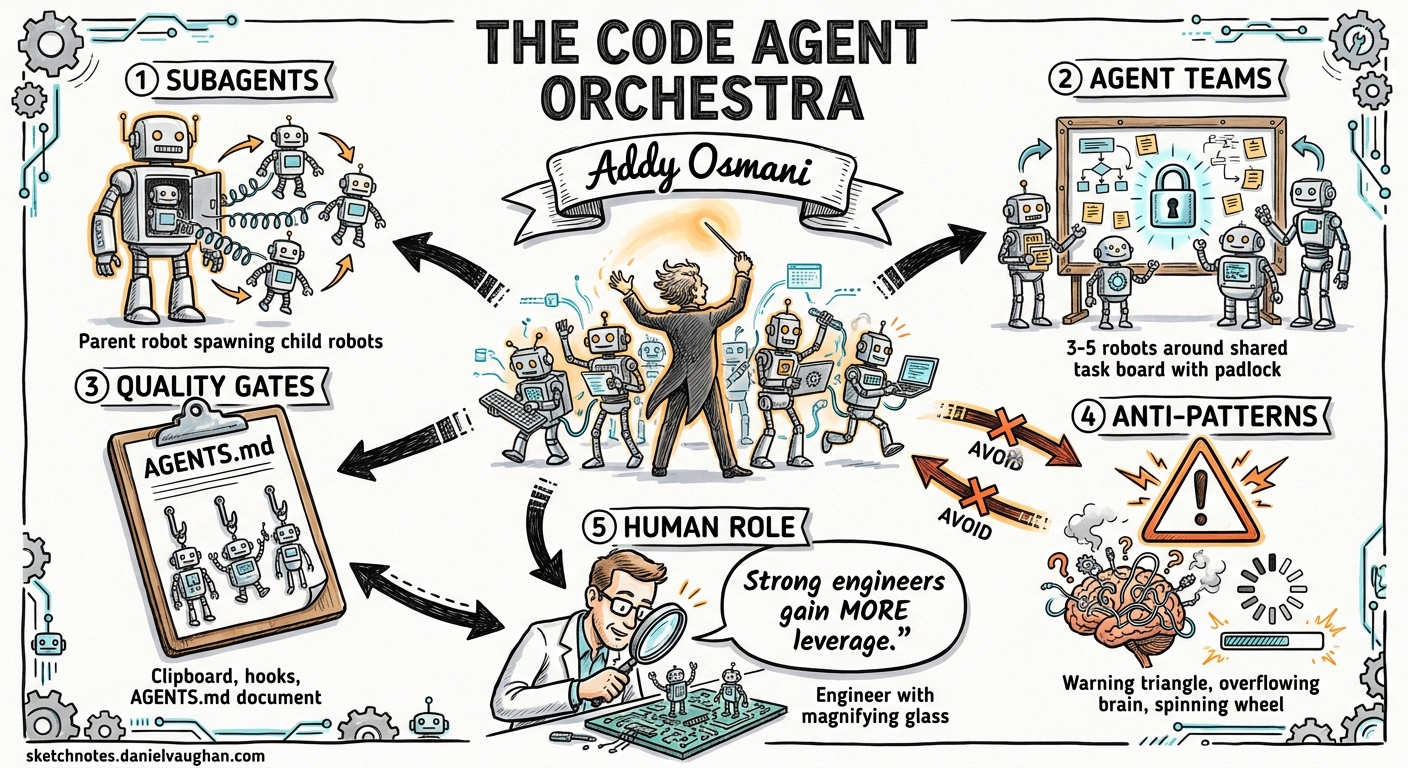
Source: https://addyosmani.com/blog/code-agent-orchestra/ Captured: 2026-05-14
Summary
Addy Osmani’s deep analysis of what makes multi-agent coding work. Essential reading for anyone building agentic pods.
Core Patterns
1. Subagents (Task Decomposition)
Parent orchestrator spawns focused child agents with specific briefs and file ownership. Good for simple decomposition.
2. Agent Teams (True Parallelism)
- Shared task list with dependency tracking
- Peer-to-peer messaging between teammates
- File locking to prevent conflicts
- Optimal team size: 3-5 agents
3. Hierarchical Delegation
Feature leads spawn their own specialists — 3x deeper decomposition without exploding context windows.
Critical Quality Gates
- Plan Approval — require written plans before implementation. Cheaper to catch architecture bugs before code exists.
- Hooks — automated checks on lifecycle events (tests, linting) that block progression
- AGENTS.md — human-curated institutional memory. LLM-generated AGENTS.md files offer no benefit and can reduce success rates.
Anti-Patterns
- Context Overload — single agents lose important details as conversations grow
- Unbounded Loops — set
MAX_ITERATIONS=8with forced reflection steps - Verification Neglect — generation is easy; verification is the bottleneck
Architecture Rules
- One File, One Owner — never let two agents edit the same file. Git worktrees for isolation.
- Multi-Model Routing — planning to cheap models, implementation to mid-tier, review to specialised
- Self-Improving Sessions — each session reads AGENTS.md; approved learnings merge back
The Human Role
“Strong engineers gain more leverage from these tools, not less.”
Keep for yourself: architecture/API design, deciding what NOT to build, reviewing agent output with full system context. Spec quality directly multiplies across the entire fleet — vague requirements propagate across parallel runs, each failing differently.