Multi-Agent Orchestration Patterns for Codex CLI
Multi-Agent Orchestration Patterns for Codex CLI
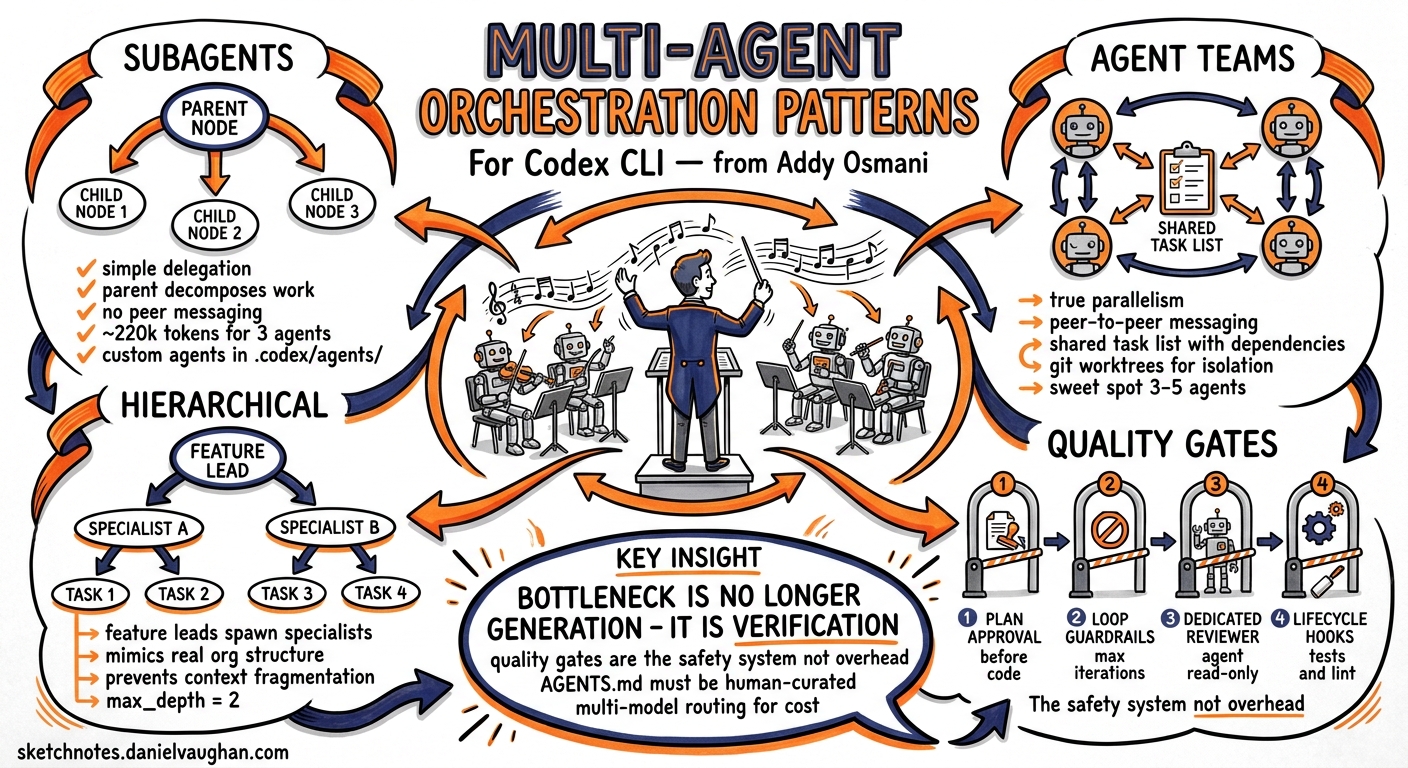
Published: 2026-05-18 Source: Addy Osmani — “The Code Agent Orchestra” (https://addyosmani.com/blog/code-agent-orchestra/)
Summary
A synthesis of Addy Osmani’s analysis of what makes multi-agent coding work, mapped to Codex CLI capabilities.
Three Coordination Patterns
1. Subagents (Simple Delegation)
- Parent decomposes work, spawns focused children with specific briefs
- No peer messaging — parent collects all results
- Codex CLI native: use custom agents in
~/.codex/agents/or.codex/agents/ - Cost: ~220k tokens for a three-agent task
2. Agent Teams (True Parallelism)
- Shared task list with dependency tracking
- Peer-to-peer messaging between teammates
- Sweet spot: 3-5 agents; costs scale linearly
- In Codex: combine subagents with git worktrees for isolation
3. Hierarchical Subagents
- Feature leads spawn their own specialists
- Mimics real org structure — prevents context fragmentation
- Codex: set
max_depth = 2(carefully) to allow one level of sub-delegation
Four Essential Quality Gates
- Plan approval — agents write implementation plans before coding; review before code exists
- Loop guardrails — set max iterations with forced reflection on failure
- Dedicated reviewer agent — read-only tools, lint/test only, auto-triggered on task completion
- Lifecycle hooks — automated checks: tests must pass, linting before merge
Key Insight: The Bottleneck Shifted
“The bottleneck is no longer generation. It’s verification.”
Agents produce impressive output at speed, but human confidence in correctness is the hard constraint. Quality gates aren’t overhead — they’re the safety system.
Practical Recommendations
AGENTS.md Discipline
- Human-curated only (LLM-generated versions show ~3% performance degradation)
- Document: style, gotchas, architecture decisions, test strategies
- Acts as institutional memory across sessions
Multi-Model Routing
- Planning/architecture → cheaper models (GPT-5.4 mini)
- Implementation → GPT-5-codex
- Review → specialised reviewer agent with strict instructions
The Factory Model
- View as a pipeline: Plan → Spawn → Monitor → Verify → Integrate → Retro
- WIP limits: 3-5 concurrent agents
- Kill criteria: stuck after 3+ iterations
- Granular commits on feature branches
Mapping to Codex CLI
| Osmani’s Pattern | Codex CLI Implementation |
|---|---|
| Subagents | Custom agent TOML files + spawn_agents_on_csv |
| Agent teams | Multiple subagents + git worktrees |
| Hierarchical | max_depth = 2 with feature-lead agents |
| Plan approval | Architect agent reviews before worker agents start |
| Reviewer agent | sandbox_mode = "read-only" custom agent |
| Lifecycle hooks | /hooks configuration in config.toml |
| Multi-model routing | Per-agent model override in TOML |