Codex CLI: State of Play — May 2026
Codex CLI: State of Play — May 2026
Date: 2026-05-23
Where Codex CLI Stands Today
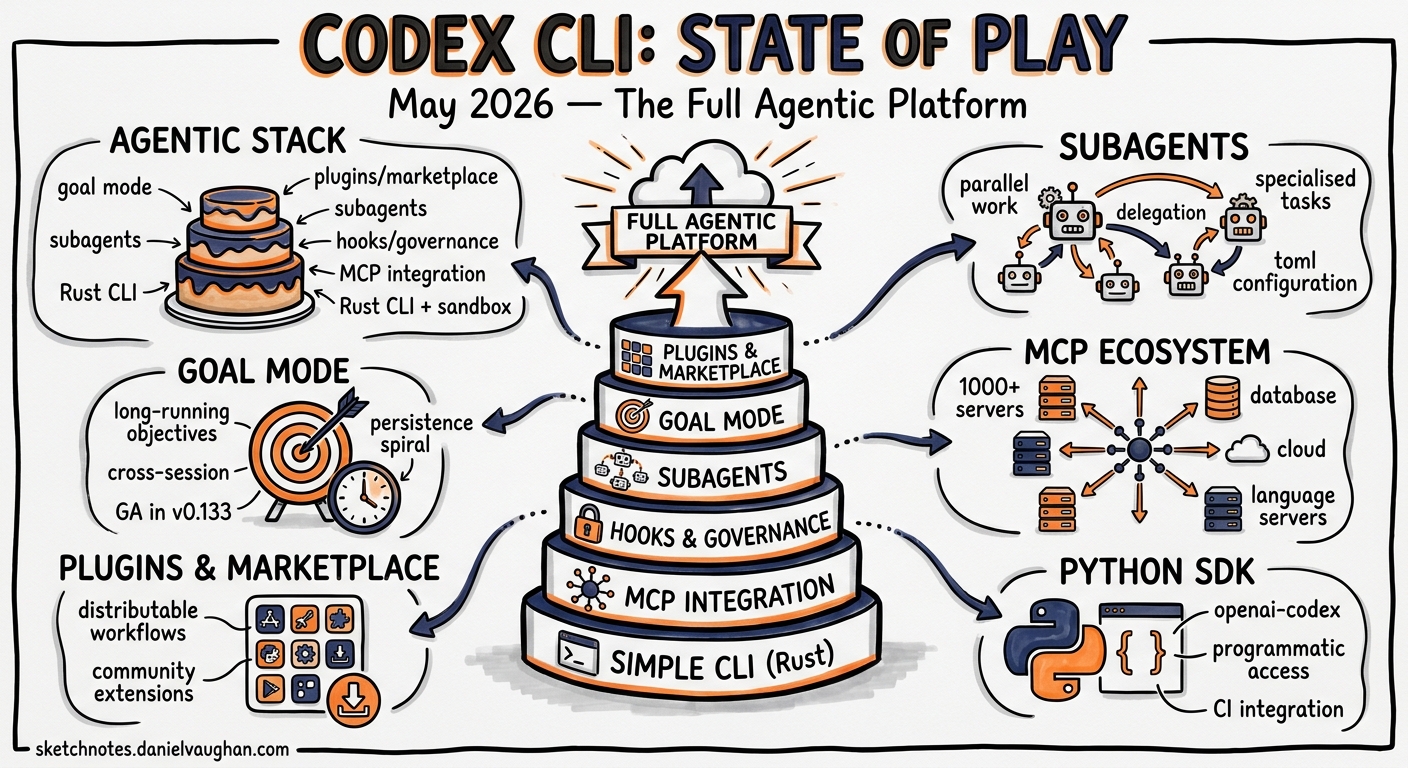
OpenAI’s Codex CLI has evolved from a simple terminal coding assistant into a full agentic platform. As of v0.133.0 (May 21, 2026), it includes:
- Subagents for parallel, specialised work
- Goal mode for persistent, long-running objectives
- Plugins and marketplace for distributable workflows
- MCP integration for connecting to external tools
- Hooks for governance and audit logging
- Python SDK (
openai-codex) for programmatic access
The Agentic Stack
Codex’s agentic capabilities form a layered stack:
- Foundation: Rust-based CLI with bubblewrap sandboxing (Linux) and Docker devcontainer support
- Agent Layer: Built-in agents (default, worker, explorer) + custom TOML-defined agents
- Orchestration: Subagent spawning with configurable parallelism (
max_threads) and depth limits - Persistence: Goal mode for multi-session, long-running objectives
- Extension: Plugins bundling skills, apps, and MCP servers
- Integration: MCP client/server, Agents SDK compatibility, AGENTS.md cross-agent standard
Key Numbers
- 150+ ecosystem tools catalogued in awesome-codex-cli
- 136+ community subagents (VoltAgent collection)
- 1,340+ community skills (antigravity-awesome-skills)
- 20+ official launch plugins (Slack, Figma, Notion, Sentry)
- 60,000+ projects using agents.md standard
Enterprise Angle
Thibault Sottiaux (OpenAI Head of Codex Product) positions Codex as “becoming the standard agent” for enterprise. Key enterprise features:
- Permission profiles with inheritance
- Hook-based audit logging and governance
- Managed
requirements.tomlfor reproducible environments - Plugin marketplace with enterprise controls
- OAuth support for MCP servers
What’s Missing / Coming
- Self-serve plugin publishing (announced “coming soon”)
- Windows native support (expected late 2026)
- PreToolUse hooks for non-Bash tools (current gap)
- Deeper CI/CD integration patterns
For the Agentic Pod
The most relevant areas for Daniel’s agentic pod work:
- Subagent orchestration patterns — PR review pipelines, CSV batch processing
- Goal mode for long-running automation — migration tasks, documentation generation
- MCP server composition — chaining multiple MCP servers for complex workflows
- Cross-agent standards — agents.md for projects that use both Codex and Claude Code
- Codex as MCP server — letting other agents (Claude Code) call Codex agents