Codex CLI as an MCP Server: Orchestrating Agents with the OpenAI Agents SDK
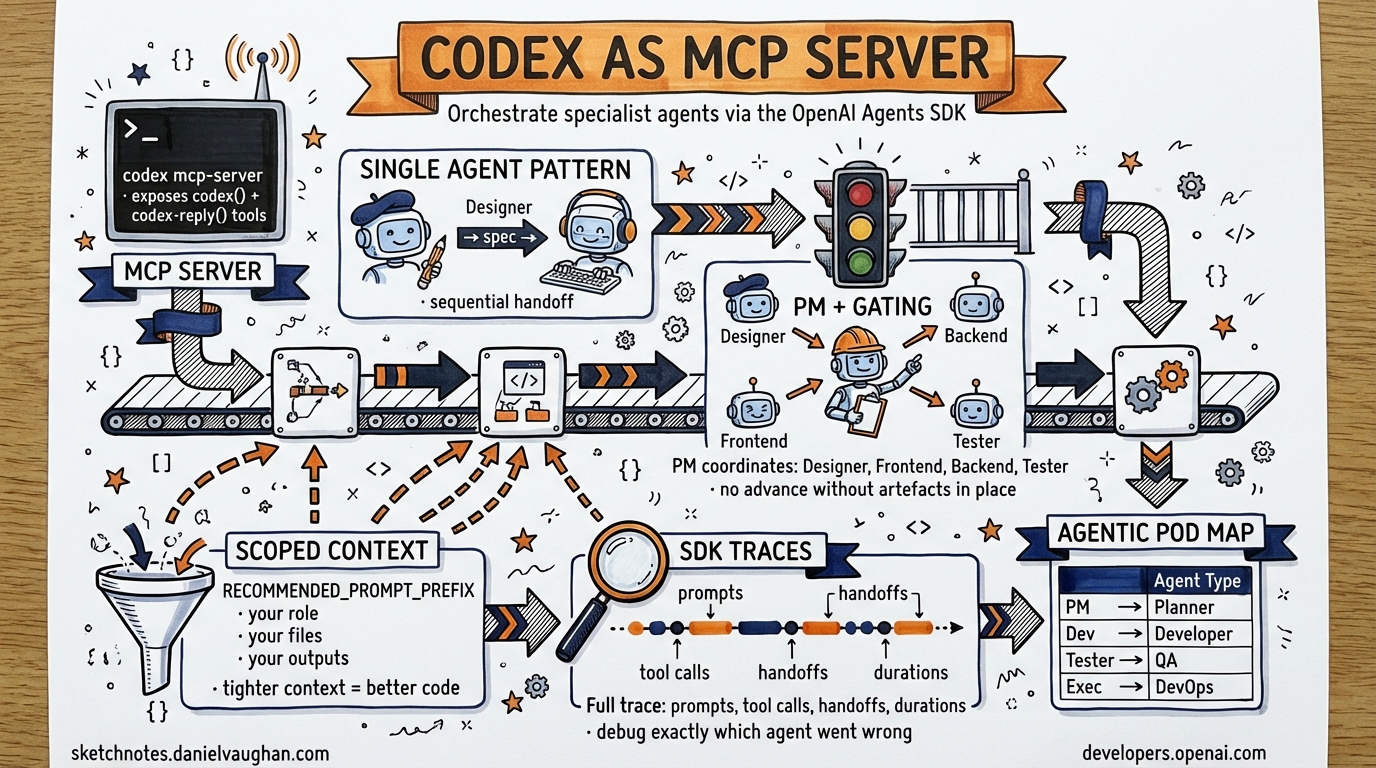
Codex CLI as an MCP Server: Orchestrating Agents with the OpenAI Agents SDK
Published 2026-03-26. Based on the OpenAI Cookbook tutorial — “Building Consistent Workflows with Codex CLI & Agents SDK”.
The Pattern
Expose Codex CLI as a long-running MCP server, then orchestrate it from the OpenAI Agents SDK. This unlocks:
- Deterministic code generation routed through specialised agent roles
- Full traceability via SDK Traces (prompts, tool calls, handoffs, timelines)
- Scalable multi-agent pipelines with gating logic between stages
# Codex CLI starts as an MCP server — the SDK connects to it
codex mcp-server
The MCP server exposes two tools:
codex()— initiate a new Codex conversationcodex-reply()— continue an existing conversation
Single-Agent Architecture
The simplest pattern: one Designer Agent, one Developer Agent, sequential handoff.
from agents import Agent, MCPServerStdio
import asyncio

async def main():
    async with MCPServerStdio(
        command="codex",
        args=["mcp-server"],
        client_session_timeout_seconds=360000  # long timeout for agentic tasks
    ) as codex_mcp:

        designer = Agent(
            name="Designer",
            instructions="Brainstorm a specification for the requested feature.",
            mcp_servers=[codex_mcp]
        )

        developer = Agent(
            name="Developer",
            instructions="""Implement the spec provided.
            Use approval-policy: never and sandbox: workspace-write.
            Write all files before returning.""",
            mcp_servers=[codex_mcp]
        )

        # Designer → spec → Developer → implementation
        spec = await designer.run("Build a REST API for user authentication")
        await developer.run(spec.output)
Key config for the Developer agent:
codex_params = {
    "approval-policy": "never",
    "sandbox": "workspace-write"
}
Multi-Agent Orchestration with Gating Logic
For complex projects, a Project Manager agent coordinates specialised roles and enforces quality gates before advancing.
project_manager = Agent(
    name="Project Manager",
    instructions="""
    You coordinate a team of specialist agents:
    - Designer: product spec + architecture
    - Frontend Developer: React/TypeScript components
    - Backend Developer: API + database layer
    - Tester: unit and integration tests

    GATING RULES:
    1. Do not advance to Frontend until design artefacts are present in /design/
    2. Do not advance to Backend until API contract is defined in /api/schema.json
    3. Do not advance to Tester until both Frontend and Backend hand off
    4. Do not return final output until all tests pass

    Each specialist receives: their role, the overall spec, and only the files relevant to their work.
    """,
    agents=[designer, frontend_dev, backend_dev, tester]
)
The RECOMMENDED_PROMPT_PREFIX Pattern
Each specialist agent should receive scoped context to reduce hallucination and improve handoffs:
RECOMMENDED_PROMPT_PREFIX = """
You are {role}.
Project context: {spec_summary}
Your input artefacts: {relevant_files}
Your output artefacts: {expected_outputs}
Do not modify files outside your scope.
"""
This is the single biggest quality improvement in multi-agent Codex pipelines — agents with scoped context produce tighter, more consistent output than agents with full project context.
Observability with SDK Traces
The SDK automatically captures a full trace for every run:
| Trace field | What it contains |
|---|---|
| Prompts | All agent instructions + user messages |
| Tool invocations | Every codex() / codex-reply() call |
| Handoffs | When and what was passed between agents |
| Execution timeline | Duration per step |
| File artefacts | Files created/modified by each agent |
Access traces:
from agents import trace

with trace("feature-build"):
    result = await project_manager.run("Build user auth feature")
    # Full trace available in OpenAI dashboard and locally
Why traces matter for Daniel’s agentic pod: When a multi-agent run fails mid-way (the Developer’s code doesn’t compile, the Tester finds regressions), traces let you identify exactly which agent made the bad decision and what context it had.
Main Use Cases
| Use case | Agents involved | Gating |
|---|---|---|
| Large-scale refactoring | PM → Developer(s) → Tester | Tests pass before merge |
| Feature rollout across repos | PM → N Developer agents (parallel) | Each repo passes its own test suite |
| Framework migration | Analyser → Developer → Tester | Checkpoint per module |
| Parallel frontend/backend dev | PM → Frontend + Backend (concurrent) → Tester | API contract must exist before both start |
Connection to Daniel’s Agentic Pod
This pattern is the architecture foundation for the “agentic pod” — multiple Codex agents with roles, coordinated by an orchestrator. Key mapping:
| Agentic Pod Role | SDK Agent |
|---|---|
| Planner / Tech Lead | Project Manager agent with gating rules |
| Feature Developer | Developer agent with scoped MCP tools |
| QA | Tester agent, output-gated |
| DevOps | CI agent using codex exec (non-interactive) |
| Reviewer | Designer/Architect agent pre-handoff |
The SKILL.md files in your repo map to the instructions field in each SDK Agent — you’re already building in this direction.