From Harness Engineering to Symphony: The Autonomous Development Stack
Published 2026-03-26. Sources: github.com/openai/symphony, openai.com/index/harness-engineering/, community research.
On March 5, 2026, OpenAI quietly released a GitHub repository called Symphony.1 Within three weeks it had 13K stars.2 ⚠️ [unverified] The concept it embodies — harness engineering — is one of the most important ideas in agentic software development, and it connects directly to everything you do when you configure Codex CLI for serious use.
The Problem Symphony Solves
Most teams using Codex today supervise agents directly: you open a session, describe a task, watch what happens, approve or correct, and repeat. This is valuable but it’s still fundamentally human-in-the-loop at the task level.
Symphony solves a different problem: how do you manage dozens of autonomous agents working on dozens of tasks simultaneously, without a human watching each one?
The answer is a structured handoff model: issues go into a state called “Ready for Agent” on a Linear board.1 Symphony picks them up, spawns an isolated Codex agent per issue, lets it work, and only surfaces a pull request to a human when the agent has produced proof of work.1
What is Harness Engineering?
OpenAI’s engineering blog (openai.com/index/harness-engineering/) introduced the term.3 Here’s the conceptual ladder:
| Discipline | What you’re designing |
|---|---|
| Traditional engineering | Code |
| Prompt engineering | Instructions for AI |
| Harness engineering | The infrastructure, constraints, and feedback loops that make AI agents reliably productive |
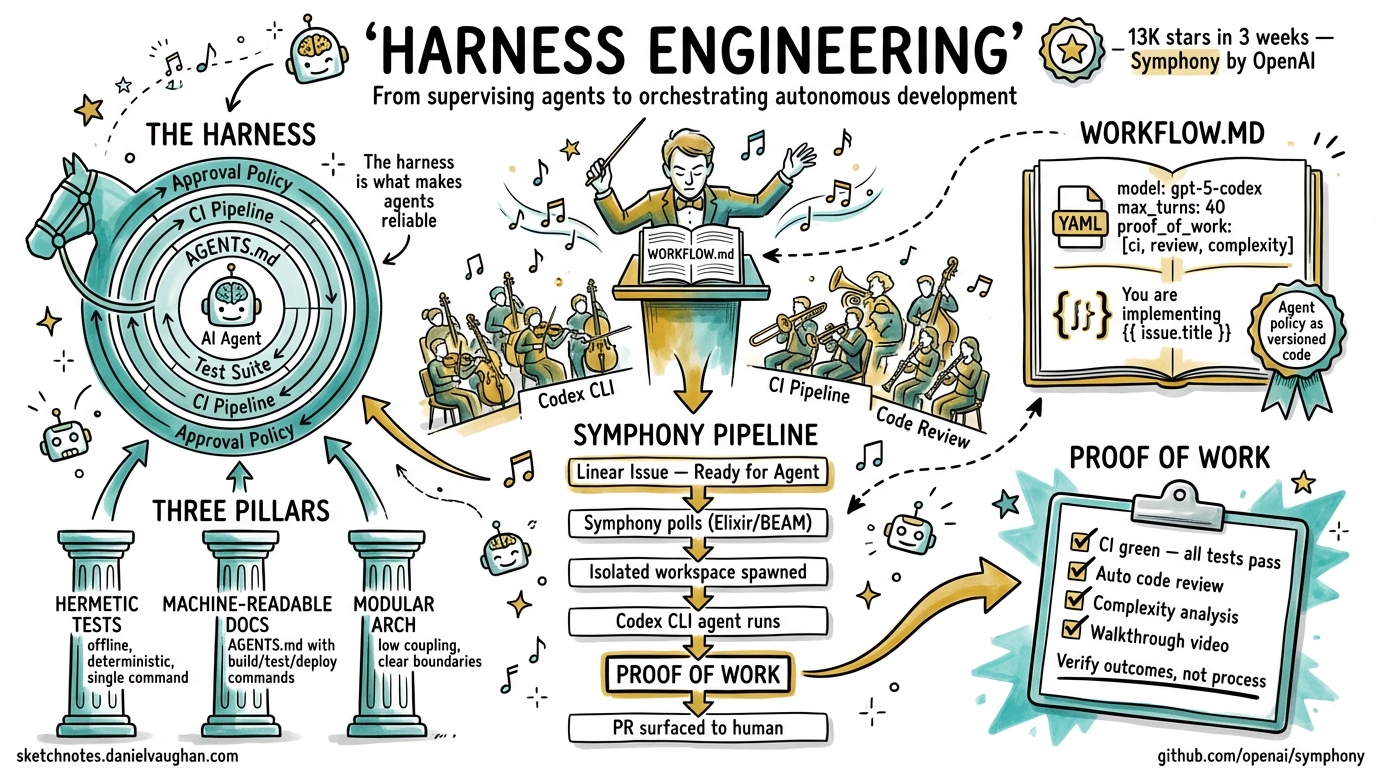
The harness is everything that wraps the agent: AGENTS.md, test suites, build scripts, environment setup, CI pipelines, approval policies. When these are designed well, an agent can take a task and complete it autonomously with high confidence. When they’re not, even a capable model will thrash, make wrong assumptions, or break things.
Harness engineering is what you’re doing every time you:
- Write or refine your AGENTS.md
- Configure hooks (SessionStart, PostToolUse, userpromptsubmit)
- Make your test suite hermetic (no flaky external dependencies)
- Set up
codex execprofiles for CI - Define approval policies in your sandbox config
Three Pillars of a Harness-Ready Codebase
Symphony documentation makes these requirements explicit:1
1. Hermetic Testing
Tests that run locally, reliably, without external dependencies. An agent that runs npm test and gets a deterministic result can iterate on failures independently. An agent that runs tests which depend on staging databases, live APIs, or specific machine state will thrash.
In practice: Mock external services. Seed test databases. Make every test runnable with a single command that always works offline.
2. Machine-Readable Documentation
An agent should be able to discover how to build, test, and deploy your project without asking questions. This means:
# AGENTS.md

## Build
npm run build

## Test
npm test

## Lint
npm run lint

## Deploy (staging)
npm run deploy:staging
If the agent can’t find this, it will guess — and guessing costs tokens and introduces errors.
3. Modular Architecture
Codebases where side effects are minimised and boundaries are clear. An agent making a change to a payment module shouldn’t risk breaking the notification service. High coupling creates correctness uncertainty; low coupling lets agents work confidently.
The Symphony Workflow in Detail
Linear board: "Ready for Agent" state
          ↓
Symphony polls (Elixir/BEAM — can run hundreds of agents concurrently)
          ↓
Creates per-issue isolated workspace (deterministic, hermetic)
          ↓
Spawns Codex CLI agent with WORKFLOW.md as system prompt
          ↓
Agent implements task autonomously
          ↓
Proof of Work generated:
  - CI/CD status (tests green)
  - Automated code review feedback
  - Code complexity analysis
  - Walkthrough video of changes
          ↓
Human reviews PR with evidence, not supervision
The critical shift: humans review verified outcomes rather than supervising process. The agent doesn’t just claim it’s done — it demonstrates completion.
WORKFLOW.md: Agent Policy as Code
Symphony introduces a new config file format that is more powerful than AGENTS.md: WORKFLOW.md.1
---
# YAML front matter — runtime configuration
model: gpt-5-codex
max_turns: 40
issue_tracker: linear
workspace_mode: isolated
proof_of_work: [ci, review, complexity]
---
# Markdown body — Jinja prompt template

You are implementing .

Context:


Repository:
Branch:

Rules:
- Run the full test suite before marking done
- Do not modify
- Write tests for any new functions
The YAML front matter is the runtime config (model, limits, integrations). The Markdown body is the agent’s system prompt, with Jinja templating for issue-specific context.
Why this matters: Agent behaviour is now a versioned repo artifact. Changes to how your agent works are tracked in git alongside the code it produces. You can diff, review, and roll back agent policy just like application code.
The Proof of Work Principle
The most important idea in Symphony is proof of work.1 An agent completing a task must demonstrate completion through verifiable evidence — not just report that it’s done.
Before a PR is surfaced to a human, Symphony requires:1
- CI green — all tests pass in the CI pipeline
- Review feedback — automated code review analysis
- Complexity analysis — code change size and complexity metrics
- Walkthrough video — a recording of what the agent changed and why
This addresses a fundamental trust problem with autonomous agents: how do you know the task was actually done correctly? The proof-of-work model forces accountability into the agent loop itself.
Applying this without Symphony: Even in a direct Codex CLI workflow, you can enforce proof-of-work thinking:
- End every subagent with: “Run the tests and report results before finishing”
- Use a
Stophook that checks CI status - Require the agent to write a summary of what it changed before closing the session
How This Fits Your Agentic Pod
If you’re building an agentic pod with Codex, you’re already doing harness engineering. Symphony shows where that road leads:
| You’re doing now | Symphony’s vision |
|---|---|
| AGENTS.md with project context | WORKFLOW.md with Jinja-templated agent policies |
| Running Codex sessions manually per task | Symphony orchestrating sessions per Linear issue |
| Reviewing agent output in the terminal | Reviewing a PR backed by CI, code review, and a walkthrough video |
| Git worktrees for isolation | Per-issue deterministic isolated workspaces |
| PostToolUse hook running tests | Proof of work enforced before PR submission |
Technical Architecture: Why Elixir?
Symphony is built in Elixir (95.4% of the codebase) ⚠️ [unverified] on the Erlang/BEAM runtime.1 This isn’t accidental:
- Concurrency: BEAM handles thousands of lightweight processes. Running 50 parallel Codex agents is manageable; doing this in a Python process pool would be fragile.4
- Fault tolerance: OTP supervision trees mean one failed agent restarts automatically. A Python async loop that panics on one agent crashes everything.4
- Long-running processes: Agents can take minutes or hours. BEAM is designed for this; HTTP-based orchestration frameworks are not.4
The downside: Elixir has a smaller ecosystem and a steeper learning curve for most teams.
Current Limitations
Symphony is in engineering preview — valuable for learning the pattern, not yet recommended for production:15
- Linear only (no Jira, GitHub Issues, etc.)1
- Single agent per issue (no internal subagent spawning within Symphony)5
- No quality gates beyond CI/tests ⚠️ [unverified]
- Requires Elixir knowledge for customisation1
- No multi-repo support ⚠️ [unverified]
Key Takeaway
Symphony is the most concrete vision of where agentic software development is heading: from humans supervising agents at the task level, to humans managing work at the project level while agents operate autonomously below.
The three things that make this possible — hermetic tests, machine-readable documentation, modular architecture — are the same things that make your Codex CLI setup effective today. Harness engineering is both the practice and the path.
See also:
- notes/symphony.md — reference note on Symphony
- articles/2026-03-26-codex-cli-cicd-non-interactive.md — Codex in CI/CD
- articles/2026-03-26-codex-cli-hooks-deep-dive.md — hooks for proof-of-work patterns
Citations
-
OpenAI Symphony — GitHub Repository ↩ ↩2 ↩3 ↩4 ↩5 ↩6 ↩7 ↩8 ↩9 ↩10 ↩11
-
Star count not independently verified at time of writing; check the repository directly for the current figure. ↩
-
Harness engineering: leveraging Codex in an agent-first world — OpenAI Engineering Blog (Ryan Lopopolo) ↩
-
OpenAI Releases Symphony: An Open Source Agentic Framework — MarkTechPost ↩ ↩2 ↩3
-
OpenAI Symphony SPEC.md — Limitations and single-agent-per-issue design ↩ ↩2