Codex CLI in 2026: What’s New, What’s Changed and What’s Coming
Written 2026-03-27. Based on official changelog, GitHub releases, and community research.
Codex CLI has changed substantially since its initial release. This article captures the most important developments of 2026 so far — from new models to enterprise hooks, from the subagents GA to the upcoming plugin system — in one place.
The Big Picture
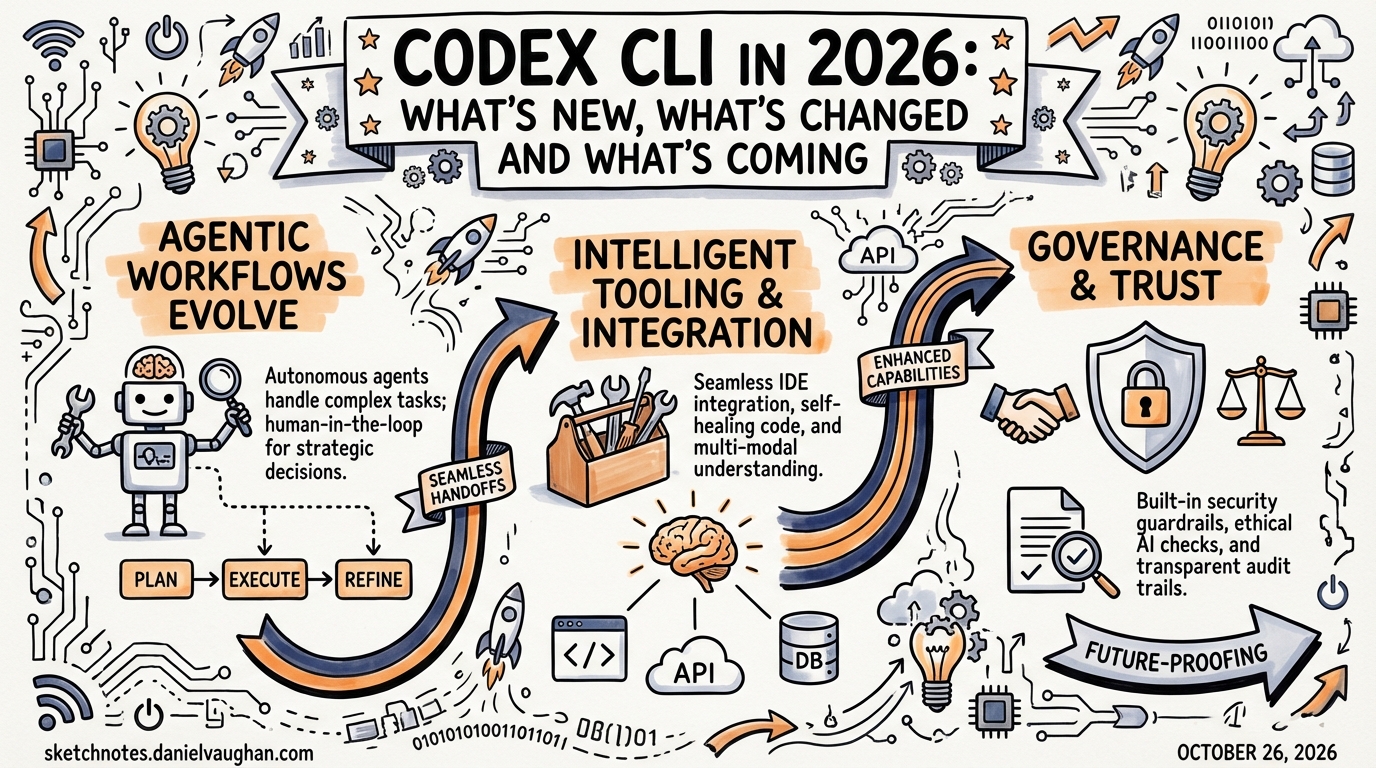
Three themes dominate 2026 Codex development:
- Speed and real-time interaction — GPT-5.3-Codex-Spark (1,000+ tok/s), WebSocket latency improvements
- Agentic autonomy — Subagents GA, Smart Approvals, PostToolUse hooks, worktree automations
- Enterprise readiness — Custom CA certs, userpromptsubmit hooks, managed configs, plugin policy enforcement
New Models
gpt-5-codex and gpt-5-codex-mini (Late March 2026)
The new default models for Codex CLI, announced by @thsottiaux:
gpt-5-codex— new flagship: “fast for small things, working hard when it matters — solid jump in produced code quality”gpt-5-codex-mini— up to 4x more usage included for Plus/Edu/Team plans; 50% increased limits overall; Pro users get priority processing
codex -m gpt-5-codex        # flagship
codex -m gpt-5-codex-mini   # usage-efficient for subagents and exploration
Recommendation: gpt-5-codex for primary work; gpt-5-codex-mini for subagents, exploration, and large-file review where token efficiency matters.
GPT-5.4 and GPT-5.4-mini (March 17, 2026)
- GPT-5.4 — frontier reasoning + coding model, was the previous default
- GPT-5.4-mini — 2x faster than GPT-5.4, uses 30% of included limits; good for fast iteration and subagent work
GPT-5.3-Codex-Spark (February 12, 2026) ⭐
OpenAI’s most novel model release: purpose-built for real-time coding.
| Spec | Value |
|---|---|
| Speed | 1,000+ tokens/second |
| Context | 128k tokens |
| Input types | Text only (at launch) |
| Hardware | Cerebras Wafer Scale Engine 3 |
| Availability | Research preview — ChatGPT Pro only |
| API | Not available at launch |
Why it matters: Codex-Spark makes the agent feel like a live collaborator, not a batch process. OpenAI also reduced full pipeline latency alongside the model — per-token overhead down 30%, time-to-first-token down 50%, per-round-trip overhead down 80% via persistent WebSocket.
Strategic significance: This is the first OpenAI model deployed on Cerebras hardware (not NVIDIA GPUs) — part of a 10B+ partnership announced in early 2026. It signals OpenAI investing in diverse inference infrastructure for ultra-low-latency AI.
The two-mode vision: With Spark + GPT-5-codex, Codex now supports both long-running autonomous tasks (high-reasoning models) and real-time pair-programming (Spark). Different tools for different moments in the development loop.
Subagents: GA Since March 16, 2026 ⭐
Subagents shipped as generally available in v0.115.0 (March 16), retweeted by Sam Altman. Up to 6 subagents can run concurrently.
Built-in roles
| Role | Access | Best for |
|---|---|---|
explorer |
Read-only | Codebase scanning, dependency mapping, context gathering |
worker |
Read-write | Implementation, large batches of small tasks |
default |
Read-write | General-purpose single task |
Custom agents (TOML)
Define in ~/.codex/agents/<name>.toml (personal) or .codex/agents/<name>.toml (project):
name = "test-runner"
description = "Runs the test suite and diagnoses failures"
developer_instructions = "Focus only on test analysis and fixes."
model = "gpt-5-codex-mini"
reasoning_effort = "medium"
Smart Approvals (v0.115.0)
Rather than blindly auto-approving in --full-auto mode, a lightweight guardian subagent reviews pending actions and routes them — approve silently, escalate to user, or block. Makes full-auto safer for CI and overnight runs.
Hooks: Three Live, One Coming
userpromptsubmit (v0.116.0, March 19)
Fires before a prompt enters conversation history. Key for audit logging and policy enforcement in regulated environments:
# ~/.codex/config.toml
[hooks]
userpromptsubmit = "~/.codex/hooks/audit-prompt.sh"
The hook receives the raw prompt on stdin. Exit 0 = allow, exit 1 = block. The hook can also modify the prompt before passing it on.
PostToolUse (v0.117.0, arriving soon)
Fires after any tool executes. Key use case: auto-run tests after every file write.
[hooks]
post_tool_use = "~/.codex/hooks/auto-test.sh"
# auto-test.sh — receives tool event JSON on stdin
TOOL=$(cat | jq -r '.tool_name')
if [[ "$TOOL" == "write_file" || "$TOOL" == "edit_file" ]]; then
  npm test --silent 2>&1 | tail -5
fi
Note: PostToolUse fires after the tool has run, so it cannot undo. For blocking behaviour use userpromptsubmit.
Existing hooks (stable)
| Hook | Trigger |
|---|---|
SessionStart |
Session begins — load context, pre-flight checks |
Stop |
Session ends — cleanup, notify team, audit log |
New CLI Features
Integrated Terminal Reading (late March 2026)
Codex can now read the integrated terminal for the current thread. This means:
- It can check whether your dev server is running
- It can see failed build output without you pasting it in
- The agent maintains awareness of your terminal state while working
This closes a significant gap: previously, you had to manually copy-paste terminal output to give Codex context about runtime errors or running processes.
codex cloud Command
New command for working with cloud-based tasks from the terminal:
codex cloud # triage and launch Codex cloud tasks without leaving terminal
Lets you launch cloud tasks, choose environments, and apply resulting diffs — all from within your terminal session.
Mid-Thread Conversation Forks
You can now fork a conversation from any earlier message, not just the latest turn. Useful when you want to explore an alternative approach from a previous decision point without losing the current thread.
/fork # fork from any earlier message in the current thread
Enterprise Features
Custom CA Certificate Support (v0.116.0)
Corporate environments with TLS inspection proxies (Zscaler, etc.) can now configure custom CA certificates:
export SSL_CERT_FILE=/path/to/corporate-ca.pem
# Or use the Codex-specific env vars
This unblocks Codex in the most common enterprise network configurations.
Device-Code ChatGPT Sign-In (v0.116.0)
Onboarding now supports ChatGPT account login directly — no separate API key required for Plus/Pro users. Token refresh is handled automatically for existing sessions.
brew install codex
codex   # follow device-code sign-in flow
Plugin Policy Enforcement (v0.116.0+)
Enterprise admins can configure a plugin suggestion allowlist — Codex will only prompt to install approved plugins. Install/uninstall state syncs remotely, making fleet management feasible.
Automations: Significantly Upgraded (March 12–27)
The Codex app’s Automations feature received a major update:
- Local or worktree execution — choose per automation; worktree-based for cleaner isolation
- Custom reasoning levels and models — e.g., light reasoning for triage, high for complex analysis
- Template gallery — built-in templates as starting points
- Custom themes — accent/background/foreground, UI and code fonts; shareable
v0.117.0 Alpha: What’s Coming
Active development as of late March 2026 (22+ alpha releases in 2 days):
- PostToolUse hook — see above
- Plugin system GA — plugins becoming first-class feature
- Improved MCP tool elicitation — better UX for MCP tool selection
- Additional app-server transports — beyond stdio; WebSocket auth for app-server
- MCP tool call span instrumentation — tracing/observability for MCP calls
- Home-relative paths on Windows —
~/paths work correctly - Skills extracted to separate crate — architectural improvement
Ecosystem Growth
The broader Codex ecosystem has matured considerably:
- awesome-codex-cli now lists 60+ curated tools
- Agentmaxxing has become a mainstream pattern — multiplexers (AMUX, dmux, Emdash) make running 10+ parallel agents practical
- OpenAI acquired Astral (uv, ruff) — signal of deeper Python tooling investment
- opencode reached 95K stars as the leading open-source alternative
- Nimbalyst replaced Crystal as the leading visual workspace for parallel sessions
What’s Still Coming
| Feature | Status | Why it matters |
|---|---|---|
| Codex-Spark GA | Research preview | When GA, fastest feedback loop for everyday coding |
| PostToolUse hook stable | v0.117.0 alpha | Auto-test-on-write without human approval |
| Plugin system GA | v0.117.0 alpha | First-class extensibility |
| Image output on CLI | Cloud only | Visual UI iteration from terminal |
| Windows native (non-WSL) | Experimental | Unblocks Windows-first enterprise teams |
| More SDK languages | Python shipping | Embed Codex in CI, custom tooling |
The Version Trail
| Version | Date | Key features |
|---|---|---|
| v0.117.0 | Coming soon | PostToolUse hook, Plugin GA, WebSocket auth |
| v0.116.0 | March 19 | userpromptsubmit hook, Custom CA certs, ChatGPT login |
| v0.115.0 | March 16 | Subagents GA, Smart Approvals, Python SDK |
| v0.114.0 | March 11 | Hooks engine, experimental code mode, health checks |
TL;DR
If you last looked at Codex CLI a few months ago, here’s what changed most:
- New models:
gpt-5-codex+gpt-5-codex-miniare the new defaults. Codex-Spark adds real-time speed for Pro users. - Subagents are GA: 6 concurrent agents, guardian-based Smart Approvals for safe full-auto
- Hooks are real:
userpromptsubmitfor enterprise audit trails;PostToolUselanding soon - Terminal awareness: Codex can now read your terminal state to stay context-aware
- Enterprise is serious: Custom CA certs, plugin policy, device-code auth — corporate deployment is now tractable
- The ecosystem: 60+ community tools, multiplexers for 10+ parallel agents, agentmaxxing as a mainstream practice