Reasoning Effort Tuning: Minimal to xhigh for Cost and Speed
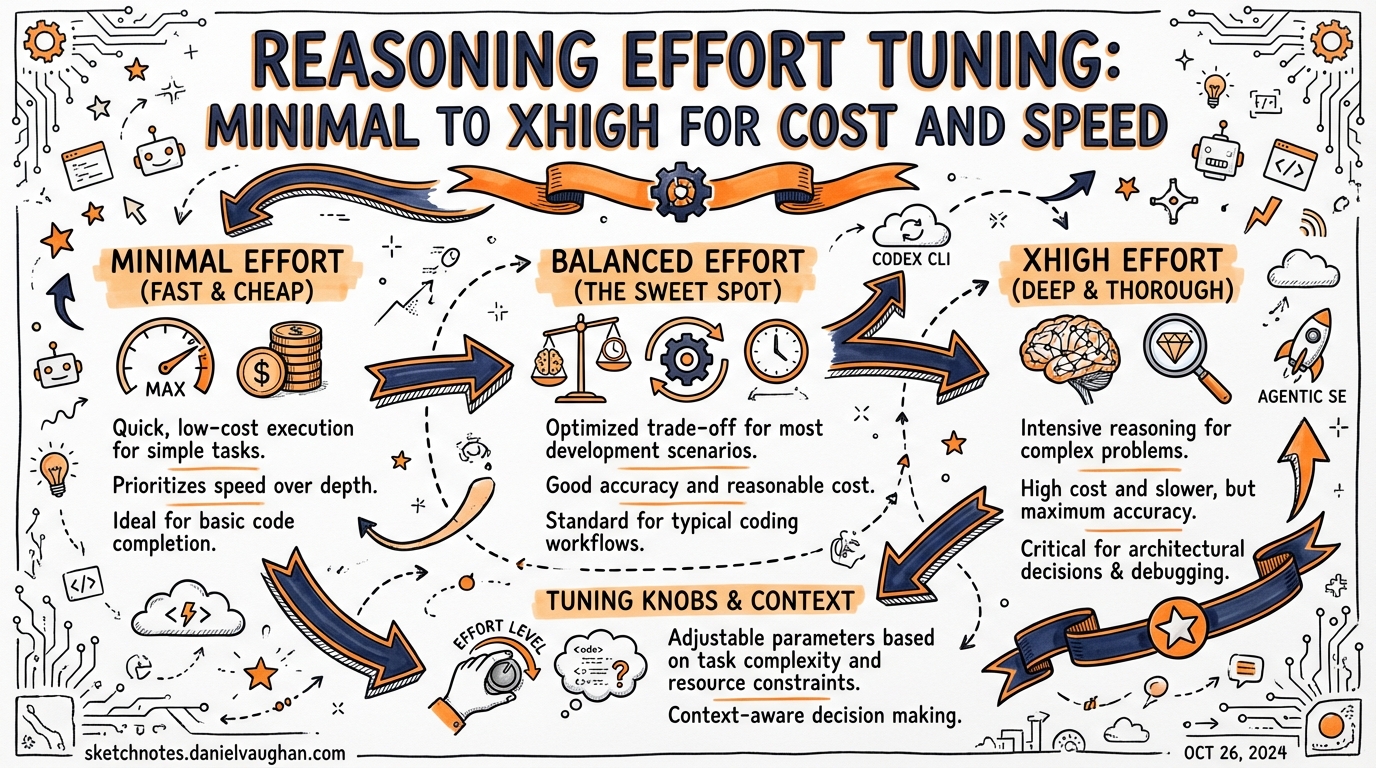
Reasoning Effort Tuning: Minimal to xhigh for Cost and Speed
Codex CLI’s reasoning engine has a single knob that dramatically affects cost, speed, and quality: model_reasoning_effort. Most developers leave it at the default (medium) and don’t think about it again. That’s the right call for interactive work — but it leaves significant cost savings and quality gains on the table for everything else.
The Five Effort Levels
| Level | Tokens used | Speed | Best for |
|---|---|---|---|
minimal |
Fewest | Fastest | Trivial tasks: rename, format, single-line fix |
low |
Low | Fast | Boilerplate generation, well-defined data transforms |
medium ✅ |
Moderate | Responsive | Default. Everyday interactive coding |
high |
High | Slower | Multi-file refactors, complex debugging, architectural decisions |
xhigh |
Most | Slowest | Long-horizon autonomous tasks, hard algorithmic problems, deep security audits |
Default: medium — OpenAI’s recommended all-day driver. Balances quality and cost for most interactive sessions.
Newest addition: xhigh — introduced for non-latency-sensitive tasks where quality matters more than speed. Codex “thinks for an even longer period” before responding.
How to Set It
In ~/.codex/config.toml (global default)
model = "gpt-5.4"
model_reasoning_effort = "medium"          # applies to all tasks
plan_mode_reasoning_effort = "high"        # override for /plan mode only
Via the -e flag (per-session)
codex -e high "Refactor the auth module to use JWT"
codex -e minimal "Add a docstring to this function"
codex -e xhigh "Find the race condition in this event loop"
In profiles (per-workflow)
Profiles let you pre-configure effort per context. Add to config.toml:
[profiles.daily]
model_reasoning_effort = "medium"

[profiles.deep-work]
model_reasoning_effort = "high"
model = "gpt-5.4"

[profiles.triage]
model_reasoning_effort = "low"
model = "gpt-5.4-mini"
Launch with: codex --profile deep-work "..." or set default_profile = "daily".
Slash command (mid-session)
Type /effort high in the Codex TUI to switch reasoning effort without restarting the session.
Plan Mode Override
plan_mode_reasoning_effort is a separate config key that kicks in when you use /plan. Since planning is where quality matters most (a bad plan compounds into a bad implementation), it makes sense to run plan mode at a higher effort than your default:
model_reasoning_effort = "medium"    # interactive coding
plan_mode_reasoning_effort = "high"  # planning always gets more thought
When plan_mode_reasoning_effort is unset, plan mode uses its built-in preset default (currently high).
Token Economics: What You’re Actually Paying For
Reasoning models use reasoning tokens in addition to input/output tokens. Reasoning tokens are “thinking work” — the model uses them internally to break down problems. They count toward your usage but don’t appear in the conversation.
The multiplier is steep at xhigh. Budget accordingly:
| Effort | Approximate reasoning token multiplier (vs medium) |
|---|---|
minimal |
~0.1x |
low |
~0.3x |
medium |
1x (baseline) |
high |
~3–5x |
xhigh |
~8–15x |
Exact multipliers are model-dependent and not publicly documented. These are approximate based on community benchmarks.
GPT-5.1-Codex-Max efficiency note
GPT-5.1-Codex-Max achieves better SWE-bench Verified performance than GPT-5.1-Codex at the same medium effort while using 30% fewer thinking tokens. If you’re on the Max tier, you get better quality at lower cost — no effort tuning required.
Subagent Economics: The Real Win
The effort tuning story is most powerful in multi-subagent workflows. When you spawn subagents via TOML, each runs independently and incurs its own reasoning cost. The pattern: parent agent at high/medium for orchestration; subagents at low/minimal for execution.
Example subagent config in codex-tasks.toml:
[[agents]]
id = "planner"
prompt = "Break this feature into 5 non-overlapping implementation tasks"
reasoning_effort = "high"      # plan quality matters

[[agents]]
id = "implementer-1"
prompt = "Implement task 1: add the database migration"
reasoning_effort = "low"       # task is well-defined, save tokens

[[agents]]
id = "tester"
prompt = "Write unit tests for the migration"
reasoning_effort = "low"       # mechanical work

[[agents]]
id = "reviewer"
prompt = "Review all changes for security issues"
reasoning_effort = "high"      # security needs careful reasoning
This pattern can reduce overall token spend by 50–70% vs running everything at medium, while maintaining quality where it matters.
Decision Framework
Is the task well-defined, single-file, or mechanical?
  → minimal or low

Is it a standard interactive session or multi-file edit?
  → medium (default, leave it)

Does it involve planning, architecture, or debugging a hard problem?
  → high (or set plan_mode_reasoning_effort = "high")

Is it a long-running autonomous task, security audit, or algorithmic hard problem?
  → xhigh (but set expectations: this is slow and expensive)

Is it a subagent executing a clearly-specified task?
  → low or minimal (your orchestrator already did the hard thinking)
Common Mistakes
- ❌ Running everything at
high— 3–5x the token cost for routine tasks. Use profiles to scope it. - ❌ Leaving plan mode at
medium— plan quality is where you get compounding returns. Always run plan mode athighor better. - ❌ Treating
xhighas a default — it’s a specialist tool for hard problems, not a quality upgrade for everything. - ❌ Not using profiles — the
-eflag is for one-offs; profiles are for habits. - ❌ Same effort for all subagents — orchestrators need
high, executors needlow. Match effort to role.
Config Reference
# Full effort configuration in config.toml
model_reasoning_effort = "medium"          # global default
plan_mode_reasoning_effort = "high"        # /plan mode override

[profiles.ci]
model_reasoning_effort = "low"             # fast CI runs
model = "gpt-5.4-mini"

[profiles.audit]
model_reasoning_effort = "xhigh"           # security/compliance reviews
model = "gpt-5.4"
Valid values: "minimal" |
"low" |
"medium" |
"high" |
"xhigh" (model-dependent). |
Published 2026-03-27. Based on official Codex CLI config reference, changelog, and community benchmarks.