Codex CLI Cost Management: Token Strategy, Model Routing and Quota Control
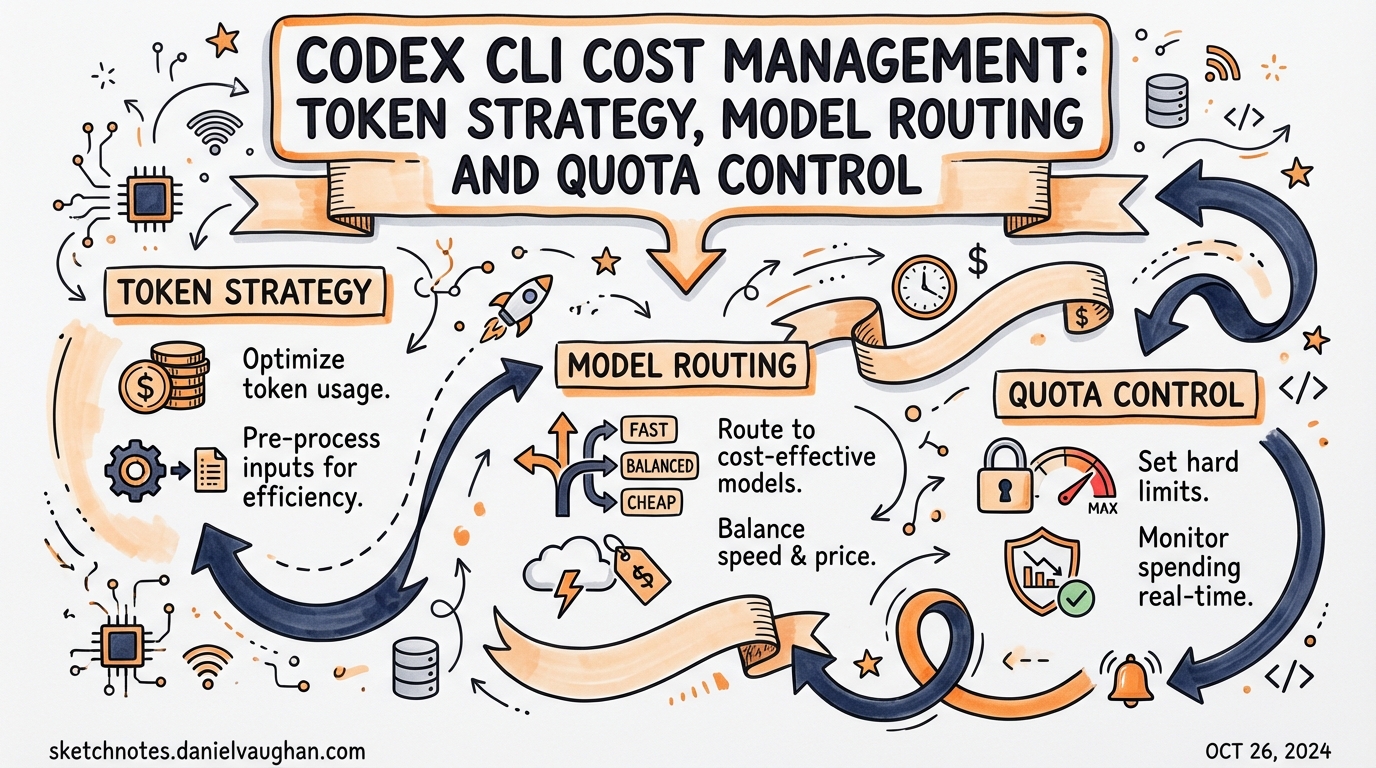
Codex CLI Cost Management: Token Strategy, Model Routing and Quota Control
Published: 2026-03-28
The biggest surprise in Codex deployments isn’t the cost of output tokens — it’s the accumulated cost of conversation history. A session that reads ten files and runs ten tool calls adds 5,000+ tokens to the context on every subsequent API call. In a twenty-call session that’s 100,000 extra tokens of history on top of actual output. This is what makes /compact a financial decision as well as a quality one.
Subscription vs API: Two Different Products
ChatGPT Plus/Pro subscribers: Codex quota is expressed in compute-equivalent units, resets monthly, and doesn’t roll over. Subscription quota is sufficient for individual exploratory use; teams generating real output typically exhaust per-user allocations.
API key users: Billed per token at published rates. The current ratio that matters most:
| Model | Relative cost | Best for |
|---|---|---|
gpt-4.1-nano |
0.05x | Search, formatting, deterministic transforms |
gpt-4.1-mini |
0.2x | Exploration, test gen, docs, draft refactoring |
gpt-4.1 |
1.0x | Complex multi-file work, bug diagnosis in large codebases |
o4-mini |
~0.6x (+ reasoning tokens) | Security audits, novel algorithms, deep reasoning |
o3 |
~5x | Reserve for hardest problems |
Prices approximate as of March 2026 — verify at openai.com/pricing before budgeting.
The gpt-4.1-mini / gpt-4.1 cost ratio of 5x is the most important number in Codex cost management. Most agentic tasks don’t require the full model.
Estimating Team Costs
A worked example for a five-engineer team, orchestrator/worker pattern:
- Each engineer runs ~15 Codex tasks/day, ~3 hours of active sessions
- Orchestrator on
gpt-4.1: 40K input + 4K output tokens per task - 2.5 workers per task on
gpt-4.1-mini: 25K input + 3K output tokens each
Per-engineer per-day:
- Orchestrators: 15 × ($0.08 + $0.032) = $1.68
- Workers: 37.5 × ($0.01 + $0.0048) = $0.55
- Total: $2.23/day
Monthly team cost (22 working days): $2.23 × 5 × 22 = ~$245/month
If workers ran on gpt-4.1 instead of gpt-4.1-mini: ~$750/month (+205%). Model routing matters.
Key heuristic: If you could specify the correct output before the agent runs, you probably don’t need a reasoning-class model. If the agent needs to explore solution space and evaluate trade-offs, reasoning models earn their cost.
Three Configuration Tools
1. Per-Session Token Ceiling
# ~/.codex/config.toml
max_tokens_per_session = 200000
Hard limit on cumulative tokens (input + output) across all API calls in the session. Prevents runaway sessions. Note: counts tokens across all calls including those before /compact.
2. Named Profiles for Model Routing
[profiles.base]
sandbox_mode    = "workspace-write"
approval_policy = "on-request"

[profiles.explore]
inherits = "base"
model    = "gpt-4.1-mini"
max_tokens_per_session = 100000

[profiles.commit]
inherits = "base"
model    = "gpt-4.1"
max_tokens_per_session = 300000

[profiles.reason]
inherits = "base"
model    = "o4-mini"
max_tokens_per_session = 150000

default_profile = "explore"
Invoke explicitly:
codex --profile commit "implement the new user authentication flow"
codex --profile reason "audit this authentication module for security vulnerabilities"
The explore profile is the default — cheap, capped, appropriate for browsing and quick experiments.
3. Enterprise: requirements.toml Cost Policy
# requirements.toml — distributed centrally
[required]
max_tokens_per_session = { max = 400000 }
model = { allowed = ["gpt-4.1", "gpt-4.1-mini", "gpt-4.1-nano", "o4-mini"] }
Prevents engineers from accidentally running o3 on routine tasks. Effective only if distributed and updated centrally via MDM.
Monitoring with Hooks
Local cost log (individual developer)
[[hooks]]
event   = "postTaskComplete"
command = """
jq -n --argjson data "$CODEX_HOOK_DATA" \
  '{ts: now | todate, model: $data.model, tokens_in: $data.usage.input_tokens, tokens_out: $data.usage.output_tokens, session_id: $data.session_id}' \
  >> ~/.codex/usage.jsonl
"""
Analyse after a week:
jq -s '[.[] | select(.ts | startswith("2026-03"))] |
  {input_cost: (map(.tokens_in) | add) * 0.000002,
   output_cost: (map(.tokens_out) | add) * 0.000008}' \
  ~/.codex/usage.jsonl
Team webhook
[[hooks]]
event   = "postTaskComplete"
command = """
curl -s -X POST "$CODEX_COST_WEBHOOK_URL" \
  -H "Content-Type: application/json" \
  -d "$CODEX_HOOK_DATA"
"""
Alert on large sessions
[[hooks]]
event   = "postTaskComplete"
command = """
TOTAL=$(echo "$CODEX_HOOK_DATA" | jq '.usage.input_tokens + .usage.output_tokens')
if [ "$TOTAL" -gt 500000 ]; then
  curl -s -X POST "$SLACK_WEBHOOK_URL" \
    -H "Content-Type: application/json" \
    -d "{\"text\": \"Large Codex session: $TOTAL tokens\"}"
fi
"""
Fires when a single session exceeds ~500K tokens (~$1.50–2.00 at current gpt-4.1 rates).
Cost-Quality Decision Matrix
| Task | Use |
|---|---|
| Code search and navigation | nano or mini |
| Formatting, linting | nano |
| Test generation (known patterns) | mini |
| Documentation | mini |
| Exploratory refactoring | mini |
| Complex multi-file refactoring | gpt-4.1 |
| Architecture design | gpt-4.1 or o4-mini |
| Security audit | o4-mini or o3 |
| Novel algorithm | o4-mini or o3 |
| Bug diagnosis in large codebase | gpt-4.1 |
Tip from
ccusage: Runccusageagainst your~/.codexsession files to see per-day token consumption and identify which sessions are your biggest cost drivers.
The /compact Command as a Financial Tool
Every subsequent API call after a file read re-charges for that file’s tokens as conversation history. A long uncompacted session accumulates this debt on every turn.
Running /compact mid-session replaces the detailed history with a summary — typically reducing context by 30–50%. This has a direct cost benefit for every subsequent API call in that session.
Pattern for long sessions: /compact when the context meter hits ~60% full. Don’t wait until compaction is forced — forced compaction under pressure loses more detail than proactive manual compaction.
Enterprise Billing Attribution
Use separate API keys per team to get natural billing breakdown in the OpenAI dashboard. Configure via:
# Per-team config distributed via configuration management
api_key_source = "environment"  # reads OPENAI_API_KEY from env
Import OpenAI API costs into cloud cost management tools (AWS Cost Explorer, GCP Billing) for chargeback. The postTaskComplete hook generates per-session data; a daily aggregation job feeds your cost management system.
Key Numbers to Know
gpt-4.1-miniis ~1/5th the cost ofgpt-4.1for agentic sessions- A five-engineer orchestrator/worker team: ~$245/month on API billing
- Switching workers from
minito full: 3x total cost increase - Manual
/compactat 60% context: 30–50% cost reduction per subsequent call max_tokens_per_session = 200000is a safe default ceiling for individual devs
Source: OpenAI Codex developer documentation + book chapter research, 2026-03-28