Codex CLI OpenTelemetry: Observability and Metrics in Production
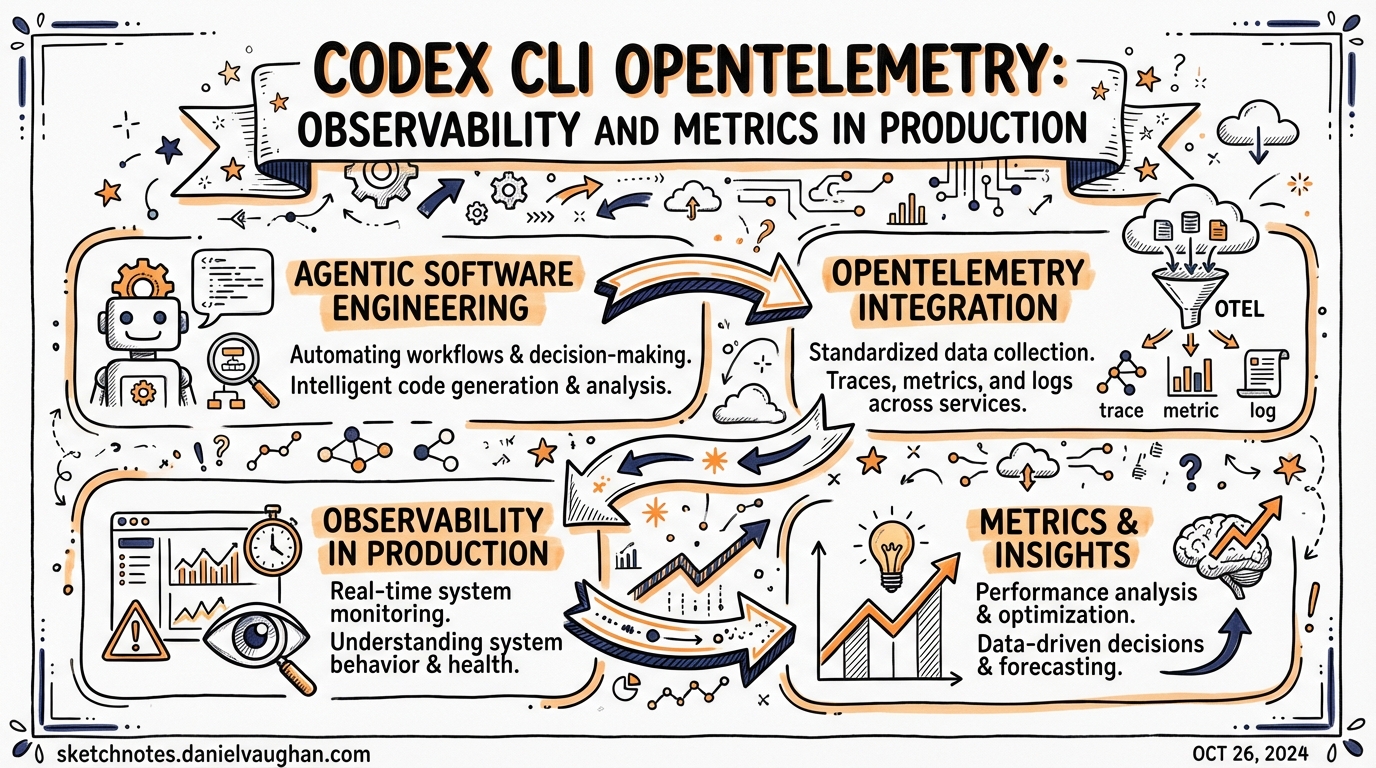
Codex CLI ships built-in OpenTelemetry support for production observability — traces, logs, and metrics from every agent run, exportable to any OTLP-compatible backend.
Why Observability Matters for Agentic Workflows
Running Codex in a single session is debuggable. Running it across an agentic pod — orchestrator, planner, multiple workers, reviewers — generates complexity that escapes manual inspection. You need:
- Latency visibility: Which agent is taking longest? Is it the model or the tool calls?
- Cost tracking: How many tokens per session, per agent type, per day?
- Failure analysis: Where in a multi-agent chain do things go wrong?
- Audit trails: What did the agent do, in what order, with what approvals?
Codex CLI’s [otel] section in config.toml enables all of this through standard OpenTelemetry.
The [otel] Configuration Table
OTel export is opt-in and disabled by default (local runs remain self-contained). Enable it by adding an [otel] section to ~/.codex/config.toml or your project .codex/config.toml.
Minimal setup (capture but don’t export):
[otel]
environment = "dev"       # tags events with env=dev
exporter = "none"         # records locally, sends nothing
log_user_prompt = false   # redacts prompt text (default)
Export via OTLP/HTTP:
[otel]
environment = "staging"
exporter = { otlp-http = { endpoint = "https://otel.example.com/v1/logs", protocol = "binary", headers = { "x-otlp-api-key" = "${OTLP_TOKEN}" } } }
log_user_prompt = false
Export via OTLP/gRPC:
[otel]
environment = "production"
exporter = { otlp-grpc = { endpoint = "https://otel.example.com:4317", headers = { "x-otlp-meta" = "${OTLP_META}" } } }
TLS support: The config reference supports full mutual TLS:
[otel]
tls_ca_cert = "/etc/pki/otel-ca.pem"
tls_client_cert = "/etc/pki/client.pem"
tls_client_key = "/etc/pki/client.key"
What Gets Exported
Codex tags every exported event with:
service.name = "codex-cli"app.version— CLI versionenv— your configured environmentauth_mode,originator,session_source,model
Spans and logs cover:
- Outbound API requests and streamed responses
- User input (if
log_user_prompt = true) - Tool-approval decisions
- Results of every tool invocation (Bash, FileRead, FileWrite, etc.)
Metrics (counters + duration histograms):
- API call counts and latencies
- Stream throughput
- Tool call volumes per type
- Token counts per session
Exporters batch asynchronously and flush on shutdown — no blocking during agent runs.
Known Gaps
Two Codex entry points have incomplete OTel support (as of v0.117.0):
| Entry Point | Traces | Logs | Metrics |
|---|---|---|---|
codex (interactive) |
✅ | ✅ | ✅ |
codex exec |
✅ | ✅ | ❌ no metrics |
codex mcp-server |
❌ | ❌ | ❌ |
Tracked: Issue #12913 — codex exec and codex mcp-server observability gaps.
There is also a known bug where plain HTTP was observed being sent to a gRPC endpoint specified with https:// — related to an upstream opentelemetry-rust issue. Use otlp-http with a binary protocol endpoint if you hit TLS/protocol mismatches.
Integrating with Observability Backends
SigNoz
Point the OTLP endpoint at your SigNoz Cloud ingest URL. Traces appear automatically in the Traces tab under service.name = codex-cli. SigNoz’s Codex monitoring guide covers the full setup.
Grafana + Jaeger
Run an OTel Collector as middleware:
# otel-collector.yaml
receivers:
  otlp:
    protocols:
      grpc:
        endpoint: "0.0.0.0:4317"

processors:
  batch: {}
  # optionally filter sensitive prompts here

exporters:
  jaeger:
    endpoint: "jaeger:14250"
  prometheus:
    endpoint: "0.0.0.0:8889"

service:
  pipelines:
    traces:
      receivers: [otlp]
      processors: [batch]
      exporters: [jaeger]
    metrics:
      receivers: [otlp]
      processors: [batch]
      exporters: [prometheus]
# ~/.codex/config.toml
[otel]
environment = "production"
exporter = { otlp-grpc = { endpoint = "http://localhost:4317" } }
Collector advantages:
- Redact sensitive fields before they leave your network
- Batch and retry on network failures
- Add Kubernetes pod/namespace context automatically
- Fan out to multiple backends from one agent config
Opik (Comet)
Opik maps Codex OTel settings to its own ingest endpoints — useful if you’re already tracking ML experiments in Comet. See the Opik Codex integration guide.
VictoriaMetrics
For a fully open-source cost-effective stack, VictoriaMetrics + OTel Collector gives you deep insights into Codex token economics and tool call volumes. The VictoriaMetrics vibe coding observability guide covers all major coding agents including Codex.
Building a Cost Dashboard
Token metrics from OTel give you the raw data for a cost dashboard. The key metric to track: tokens.used per session, segmented by model.
Pair with the postTaskComplete hook to log a cost record to ~/.codex/usage.jsonl at session end:
// ~/.codex/config.toml - hooks section
[hooks]
postTaskComplete = "~/.codex/hooks/log-cost.sh"
#!/bin/bash
# ~/.codex/hooks/log-cost.sh
# Called with session metadata on stdin as JSON
jq -c '{ts: now, model: .model, tokens: .token_count, session: .session_id}' >> ~/.codex/usage.jsonl
Then in Grafana: count tokens by model, multiply by model price, sum per day. You get a live cost graph without any third-party tracking.
Privacy
Rule: Keep log_user_prompt = false (the default) unless your policy explicitly permits prompt text export.
Even with log_user_prompt = false, tool call results are exported — which can contain file contents if the agent read sensitive files. Use the OTel Collector processor to redact or filter before forwarding to external backends:
processors:
  redaction:
    allow_all_keys: false
    blocked_values: ["AKIA.*", "sk-.*", "ghp_.*"]  # AWS/OpenAI/GitHub keys
Per-Profile OTel Tuning
You can vary OTel verbosity by profile:
[profiles.ci]
model = "gpt-5-codex"
# CI: full telemetry to production collector
[otel]
environment = "ci"
exporter = { otlp-http = { endpoint = "${CI_OTEL_ENDPOINT}", headers = { "Authorization" = "Bearer ${CI_OTEL_TOKEN}" } } }

[profiles.dev]
model = "gpt-5-codex-mini"
# Local dev: capture but don't export
[otel]
environment = "dev"
exporter = "none"
Summary
| Use case | Config |
|---|---|
| Local development | exporter = "none" — records locally, no network |
| Staging / CI | OTLP/HTTP to your collector with environment = "staging" |
| Production | OTLP/gRPC + full TLS, OTel Collector for redaction |
| Enterprise audit trail | log_user_prompt = true (if policy allows) + OTel Collector |
Key gap to watch: codex exec and codex mcp-server don’t emit metrics yet — track Issue #12913 for when this is fixed.
Published: 2026-03-28 Sources: Official advanced config · SigNoz Codex docs · Issue #12913 · VictoriaMetrics blog · Opik integration