Codex Model Lineage: The Context Compaction Breakthrough That Made Long-Horizon Agents Possible
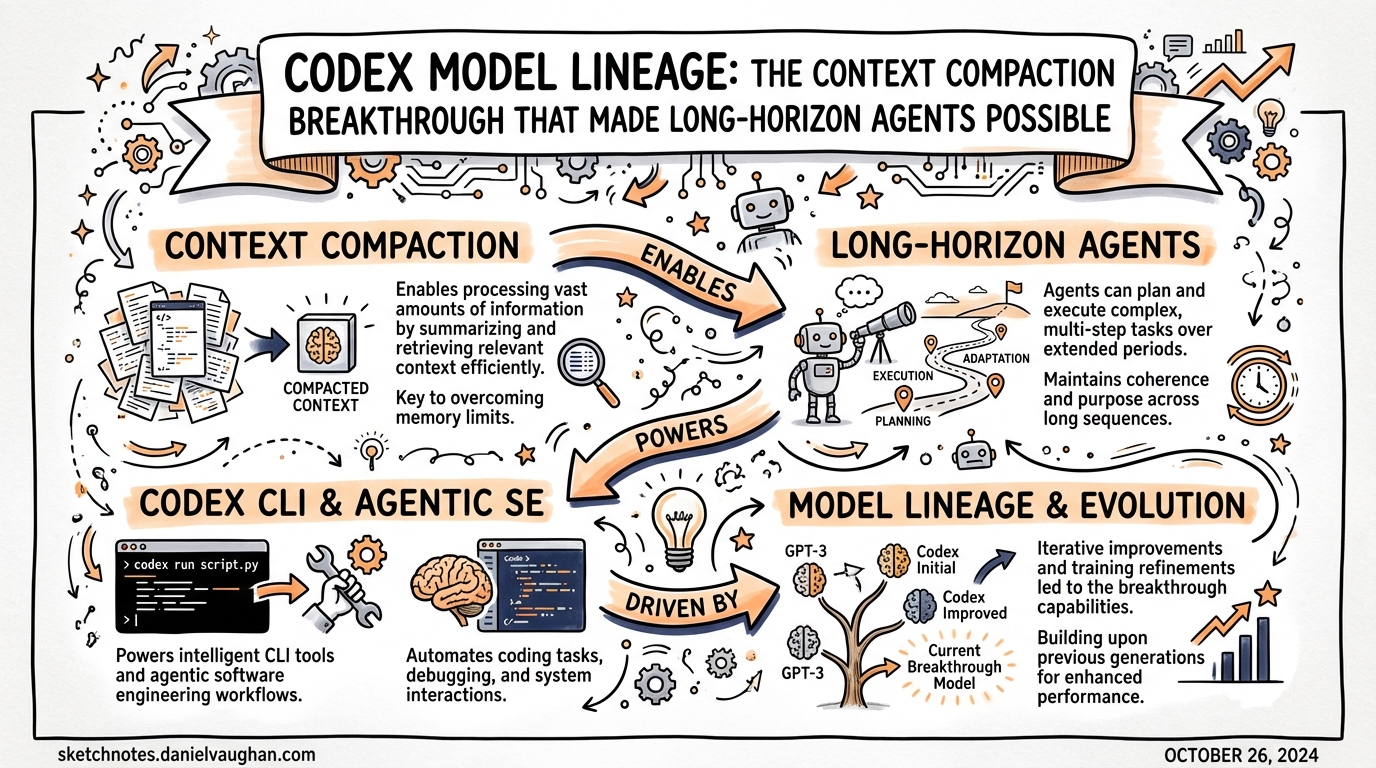
Codex Model Lineage: The Context Compaction Breakthrough
| *Published: 2026-03-28 | Sources: openai.com/index/introducing-gpt-5-2-codex, openai.com/index/introducing-gpt-5-3-codex* |
If you’ve been using Codex CLI for agentic work, you’ve probably hit the wall: a long-running session starts hallucinating earlier decisions, loses track of what files were changed, and forces you to restart. This isn’t a prompting problem — it’s a context architecture problem. Understanding how the Codex model family evolved to address it reveals why modern long-horizon workflows are now actually viable.
The GPT-5.x-Codex Family at a Glance
| Model | Released | Key advance | SWE-Bench Pro | Terminal-Bench 2.0 |
|---|---|---|---|---|
gpt-5.1-codex-max |
Late 2025 | Compaction across windows (external scaffolding) | ~50.8% | ~58.1% |
gpt-5.2-codex |
Jan 14, 2026 | Native context compaction baked into model | 56.4% | 64.0% |
gpt-5.3-codex |
Feb 5, 2026 | Frontier reasoning + coding unified; interactive steering | 56.8% | 77.3% |
gpt-5.3-codex-spark |
Feb 2026 | 1,000+ tok/s on Cerebras hardware (research preview) | — | — |
gpt-5-codex |
March 2026 | New flagship; 4x efficiency sibling (gpt-5-codex-mini) | — | — |
What Changed in GPT-5.2-Codex
Released: January 14, 2026 (OpenAI announcement)
GPT-5.2-Codex is a fine-tune of GPT-5.2 purpose-built for professional software engineering and defensive cybersecurity. Its headline capability: native context compaction.
Before: compaction as external scaffolding
GPT-5.1-Codex-Max could work across multiple context windows — but the compaction was handled by external harness code: summarise older turns, inject the summary, continue. This worked but introduced its own failure modes: the harness might summarise poorly, the model wasn’t trained to expect or interpret those summaries, and long-range coherence suffered.
After: compaction baked into the model itself
GPT-5.2-Codex was specifically optimised for Codex’s compaction workflow. The model knows, during training, that context windows compress and resume. It produces and consumes summaries that are semantically faithful yet token-efficient. The result: genuinely coherent multi-file sessions that span thousands of file operations without losing track.
“The ability for the model to work coherently across multiple context windows” — OpenAI, on how GPT-5.2-Codex’s cybersecurity CTF jump was attributed to compaction.
Key Benchmarks
- SWE-Bench Pro: 56.4% — evaluates correct patches in large, unfamiliar codebases (↑ from 50.8% for GPT-5.1)
- Terminal-Bench 2.0: 64.0% — live terminal environment agentic behaviour
- CVE-Bench: 87% — cybersecurity vulnerability identification and patching
- Tau2-bench tool-call accuracy: 98.7% — agentic workflows rarely fail due to incorrect tool invocations (critical for reliability in automation pipelines)
- SWE-Bench Verified: 80%
The Tau2-bench number is under-discussed. A 98.7% tool-call accuracy rate means that in an automated CI pipeline, the Codex agent very rarely issues malformed tool calls that break the workflow. This is what makes codex exec in unattended pipelines actually practical.
The Architecture: MoE Matters
GPT-5.2-Codex uses a Mixture-of-Experts (MoE) architecture with sparse activation. Only a subset of parameters fire per token, which:
- Keeps per-token inference costs manageable despite deep specialisation
- Allows specialised “expert” sub-networks for coding, tool use, and cybersecurity to operate independently
- Enables the model to be both broad (Tau2-bench tool accuracy) and deep (CVE-Bench security)
This is why the pricing ($1.75/M input, $14/M output) is reasonable for a model that performs at enterprise coding standards.
What GPT-5.3-Codex Added
Released February 5, 2026, GPT-5.3-Codex extends the compaction foundation with two additions:
- Interactive steering without context loss — you can redirect the agent mid-task and it maintains coherent state. Previously, mid-task redirects often caused the agent to lose its thread.
- Frontier reasoning unified into the coding model — GPT-5.3-Codex combines the coding performance of GPT-5.2-Codex with the reasoning depth of GPT-5.2 base in a single system, 25% faster.
Terminal-Bench 2.0 score jumps to 77.3% (from 64.0%) — a 13 percentage point gain that reflects improved tool use chaining and long-horizon task completion, not just code generation quality.
Practical Implications for Agentic Workflows
1. Long autonomous runs are now viable defaults
With GPT-5.2-Codex and later, the /compact command became a genuine strategy (not a workaround). The model is trained to handle compacted context — so proactively compacting at 60% utilisation actually works as intended. Earlier models lost coherence post-compaction more readily.
2. CI/CD automation unlocked by 98.7% tool reliability
For codex exec in unattended GitHub Actions pipelines, the bottleneck was previously incorrect tool invocations breaking the automation. GPT-5.2-Codex’s Tau2-bench result suggests this failure mode is largely solved.
3. Subagent economics changed
With higher per-subagent reliability, you can now afford to spin up more subagents per orchestration run without expecting a fixed failure rate. The 56.4% SWE-Bench Pro performance means each subagent resolves harder tasks before needing human escalation.
4. Cybersecurity as a first-class use case
The jump to 87% on CVE-Bench makes GPT-5.2-Codex (and its successors) viable for automated security review in the agentic pod. Codex Security (launched March 21, 2026) uses this capability lineage.
Model Selection Guidance (Updated)
# config.toml — recommended routing strategy
[profiles.explore]
model = "gpt-5-codex-mini"       # fast exploration, cost-efficient subagents

[profiles.commit]
model = "gpt-5-codex"            # standard commits, most tasks

[profiles.deep]
model = "gpt-5.3-codex"          # complex long-horizon sessions, security reviews

[profiles.legacy-long]
model = "gpt-5.2-codex"          # still available; good for predictable compaction-heavy runs
If you have existing workflows built around GPT-5.2-Codex (e.g., pinned in CI), they remain fully supported and the compaction behaviour is stable. Upgrading to GPT-5.3-Codex gives you interactive steering; upgrading to gpt-5-codex gives you the new efficiency tier.
What to Watch in v0.118.0
The v0.118.0 alpha builds (alpha.1–alpha.3 as of March 27) haven’t published release notes yet. Given the model lineage trajectory, watch for:
- Further compaction improvements (multi-agent session handoff)
gpt-5-codexbecoming the default model- Spark model graduating from research preview
See: notes/changelog-watch.md for v0.118.0 tracking
| *Added: 2026-03-28 | Covers: GPT-5.2-Codex (Jan 14, 2026), GPT-5.3-Codex (Feb 5, 2026)* |