Codex CLI Rules Engine: Starlark Policies, Approval Fatigue, and the Coming `general_rule` Fix
Codex CLI Rules Engine: Starlark Policies, Approval Fatigue, and the Coming general_rule Fix
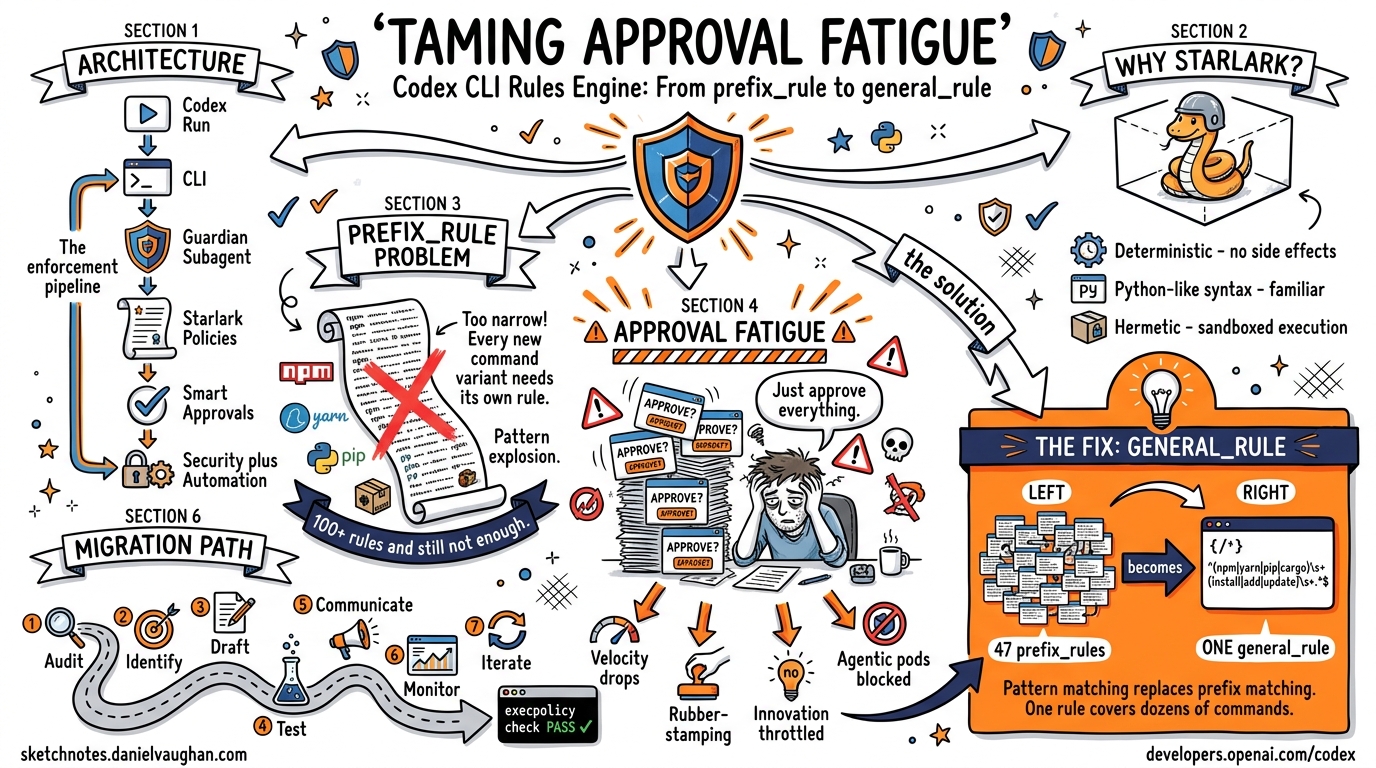
Navigating the challenges of policy enforcement in agentic workflows.
Codex CLI’s rules engine lets teams define executable policies that govern what the agent can and cannot do – without requiring a human to approve every action. This article covers the architecture (Starlark policy files, the Guardian subagent), the current prefix_rule system and its limitations, the approval fatigue problem it creates, and the proposed general_rule() fix.
Architecture Overview
The rules engine sits between the Codex CLI agent loop and the actions it wants to execute:
flowchart LR
    A[codex run] --> B[CLI]
    B --> C["Guardian Subagent<br/>(I enforce the rules!)"]
    C --> D[Starlark Policies]
    D --> E[Smart Approvals]
    E --> F[Security + Automation]
The Guardian subagent is the enforcement point. It loads .rules files written in Starlark, evaluates each proposed action against the defined policies, and either approves, denies, or escalates to the human.
The .rules File
Rules files use Starlark (a Python-like configuration language originally developed for Bazel). They are loaded and evaluated by the Guardian subagent at runtime.
# my_project.rules
load("...", "prefix_rule")

rule = prefix_rule(
    name = "allow-npm-install",
    prefix = "npm install",
    action = "approve"
)
Why Starlark?
- Deterministic: No side effects, no imports, no I/O – safe to evaluate untrusted policy files
- Familiar syntax: Python-like, so most developers can read and write rules immediately
- Hermetic execution: The Guardian evaluates rules in a sandboxed Starlark interpreter
prefix_rule() Semantics
The current primary rule type is prefix_rule(), which matches commands by their prefix:
flowchart LR
    A[Input Data] --> B{prefix_rule match?}
    B -->|YES| C["Approve<br/>auto-run"]
    B -->|NO| D["Deny/Flag<br/>require human approval or block"]
Example Rules
# Approve common safe commands
prefix_rule(prefix="npm install", action="approve")
prefix_rule(prefix="npm test", action="approve")
prefix_rule(prefix="git status", action="approve")
prefix_rule(prefix="cat ", action="approve")

# Block dangerous commands
prefix_rule(prefix="rm -rf /", action="deny")
prefix_rule(prefix="curl | bash", action="deny")
The Problem with prefix_rule
Prefix matching is too narrow for real-world agentic workflows:
-
Every new prefix requires a new rule. When the agent invents a slightly different command (
npm ciinstead ofnpm install,yarn addinstead ofnpm install), it falls through to manual approval. - Community rule sets are fragile. Teams share large
prefix_rulelists, but maintaining them is:- High overhead (hundreds of rules for common workflows)
- Prone to errors (typos, missing variants)
- Hard to scale (every new tool or command pattern needs a new entry)
- Pattern explosion. Agentic workflows generate creative command variants that prefix matching cannot anticipate.
The Approval Fatigue Problem
The consequence of narrow prefix_rule matching is approval loop fatigue:
APPROVAL REQUIRED
APPROVAL REQUIRED
APPROVAL REQUIRED
APPROVAL REQUIRED
...
In practice, developers face endless manual approvals for every new command prefix the agent tries. This creates several problems:
- Developer velocity drops – the agent is blocked waiting for approval, and the developer is interrupted
- Developers start rubber-stamping – after the 50th approval, humans stop reading and just hit “approve,” defeating the security purpose
- Innovation is throttled – the agent cannot explore creative solutions because every novel command needs approval
- Agentic pod workflows suffer – autonomous agents in CI/CD and pod-based workflows cannot function with constant approval requirements
Impact on Agentic Pod Workflows
Agentic pods – where multiple Codex CLI agents work on different parts of a project simultaneously – are particularly affected. Each agent generates unique command sequences, and the combined approval volume makes human oversight impractical. The result: either teams use --yolo (no safety) or they experience constant interruption (no productivity).
The Current Workaround: Shared Community Rule Sets
Teams currently address approval fatigue by maintaining and sharing large prefix_rule collections:
# community_rules.rules -- maintained by the team/community
load("...", "prefix_rule")

# Package managers (47 rules)
prefix_rule(prefix="npm install", action="approve")
prefix_rule(prefix="npm ci", action="approve")
prefix_rule(prefix="npm test", action="approve")
prefix_rule(prefix="npm run build", action="approve")
prefix_rule(prefix="yarn add", action="approve")
prefix_rule(prefix="yarn install", action="approve")
prefix_rule(prefix="pip install", action="approve")
prefix_rule(prefix="pip3 install", action="approve")
# ... dozens more ...

# Git commands (23 rules)
prefix_rule(prefix="git status", action="approve")
prefix_rule(prefix="git diff", action="approve")
prefix_rule(prefix="git log", action="approve")
prefix_rule(prefix="git add", action="approve")
# ... more ...

# Build tools (31 rules)
prefix_rule(prefix="make ", action="approve")
prefix_rule(prefix="cargo build", action="approve")
prefix_rule(prefix="cargo test", action="approve")
prefix_rule(prefix="go build", action="approve")
prefix_rule(prefix="go test", action="approve")
# ... more ...
This works but is high overhead, prone to errors, and hard to scale. When a new tool enters the workflow, every team must update their shared rules file.
The Proposed Fix: general_rule()
The general_rule() proposal addresses the fundamental limitation of prefix-only matching by introducing pattern-based, flexible policies:
# Instead of dozens of prefix_rules:
general_rule(allow_cli_safe_patterns)
How general_rule() Differs from prefix_rule()
| Feature | prefix_rule() |
general_rule() |
|---|---|---|
| Matching | Exact prefix only | Pattern matching (globs, regex, semantic) |
| Scope | Single command | Categories of commands |
| Maintenance | One rule per command variant | One rule per pattern |
| Flexibility | Rigid | Broad, flexible policies |
Example general_rule() Policies
# Approve all read-only filesystem operations
general_rule(
    name = "allow-reads",
    pattern = "cat|head|tail|less|wc|file|stat|ls|find|tree *",
    action = "approve"
)

# Approve all package manager install commands
general_rule(
    name = "allow-package-install",
    pattern = "(npm|yarn|pnpm|pip|pip3|cargo|go) (install|add|get|ci)",
    action = "approve"
)

# Approve all test runners
general_rule(
    name = "allow-tests",
    pattern = "(npm|yarn|cargo|go|pytest|jest|mocha) test*",
    action = "approve"
)

# Block destructive operations regardless of prefix
general_rule(
    name = "block-destructive",
    pattern = "rm -rf /|mkfs|dd if=|:(){ :|:& };:",
    action = "deny"
)
Benefits
- Fewer rules, broader coverage – one
general_rulereplaces dozens ofprefix_ruleentries - Pattern matching, not just prefixes – match anywhere in the command string
- Reduced manual intervention – the agent can operate more autonomously within safe bounds
- Scales with new tools – patterns like
* test*catch new test runners automatically
Testing Policies: execpolicy check
Before deploying rules to production, validate them with the built-in policy checker:
codex execpolicy check my_policy.rules
This command:
- Loads and parses the
.rulesfile - Validates Starlark syntax
- Checks for conflicting rules (e.g., a rule that both approves and denies the same pattern)
- Reports coverage gaps (common commands that have no matching rule)
- Returns a pass/fail result
$ codex execpolicy check my_policy.rules
Parsing... OK
Conflicts... none
Coverage... 87% of common commands covered
Result: PASS
Always run execpolicy check before deploying updated rules files.
A Production-Ready Default Rules File
The Codex CLI team is working on a default rules file that ships with the CLI:
- Base policies – safe defaults for common development workflows
- Security checks – blocks for known-dangerous patterns
- Best practices – encoding community consensus on safe agent behavior
- Customizable templates – starting points for team-specific policies
The philosophy: start secure, customize later. Teams can extend the default rules rather than building from scratch.
Practical Checklist for Migrating to general_rule()
When general_rule() becomes available, follow this migration path:
- Audit existing
prefix_rules– inventory all current rules and their approval patterns - Identify common patterns – group related
prefix_ruleentries that can be consolidated - Draft
general_rule()policies – write pattern-based rules that replace groups of prefix rules - Test with
execpolicy check– validate the new rules file - Communicate changes to teams – ensure all developers understand the new policy scope
- Monitor for false positives – watch for legitimate commands being blocked by overly broad patterns
- Iterate and refine – adjust patterns based on real-world usage data
The Road Ahead
The combination of general_rule(), the Guardian subagent, and smart approvals points toward a future where:
- Agentic pod workflows run with faster deployment, autonomous decision-making within safe bounds, and increased efficiency
- Approval fatigue disappears for common workflows while maintaining security for novel or dangerous operations
- Policy-as-code becomes the standard for governing AI agent behavior, not just human-written approval lists
The rules engine is evolving from a simple prefix matcher to a full policy evaluation framework – bringing the same rigor to AI agent governance that infrastructure-as-code brought to deployment.
Sources: sketchnotes.danielvaughan.com, developers.openai.com/codex