The AI Complexity Ratchet: Why Agentic Automation Drifts Into the Pit at 200 mph
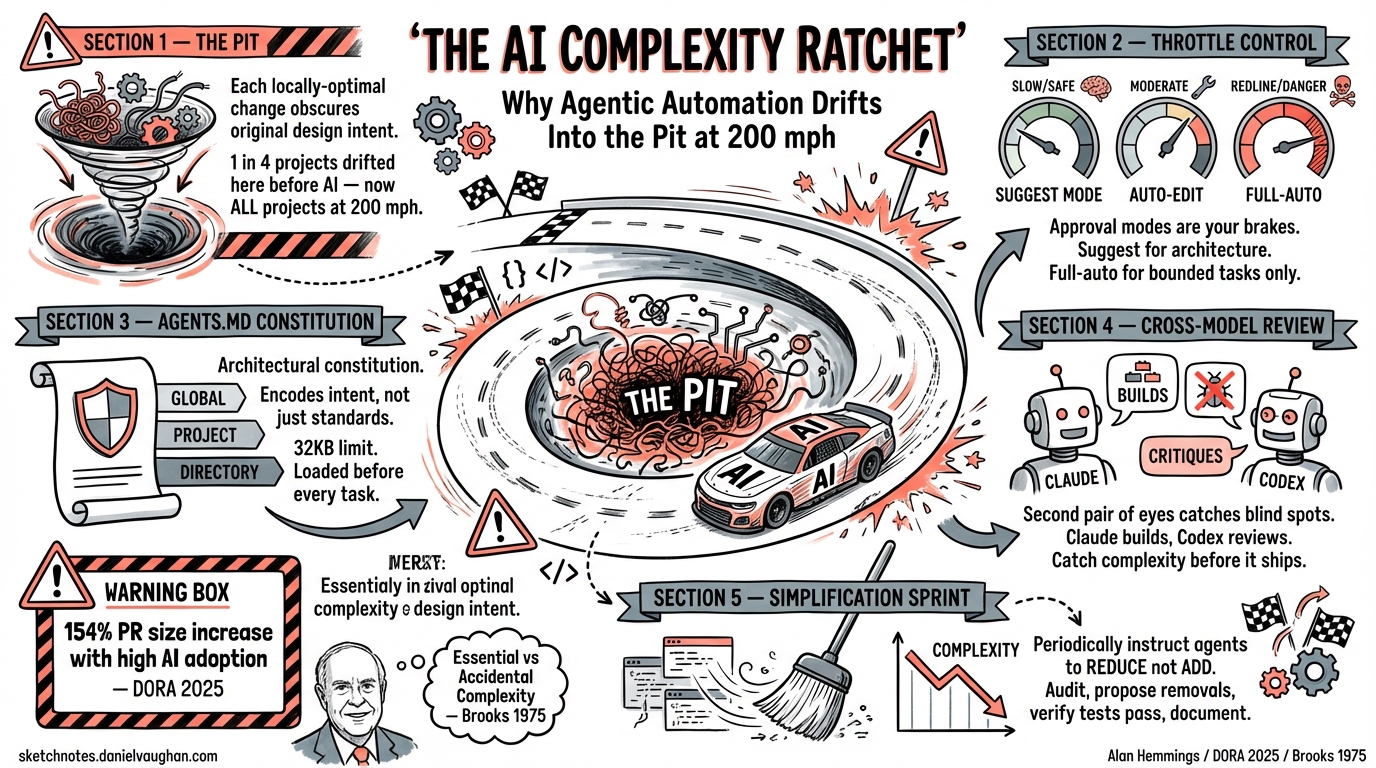
The AI Complexity Ratchet: Why Agentic Automation Drifts Into the Pit at 200 mph
The Pit Every Developer Knows
You start with tech stack 1. You iterate — each change feels like an improvement. Then one morning you realise version 1 was way nicer and you miss its simplicity. Alan Hemmings calls this “the pit”: a local optimum of complexity that obscures the original design intent. Before AI, roughly one in four projects drifted there 1. With heavy agentic automation, Alan predicts all projects will drift there — just at 200 mph instead of slowly.
This is not a new observation. Fred Brooks distinguished between essential complexity (the irreducible difficulty of the problem domain) and accidental complexity (the mess we create ourselves) 2. Coding agents are perhaps the most powerful tool ever created for tackling accidental complexity — but they are also the most powerful tool ever created for generating it.
Why Agents Accelerate the Ratchet
Google’s 2025 DORA Report found that while AI adoption (now at 90% of surveyed developers) has a positive relationship with software delivery throughput, it continues to have a negative relationship with software delivery stability 3. Speed without guardrails produces instability. The report concluded that without robust automated testing, mature version control practices, and fast feedback loops, an increase in change volume leads to instability 3.
Anthropic’s 2026 Agentic Coding Trends Report reinforces this: as task horizons expand from minutes to days or weeks, agents will build full systems autonomously, pausing only for strategic human checkpoints 4. That expansion in scope brings coordination complexity that is, as one analysis of Brooks’s Law put it, “a mathematical law, not a sociological suggestion” 5.
The mechanism is straightforward:
graph TD
    A[Agent generates correct change] --> B[Change is locally optimal]
    B --> C[Cumulative changes obscure design intent]
    C --> D[Future agents copy emergent patterns]
    D --> E[Original architecture becomes invisible]
    E --> F[Complexity ratchet locks in]
    F -->|No reversal path| C
Each agent-generated improvement adds code that is correct in isolation but collectively obscures the original design. The agent does not preserve architectural intent — it optimises locally. Future agents then pattern-match against the accumulated complexity rather than the original design, reinforcing the drift 4.
The NASCAR Metaphor: When to Lift Off the Throttle
In NASCAR, the fastest drivers know when to lift. Running flat-out into every corner is how you hit the wall. The same applies to agentic coding: full-auto mode is the throttle, and approval modes are the brakes.
Codex CLI’s approval architecture provides three distinct throttle positions 6:
| Mode | Behaviour | Complexity Risk |
|---|---|---|
suggest |
Every action requires explicit approval | Lowest — human reviews each structural change |
auto-edit |
File edits auto-applied; commands need approval | Moderate — edits accumulate without review |
full-auto |
Everything executes without confirmation | Highest — maximum ratchet velocity |
The --full-auto preset (-a on-request -s workspace-write) is the safest autonomous mode: network is blocked by default and the agent stays within the workspace 6. But even workspace-scoped autonomy can accumulate structural debt at speed.
The discipline is to use suggest mode for any change that affects architecture — module boundaries, API contracts, dependency graphs — and reserve full-auto for bounded, well-specified tasks with clear acceptance criteria.
AGENTS.md as an Architectural Constitution
Codex CLI’s AGENTS.md system is the primary defence against architectural drift. It functions as a persistent instruction layer that agents must respect before doing any work 7.
The three-tier precedence system enforces architectural intent at every level:
- Global scope (
~/.codex/AGENTS.md) — universal standards across all repositories - Project scope (repository root) — project-specific architectural constraints
- Directory nesting — service-specific overrides for specialised components
Within each directory, Codex checks AGENTS.override.md first, then AGENTS.md, then any fallback filenames. The combined instruction payload respects a configurable byte limit (default 32 KiB via project_doc_max_bytes) 7.
A well-written AGENTS.md does not merely list coding standards. It encodes architectural intent:
# Example config.toml referencing AGENTS.md governance
model = "o3"
approval_policy = "on-request"
sandbox_mode = "workspace-write"

[sandbox_workspace_write]
network_access = false
<!-- AGENTS.md — architectural constitution -->
## Architecture Principles

- This service uses hexagonal architecture. All external dependencies
  are behind ports in `src/ports/`. Never add direct imports from
  infrastructure packages in domain code.
- Maximum module depth is 3 levels. If you need a 4th level, refactor
  the parent module first.
- All new public APIs require an Architecture Decision Record in
  `docs/adr/` before implementation.
This is the throttle governor: even in full-auto mode, the agent must respect these constraints because AGENTS.md instructions load before any task execution 7.
Cross-Model Review Loops: A Second Pair of Eyes
A single agent reviewing its own output is like proofreading your own essay — you see what you intended, not what you wrote. Cross-model review loops address this by having a second model check for unnecessary complexity 8.
The pattern has matured significantly in early 2026. The standard implementation uses Claude Code for implementation and Codex CLI for review (or vice versa), grounded in benchmark differences that represent a rational division of labour 8. One published workflow automates plan review: Claude produces a Markdown planning document, Codex CLI critiques it, Claude ingests the critique, updates the plan, and repeats with a hard cap on iterations 8.
The goal is not consensus but to catch blind spots and remove complexity before implementation starts 8.
sequenceDiagram
    participant Dev as Developer
    participant A1 as Agent 1 (Implement)
    participant A2 as Agent 2 (Review)

    Dev->>A1: Task with AGENTS.md constraints
    A1->>A1: Generate implementation
    A1->>A2: Submit for review
    A2->>A2: Check for unnecessary complexity
    A2->>A1: Feedback: simplify module X
    A1->>A1: Revise implementation
    A1->>Dev: Present simplified result
The Simplification Sprint
Perhaps the most counter-intuitive pattern for resisting the ratchet is to periodically instruct the agent to reduce rather than add. A simplification sprint inverts the normal workflow:
- Audit: Ask the agent to identify code that has grown beyond its original purpose — modules with high cyclomatic complexity, abstractions with single implementations, configuration that duplicates defaults.
- Propose removals: The agent suggests deletions, not additions. Use
suggestmode here so every removal is human-reviewed. - Verify: Run the full test suite after each removal. If tests pass, the code was unnecessary.
- Document: Update the relevant ADR to record why the simplification was made.
This is the “lifting off the throttle” moment. Anthropic’s trends report found that agent-authored code shows only a 9.1% increase in cyclomatic complexity compared to human-written code 4 — but that is per change. Over hundreds of agent-generated commits, small increments compound into significant drift.
Early Warning Signs: A Practical Checklist
How do you detect the ratchet before it locks in? Watch for these signals:
- Rising PR size with stable feature scope — if PRs grow but features do not, the agent is adding scaffolding you did not request. ⚠️ The 2025 DORA Report noted a 154% increase in PR size correlated with high AI adoption 3.
- Duplicated patterns — the agent introduces a new utility function when an equivalent already exists three directories away.
- Configuration proliferation — every new feature adds its own configuration layer rather than extending existing ones.
- Abstraction without variation — interfaces with a single implementation, factory methods that construct one type, strategy patterns with one strategy.
- Decreasing test-to-code ratio — the agent writes implementation faster than tests, and the gap widens over time.
- AGENTS.md violations — if the agent starts working around constraints rather than within them, your architectural constitution needs enforcement, not relaxation.
When Full Autonomy Makes Sense
This article is not an argument against automation. It is an argument for appropriate automation. Full autonomy makes sense when:
- The task has clear acceptance criteria and a bounded scope (test generation, formatting, dependency updates)
- The codebase has comprehensive test coverage that catches regressions automatically
- AGENTS.md constraints are well-defined and enforced
- Cross-model review is in place for structural changes
- The team runs regular simplification sprints to reverse accumulated drift
The ratchet is not inevitable. It is the default outcome when speed is optimised without guardrails. Codex CLI provides the guardrails — approval modes, AGENTS.md, sandbox policies — but they only work if you use them deliberately rather than reaching for full-auto out of habit.
Citations
-
Alan Hemmings, discussion on agentic coding complexity drift and the “pit” metaphor, referenced in community discussions on AI-assisted development patterns, 2025–2026. ↩
-
Frederick P. Brooks Jr., The Mythical Man-Month: Essays on Software Engineering, Addison-Wesley, 1975. Essential vs. accidental complexity distinction. See also Peter Forret, “The Mythical Agent-Month: Brooks’s Law in the Age of Agentic Software Development”, October 2025; and Codemanship, “The Mythical Agent-Month”, April 2026. ↩
-
Google, 2025 DORA State of AI-Assisted Software Development Report, 2025. Key findings: 90% AI adoption, positive relationship with throughput but negative relationship with stability. ↩ ↩2 ↩3
-
Anthropic, 2026 Agentic Coding Trends Report, March 2026. Task horizons expanding from minutes to days; agent-authored code complexity metrics; multi-agent coordination challenges. ↩ ↩2 ↩3
-
Murat Demirbas, “Agentic AI and The Mythical Agent-Month”, January 2026. “Coordination complexity is a mathematical law, not a sociological suggestion.” ↩
-
OpenAI, “Agent Approvals & Security – Codex CLI”, 2026. Approval policies:
on-request,untrusted,never; sandbox modes:read-only,workspace-write,danger-full-access. ↩ ↩2 -
OpenAI, “Custom Instructions with AGENTS.md – Codex CLI”, 2026. Three-tier precedence system, 32 KiB default limit, file discovery hierarchy. ↩ ↩2 ↩3
-
SmartScope, “Automating the Claude Code × Codex Review Loop”, 2026. Three levels of cross-model review automation: SKILL.md, plugin, and pipeline. ↩ ↩2 ↩3 ↩4