Claude Managed Agents: What Anthropic's Cloud-Hosted Agent Platform Means for Codex CLI
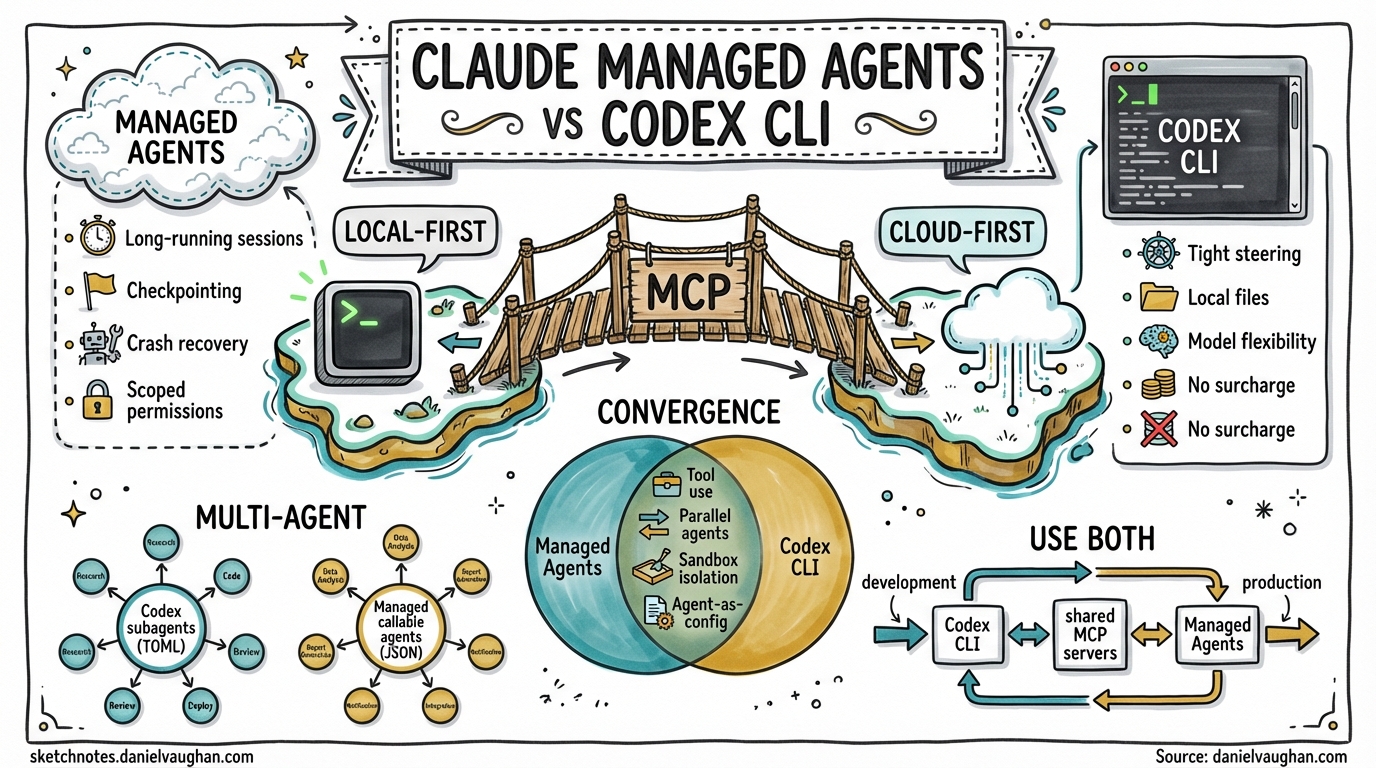
Claude Managed Agents: What Anthropic’s Cloud-Hosted Agent Platform Means for Codex CLI
On 8 April 2026 Anthropic launched Claude Managed Agents in public beta — a suite of composable APIs for building and deploying cloud-hosted agents at scale 1. The timing is deliberate: every major AI lab now ships an agent runtime, and Anthropic’s entry collapses months of infrastructure work into days. For practitioners already running Codex CLI, the question is not “which one wins?” but “where does each fit, and how do they compose?”
This article dissects what Managed Agents actually ships today, compares its architectural choices with Codex CLI’s local-first model, examines the multi-agent overlap, and argues that MCP — supported by both platforms — makes them complementary rather than exclusive.
What Managed Agents Does
Claude Managed Agents is a managed runtime that pairs an agent harness tuned for performance with production infrastructure 2. You define an agent — model, system prompt, tools, MCP servers, and skills — as a versioned JSON configuration, then reference it by ID each time you start a session 3. Anthropic handles the rest:
- Sandboxed execution — bash, file operations, web search and web fetch run inside secure containers 4.
- Long-running sessions — agents operate autonomously for hours; progress persists through disconnections 1.
- Checkpointing and crash recovery — sessions resume from the last checkpoint after outages 2.
- Scoped permissions — fine-grained control over which tools an agent can invoke 3.
- End-to-end tracing — full observability into agent reasoning and tool calls 1.
The bundled toolset, agent_toolset_20260401, provides eight pre-built tools: bash, read, write, edit, glob, grep, web_fetch, and web_search 4. Individual tools can be selectively disabled per agent.
What Is Still in Research Preview
Two headline features are not in the public beta and require separate access requests 5:
- Multi-agent coordination — an agent can spin up and direct other agents to parallelise complex work.
- Self-evaluation — the agent defines outcomes and success criteria, then iterates autonomously until they are met.
This distinction matters. The public beta is a single-agent runtime with excellent infrastructure. The multi-agent orchestration that makes Managed Agents sound most powerful is gated behind research preview 5.
Pricing
Standard Claude Platform token rates apply, plus $0.08 per session-hour for active runtime 6. Idle time waiting for input does not count. For a typical 20-minute coding session, the infrastructure surcharge is roughly $0.03 — negligible next to token costs for a Sonnet 4.6 or Opus 4.6 workload.
Architectural Comparison with Codex CLI
The two platforms approach the same problem from opposite ends.
graph LR
    subgraph "Codex CLI — Local-First"
        A[Developer Terminal] --> B[Codex Agent Loop]
        B --> C[Local Sandbox<br/>seatbelt / Landlock]
        B --> D[Local File System]
        B --> E[Approval Prompts]
    end

    subgraph "Managed Agents — Cloud-First"
        F[API Client] --> G[Managed Runtime]
        G --> H[Cloud Sandbox<br/>Container]
        G --> I[Persistent Session State]
        G --> J[Scoped Permissions]
    end

    style A fill:#f9f,stroke:#333
    style F fill:#bbf,stroke:#333
| Dimension | Codex CLI | Claude Managed Agents |
|---|---|---|
| Execution | Local process, developer’s machine 7 | Cloud container, Anthropic infrastructure 1 |
| Session model | Interactive TUI or codex exec batch 7 |
Long-running autonomous, hours-scale 1 |
| Safety model | Approval modes (suggest / auto-edit / full-auto) + OS sandbox (macOS seatbelt, Linux Landlock) 8 | Scoped permissions + container isolation 3 |
| State | Ephemeral (session-scoped, lost on exit unless resumed) | Persistent (checkpointed, survives disconnection) 2 |
| Agent definition | config.toml profiles + AGENTS.md 7 |
Versioned JSON agent configs via API 3 |
| Developer loop | Tight — approve/reject in real-time | Loose — fire-and-forget, review later |
| Models | OpenAI-native (GPT-5.4, gpt-5.3-codex) + custom providers 9 | Claude-native (Sonnet 4.6, Opus 4.6) 3 |
The fundamental trade-off is steering granularity versus autonomy duration. Codex CLI excels when you want to stay in the loop, approving each tool call or at least each batch. Managed Agents excels when the task specification is clear enough to delegate entirely — “process these 500 PRs overnight” rather than “help me refactor this function” 10.
Multi-Agent Overlap
Both platforms invest heavily in multi-agent orchestration, but with different maturity levels and architectural choices.
Codex CLI Subagents (GA)
Codex CLI’s subagent system is generally available 11. Custom agents are defined as TOML files under ~/.codex/agents/ or .codex/agents/, with per-agent model, reasoning effort, sandbox mode, and instructions 11. The orchestration primitives include:
[features]
multi_agent = true

[agents.explorer]
description = "Fast reconnaissance of large codebases"
config_file = "explorer.toml"

[agents.reviewer]
description = "Thorough code review with security focus"
config_file = "reviewer.toml"
The parent agent spawns subagents, routes instructions, waits for results, and closes threads — a hub-and-spoke pattern where all coordination flows through the orchestrator 11. Batch processing uses spawn_agents_on_csv for data-parallel workloads 12.
Managed Agents Multi-Agent (Research Preview)
Managed Agents’ multi-agent coordination allows an agent to spin up child agents dynamically via the callable_agents array in the agent configuration 5. The parent-child spawning model is conceptually similar to Codex subagents, but runs entirely in the cloud with Anthropic managing the lifecycle 1.
graph TD
    subgraph "Codex CLI Multi-Agent"
        O1[Orchestrator] -->|spawn| S1[Explorer Subagent]
        O1 -->|spawn| S2[Reviewer Subagent]
        O1 -->|spawn| S3[Writer Subagent]
        S1 -->|result| O1
        S2 -->|result| O1
        S3 -->|result| O1
    end

    subgraph "Managed Agents Multi-Agent"
        O2[Parent Agent] -->|callable_agents| C1[Child Agent A]
        O2 -->|callable_agents| C2[Child Agent B]
        C1 -->|result| O2
        C2 -->|result| O2
    end
The key difference: Codex subagents run locally and the developer retains approval authority. Managed Agents children run in the cloud and inherit the parent’s scoped permissions — no human in the loop unless you build one via webhooks.
The A2A Absence
Neither platform currently supports Google’s Agent2Agent (A2A) protocol 13, the open standard for cross-vendor agent interoperability donated to the Linux Foundation in 2025. A2A enables peer-to-peer agent communication via Agent Cards and task lifecycle management 13. Its absence from both Codex CLI and Managed Agents means cross-platform orchestration — a Codex subagent coordinating with a Managed Agent — requires custom glue code today. MCP bridges the tool layer, but not the agent coordination layer.
The Convergence Thesis
Despite starting from opposite ends — local terminal versus cloud API — both platforms are converging on remarkably similar patterns:
- Tool use — both provide bash, file operations, web search, and extensibility via MCP 47.
- Parallel agents — both support spawning multiple agents for concurrent work 511.
- Sandbox isolation — both enforce tool-level security boundaries, albeit through different mechanisms 38.
- Agent-as-configuration — both define agent behaviour declaratively (TOML vs JSON) rather than imperatively 37.
The convergence suggests the industry is settling on a common agent architecture. The differentiator is not the pattern but the deployment model: local-first with developer steering (Codex CLI) versus cloud-first with autonomous execution (Managed Agents).
MCP as the Bridge
Both Codex CLI and Managed Agents support the Model Context Protocol 73, making them composable rather than exclusive. An MCP server that exposes your internal APIs, databases, or monitoring tools works with either runtime unchanged.
This creates a practical integration architecture:
graph TB
    subgraph "Shared Infrastructure"
        MCP1[MCP Server:<br/>Internal APIs]
        MCP2[MCP Server:<br/>Database]
        MCP3[MCP Server:<br/>Monitoring]
    end

    subgraph "Development Time"
        DEV[Codex CLI] --> MCP1
        DEV --> MCP2
    end

    subgraph "Production / Async"
        PROD[Managed Agent] --> MCP1
        PROD --> MCP2
        PROD --> MCP3
    end
Your MCP servers become the portable capability layer. Invest in MCP tooling once, deploy through whichever agent runtime suits the task. Interactive refactoring at your terminal? Codex CLI. Overnight batch processing of 200 repositories? Managed Agents.
What This Means for Practitioners
Use Codex CLI When
- You need tight steering — approving individual tool calls, redirecting mid-task.
- The work involves local uncommitted changes or sensitive files that should not leave your machine.
- You want model flexibility — GPT-5.4, gpt-5.3-codex-spark, or local models via custom providers 9.
- Cost sensitivity is high — Codex CLI has no per-session-hour surcharge.
Use Managed Agents When
- The task is well-specified and autonomous — clear inputs, clear success criteria.
- Sessions need to run for hours without a developer present 1.
- You need production-grade infrastructure — checkpointing, crash recovery, tracing — without building it yourself 2.
- The workflow is Claude-native — leveraging Sonnet 4.6 or Opus 4.6 strengths.
Use Both When
- Development happens in Codex CLI (interactive, local, fast feedback loops).
- Production agent services run on Managed Agents (autonomous, persistent, observable).
- MCP servers provide the shared tool layer, reusable across both runtimes.
The Competitive Landscape Implications
Managed Agents’ launch intensifies the agent platform war. OpenAI has the Codex CLI and the Agents SDK 14; Anthropic now has Claude Code, the Claude Agent SDK, and Managed Agents; Google has the Agent Development Kit and A2A 13. Each is building a full-stack agent platform, but with different centres of gravity:
- OpenAI: model-native tooling, local-first CLI, open-source Codex CLI 7.
- Anthropic: managed infrastructure, cloud-first deployment, enterprise sandboxing 1.
- Google: protocol standardisation (A2A, MCP contributions), framework-agnostic interop 13.
For teams already invested in Codex CLI, Managed Agents is not a replacement — it is an expansion of the solution space. The practitioners who will benefit most are those who recognise that different tasks demand different deployment models, and who build their tooling (AGENTS.md, MCP servers, agent configurations) to be portable across both.
Citations
Medium, April 2026. Medium article
-
Anthropic, “Claude Managed Agents: get to production 10x faster”, claude.com/blog, 8 April 2026. https://claude.com/blog/claude-managed-agents ↩ ↩2 ↩3 ↩4 ↩5 ↩6 ↩7 ↩8
-
The Decoder, “Anthropic launches managed infrastructure for autonomous AI agents”, 9 April 2026. https://the-decoder.com/anthropic-launches-managed-infrastructure-for-autonomous-ai-agents/ ↩ ↩2 ↩3 ↩4
-
Anthropic, “Claude Managed Agents overview”, Claude API Docs. https://platform.claude.com/docs/en/managed-agents/overview ↩ ↩2 ↩3 ↩4 ↩5 ↩6 ↩7 ↩8
-
Anthropic, “Tools — Claude Managed Agents”, Claude API Docs. https://platform.claude.com/docs/en/managed-agents/tools ↩ ↩2 ↩3
-
unicodeveloper, “Claude Managed Agents: Honest Pros and Cons”, ↩ ↩2 ↩3 ↩4
-
SiliconANGLE, “Anthropic launches Claude Managed Agents to speed AI agent development”, 8 April 2026. SiliconANGLE article ↩
-
OpenAI, “Codex CLI”, GitHub. https://github.com/openai/codex ↩ ↩2 ↩3 ↩4 ↩5 ↩6 ↩7
-
OpenAI Developers, “Codex CLI Approval Modes and Sandbox”, Codex Documentation. https://developers.openai.com/codex/config-advanced ↩ ↩2
-
danielvaughan, “Codex CLI Custom Model Providers: Azure, Vercel, Local LLMs and Dynamic Bearer Tokens”, codex.danielvaughan.com, 31 March 2026. https://codex.danielvaughan.com/2026/03/31/codex-cli-custom-model-providers/ ↩ ↩2
-
Northflank, “Claude Code vs OpenAI Codex: which is better in 2026?”. https://northflank.com/blog/claude-code-vs-openai-codex ↩
-
OpenAI Developers, “Subagents — Codex”. https://developers.openai.com/codex/subagents ↩ ↩2 ↩3 ↩4
-
danielvaughan, “Codex CLI Subagents: TOML Format, Parallelism and spawn_agents_on_csv”, codex.danielvaughan.com, 26 March 2026. https://codex.danielvaughan.com/2026/03/26/codex-cli-subagents-toml-parallelism/ ↩
-
Google Developers Blog, “Announcing the Agent2Agent Protocol (A2A)”. https://developers.googleblog.com/en/a2a-a-new-era-of-agent-interoperability/ ↩ ↩2 ↩3 ↩4
-
OpenAI Developers, “Use Codex with the Agents SDK”. https://developers.openai.com/codex/guides/agents-sdk ↩