Claude Opus 4.7 Launch: What It Means for AI Coding Agents
Claude Opus 4.7 Launch: What It Means for AI Coding Agents
Source: anthropic.com/news/claude-opus-4-7
Overview
On 16 April 2026, Anthropic released Claude Opus 4.7 (API identifier: claude-opus-4-7), the successor to Opus 4.6. Pricing remains unchanged at $5 per million input tokens and $25 per million output tokens – the same as Opus 4.6 – making it a capability upgrade rather than a pricing-tier shift.
Opus 4.7 is available on Claude.ai, the Anthropic API, Amazon Bedrock, Google Cloud Vertex AI, and Microsoft Foundry.
Key Improvements
Improved Agentic Execution Rigor
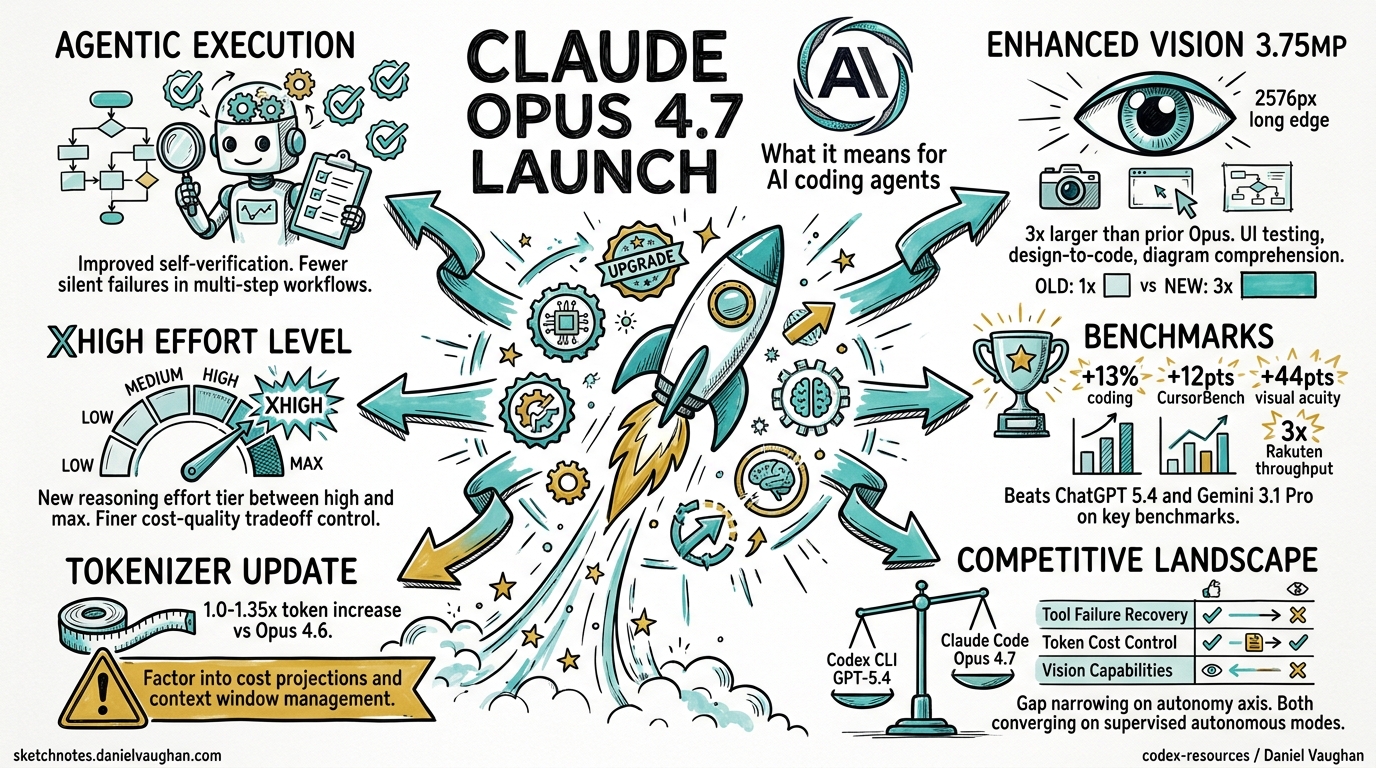
Opus 4.7 introduces tighter agentic execution guarantees. The model demonstrates improved self-verification capabilities, meaning it is more likely to check its own work before declaring a task complete. For coding agents like Claude Code and Codex CLI (via cross-model bridging), this translates to fewer silent failures in multi-step workflows and better adherence to instructions that require sequential reasoning across tool calls.
Enhanced Vision: 3.75 MP (2,576 px Long Edge)
The maximum image resolution jumps to 3.75 megapixels with a 2,576-pixel long edge – approximately 3x larger than prior Opus models. This is significant for workflows that involve screenshot analysis, UI testing, design-to-code pipelines, and diagram comprehension. Agents processing visual inputs will get substantially more detail per image without needing to tile or downscale.
New xhigh Effort Level
Opus 4.7 adds a new reasoning effort level called xhigh, positioned between high and max. This gives developers finer control over the cost-quality tradeoff for complex tasks that benefit from extended reasoning but do not require the full token budget of max effort.
Updated Tokenizer
The tokenizer has been updated, resulting in a 1.0-1.35x token increase for equivalent prompts compared to Opus 4.6. Teams should factor this into cost projections and context window management, particularly for long-session workflows where token budgets are tight.
New /ultrareview Slash Command in Claude Code
Opus 4.7 ships alongside a new /ultrareview slash command in Claude Code that leverages the model’s improved self-verification capabilities for deep code review passes. This extends the existing review workflow with a more thorough multi-pass analysis.
Availability
| Platform | Status |
|---|---|
| Claude.ai | Available |
| Anthropic API | Available (claude-opus-4-7) |
| Amazon Bedrock | Available |
| Google Cloud Vertex AI | Available |
| Microsoft Foundry | Available |
Pricing
| Tier | Input | Output |
|---|---|---|
| Opus 4.7 | $5 / MTok | $25 / MTok |
| Opus 4.6 (unchanged) | $5 / MTok | $25 / MTok |
No pricing change from the previous generation.
Benchmarks
Early benchmark data shows Opus 4.7 delivering measurable improvements across multiple domains:
| Benchmark | Opus 4.7 | Opus 4.6 | Improvement |
|---|---|---|---|
| Coding (93-task eval) | — | — | +13% lift |
| CursorBench | 70% | 58% | +12 pts |
| General Finance | 0.813 | 0.767 | +6% |
| Visual acuity | 98.5% | 54.5% | +44 pts |
| Document reasoning | — | — | 21% fewer errors |
| Production tasks (Rakuten) | 3× more completed | baseline | +200% throughput |
| Tool-call accuracy | — | — | Double-digit improvement |
Anthropic claims Opus 4.7 beats ChatGPT 5.4 and Gemini 3.1 Pro across key benchmarks. The tool-call accuracy improvement and failure recovery capability are particularly relevant for agentic workflows — agents that can recover from tool failures mid-execution waste fewer tokens on retries and dead-end paths.
Mythos Preview Context
Anthropic concedes that Opus 4.7 still trails its unreleased Mythos Preview model, which has been shared only with select tech and cybersecurity companies. According to Axios, Opus 4.7 includes differential training to reduce cyber capabilities compared to Mythos — a deliberate capability cap for the public release. A new Cyber Verification Program enables legitimate security researchers to access fuller capabilities for vulnerability testing and red-teaming.
Impact on Codex CLI and Claude Code Workflows
For Claude Code users, Opus 4.7 is a direct upgrade: better agentic execution, larger vision inputs, and the new /ultrareview command. Auto Mode is now extended to Max users for autonomous decision-making. For Codex CLI users who access Claude models via the codex-plugin-cc cross-model bridge or multi-provider configurations, the improved self-verification and vision capabilities carry over to cross-platform workflows.
The tokenizer change (1.0-1.35x increase) is the main operational consideration. Teams running close to context window limits or with tight per-session token budgets should test their existing workflows against Opus 4.7 before switching, and adjust compaction thresholds or budget caps accordingly.
Task Budgets (Public Beta)
Opus 4.7 introduces task budgets in public beta — a feature to guide token spending on longer runs. This directly parallels Codex CLI’s own goal mode token budgets (PRs #18074-#18077), suggesting convergent evolution: both platforms are solving the same problem of autonomous agents needing spending guardrails.
Competitive Implications
| Dimension | Codex CLI (GPT-5.4) | Claude Code (Opus 4.7) |
|---|---|---|
| Coding benchmark | Strong (GPT-5.4 Codex line) | 70% CursorBench, +13% coding lift |
| Tool failure recovery | Guardian + hooks | Native model capability |
| Token cost control | Goal mode budgets | Task budgets (beta) |
| Effort levels | Standard reasoning | xhigh new tier |
| Autonomy | Goal mode, full-auto | Auto Mode (93% approval) |
| Vision | Screenshot via MCP | 3.75 MP native (2,576 px) |
The competitive gap is narrowing on the autonomy axis: both platforms are converging on “supervised autonomous” modes with cost guardrails. The key differentiator remains infrastructure — Codex CLI’s Rust-based sandbox and hook system vs Claude Code’s model-native self-verification.
Further Reading
- Anthropic announcement
- Axios: Anthropic releases Claude Opus 4.7, concedes it trails Mythos
- 9to5Mac: New Opus 4.7 model with focus on advanced software engineering
- GitHub Blog: Claude Opus 4.7 is generally available
- Chapter 4 (Benchmarks) and Chapter 5 (Competing Tools) of the Codex CLI book cover Claude model performance in detail