Self-Healing CI/CD for Agentic Systems: The Pipeline Doctor Pattern and LLM-as-a-Judge
Self-Healing CI/CD for Agentic Systems: The Pipeline Doctor Pattern and LLM-as-a-Judge
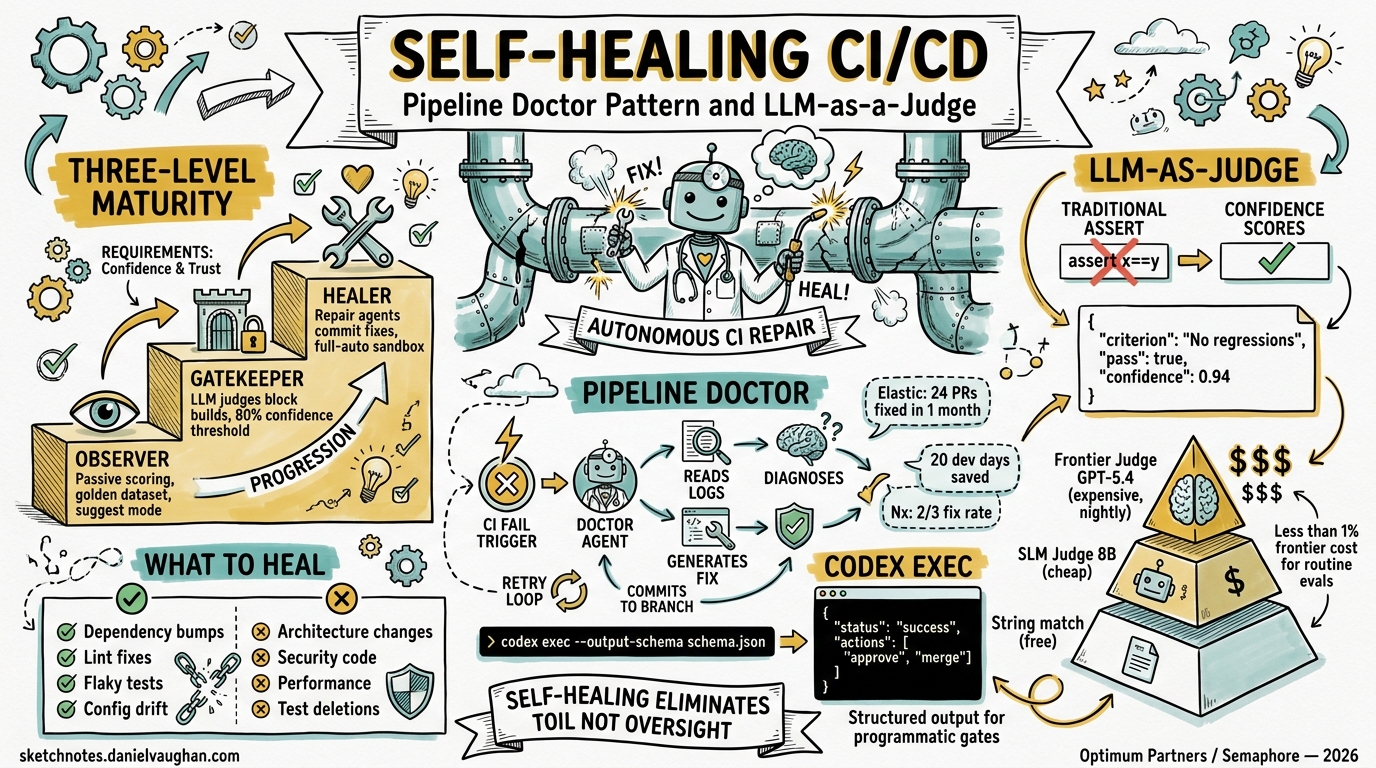
Traditional CI/CD pipelines were designed for deterministic software. A test either passes or fails; a build either compiles or doesn’t. But agentic AI systems produce probabilistic outputs — they don’t return Y, they return Y-ish1. This fundamental mismatch has driven a new generation of self-healing CI patterns that replace binary assertions with confidence-scored evaluations, and manual triage with autonomous repair agents.
This article covers the three-level self-healing maturity model, the Pipeline Doctor pattern for autonomous failure remediation, and how LLM-as-a-Judge replaces brittle assertions — all mapped to Codex CLI’s permission model and codex exec command.
The Three-Level Self-Healing Maturity Model
The industry has converged on a three-level progression for self-healing CI, each mapping cleanly to Codex CLI’s approval modes2:
graph TD
    A[Level 1: Observer] -->|Confidence baseline established| B[Level 2: Gatekeeper]
    B -->|Fix success rate > 80%| C[Level 3: Healer]

    A --- A1["Passive LLM scoring<br/>No build blocking<br/>Golden dataset creation"]
    B --- B1["LLM-as-Judge gates builds<br/>Confidence threshold: 80%<br/>Failures escalate to humans"]
    C --- C1["Repair agents commit fixes<br/>Full-auto sandbox mode<br/>Human review before merge"]

    style A fill:#e1f5fe
    style B fill:#fff3e0
    style C fill:#e8f5e9
Level 1: Observer (suggest approval mode)
Deploy LLM-as-a-Judge in passive mode. The judge scores every build without blocking anything, building a “golden dataset” of what good looks like1. In Codex CLI terms, this maps to suggest approval mode — the agent analyses and recommends but never writes.
codex exec "Analyse the CI logs at /tmp/build-output.log. \
  Score each test result for correctness on a 0-1 scale. \
  Output a JSON summary with pass/fail/confidence for each test suite." \
  --output-schema '{"type":"object","properties":{"suites":{"type":"array","items":{"type":"object","properties":{"name":{"type":"string"},"pass":{"type":"boolean"},"confidence":{"type":"number"}}}}}}' \
  --sandbox-mode read-only
Level 2: Gatekeeper (auto-edit approval mode)
Promote the judge to a blocking gate. If the judge scores an output below the confidence threshold, fail the build1. The agent can now modify test expectations and configuration but not production code.
Level 3: Healer (full-auto approval mode)
Grant the repair agent write access. The agent reads logs, diagnoses failures, commits fixes, and re-runs the pipeline2. This maps to full-auto mode — Codex CLI’s convenience alias that enables workspace-write sandbox with on-request approval policy3.
The Pipeline Doctor Pattern
The Pipeline Doctor is an architectural pattern where CI failure events trigger specialised repair agents rather than simply notifying developers2. The pattern has three phases:
sequenceDiagram
    participant CI as CI Pipeline
    participant D as Pipeline Doctor
    participant R as Repository
    participant V as Validation Pipeline

    CI->>CI: Build/test fails
    CI->>D: Trigger with failure logs + context
    D->>D: Diagnose failure category
    D->>R: Read relevant source files
    D->>D: Generate minimal fix
    D->>R: Commit fix to branch
    R->>V: Trigger validation pipeline
    V-->>D: Pass/fail result
    alt Validation passes
        D->>R: Open PR for human review
    else Validation fails
        D->>D: Retry with different approach
    end
Implementing Pipeline Doctor with Codex CLI
The OpenAI Cookbook provides an official pattern for CI autofix using codex-action4. The workflow triggers on workflow_run completion with failure status:
name: Self-Healing CI
on:
  workflow_run:
    workflows: ["CI Build"]
    types: [completed]

jobs:
  autofix:
    if: ${{ github.event.workflow_run.conclusion == 'failure' }}
    runs-on: ubuntu-latest
    permissions:
      contents: write
      pull-requests: write
    steps:
      - uses: actions/checkout@v4
        with:
          ref: ${{ github.event.workflow_run.head_branch }}

      - uses: openai/codex-action@main
        with:
          prompt: |
            You are working in this repository. The CI build failed.
            Read the failure logs, identify the root cause, implement
            the minimal fix needed, and verify it passes locally.
          codex_args: '["--config","sandbox_mode=\"workspace-write\""]'
        env:
          OPENAI_API_KEY: ${{ secrets.OPENAI_API_KEY }}

      - uses: peter-evans/create-pull-request@v6
        with:
          commit-message: "fix(ci): auto-fix failing tests via Codex"
          branch: codex/auto-fix-${{ github.event.workflow_run.id }}
          title: "fix(ci): automated repair for ${{ github.event.workflow_run.head_branch }}"
Production Evidence: Elastic’s 24-PR Month
Elastic’s Control Plane team provides the strongest production evidence for the Pipeline Doctor pattern. They integrated Claude Code into their Buildkite CI to automatically fix broken Renovate dependency PRs5. Results from the first month:
- 24 broken PRs fixed autonomously
- 22 commits by the repair agent (22 July – 22 August 2025)
- ~20 days of estimated developer time saved
- ~500 dependencies managed across core services
Critical to their success was a well-maintained CLAUDE.md file (analogous to AGENTS.md in Codex CLI) that taught the agent preferred coding practices5. They also enforced safety guardrails: auto-merge was disabled so every AI-generated fix required human review, and --allowedTools restricted which commands the agent could execute.
Nx Cloud: Two-Thirds Fix Rate
Nx Cloud’s self-healing CI uses project-graph awareness to achieve approximately a two-thirds success rate on broken PRs6. The system leverages Nx’s dependency graph to understand which projects are affected by a failure, providing the repair agent with targeted context rather than the entire monorepo. Nx shipped a Claude Code plugin in Q1 2026 that bundles LLM metadata with Nx plugins, improving agent context for repair tasks7.
LLM-as-a-Judge: Beyond Binary Assertions
LLM-as-a-Judge replaces rigid assert x == y checks with confidence-scored evaluations from a secondary model8. This is essential when testing agentic outputs that are correct but not identical — a refactored function, an alternative algorithm, or a differently-worded commit message.
The Judge Returns Structured Scores
Instead of boolean pass/fail, the judge returns structured evaluations:
{
  "criterion": "code_correctness",
  "pass": true,
  "confidence": 0.94,
  "reasoning": "Implementation handles edge cases correctly, uses appropriate error types"
}
The SLM Cost Trick
Running a frontier model as judge on every PR introduces meaningful cost and latency. The emerging pattern is to fine-tune a small language model (8B parameters) as a specialised judge9. JudgeLM research demonstrates that fine-tuned judges at 7B–33B parameters achieve agreement rates exceeding 90%, surpassing human-to-human agreement on evaluation benchmarks10.
The practical deployment pattern recommended across the industry8:
| Gate | Model | When |
|---|---|---|
| String-match + execution evals | None (deterministic) | Every commit |
| Fine-tuned SLM judge (8B) | Llama 3.3 8B fine-tuned | Every PR |
| Frontier LLM judge | GPT-5.4 / Claude Opus 4.6 | Nightly / pre-release |
This tiered approach delivers <1% of frontier model cost for routine evaluations while reserving expensive models for comprehensive pre-release quality gates1.
Codex Exec as Judge
codex exec with --output-schema provides a natural interface for LLM-as-a-Judge in CI pipelines:
#!/bin/bash
# judge.sh — evaluate agent-generated code against acceptance criteria

DIFF=$(git diff main...HEAD)
CRITERIA="articles/acceptance-criteria.md"

codex exec "You are a code review judge. Evaluate this diff against the \
  acceptance criteria. Score each criterion 0-1. Flag any security concerns." \
  --input <(echo "$DIFF") \
  --output-schema '{
    "type": "object",
    "properties": {
      "overall_pass": {"type": "boolean"},
      "overall_confidence": {"type": "number"},
      "criteria_scores": {
        "type": "array",
        "items": {
          "type": "object",
          "properties": {
            "criterion": {"type": "string"},
            "score": {"type": "number"},
            "note": {"type": "string"}
          }
        }
      },
      "security_flags": {"type": "array", "items": {"type": "string"}}
    }
  }' \
  --sandbox-mode read-only \
  --model gpt-5.4-mini
The --output-schema flag ensures the judge returns structured JSON that downstream pipeline steps can parse with jq, enabling programmatic gate decisions11.
GitHub Agentic Workflows: The Platform-Native Approach
GitHub Agentic Workflows, in technical preview since February 2026, provide a platform-native alternative to custom self-healing pipelines12. Instead of YAML, you write Markdown files with YAML frontmatter that describe automation goals in natural language:
---
name: fix-ci-failures
on:
  workflow_run:
    workflows: ["CI"]
    types: [completed]
permissions:
  contents: read
safe-outputs:
  - create-pull-request
  - add-comment
  - noop
tools:
  - gh
  - npm
---

Analyse the CI failure logs. Classify the failure as transient
(network timeout, rate limit) or permanent (compilation error,
breaking change). For permanent failures, create a fix PR. For
transient failures, add a comment. Never raise minimum SDK versions
or delete tests.
The security model is noteworthy: workflows run read-only by default, with write operations channelled through declared “safe outputs”. The agent requests; a gated job decides12. Tiago Pascoal demonstrated this pattern fixing Dependabot dependency PRs in a Kotlin Android project, with the agent distinguishing between infrastructure issues and code problems13.
Organisational Implications
The Maturity Ladder
Most teams should start at Level 1 (Observer) and progress only after building confidence in judge accuracy. Elastic’s experience shows that “tuning AI agents’ behaviour marks the difference between failure and success”5 — jumping straight to Level 3 without establishing guardrails invites cascading automated damage.
What to Heal and What Not To
Self-healing works best for:
- Dependency bumps (Renovate/Dependabot PRs with breaking API changes)
- Linting and formatting failures
- Flaky test stabilisation (retry logic, timeout adjustments)
- Configuration drift (environment variable changes, version pinning)
Self-healing should not attempt:
- Architectural changes
- Security-sensitive code modifications
- Performance regressions (these need profiling, not patching)
- Test deletions (⚠️ a common agent shortcut that masks real failures)
Cost Economics
The cost equation favours self-healing once a team manages more than a handful of dependencies. Elastic’s 20 days saved in one month5 against the cost of API calls and compute for the repair agent represents a significant return. The SLM judge pattern keeps ongoing evaluation costs minimal — a fine-tuned 8B model running on a single GPU costs orders of magnitude less than developer hours spent triaging flaky CI1.
Putting It Together: A Complete Self-Healing Pipeline
graph LR
    A[PR Opened] --> B[CI Pipeline]
    B -->|Pass| C[SLM Judge Gate]
    B -->|Fail| D[Pipeline Doctor]
    D -->|Fix committed| B
    D -->|Fix failed 3x| E[Human Escalation]
    C -->|Confidence ≥ 0.8| F[Merge Queue]
    C -->|Confidence < 0.8| G[Frontier Judge]
    G -->|Pass| F
    G -->|Fail| E

    style D fill:#e8f5e9
    style C fill:#fff3e0
    style G fill:#e1f5fe
This architecture combines the Pipeline Doctor for failure remediation with tiered LLM-as-a-Judge for quality gating. The SLM judge handles routine evaluations cheaply, escalating only uncertain cases to a frontier model. Human developers remain the final authority on merge decisions — self-healing CI eliminates toil, not oversight.
Citations
-
Optimum Partners, “Building Self-Healing CI/CD Pipelines for Agentic AI Systems,” 2026. https://optimumpartners.com/insight/how-to-architect-self-healing-ci/cd-for-agentic-ai/ ↩ ↩2 ↩3 ↩4 ↩5
-
Semaphore, “AI-Driven CI: Exploring Self-Healing Pipelines,” 2026. https://semaphore.io/blog/self-healing-ci ↩ ↩2 ↩3
-
OpenAI, “Codex CLI
--full-autodescription,” GitHub Issue #6522. https://github.com/openai/codex/issues/6522 ↩ -
OpenAI, “Use Codex CLI to automatically fix CI failures,” OpenAI Cookbook. https://developers.openai.com/cookbook/examples/codex/autofix-github-actions ↩
-
Elastic, “CI/CD pipelines with agentic AI: How to create self-correcting monorepos,” Elasticsearch Labs. https://www.elastic.co/search-labs/blog/ci-pipelines-claude-ai-agent ↩ ↩2 ↩3 ↩4
-
Nx, “AI-Powered Self-Healing CI,” Nx Docs. https://nx.dev/docs/features/ci-features/self-healing-ci ↩
-
Nx, “Nx 2026 Roadmap: Expanding Agent Autonomy, Improving Performance,” Nx Blog. https://nx.dev/blog/nx-2026-roadmap ↩
-
Label Your Data, “LLM as a Judge: A 2026 Guide to Automated Model Assessment.” https://labelyourdata.com/articles/llm-as-a-judge ↩ ↩2
-
Monte Carlo Data, “LLM-As-Judge: 7 Best Practices & Evaluation Templates.” https://www.montecarlodata.com/blog-llm-as-judge/ ↩
-
Zhu et al., “JudgeLM: Fine-tuned Large Language Models are Scalable Judges,” ICLR 2025 Spotlight. https://arxiv.org/abs/2310.17631 ↩
-
OpenAI, “Codex CLI for CI/CD: codex exec, Non-Interactive Mode and Pipeline Integration,” codex-resources. Published 2026-03-26. ↩
-
GitHub, “GitHub Agentic Workflows are now in technical preview,” GitHub Changelog, 13 February 2026. https://github.blog/changelog/2026-02-13-github-agentic-workflows-are-now-in-technical-preview/ ↩ ↩2
-
Tiago Pascoal, “Self-Healing CI: Using GitHub Agentic Workflows to Automatically Fix CI Failures,” 12 March 2026. https://pascoal.net/2026/03/12/self-healing-ci-using-gh-aw/ ↩