Self-Evolving Agents in Practice: Implementing the OpenAI Cookbook Retraining Loop with Codex CLI Hooks
Self-Evolving Agents in Practice: Implementing the OpenAI Cookbook Retraining Loop with Codex CLI Hooks
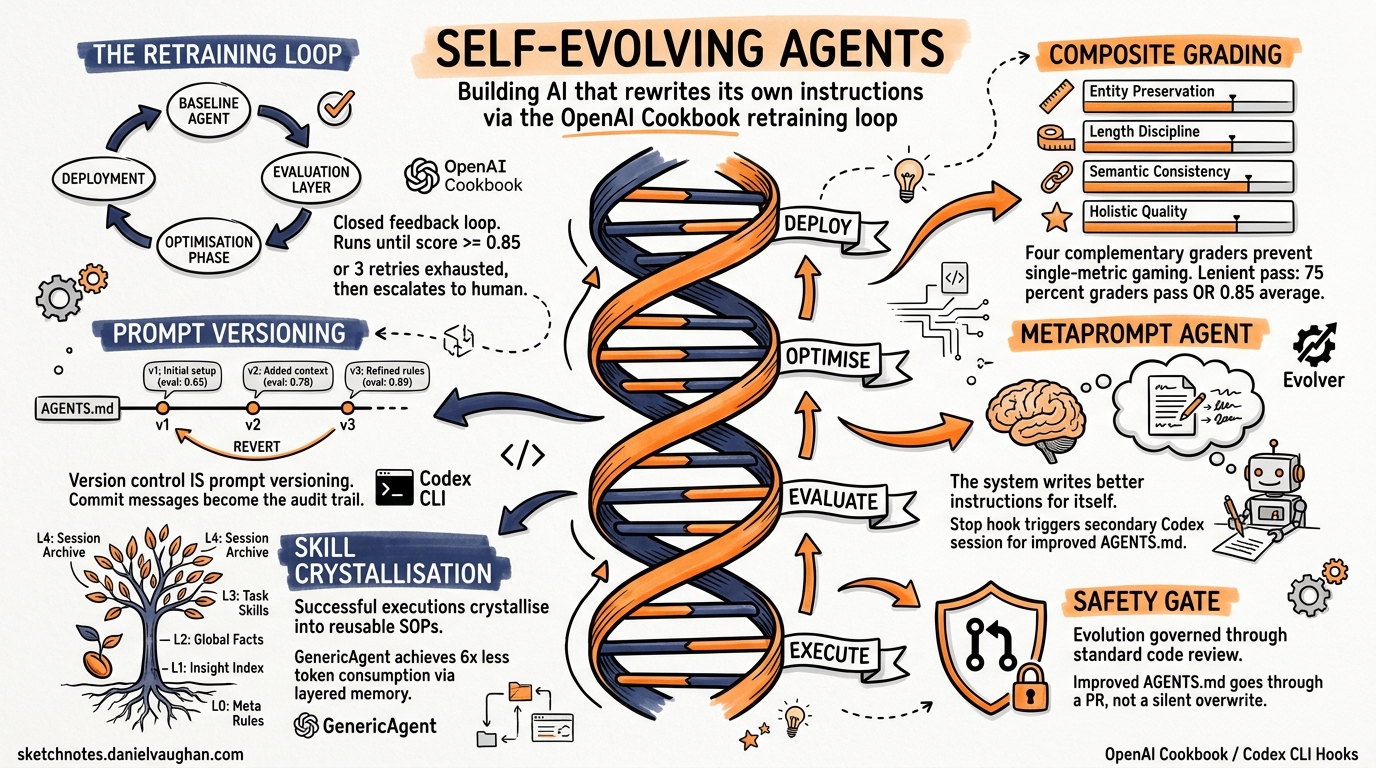
Most agentic systems plateau after proof-of-concept. The agent handles the happy path, but edge cases accumulate, prompts drift, and performance quietly degrades. The official OpenAI Cookbook now provides a reference architecture for self-evolving agents — systems that diagnose their own failures, capture structured feedback, and iteratively refine their behaviour through autonomous retraining loops1. This article maps that architecture onto Codex CLI’s hook system, showing how to build a self-improving coding agent using tools you already have.
The Retraining Loop: Four Stages
The cookbook’s core pattern is a closed feedback loop with four stages1:
graph LR
    A[Baseline Agent] --> B[Evaluation Layer]
    B --> C[Optimisation Phase]
    C --> D[Deployment]
    D --> A
    B -->|Score ≥ threshold| D
- Baseline Agent executes a task using the current prompt configuration
- Evaluation Layer scores the output through composite grading (rule-based validators + LLM-as-judge)
- Optimisation Phase feeds failure signals to a metaprompt agent that generates improved instructions
- Deployment replaces the baseline prompt when the improved version exceeds target thresholds
The loop continues until scores pass (typically ≥0.85 average across graders) or a retry budget of three attempts is exhausted, at which point human escalation triggers1.
Composite Grading: Why One Metric Isn’t Enough
The cookbook employs four complementary graders to prevent single-metric optimisation1:
| Grader | Type | Threshold | Purpose |
|---|---|---|---|
| Entity preservation | Rule-based | 0.80 | Ensures critical terms survive summarisation |
| Length discipline | Deterministic | 0.85 | Maintains target word count ±20% |
| Semantic consistency | Cosine similarity | 0.85 | Guards against content drift |
| Holistic quality | LLM-as-judge | 0.85 | Captures nuanced signals rules miss |
The lenient pass criteria require either ≥75% of graders to pass individually, or an average score ≥0.85 across all four1. This accommodates scenarios where perfection on every dimension simultaneously isn’t achievable.
For Codex CLI, the natural mapping is a PostToolUse hook that runs composite validation after each tool execution:
{
  "hooks": [
    {
      "event": "PostToolUse",
      "matcher": "Bash",
      "command": ".codex/hooks/composite-grader.sh",
      "statusMessage": "Running composite evaluation..."
    }
  ]
}
The hook receives the executed command and its output via stdin JSON2, enabling a grader script to run linting, type checking, test suites (rule-based) and optionally pipe the output through an LLM-as-judge evaluation.
Note: PostToolUse hooks currently only fire for the Bash tool2. Apply Patch events do not yet trigger hooks (tracked in issue #167323). Plan your grading pipeline around Bash-based validation commands.
Prompt Versioning via AGENTS.md Git History
The cookbook’s VersionedPrompt class tracks prompt iterations with immutable version numbers, timestamps, and associated eval metadata1. In Codex CLI, you get this for free through AGENTS.md under version control.
graph TD
    A[AGENTS.md v1] -->|git commit| B[AGENTS.md v2]
    B -->|git commit| C[AGENTS.md v3]
    C -->|regression detected| A
    B -->|eval scores| D[Eval Metadata in Commit Messages]
    C -->|eval scores| D
Codex walks down from the project root to your current working directory, concatenating AGENTS.md files found along the path4. Files closer to the working directory override earlier guidance because they appear later in the combined prompt4. This hierarchical resolution means you can version task-specific instructions independently of project-level rules.
A practical versioning workflow:
# After a successful eval run, commit the improved AGENTS.md
git add AGENTS.md
git commit -m "agents: v14 — improve error handling instructions

Eval scores: entity=0.92, length=0.88, semantic=0.91, quality=0.87
Average: 0.895 (target: 0.85) — PASS
Previous version average: 0.81"

# If a regression surfaces, revert cleanly
git revert HEAD --no-edit
Each commit message becomes the audit trail — the eval_id and run_id equivalent from the cookbook’s PromptVersionEntry1.
The Metaprompt Pattern: An Agent That Rewrites Its Own Instructions
The cookbook’s most powerful concept is the metaprompt agent — a dedicated agent that receives the original prompt, the failed output, and specific grader feedback, then generates an improved prompt1. It’s the “self-evolving” core: the system writes better instructions for itself.
In Codex CLI, implement this as a Stop hook that triggers a secondary Codex session:
#!/usr/bin/env bash
# .codex/hooks/metaprompt-optimiser.sh
# Triggered by the Stop hook event

INPUT=$(cat)
STOP_REASON=$(echo "$INPUT" | jq -r '.stopReason // empty')

# Only trigger on task completion, not user interrupts
if [ "$STOP_REASON" != "task_complete" ]; then
  echo '{"continue": false}'
  exit 0
fi

# Run eval suite against the session transcript
TRANSCRIPT=$(echo "$INPUT" | jq -r '.transcript_path')
EVAL_SCORE=$(codex exec "Evaluate the quality of the work in $TRANSCRIPT against our grading rubric in .codex/eval-rubric.md. Return a JSON score object." 2>/dev/null | jq -r '.average_score')

if (( $(echo "$EVAL_SCORE < 0.85" | bc -l) )); then
  # Trigger metaprompt optimisation
  codex exec "You are a prompt optimisation agent. Read the current AGENTS.md instructions and the session transcript at $TRANSCRIPT. The composite eval score was $EVAL_SCORE (target: 0.85). Generate an improved AGENTS.md that addresses the identified weaknesses. Write the result to AGENTS.md.proposed" 2>/dev/null

  echo '{"systemMessage": "Eval score below threshold. Proposed AGENTS.md improvement generated.", "continue": false}'
else
  echo '{"continue": false}'
fi
The Stop hook supports continue, stopReason, and systemMessage fields2. Setting continue: false with a systemMessage ensures the feedback is logged without forcing further agent execution.
Skill Crystallisation: From Sessions to Reusable Knowledge
GenericAgent (3.9K ⭐) independently arrived at the same pattern through its L3 task skills layer — successful complex task executions are crystallised into reusable SOPs stored for direct invocation on future similar tasks5. The framework claims 6× less token consumption than comparable agents by using layered memory (L0–L4) instead of massive context windows5.
graph TD
    subgraph GenericAgent Memory
        L0[L0: Meta Rules] --> L1[L1: Insight Index]
        L1 --> L2[L2: Global Facts]
        L2 --> L3[L3: Task Skills / SOPs]
        L3 --> L4[L4: Session Archive]
    end
    subgraph Codex CLI Equivalent
        A0[AGENTS.md] --> A1[Memory System]
        A1 --> A2[Project Memory]
        A2 --> A3[SKILL.md / Skills]
        A3 --> A4[Session Transcripts]
    end
    L0 -.->|maps to| A0
    L3 -.->|maps to| A3
| GenericAgent Layer | Purpose | Codex CLI Analogue |
|---|---|---|
| L0 — Meta Rules | Behavioural constraints | AGENTS.md system prompt |
| L1 — Insight Index | Fast routing and recall | Built-in memory system4 |
| L2 — Global Facts | Accumulated knowledge | Project-level memory |
| L3 — Task Skills | Reusable workflows | Skills / SKILL.md files |
| L4 — Session Archive | Long-horizon recall | Session transcripts (JSONL) |
For Codex CLI, skill crystallisation can be implemented through a SessionStart hook that analyses previous session transcripts and extracts reusable patterns:
#!/usr/bin/env bash
# .codex/hooks/skill-crystalliser.sh
# Runs on SessionStart to check for crystallisation opportunities

INPUT=$(cat)
SOURCE=$(echo "$INPUT" | jq -r '.source')

# Only run on fresh sessions, not resumes
if [ "$SOURCE" = "resume" ]; then
  echo '{"continue": true}'
  exit 0
fi

# Check for recent successful sessions worth crystallising
RECENT=$(find ~/.codex/sessions -name "*.jsonl" -mtime -1 -type f | head -5)
if [ -n "$RECENT" ]; then
  CONTEXT="Review these recent sessions for repeatable patterns worth crystallising into SKILL.md entries: $RECENT"
  echo "{\"additionalContext\": \"$CONTEXT\", \"continue\": true}"
else
  echo '{"continue": true}'
fi
SessionStart hooks support the additionalContext field2, which injects developer context into the session without appearing as a system message. This primes the agent to consider skill crystallisation without overriding the user’s actual task.
EvoMap/Evolver: Governed Evolution with Audit Trails
EvoMap’s Evolver (4.4K ⭐) takes a more formal approach through its Genome Evolution Protocol (GEP)6. Where the cookbook evolves prompts and GenericAgent evolves skills, Evolver evolves structured genes — reusable improvement patterns bundled into capsules with a full audit trail6.
The evolution strategies map well to Codex CLI’s profile system:
| Evolver Strategy | Mix | Codex CLI Profile Equivalent |
|---|---|---|
balanced |
50% innovate, 30% optimise, 20% repair | Default development profile |
innovate |
80% new features | Greenfield/prototyping profile |
harden |
Stability focus | Pre-release CI profile |
repair-only |
Emergency mode | Production incident response |
All three frameworks — the OpenAI Cookbook, GenericAgent, and Evolver — converge on the same fundamental cycle: execute → evaluate → improve → deploy7. The implementation details differ (prompts vs skills vs genes), but the architectural pattern is identical.
Approval Mode Escalation as Threshold Enforcement
The cookbook’s lenient pass thresholds (75% grader pass rate or 0.85 average)1 map naturally to Codex CLI’s approval mode escalation. Configure progressively stricter modes based on evaluation confidence:
# config.toml — profile-based escalation
[profile.high-confidence]
approval-mode = "auto-edit"  # Score ≥ 0.90: full autonomy

[profile.moderate-confidence]
approval-mode = "suggest"    # Score 0.85–0.90: suggestions only

[profile.low-confidence]
approval-mode = "ask-every"  # Score < 0.85: human approval required
A hook can dynamically select the profile based on the most recent eval score, creating a self-regulating feedback loop where agent autonomy scales with demonstrated competence.
Putting It All Together
A complete self-evolving Codex CLI setup combines these patterns into a coherent pipeline:
sequenceDiagram
    participant U as User
    participant C as Codex CLI
    participant H as Hooks Pipeline
    participant E as Eval Suite
    participant M as Metaprompt Agent

    U->>C: Submit task
    C->>C: Load AGENTS.md (versioned)
    C->>H: SessionStart → skill context injection
    C->>C: Execute task
    C->>H: PostToolUse → composite grading
    H->>E: Run rule-based + LLM-as-judge
    E-->>H: Scores
    alt Score ≥ 0.85
        H-->>C: Continue (auto mode)
    else Score < 0.85
        H-->>C: systemMessage with feedback
        C->>C: Self-correct based on feedback
    end
    C->>H: Stop → trigger metaprompt
    H->>M: Analyse transcript + scores
    M-->>H: Proposed AGENTS.md improvement
    H-->>U: Review proposed changes (PR)
The critical safety mechanism is the git-backed PR review gate. Unlike GenericAgent’s autonomous skill writing or Evolver’s automatic gene solidification, Codex CLI’s evolution is governed through standard code review — the improved AGENTS.md goes through a pull request, not a silent overwrite4. This makes the pattern suitable for team environments where prompt changes have the same blast radius as code changes.
Limitations and Gaps
Several gaps remain before this pattern is fully production-ready:
- PostToolUse hook coverage: currently Bash-only; Apply Patch events don’t trigger hooks3, meaning code edits bypass the grading pipeline
- No native eval framework: Codex CLI lacks a built-in eval runner; you must shell out to external tools or
codex exec - SessionComplete hook: ⚠️ The backlog references a “SessionComplete” hook, but no such event type exists in the current hooks documentation2. The Stop hook is the closest equivalent
- Context limits: composite grading adds tokens; monitor context compaction behaviour when running multi-grader pipelines
Citations
-
OpenAI. “Self-Evolving Agents — A Cookbook for Autonomous Agent Retraining.” OpenAI Developers Cookbook, 2025. https://developers.openai.com/cookbook/examples/partners/self_evolving_agents/autonomous_agent_retraining ↩ ↩2 ↩3 ↩4 ↩5 ↩6 ↩7 ↩8 ↩9
-
OpenAI. “Hooks — Codex.” OpenAI Developers, 2026. https://developers.openai.com/codex/hooks ↩ ↩2 ↩3 ↩4 ↩5
-
“ApplyPatchHandler doesn’t emit PreToolUse/PostToolUse hook event.” GitHub Issue #16732, openai/codex. https://github.com/openai/codex/issues/16732 ↩ ↩2
-
OpenAI. “Custom instructions with AGENTS.md — Codex.” OpenAI Developers, 2026. https://developers.openai.com/codex/guides/agents-md ↩ ↩2 ↩3 ↩4
-
lsdefine. “GenericAgent: Self-evolving agent — grows skill tree from 3.3K-line seed.” GitHub, 2026. https://github.com/lsdefine/GenericAgent ↩ ↩2
-
EvoMap. “Evolver: The GEP-Powered Self-Evolution Engine for AI Agents.” GitHub, 2026. https://github.com/EvoMap/evolver ↩ ↩2
-
SoftmaxData. “Self-Evolving Agents: Three Frameworks That Let Your AI Improve Itself.” 2026. https://softmaxdata.com/blog/evo/ ↩