Agent Identity Key Rotation and Security Operations for Codex CLI
Agent Identity Key Rotation and Security Operations for Codex CLI
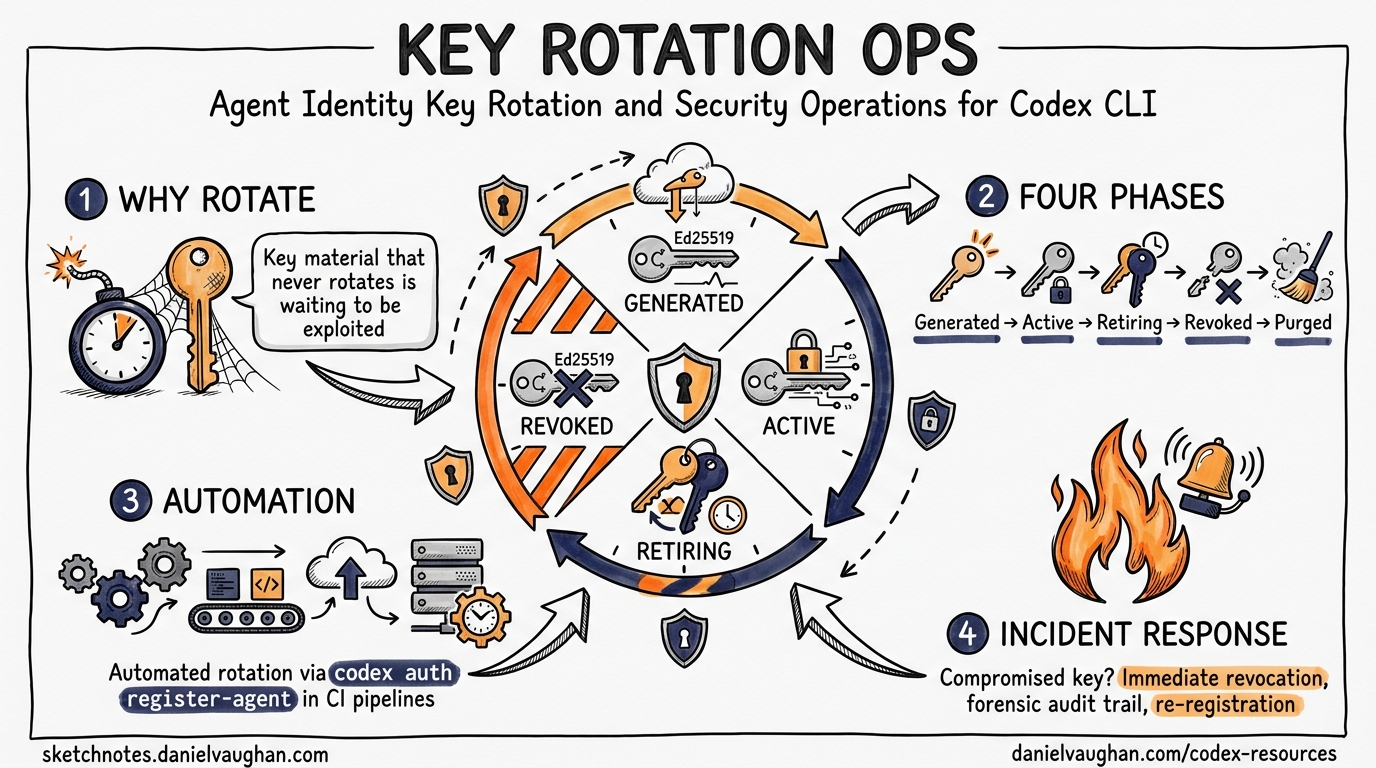
Introduction
The v0.123 release of Codex CLI introduced AuthMode::AgentIdentity, giving each agent its own Ed25519 key pair and replacing forwarded bearer tokens with signed AgentAssertion values12. The companion article on agent identity authentication covers the architecture; this article addresses the operational question enterprises immediately ask: how do we rotate these keys, and what do we do when one is compromised?
Key material that never rotates is key material waiting to be exploited. Ed25519 private keys stored in auth.json are high-value targets — they grant autonomous API access scoped to an organisational account2. A robust rotation strategy is not optional; it is the price of admission for running agent identities in production.
The Key Lifecycle Model
Agent identity keys follow a four-phase lifecycle that mirrors established cryptographic key management practice34:
stateDiagram-v2
    [*] --> Generated: codex auth register-agent
    Generated --> Active: Server confirms public key
    Active --> Retiring: New key generated, overlap begins
    Retiring --> Revoked: Overlap period expires
    Revoked --> [*]: Key material purged
Each phase has distinct operational requirements:
| Phase | Duration | Agent Behaviour | Server Behaviour |
|---|---|---|---|
| Generated | Seconds | Key pair created locally | Public key registered, not yet trusted |
| Active | 30–90 days (policy-dependent) | Signs all AgentAssertion values |
Verifies assertions against this key |
| Retiring | 24–48 hours | New key signs; old key still valid | Accepts assertions from both keys |
| Revoked | Permanent | Old key material deleted | Rejects assertions from old key |
The overlap period during the Retiring phase is critical. It provides a rollback window if the new key proves problematic and allows in-flight assertions signed with the old key to complete without 401 errors3.
Scheduled Rotation
Rotation Cadence
Industry guidance recommends rotating API keys on a 60–90-day cycle56. For agent identity Ed25519 keys, a 90-day cycle strikes a reasonable balance between security posture and operational overhead. Organisations subject to compliance frameworks (SOC 2, FedRAMP) may require shorter cycles — consult your auditor.
Manual Rotation Workflow
⚠️ The exact CLI subcommands for key rotation are inferred from the v0.123 architecture and PR descriptions. They may change before stable release.
# Step 1: Generate a new key pair while the old one remains active
codex auth rotate-agent-key --overlap 48h

# Step 2: Verify the new key is functional
codex auth verify-agent-identity

# Step 3: After the overlap period, revoke the old key
codex auth revoke-key --key-id <old-key-id>

# Step 4: Confirm only the new key is active
codex auth list-keys
The --overlap flag ensures both keys are accepted by the server during the transition. This follows the “add before you remove” principle that underpins zero-downtime key rotation3.
Automated Rotation with Secrets Managers
In production, manual rotation does not scale. Integrating Codex agent identity key rotation with a secrets manager automates the process and provides an audit trail.
HashiCorp Vault
HashiCorp Vault already offers a dynamic secrets plugin for OpenAI API keys that creates, rotates, and revokes credentials on demand7. The same pattern applies to agent identity keys:
# Vault policy for Codex agent key rotation
vault write codex-agent/config \
  rotation_schedule="0 0 * * 6" \
  overlap_period="48h"

# CI runner fetches current agent identity at job start
vault read -format=json codex-agent/creds/ci-runner \
  | jq -r '.data' > ~/.codex/auth.json
sequenceDiagram
    participant Vault as HashiCorp Vault
    participant Runner as CI Runner
    participant Codex as Codex CLI
    participant API as OpenAI API

    Vault->>Vault: Scheduled rotation (every 90 days)
    Vault->>API: Register new public key
    API-->>Vault: Key ID confirmed
    Vault->>Vault: Store new key material
    Note over Vault: 48h overlap: both keys valid

    Runner->>Vault: Request agent credentials
    Vault-->>Runner: Current auth.json payload
    Runner->>Codex: Launch with agent identity
    Codex->>API: AgentAssertion (signed with current key)
    API-->>Codex: 200 OK

    Vault->>API: Revoke old key (after overlap)
    API-->>Vault: Revocation confirmed
AWS Secrets Manager
For AWS-native environments, use Secrets Manager with a Lambda rotation function8:
# Store agent identity in Secrets Manager
aws secretsmanager create-secret \
  --name codex/agent-identity/ci-runner \
  --secret-string file://~/.codex/auth.json

# Configure automatic rotation every 90 days
aws secretsmanager rotate-secret \
  --secret-id codex/agent-identity/ci-runner \
  --rotation-lambda-arn arn:aws:lambda:eu-west-1:123456789:function:codex-key-rotator \
  --rotation-rules '{"ScheduleExpression":"rate(90 days)"}'
The Lambda function should implement the four-step rotation pattern: createSecret → setSecret (register new public key with OpenAI) → testSecret (verify agent assertion works) → finishSecret (promote new version, schedule old key revocation)8.
Incident Response: Compromised Key Material
When an agent’s Ed25519 private key is suspected or confirmed compromised, response time matters. A stolen key allows an attacker to forge AgentAssertion values and impersonate the agent until the key is revoked.
Immediate Response Runbook
# 1. Revoke the compromised key immediately (no overlap period)
codex auth revoke-key --key-id <compromised-key-id> --force

# 2. Generate and register a replacement key
codex auth register-agent --account <account-email> --replace

# 3. Distribute the new auth.json to all runners using this identity
# (via your secrets manager — never copy manually)
vault write codex-agent/creds/ci-runner @new-auth.json

# 4. Audit recent activity from the compromised identity
# Query OpenAI's usage API filtering by the agent's account_id
curl -H "Authorization: Bearer $OPENAI_ADMIN_KEY" \
  "https://api.openai.com/v1/organization/usage?agent_id=<account-id>&start=$(date -d '-7 days' +%s)"
Post-Incident Analysis
After containment, conduct a thorough investigation:
-
Determine the compromise vector. Was
auth.jsonexposed in logs, committed to a repository, or extracted from an unsecured runner? Thecli_auth_credentials_storesetting should bekeyringon shared systems — file-based storage with 0o600 permissions is insufficient if the host itself is compromised9. -
Review assertion logs. Since
AgentAssertionvalues include task IDs and timestamps2, cross-reference API server logs to identify assertions not corresponding to legitimate agent runs. -
Scope the blast radius. Agent identity keys are scoped to an organisational account, not to a user’s full permissions2. Determine what the compromised agent identity was authorised to access and whether those resources were affected.
-
Update controls. If compromise occurred through file exposure, migrate to keyring-based storage. If through a CI runner, implement ephemeral credential injection via your secrets manager rather than persisted
auth.jsonfiles.
Hardening Agent Identity Storage
Credential Store Configuration
Codex CLI offers three credential storage backends9:
# config.toml — prefer keyring on shared infrastructure
cli_auth_credentials_store = "keyring"

# For MCP server credentials too
mcp_oauth_credentials_store = "keyring"
| Backend | Security | Best For |
|---|---|---|
file |
Plaintext at ~/.codex/auth.json (0o600) |
Single-user dev machines |
keyring |
OS credential store (Keychain, libsecret, Windows Credential Manager) | Shared machines, production |
auto |
Prefers keyring, falls back to file | General use |
CI/CD-Specific Hardening
For ephemeral CI runners, never persist auth.json to disk longer than the job lifetime10:
#!/bin/bash
# CI job wrapper: inject credentials, run, clean up
trap 'rm -f ~/.codex/auth.json' EXIT

# Fetch fresh credentials from secrets manager
vault read -format=json codex-agent/creds/ci-runner \
  | jq -r '.data' > ~/.codex/auth.json
chmod 600 ~/.codex/auth.json

# Run the Codex task
codex --approval-mode full-auto -q "Run the test suite"
Key principles for CI/CD environments10:
- One identity per runner. Never share
auth.jsonacross concurrent jobs. - Ephemeral injection. Fetch credentials at job start, delete at job end.
- No repository storage. Agent identity files must never be committed. Use pre-commit hooks with tools like GitGuardian or Trufflehog to catch accidental commits6.
- Audit logging. Enable verbose auth logging during rotation windows to catch failures early.
Monitoring Key Health
Proactive monitoring prevents rotation failures from becoming outages:
flowchart LR
    A[Key Age Monitor] -->|> 80 days| B[Alert: Rotation Due]
    A -->|> 90 days| C[Alert: Key Expired]
    D[Assertion Failure Monitor] -->|401 spike| E[Alert: Possible Key Issue]
    F[auth.json Integrity Check] -->|Missing/corrupted| G[Alert: Credential Store Error]
    B --> H[Automated Rotation Trigger]
    C --> I[Emergency Rotation]
    E --> I
Useful monitoring checks:
- Key age: Compare
registered_atinauth.jsonagainst your rotation policy. Alert at 80% of the rotation interval. - Assertion failure rate: A sudden increase in 401 responses indicates either a key issue or a server-side revocation.
- File integrity: On systems using file-based storage, verify
auth.jsonpermissions remain 0o600 and the file has not been modified outside of Codex processes.
Summary
Agent identity key rotation is not a feature you configure once and forget. It requires:
- A defined rotation cadence (90 days is a sensible default) with automated execution via a secrets manager.
- An overlap period (48 hours minimum) to prevent downtime during transitions.
- An incident response runbook that your team has rehearsed, not just documented.
- Keyring-based storage on any machine that is not a single-user development laptop.
- Monitoring that alerts before keys expire and detects anomalous assertion patterns.
The v0.123 agent identity architecture gives Codex CLI agents a proper cryptographic identity12. Keeping that identity secure is an ongoing operational discipline, not a one-time setup task.
Citations
-
OpenAI Codex CLI PR #18757 — Isolate agent identity into standalone crate. GitHub ↩ ↩2
-
OpenAI Codex CLI PR #18785 — Add
AuthMode::AgentIdentitywith durable key material. GitHub ↩ ↩2 ↩3 ↩4 ↩5 -
Sulc, D. “JWKS and Zero-Downtime Key Rotation.” davidsulc.com ↩ ↩2 ↩3
-
Kiteworks. “Encryption Key Rotation Best Practices: When and How to Change Your Keys Without Disruption.” kiteworks.com ↩
-
SecureBin. “API Key Rotation Best Practices: Automate Secret Lifecycle.” securebin.ai ↩
-
OpenAI. “Best Practices for API Key Safety.” OpenAI Help Center ↩ ↩2
-
HashiCorp. “Managing OpenAI API Keys with HashiCorp Vault’s Dynamic Secrets Plugin.” hashicorp.com ↩
-
AWS. “Rotate AWS Secrets Manager secrets.” AWS Documentation ↩ ↩2
-
OpenAI. “Authentication — Codex CLI.” developers.openai.com ↩ ↩2
-
OpenAI. “Maintain Codex account auth in CI/CD (advanced).” developers.openai.com ↩ ↩2