Codex at Four Million: What Three Weeks of Hypergrowth Reveals About the Agentic Coding Market
Codex at Four Million: What Three Weeks of Hypergrowth Reveals About the Agentic Coding Market
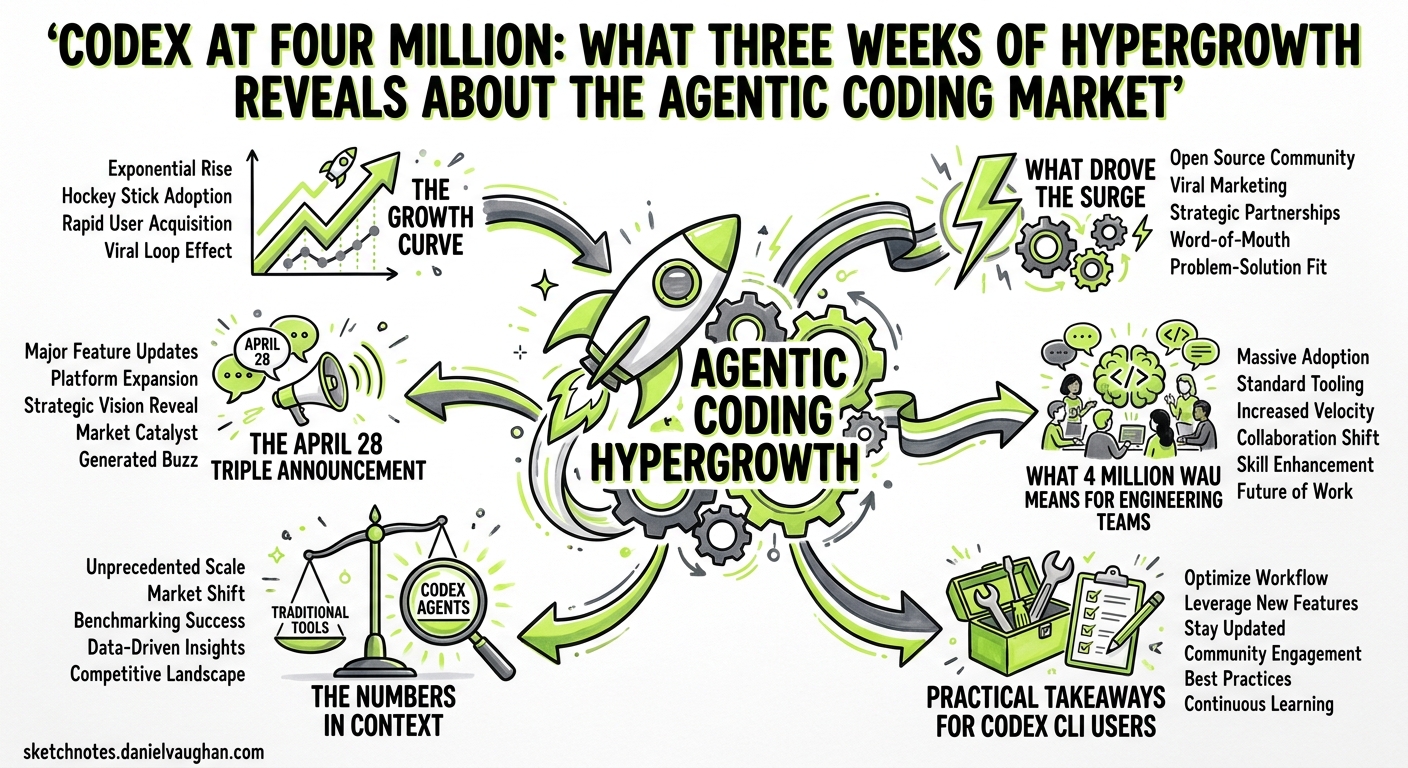
On 28 April 2026, the OpenAI-AWS partnership announcement casually confirmed that “more than 4 million people now use Codex every week” 1. Three weeks earlier, Sam Altman had celebrated 3 million 2. Six weeks before that, the figure was 2 million 3. Codex doubled its weekly active user base in under two months — while simultaneously launching a new frontier model, restructuring its pricing, signing the largest cloud partnership in its history, and shipping a purpose-built cybersecurity coding model.
This article dissects the growth mechanics, the strategic moves that enabled them, and what the trajectory signals for engineering teams evaluating Codex CLI for production workflows.
The Growth Curve
timeline
    title Codex Weekly Active Users — 2026
    section Q1 2026
        February : Desktop app relaunch
        March 31 : 2M+ WAU
    section April 2026
        April 8 : 3M WAU (rate limit reset)
        April 21 : 4M WAU (rate limit reset)
        April 23 : GPT-5.5 launched
        April 28 : 4M+ confirmed
                 : GPT-5.2-Codex launched
                 : AWS partnership announced
The 2M → 3M leg took roughly a week 2. The 3M → 4M leg took two weeks 4. Within ChatGPT Business and Enterprise plans specifically, Codex usage grew 6x since January 2026 5. Overall usage is up 10x since August 2025 5.
For context, GitHub Copilot — the incumbent — reported 20 million-plus developers in mid-2025 6. Codex is not yet in the same league by volume, but its growth rate is substantially faster, and its enterprise penetration is accelerating along a steeper curve.
What Drove the Surge
Three factors converged in April to create a compounding growth loop.
1. GPT-5.5 as the Default Model
On 23 April 2026, OpenAI made GPT-5.5 available across all Codex surfaces 7. The model leads agentic coding benchmarks — 82.7% on Terminal-Bench 2.0, 73.1% on Expert-SWE (long-horizon), and 84.9% on GDPval 7 — while matching GPT-5.4’s per-token latency and consuming fewer tokens per task.
For Codex CLI users, the upgrade was immediate. GPT-5.5 became the recommended model in v0.125.0 8:
# Explicitly select GPT-5.5 for a new session
codex --model gpt-5.5

# Or set it as default in config.toml
[model]
default = "gpt-5.5"
The million-token context window is the headline feature for CLI workflows. Sessions that previously hit compaction limits after 30–40 minutes can now run for hours without context drift 9. For teams running codex exec in CI pipelines, this means fewer mid-task hallucinations and more reliable structured output.
2. The Pay-As-You-Go Pricing Restructure
On 2 April 2026, OpenAI shifted Codex pricing from per-message to per-token billing, aligned with the API rate card 10. The practical effects:
| Change | Before | After |
|---|---|---|
| Billing unit | Per message | Per token (input, cached, output) |
| Business seat | $25/month | $20/month |
| Codex-only seats | Not available | Pay-as-you-go, no fixed fee, no rate limits |
| Enterprise | Seat-based only | Choice of seat-based or pay-as-you-go |
| Promotional credits | None | Up to $500 per team for new Codex-only seats 10 |
The Codex-only seat is the critical innovation. Enterprise teams that previously had to provision full ChatGPT seats at $25/month for developers who only needed the coding agent can now add seats with zero fixed cost and pure usage billing 10. For a 200-person engineering org where 60% of developers use Codex intermittently, the savings are material.
3. The Claude Code Performance Crisis
Anthropic’s competitor Claude Code suffered a well-documented performance decline through March and April 2026 11. On 24 April, Anthropic published a post-mortem identifying three engineering missteps: a March 4 reduction from “high” to “medium” reasoning effort, a March 26 bug that silently discarded reasoning history mid-session, and an April 16 system prompt change that capped responses at 25 words between tool calls 12.
TrustedSec CEO Dave Kennedy measured a 47% drop in Claude Code quality 11. Several high-profile users, including a senior AMD AI executive who called the tool “unusable for complex engineering tasks,” cancelled subscriptions 11. Anthropic resolved the issues by April 20 and reset usage limits on April 23 as an acknowledgement 12.
The timing was fortuitous for Codex. GPT-5.5 launched in Codex on the same day Anthropic published its post-mortem (23 April). Developers who had grown frustrated with Claude Code’s degraded output had a polished alternative waiting. ⚠️ It is impossible to directly attribute Codex user growth to Claude Code’s stumble — OpenAI has not published churn-source data — but the temporal correlation is striking.
The April 28 Triple Announcement
Three significant events landed on a single day.
GPT-5.2-Codex
OpenAI released GPT-5.2-Codex, a coding-optimised fine-tune of GPT-5.2 targeting four areas: native context compaction, large code changes, Windows environment support, and cybersecurity capabilities 13. Benchmark scores:
| Benchmark | GPT-5.2-Codex | GPT-5.2 | GPT-5.5 |
|---|---|---|---|
| SWE-Bench Pro | 56.4% | 55.6% | 58.6% |
| Terminal-Bench 2.0 | 64.0% | 62.2% | 82.7% |
GPT-5.5 outperforms GPT-5.2-Codex on headline benchmarks, but GPT-5.2-Codex excels at session durability — coherent work over 400K tokens without context drift 13 — and ships the strongest cybersecurity capabilities of any OpenAI model 14. For security teams running vulnerability audits and fuzzing harnesses, it is the preferred model. The practical guidance for Codex CLI users:
# Security audit profile
[agents.security-auditor]
model = "gpt-5.2-codex"
instructions = "Focus on vulnerability discovery, attack surface analysis, and fuzzing harness generation."

# General development (default)
[model]
default = "gpt-5.5"
The OpenAI-AWS Partnership
OpenAI and AWS announced three offerings in limited preview on Amazon Bedrock 1:
- OpenAI models on Bedrock — GPT-5.5 and other frontier models accessible through standard Bedrock APIs, inheriting IAM, PrivateLink, guardrails, encryption, and CloudTrail logging.
- Codex on Bedrock — the full Codex agent (CLI, desktop app, and VS Code extension) running against Bedrock-hosted models, with usage counting toward existing AWS cloud commitments.
- Managed Agents powered by OpenAI — production-ready OpenAI-powered agents deployed on AWS infrastructure, using the OpenAI agent harness.
flowchart LR
    subgraph "Enterprise AWS Account"
        A[Codex CLI] -->|SigV4 Auth| B[Amazon Bedrock]
        B --> C[GPT-5.5]
        B --> D[GPT-5.2-Codex]
        B --> E[Managed Agents]
        F[IAM / PrivateLink / CloudTrail] -.->|Governance| B
    end
    G[AWS Cloud Commitment] -.->|Billing| B
For enterprise Codex CLI teams, this eliminates the dual-billing friction of maintaining both AWS and OpenAI commercial relationships. Codex usage on Bedrock counts toward existing AWS committed spend 1, which matters enormously to procurement teams managing cloud budgets.
Codex CLI gained native Bedrock support in v0.124.0 with AWS SigV4 signing 8. The partnership announcement extends this from model access to full platform integration.
Rate Limit Reset
OpenAI reset usage limits for all paid plans on 28 April 15. Under the policy Altman announced at the 3M milestone, resets occur at each million-user mark up to 10 million 2. Pro users additionally retain promotional limits at 25x Plus rates through 31 May 2026 16.
Community reception was mixed. Several users on the OpenAI Developer Forum noted that the resets are not communicated proactively — many only discover them after hitting unexpectedly generous limits 15. Others flagged that the Codex CLI does not surface current quota status in the TUI, making it difficult to gauge remaining capacity without checking the web dashboard 15.
What 4 Million WAU Means for Engineering Teams
Signal: Codex Is Becoming Infrastructure
The 6x growth among Business and Enterprise users 5 is more significant than the headline WAU number. When enterprises adopt a tool at this rate, it begins to appear in procurement contracts, security reviews, and compliance frameworks. Teams evaluating Codex CLI should expect:
- Formalised AGENTS.md standards — as more teams adopt Codex, internal standardisation of agent configuration becomes a governance requirement.
- Budget line items — the pay-as-you-go pricing restructure means Codex spend is now trackable per-token, making it visible to finance teams who previously saw it bundled into ChatGPT seats.
- Multi-provider strategies — with Bedrock integration, enterprises can run Codex against AWS-hosted models without data leaving their VPC. Expect compliance teams to mandate this path for regulated workloads.
Signal: Model Specialisation Is Accelerating
The simultaneous availability of GPT-5.5 (broad capability) and GPT-5.2-Codex (specialised cybersecurity, long-horizon durability) reflects a trend toward purpose-built models for different workflow stages. Codex CLI’s custom agent definitions 17 let teams route different task types to different models:
flowchart TD
    A[Incoming Task] --> B{Task Type}
    B -->|General development| C[GPT-5.5<br/>Broad capability, 1M context]
    B -->|Security audit| D[GPT-5.2-Codex<br/>Cybersecurity focus]
    B -->|Quick triage| E[o4-mini<br/>Fast, cost-effective]
    B -->|Long refactor| D
Signal: The Competitor Landscape Is Volatile
Codex’s growth coincides with Claude Code’s performance crisis and Gemini CLI’s subagent launch 18. The market is not settled. Teams building agentic workflows should design for portability — AGENTS.md files, MCP server configurations, and skill definitions that work across tools — rather than deep lock-in to any single harness.
The Numbers in Context
| Metric | Value | Source |
|---|---|---|
| Codex WAU (28 Apr 2026) | 4M+ | OpenAI-AWS announcement 1 |
| Growth (Jan–Apr 2026, Business/Enterprise) | 6x | Panto statistics 5 |
| Growth (Aug 2025 – Apr 2026, overall) | 10x | OpenAI business update 5 |
| GitHub Copilot developers (mid-2025) | 20M+ | GitHub 6 |
| OpenAI enterprise revenue share (2026) | 40%+ | OpenAI 19 |
| ChatGPT Business seat price | $20/month | OpenAI pricing 10 |
| Codex-only seat price | Pay-as-you-go (no fixed fee) | OpenAI pricing 10 |
| Pro promotional limit | 25x Plus (through 31 May 2026) | OpenAI 16 |
Practical Takeaways for Codex CLI Users
- Default to GPT-5.5 for general development. Set it in your
config.tomland useAlt+./Alt+,in the TUI to adjust reasoning effort mid-session 8. - Use GPT-5.2-Codex for security work. Configure a custom agent definition in TOML for vulnerability audits and long-running refactors 13.
- Evaluate Bedrock integration if your organisation has AWS committed spend. The native provider in v0.124.0+ handles SigV4 signing and credential-chain auth 8.
- Track token spend per task. The
codex exec --jsonflag now reports reasoning-token usage alongside completion tokens 8, enabling precise cost attribution in CI pipelines. - Design for portability. Use AGENTS.md, MCP server configurations, and skill definitions that do not hard-code model names or provider endpoints. The competitive landscape will continue shifting.
Citations
-
OpenAI. “OpenAI models, Codex, and Managed Agents come to AWS.” https://openai.com/index/openai-on-aws/ ↩ ↩2 ↩3 ↩4
-
OpenAI / Sam Altman. “Codex crosses 3 million weekly active users.” April 8, 2026. Reported in Codex CLI 3 Million Users. ↩ ↩2 ↩3
-
OpenAI / Thibault Sottiaux. Confirmation of 2M WAU “a little under a month ago” relative to 3M milestone. April 8, 2026. ↩
-
Neowin. “OpenAI’s Codex hits 4 million weekly active users, adding 1 million in just two weeks.” https://www.neowin.net/news/openais-codex-hits-4-million-weekly-active-users-adding-1-million-in-just-two-weeks/ ↩
-
Panto. “Codex AI Statistics 2026: Users, Revenue & Growth.” https://www.getpanto.ai/blog/codex-ai-statistics ↩ ↩2 ↩3 ↩4 ↩5
-
GitHub. “GitHub Copilot surpasses 20 million developers.” Reported mid-2025. ↩ ↩2
-
OpenAI. “Introducing GPT-5.5.” April 23, 2026. https://openai.com/index/introducing-gpt-5-5/ ↩ ↩2
-
OpenAI. “Codex Changelog.” https://developers.openai.com/codex/changelog ↩ ↩2 ↩3 ↩4 ↩5
-
OpenAI. “GPT-5.5’s million-token context window.” Covered in Codex CLI documentation and GPT-5.5 launch materials. ↩
-
OpenAI. “Codex now offers pay-as-you-go pricing for teams.” https://openai.com/index/codex-flexible-pricing-for-teams/ ↩ ↩2 ↩3 ↩4 ↩5
-
Fortune. “Anthropic explains Claude Code’s recent performance decline after weeks of user backlash.” April 24, 2026. https://fortune.com/2026/04/24/anthropic-engineering-missteps-claude-code-performance-decline-user-backlash/ ↩ ↩2 ↩3
-
Anthropic. “An update on recent Claude Code quality reports.” April 23, 2026. https://www.anthropic.com/engineering/april-23-postmortem ↩ ↩2
-
OpenAI. “Introducing GPT-5.2-Codex.” April 28, 2026. https://openai.com/index/introducing-gpt-5-2-codex/ ↩ ↩2 ↩3
-
OpenAI GPT-5.2-Codex announcement. Cybersecurity capability rated “Medium” on internal scale; trusted access pilot available for vetted researchers. ↩
-
OpenAI Developer Community. “Codex Rate limits reset for all paid plans April 28, 2026.” https://community.openai.com/t/codex-rate-limits-reset-for-all-paid-plans-april-28-2026/1379921 ↩ ↩2 ↩3
-
OpenAI. Codex rate card. Pro promotional limits at 25x Plus through 31 May 2026. https://help.openai.com/en/articles/20001106-codex-rate-card ↩ ↩2
-
OpenAI. “Custom Agent Definitions.” Codex CLI documentation. https://developers.openai.com/codex/config-advanced ↩
-
Google Developers Blog. “Subagents have arrived in Gemini CLI.” April 15, 2026. https://developers.googleblog.com/en/subagents-have-arrived-in-gemini-cli/ ↩
-
OpenAI. Enterprise revenue share exceeding 40% in 2026. Reported via Sacra and OpenAI business updates. ↩