The Design Space of Coding Agent Harnesses: Seven Architectural Lessons from the Claude Code Analysis That Apply to Codex CLI
The Design Space of Coding Agent Harnesses: Seven Architectural Lessons from the Claude Code Analysis That Apply to Codex CLI
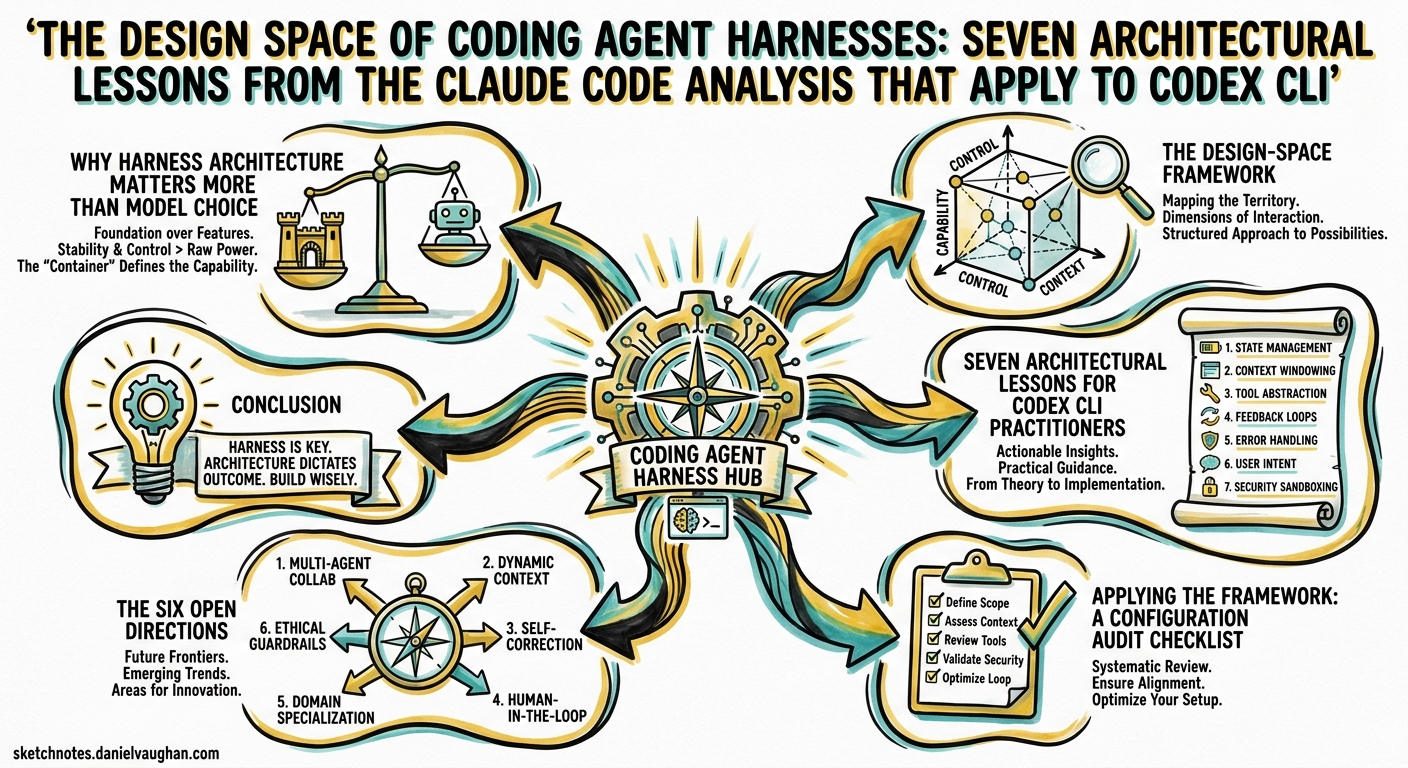
A systematic academic analysis of a competitor’s source code is rare in the AI tooling world. In April 2026, researchers from VILA-Lab published Dive into Claude Code: The Design Space of Today’s and Future AI Agent Systems (arXiv:2604.14228), a paper that reverse-engineers Claude Code’s TypeScript codebase and maps it onto a rigorous design-space framework 1. Their headline finding is striking: approximately 1.6% of the codebase handles AI decision logic, whilst 98.4% is operational infrastructure 2. The paper identifies five human values, thirteen design principles, seven system components, and a five-layer subsystem architecture that together form the scaffolding around the model.
This article translates those findings into actionable architectural awareness for Codex CLI practitioners. If you understand why agent harnesses are built the way they are, you can configure, extend, and reason about Codex CLI far more effectively.
Why Harness Architecture Matters More Than Model Choice
The paper’s central thesis reinforces what the Codex CLI community has observed since the harness-effect benchmarks of early 2026: the same model inside a different harness can score 16 percentage points higher or lower on identical benchmarks 3. OpenAI’s own engineering blog Unrolling the Codex agent loop demonstrates that much of the intelligence of a coding agent lies not in the model but in how the harness assembles context, gates permissions, and manages tool dispatch 4.
The practical implication is clear: tuning your config.toml, writing effective AGENTS.md, and configuring hooks properly is not peripheral housekeeping — it is harness engineering, and it has a measurable impact on output quality.
The Design-Space Framework
The paper maps the entire agent harness problem onto a structured taxonomy. Here is the framework, with Codex CLI’s answers alongside Claude Code’s.
Five Human Values Driving Architecture
Both Claude Code and Codex CLI derive their architecture from the same five human priorities, but weight them differently 1:
- Human decision authority — the user must retain meaningful control
- Safety and security — the agent must not damage the environment
- Reliable execution — tasks must complete predictably
- Capability amplification — the agent should enable qualitatively new workflows
- Contextual adaptability — behaviour should adapt to project-specific norms
Codex CLI leans more heavily on safety and security through its kernel-level Seatbelt sandbox (macOS) and bubblewrap (Linux) 5, whilst Claude Code opts for a layered software-only approach with an ML-based permission classifier 2.
Thirteen Principles, Seven Components
The paper traces the five values through thirteen design principles into seven functional components 1. The table below maps these to Codex CLI equivalents:
| Component | Claude Code | Codex CLI |
|---|---|---|
| User interface | CLI + IDE extensions (VS Code) | TUI + app-server protocol (WebSocket/Unix socket) 6 |
| Agent loop | queryLoop async generator |
Rust AgentLoop with append-only prompt architecture 4 |
| Permission system | 7 modes + ML classifier | 3 approval modes (suggest/auto-edit/full-auto) + deny-first rule evaluation + PreToolUse hooks 5 |
| Tools & extensibility | MCP, plugins, skills, hooks (27 event types) | MCP, plugins, skills, hooks (PreToolUse/PostToolUse), custom agents 6 |
| State & persistence | CLAUDE.md hierarchy, transcripts | AGENTS.md hierarchy, session transcripts, memories 7 |
| Execution environment | Software sandbox + shell restrictions | OS-level Seatbelt/bubblewrap sandbox + managed network proxy 5 |
| Safety/action layer | Permission gates + classifier | Approval policy + guardian + enterprise requirements.toml 8 |
Seven Architectural Lessons for Codex CLI Practitioners
1. Invest in Harness Tuning, Not Just Model Upgrades
The paper quantifies what many practitioners sense intuitively: 98.4% of the agent system is infrastructure 2. When a Codex CLI session underperforms, the diagnosis should start with harness configuration — AGENTS.md quality, MCP server setup, hook coverage — before reaching for a more expensive model.
graph LR
    A[Poor Agent Output] --> B{Diagnosis}
    B --> C[AGENTS.md quality?]
    B --> D[Context budget?]
    B --> E[Tool configuration?]
    B --> F[Model capability?]
    C --> G[Enrich project context]
    D --> H[Compact or fork]
    E --> I[Add MCP / fix hooks]
    F --> J[Upgrade model last]
    style J fill:#f9d,stroke:#333
2. Treat Permissions as Architecture, Not Configuration
Claude Code implements seven independent safety layers with an ML-based auto-classifier 2. Codex CLI takes a different but equally deliberate approach: three user-facing approval modes underpinned by deny-first rule evaluation at the OS sandbox level 5.
The lesson is not to copy Claude Code’s approach but to recognise that your permission configuration is an architectural decision with cascading effects on workflow speed, safety, and agent capability.
# config.toml — layered permission architecture
[profiles.daily]
model = "gpt-5.5"
approval_mode = "auto-edit"

[profiles.ci]
model = "gpt-5.2-codex"
approval_mode = "full-auto"

[profiles.audit]
model = "gpt-5.5"
approval_mode = "suggest"
model_reasoning_effort = "high"
3. Context Management Is Infrastructure
The paper describes Claude Code’s five-stage compaction pipeline: compaction, priority ranking, window calculation, safety filtering, and assembly 2. Codex CLI uses a different strategy — server-side compaction via a proprietary POST /v1/responses/compact endpoint that returns an encrypted handoff summary preserving the model’s latent state 9. User messages are preserved verbatim whilst assistant replies and tool outputs are replaced with a structured summary 9.
The practical takeaway: context is not a formatting detail. It is infrastructure that determines whether your agent succeeds or fails on long-horizon tasks. Budget it explicitly.
flowchart TD
    A[Session Start] --> B[AGENTS.md + skills loaded]
    B --> C[User prompt]
    C --> D[Model call + tool dispatch]
    D --> E{Context budget exceeded?}
    E -->|No| C
    E -->|Yes| F[Server-side compaction]
    F --> G[Encrypted handoff summary]
    G --> H[User messages preserved verbatim]
    H --> C
4. Extensibility Needs Graduated Risk Budgets
Claude Code partitions its extension surface into four mechanisms with different cost-risk profiles: hooks (zero context cost), skills (low), plugins (variable), and MCP servers (high) 2. Codex CLI follows a similar graduated model 6:
| Mechanism | Context cost | Risk profile | When to use |
|---|---|---|---|
| Hooks (PreToolUse/PostToolUse) | Zero — runs outside model context | Low — deterministic scripts | Validation gates, audit logging |
| Skills (markdown instructions) | Low — injected into system prompt | Low — declarative guidance | Project conventions, workflow patterns |
| Plugins (bundled skills + MCP + apps) | Variable — depends on contents | Medium — third-party code | Reusable team toolkits |
| MCP servers (external tool processes) | High — full tool schemas in context | Higher — network access, external state | Live data, external service integration |
The design lesson: start with hooks and skills. Add MCP servers only when you genuinely need external data. Every MCP tool schema consumes context tokens that could otherwise be used for reasoning 10.
5. Session Persistence Shapes Workflow Patterns
The paper notes Claude Code’s append-oriented session storage and CLAUDE.md hierarchy 1. Codex CLI mirrors this with AGENTS.md (hierarchical project context), session transcripts (local persistence), and the memories system (cross-session learning) 7.
What both systems lack — and what the paper identifies as an open research direction — is true longitudinal colleague relationships where the agent develops deep understanding of a developer’s patterns over months 1. Codex CLI’s memories system is the closest existing approximation, but it operates at the preference level rather than the deep-workflow level.
6. The Sandbox Strategy Reveals Trust Assumptions
The starkest architectural difference between Codex CLI and Claude Code lies in sandboxing. Claude Code uses software-level restrictions with a seven-mode permission classifier 2. Codex CLI drops to the kernel: macOS Seatbelt profiles, Linux bubblewrap with user namespaces, and a managed network proxy with domain allowlists 5.
This is not merely a technical difference — it encodes a fundamentally different trust assumption. Codex CLI assumes the agent will attempt actions outside its mandate and relies on the OS to enforce boundaries. Claude Code assumes the agent can be guided through software-level classification.
For enterprise teams, this distinction matters when mapping agent deployments to compliance frameworks. OS-level sandboxing provides a stronger audit trail for SOC 2 and HIPAA assessments 8.
7. The Rust Rewrite Tells the Same Story
OpenAI’s decision to rewrite Codex CLI from TypeScript to Rust 11 parallels the paper’s finding that agent harness complexity eventually outgrows the initial implementation language. The Rust rewrite targeted three goals: zero-dependency installation, native security bindings for OS-level sandboxing, and a wire protocol (app-server) that lets TypeScript, Python, and other languages extend the agent without duplicating core logic 11.
This is the harness-first philosophy in action: the infrastructure around the model loop became complex enough to justify a systems-language rewrite.
Applying the Framework: A Configuration Audit Checklist
Use the paper’s seven-component framework to audit your Codex CLI setup:
| Component | Question to ask | Config to check |
|---|---|---|
| User interface | Am I using the right surface (TUI vs exec vs app-server)? | Launch command |
| Agent loop | Is reasoning effort matched to task complexity? | model_reasoning_effort in config.toml |
| Permission system | Do my approval modes match my risk tolerance? | approval_mode, sandbox_mode |
| Tools & extensibility | Are my MCP servers worth their context cost? | /mcp verbose output |
| State & persistence | Is my AGENTS.md giving the agent enough project context? | AGENTS.md file content |
| Execution environment | Is my sandbox enforcing the boundaries I need? | sandbox_mode, deny_read_paths, shell_environment_policy |
| Safety/action layer | Do I have hooks validating critical operations? | [hooks] section in config.toml |
The Six Open Directions
The paper identifies six unsolved design problems that will shape the next generation of coding agents 1:
- Observability-evaluation gap — agents fail silently without adequate telemetry
- Longitudinal relationships — agents that learn your patterns over months
- Harness boundary evolution — where the agent’s autonomy starts and stops
- Horizon scaling — weeks-long autonomous operation
- Governance at scale — managing hundreds of agent instances
- Human capability preservation — ensuring developers don’t lose skills to delegation
Codex CLI is actively addressing several of these: OTEL-based observability 12, the memories system for longitudinal context 7, and enterprise managed configuration for governance at scale 8. The others remain open research problems for the entire field.
Conclusion
The Dive into Claude Code paper provides the most systematic published analysis of coding agent architecture to date. Its core insight — that harness engineering dominates model capability — is not new to experienced Codex CLI practitioners, but having it quantified (1.6% AI logic, 98.4% infrastructure) gives the intuition empirical weight.
The practical message is this: every hour you spend improving your AGENTS.md, tuning your approval modes, writing PostToolUse hooks, and managing your context budget is an hour spent on the 98.4% of the system that actually determines your outcomes.
Citations
-
Liu, J., Zhao, X., Shang, X. & Shen, Z. (2026). Dive into Claude Code: The Design Space of Today’s and Future AI Agent Systems. arXiv:2604.14228. https://arxiv.org/abs/2604.14228 ↩ ↩2 ↩3 ↩4 ↩5 ↩6
-
Praison, M. (2026). Dive into Claude Code: In-Depth Research Analysis of Agent Harness Architecture. https://mer.vin/2026/04/dive-into-claude-code-in-depth-research-analysis-of-agent-harness-architecture/ ↩ ↩2 ↩3 ↩4 ↩5 ↩6 ↩7
-
Jozefiak, P. (2026). AI Coding Harness Agents 2026. https://thoughts.jock.pl/p/ai-coding-harness-agents-2026 ↩
-
OpenAI. (2026). Unrolling the Codex agent loop. https://openai.com/index/unrolling-the-codex-agent-loop/ ↩ ↩2
-
OpenAI. (2026). Agent Approvals and Security — Codex CLI. https://developers.openai.com/codex/agent-approvals-security ↩ ↩2 ↩3 ↩4 ↩5
-
OpenAI. (2026). Codex CLI Changelog. https://developers.openai.com/codex/changelog ↩ ↩2 ↩3
-
OpenAI. (2026). Memories — Codex. https://developers.openai.com/codex/memories ↩ ↩2 ↩3
-
OpenAI. (2026). Managed Configuration — Codex. https://developers.openai.com/codex/managed-configuration ↩ ↩2 ↩3
-
Justin3go. (2026). Shedding Heavy Memories: Context Compaction in Codex, Claude Code, and OpenCode. https://justin3go.com/en/posts/2026/04/09-context-compaction-in-codex-claude-code-and-opencode ↩ ↩2
-
OpenAI. (2026). Features — Codex CLI. https://developers.openai.com/codex/cli/features ↩
-
ZenML. (2026). Building Production-Ready AI Agents: OpenAI Codex CLI Architecture and Agent Loop Design. https://www.zenml.io/llmops-database/building-production-ready-ai-agents-openai-codex-cli-architecture-and-agent-loop-design ↩ ↩2
-
OpenAI. (2026). Advanced Configuration — Codex. https://developers.openai.com/codex/config-advanced ↩