Agent-Generated Code Churns Faster: What 110,000 Pull Requests Reveal and How to Configure Codex CLI for Durable Output
Agent-Generated Code Churns Faster: What 110,000 Pull Requests Reveal and How to Configure Codex CLI for Durable Output
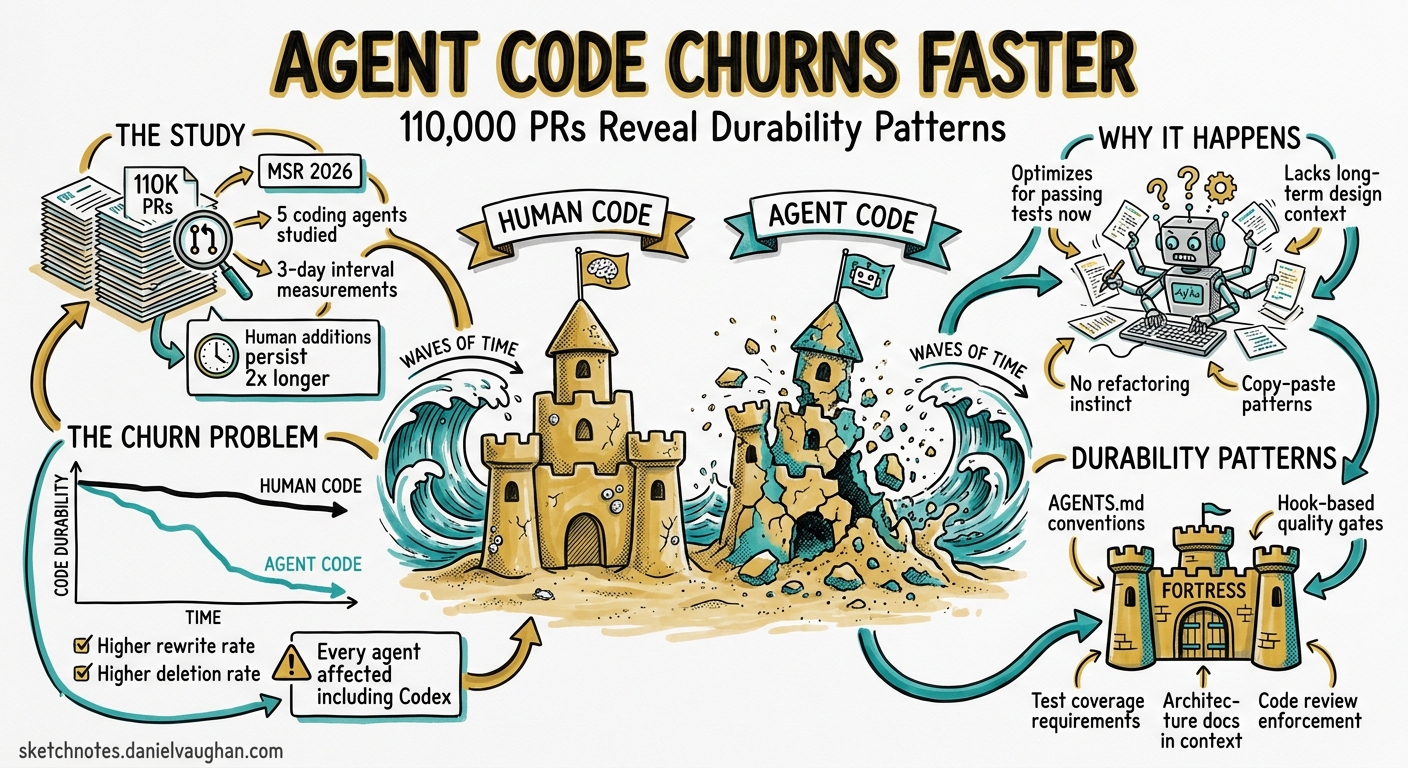
A new MSR 2026 study of 110,000 open-source pull requests across five coding agents finds that agent-generated code is rewritten and deleted significantly faster than human-authored code1. The numbers are uncomfortable: at every three-day interval measured, human additions persisted at roughly double the rate of agent-authored lines1. Code churn — the ratio of changed or deleted lines to total additions — was consistently higher for every agent studied, including Codex1.
This article synthesises the paper’s Codex-specific findings, cross-references them with industry-wide code quality data, and offers concrete Codex CLI configuration patterns to push your agent output towards the durable end of the spectrum.
The Study at a Glance
Popescu et al. constructed a dataset of approximately 110,000 open-source pull requests submitted between June and August 2025, covering five autonomous agents — OpenAI Codex, Claude Code, GitHub Copilot, Google Jules, and Devin — alongside 20,910 human-authored PRs as a control group1.
Two research questions drove the analysis:
- RQ1: How do agent-authored PRs differ from human PRs in collaboration signals and development progress?
- RQ2: How do agent-authored PRs affect code maintenance trajectories compared to human code?
flowchart LR
    A[110,000 PRs collected] --> B[Agent identification]
    B --> C[Five agents + human baseline]
    C --> D[RQ1: Activity patterns]
    C --> E[RQ2: Code persistence & churn]
    D --> F[Merge rates, comments, issue links]
    E --> G[Survival analysis at 3-day intervals]
Codex-Specific Findings
The data paints a nuanced picture of how Codex is used in the wild.
Small Changes, Fast Merges
Codex produced the smallest median change size among the five agents1. Its median PR merge time was 0.5 minutes — effectively instant — compared to a human median of 0.4 hours1. The combination suggests Codex is overwhelmingly used for small, routine modifications where the developer reviews locally before submitting the PR.
Concentrated in Low-Visibility Repositories
75.3% of Codex PRs targeted zero-star repositories1. This mirrors patterns seen in Jules (75.7%) and contrasts with Claude Code (51.7%) and human PRs (40.5%)1. The implication is clear: Codex is disproportionately used for personal projects and early-stage work rather than high-visibility open-source libraries.
Minimal Collaboration Signals
Codex PRs rarely received review comments and were seldom linked to issues1. Copilot, by contrast, linked roughly 50% of its PRs to issues1. The low interaction rate reinforces the hypothesis that Codex serves as a fast-loop local tool rather than a collaborative review mechanism.
The Churn Problem
Despite these favourable speed metrics, Codex-authored code exhibited higher churn across all measured intervals than human code1. At three-day intervals, approximately 50% of human additions persisted unchanged; agent-authored code fell well below that line1. The difference was statistically significant (p < 0.001)1.
Broader Industry Data Supports the Pattern
The MSR 2026 findings align with wider observations. Industry surveys report that teams using AI code generation experience 41% higher code churn and 7.2% decreased delivery stability2. Code duplication increases approximately fourfold2, and AI-generated code introduces 1.7x more total issues than human-written code across maintainability, logic, and security categories3. By 2026, 75% of technology decision-makers face moderate to severe technical debt linked to AI-speed practices3.
The pattern is consistent: AI agents trade durability for velocity. The code ships faster but requires more subsequent rework.
Why Agent Code Churns
Three structural factors drive the churn differential.
1. Pattern Replication over Reuse
Agents tend to replicate code patterns rather than import existing abstractions2. When a codebase already contains a utility function, Codex may generate a near-duplicate instead of referencing it. The duplicate works initially but becomes a maintenance liability as the original evolves.
2. Shallow Verification Loops
Without explicit instructions, Codex evaluates its own output — and self-evaluation is unreliable in codebases with real complexity4. When tests are absent or weak, the agent declares success based on compilation alone, leaving logic errors for humans to discover later.
3. Missing Architectural Context
AGENTS.md files with vague instructions like “write clean code” provide no actionable constraint4. When Codex lacks specific knowledge about module boundaries, naming conventions, and dependency policies, it makes reasonable but inconsistent choices that create friction with the existing codebase.
Configuring Codex CLI for Durable Output
The good news: every factor above is addressable through configuration. The following patterns target the root causes identified by the research.
Write a Precision AGENTS.md
Move from aspirational statements to concrete, machine-readable rules.
# AGENTS.md

## Architecture
- All database access goes through `src/db/repository.ts`. Never call Prisma directly from route handlers.
- Shared utilities live in `src/lib/`. Search there before creating new helpers.
- Components follow the compound pattern: `ComponentName/index.tsx`, `ComponentName.styles.ts`, `ComponentName.test.tsx`.

## Conventions
- Use named exports, never default exports.
- Error types extend `AppError` from `src/errors.ts`.
- All public functions require JSDoc with `@param` and `@returns`.

## Verification
- Run `npm test -- --coverage` after every change. Coverage must not decrease.
- Run `npm run lint` before considering work complete.
- If modifying API routes, run `npm run test:integration`.
A short, precise AGENTS.md is more effective than a long, vague one4. Start with five rules; add more only after observing repeated mistakes.
Enforce Test Verification with Hooks
Codex CLI hooks provide lifecycle events that can enforce quality gates before the agent considers work complete5. A PostToolUse hook can verify that tests pass after every file write:
# .codex/config.toml

[[hooks]]
event = "PostToolUse"
tool = "write_file"
command = "npm test -- --bail 2>&1 | tail -20"
timeout_ms = 30000
on_failure = "stop"
The on_failure = "stop" directive halts the agent loop when tests fail, forcing the agent to address failures before proceeding rather than accumulating breakage across multiple edits5.
Use /review Before Committing
The /review command runs a dedicated reviewer pass across your uncommitted changes6. Configure custom review instructions that explicitly target churn-producing patterns:
<!-- .codex/review-instructions.md -->
Flag the following:
1. Any new utility function that duplicates existing code in src/lib/
2. Functions longer than 40 lines without test coverage
3. Direct database calls outside src/db/
4. Missing error handling (bare try/catch, swallowed errors)
5. Type assertions or `any` usage without justification
Reference this file from your AGENTS.md to ensure every /review run applies the same criteria4.
Raise Reasoning Effort for Architectural Work
The model_reasoning_effort configuration key controls how deeply the model reasons about each response7. For routine edits — renaming, formatting, simple bug fixes — low or medium effort is sufficient. For architectural changes where durability matters, increase it:
# Profile for architectural work
[profiles.architecture]
model = "gpt-5.5"
model_reasoning_effort = "high"
Switch profiles with codex --profile architecture when working on code that must persist7.
Decompose Tasks to Reduce Scope Drift
The research found that larger agent-authored changes correlate with higher churn rates1. Codex already produces the smallest median changes among the five agents studied, but you can reinforce this pattern:
flowchart TD
    A[Complex feature request] --> B[Break into 3-5 focused tasks]
    B --> C[Task 1: Data model changes]
    B --> D[Task 2: Business logic]
    B --> E[Task 3: API endpoints]
    B --> F[Task 4: Tests]
    C --> G[Review & merge each independently]
    D --> G
    E --> G
    F --> G
One thread per task, not one thread per project4. Each focused task produces a smaller, more reviewable diff that is less likely to require rework.
Add a PostToolUse Duplication Check
To combat the pattern-replication problem, add a hook that warns when new code may duplicate existing utilities:
#!/usr/bin/env bash
# scripts/check-duplication.sh
# Runs after file writes to detect potential duplication

CHANGED_FILE="$1"
if [[ "$CHANGED_FILE" == *.ts ]] || [[ "$CHANGED_FILE" == *.js ]]; then
    # Extract new function names and check for similar existing ones
    npx jscpd --min-lines 5 --threshold 10 "$CHANGED_FILE" 2>/dev/null
fi
[[hooks]]
event = "PostToolUse"
tool = "write_file"
command = "bash scripts/check-duplication.sh"
timeout_ms = 15000
on_failure = "warn"
⚠️ The jscpd approach catches textual duplication but not semantic equivalence. It serves as a coarse signal rather than a definitive check.
Measuring Your Own Churn Rate
The paper’s methodology is reproducible. Track three metrics on your own Codex-assisted PRs:
- Survival rate: What percentage of lines added by Codex remain unchanged after 7 days? After 30 days?
- Churn ratio:
(lines_modified + lines_deleted) / lines_addedwithin the first two weeks post-merge. - Rework rate: How many follow-up commits in the same files within 7 days?
Git log queries can surface these numbers cheaply:
# Lines surviving after 7 days in files touched by a specific PR
git log --since="7 days ago" --numstat -- <files_from_pr> | \
  awk '{added+=$1; deleted+=$2} END {print "Churn:", deleted/added}'
If your Codex output trends above 0.3 churn ratio consistently, tighten your AGENTS.md and hook configuration before scaling usage.
The Takeaway
The MSR 2026 data does not argue against using coding agents. Codex produces the smallest, fastest-merging PRs of any agent studied, and its merge rate exceeds the human baseline1. The research argues that agent output requires deliberate durability engineering — precise instructions, automated verification, and architectural guardrails — to match the longevity of human-authored code.
Treating Codex as a fast typist who needs clear specification produces durable code. Treating it as an autonomous developer who can infer your architecture does not.
Citations
-
R. M. Popescu, D. Gros, A. Botocan, R. Pandita, P. Devanbu, and M. Izadi, “Investigating Autonomous Agent Contributions in the Wild: Activity Patterns and Code Change over Time,” MSR 2026 Technical Track, arxiv.org/abs/2604.00917, April 2026. ↩ ↩2 ↩3 ↩4 ↩5 ↩6 ↩7 ↩8 ↩9 ↩10 ↩11 ↩12 ↩13 ↩14 ↩15
-
AI-Generated Code Statistics 2026, Net Corp Software Development, netcorpsoftwaredevelopment.com, 2026. ↩ ↩2 ↩3
-
AI-Generated Code Quality Metrics and Statistics for 2026, Second Talent, secondtalent.com, 2026. ↩ ↩2
-
OpenAI, “Best practices — Codex,” developers.openai.com/codex/learn/best-practices, 2026. ↩ ↩2 ↩3 ↩4 ↩5
-
OpenAI, “Hooks — Codex CLI,” developers.openai.com/codex/hooks, 2026. ↩ ↩2
-
OpenAI, “Features — Codex CLI,” developers.openai.com/codex/cli/features, 2026. ↩
-
OpenAI, “Configuration Reference — Codex,” developers.openai.com/codex/config-reference, 2026. ↩ ↩2