Codex CLI on Amazon Bedrock: Enterprise Configuration, SigV4 Authentication, and AWS-Native Workflows
Codex CLI on Amazon Bedrock: Enterprise Configuration, SigV4 Authentication, and AWS-Native Workflows
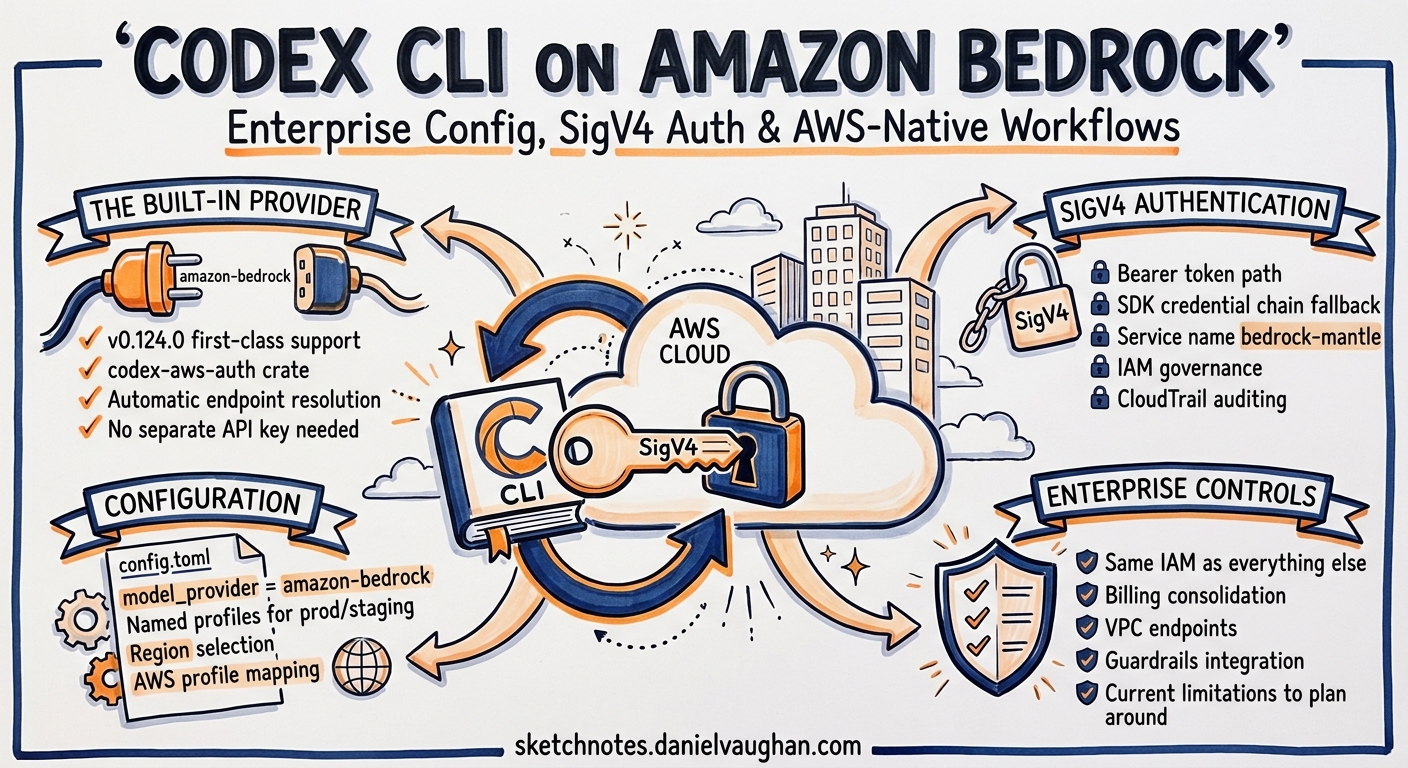
On 28 April 2026, AWS and OpenAI announced that Codex — the OpenAI coding agent — is available on Amazon Bedrock in limited preview 1. For enterprise teams already invested in AWS, this removes the requirement for a separate OpenAI API key and places all Codex inference under the same IAM governance, CloudTrail auditing, and billing consolidation they use for everything else 2.
This article walks through the end-to-end setup: built-in provider configuration, SigV4 authentication, model selection on Bedrock Mantle, enterprise security controls, and the current limitations you need to plan around.
What Changed: The Built-In amazon-bedrock Provider
Codex CLI v0.124.0 introduced first-class Bedrock support through a new built-in amazon-bedrock model provider 3. Unlike custom provider configurations that require you to specify a base_url and env_key, the built-in provider handles endpoint resolution and AWS credential signing automatically.
The implementation lives in a dedicated codex-aws-auth crate that provides AWS SDK configuration, credential resolution, and HTTP request signing with SigV4 before transport send 4. Two authentication paths are supported:
- Bearer token — prefers the
AWS_BEARER_TOKEN_BEDROCKenvironment variable when available - SDK/SigV4 signing — falls back to standard AWS credential chain resolution
The signing uses the service name bedrock-mantle rather than the standard bedrock-runtime, reflecting the OpenAI-compatible API surface that Bedrock exposes 4.
Configuration Reference
Minimal Setup
Create or update ~/.codex/config.toml:
model = "openai.gpt-oss-120b"
model_provider = "amazon-bedrock"

[model_providers.amazon-bedrock.aws]
region = "us-east-1"
That is the minimum viable configuration. The built-in provider resolves the Bedrock Mantle endpoint automatically for your specified region 5.
Profile-Based Configuration
For teams managing multiple environments, use named profiles:
profile = "bedrock-prod"

[profiles.bedrock-prod]
model = "openai.gpt-oss-120b"
model_provider = "amazon-bedrock"

[profiles.bedrock-staging]
model = "openai.gpt-oss-20b"
model_provider = "amazon-bedrock"

[model_providers.amazon-bedrock.aws]
profile = "codex-bedrock"
region = "us-east-1"
Switch profiles at invocation time:
codex --profile bedrock-staging "Refactor the auth module"
Key Configuration Parameters
| Parameter | Description | Default |
|---|---|---|
model_providers.amazon-bedrock.aws.region |
AWS region for inference | us-east-1 |
model_providers.amazon-bedrock.aws.profile |
AWS credentials profile name | SDK default |
wire_api |
API protocol (responses only) |
responses |
web_search |
Must be "disabled" on Bedrock |
— |
The wire_api defaults to responses — the only value Bedrock Mantle supports for the Codex agent loop. The older chat completions endpoint is not compatible with current Codex CLI versions 6.
Authentication: AWS Credentials for Codex
IAM Identity Centre (SSO)
For enterprise environments, configure SSO-based temporary credentials:
aws configure sso --profile codex-bedrock
Then export credentials into environment variables before launching Codex:
eval "$(aws configure export-credentials --format env --profile codex-bedrock)"
codex "Generate unit tests for the payment service"
This is the recommended approach. Profile-based credentials from ~/.aws/credentials can fail with credential provider configuration errors — the environment variable export resolves this reliably 3.
Minimum IAM Policy
Scope Codex access to specific models and actions:
{
  "Version": "2012-10-17",
  "Statement": [
    {
      "Effect": "Allow",
      "Action": [
        "bedrock:InvokeModel",
        "bedrock:InvokeModelWithResponseStream"
      ],
      "Resource": [
        "arn:aws:bedrock:us-east-1::foundation-model/openai.gpt-oss-120b",
        "arn:aws:bedrock:us-east-1::foundation-model/openai.gpt-oss-20b"
      ]
    },
    {
      "Effect": "Allow",
      "Action": "bedrock:ListFoundationModels",
      "Resource": "*"
    }
  ]
}
For production, further restrict by AWS account, region, and apply Service Control Policies (SCPs) to prevent use of unapproved regions or models 7.
Available Models and the Bedrock Mantle API
Amazon Bedrock exposes OpenAI-compatible APIs through Bedrock Mantle, a distributed inference engine that implements three API surfaces 3:
graph LR
    A[Codex CLI] -->|SigV4 signed| B[Bedrock Mantle]
    B --> C["/v1/responses<br/>OpenAI Responses API"]
    B --> D["/v1/chat/completions<br/>Chat Completions API"]
    B --> E["/anthropic/v1/messages<br/>Anthropic Messages API"]
    C -->|Required for Codex| F[openai.gpt-oss-120b<br/>openai.gpt-oss-20b]
Codex CLI requires the Responses API (/v1/responses). As of May 2026, only two models support this endpoint on Bedrock Mantle 3:
openai.gpt-oss-120b— the full-size model, suitable for complex multi-file refactors and reasoning-heavy tasksopenai.gpt-oss-20b— the smaller variant, faster and cheaper for routine operations
⚠️ Other models available on Bedrock (Claude, Nova, Llama, Mistral) do not currently support the Responses API and therefore cannot be used with Codex CLI’s agent loop 3.
Mantle vs Runtime Model IDs
A common source of confusion: Bedrock has two endpoint families with different model ID formats.
| Path | Model ID Format | Codex Compatible |
|---|---|---|
| Bedrock Mantle | openai.gpt-oss-120b |
Yes |
| Bedrock Runtime | openai.gpt-oss-120b-1:0 |
No (no Responses API) |
Use the Mantle model IDs (without version suffix) in your config.toml 7.
Supported Regions
Validated regions as of May 2026: us-east-1, us-east-2, us-west-2 7. Verify availability in your target region:
aws bedrock list-foundation-models \
  --region us-east-1 \
  --query "modelSummaries[?starts_with(modelId, 'openai')].modelId" \
  --output table
Enterprise Security Controls
The primary appeal of Bedrock-routed Codex is inheriting the full AWS enterprise control plane without additional infrastructure 2.
What You Get
graph TD
    subgraph "AWS Enterprise Controls"
        IAM[IAM Access Management]
        CT[CloudTrail Audit Logging]
        PL[AWS PrivateLink]
        GR[Bedrock Guardrails]
        ENC[Encryption at Rest & Transit]
        SCP[Service Control Policies]
    end
    subgraph "Codex on Bedrock"
        CLI[Codex CLI]
        DESK[Desktop App]
        VSC[VS Code Extension]
    end
    CLI --> IAM
    CLI --> CT
    CLI --> PL
    DESK --> IAM
    VSC --> IAM
- CloudTrail logs every model invocation with caller identity, timestamp, region, and model ID — providing the audit trail that compliance teams require 2
- IAM governs who can invoke which models, scoped to specific foundation model ARNs
- PrivateLink endpoints are available for
bedrock-mantle, keeping traffic off the public internet 7 - Guardrails can filter inputs and outputs according to organisational policy
- Billing consolidation — Codex usage counts toward existing AWS cloud commitments, simplifying procurement 1
Cost Controls
Bedrock does not publish separate Codex-specific pricing as of May 2026 7. Set account-level budgets with alerts:
aws budgets create-budget \
  --account-id 123456789012 \
  --budget file://codex-budget.json \
  --notifications-with-subscribers file://budget-alerts.json
Enable Cost Anomaly Detection with a Bedrock service filter and use Bedrock Projects for application-level cost attribution 7.
Critical Limitation: Web Search
Bedrock Mantle only supports function and mcp tool types. Codex CLI’s built-in web search tool causes validation errors on Bedrock 3. You must explicitly disable it:
[profiles.bedrock-prod]
model = "openai.gpt-oss-120b"
model_provider = "amazon-bedrock"
web_search = "disabled"
This is not optional — omitting it will produce runtime errors when the agent loop attempts to register unsupported tool types.
End-to-End Workflow
Putting it all together for a team onboarding to Codex on Bedrock:
sequenceDiagram
    participant Dev as Developer
    participant SSO as IAM Identity Centre
    participant CLI as Codex CLI
    participant BM as Bedrock Mantle
    participant CT as CloudTrail

    Dev->>SSO: aws configure sso
    SSO-->>Dev: Temporary credentials
    Dev->>Dev: eval "$(aws configure export-credentials ...)"
    Dev->>CLI: codex --profile bedrock-prod "Fix the flaky test"
    CLI->>BM: POST /v1/responses (SigV4 signed)
    BM-->>CLI: Streaming response
    CLI->>Dev: Agent loop executes (read, edit, test)
    BM->>CT: Log invocation event
Performance Expectations
Response times on Bedrock Mantle are in the 2–4 second range for typical operations — comparable to direct OpenAI API access 3. Complex multi-step agent loops will accumulate latency across turns as with any provider.
What This Does Not Cover (Yet)
The limited preview has notable gaps:
- Model breadth — only
gpt-oss-120bandgpt-oss-20bsupport the Responses API; no GPT-5.5 or o4-mini on Bedrock Mantle yet 3 - Managed Agents — Amazon Bedrock Managed Agents powered by OpenAI are a separate preview track with their own compute (AgentCore) and are not configured through
config.toml1 - General availability timeline — no GA date has been announced 1
- Regional expansion — currently limited to select US regions 7
Recommendations
- Start with a non-production repository — validate the configuration, credential flow, and CloudTrail logging before pointing Codex at your monorepo
- Use SSO with temporary credentials — avoid long-lived access keys
- Scope IAM policies tightly — restrict to specific model ARNs and regions
- Disable web search explicitly — add
web_search = "disabled"to every Bedrock profile - Monitor costs early — set budget alerts before the team scales usage
- Pin a profile name — standardise on a team-wide profile name (
bedrock-prod,bedrock-staging) in your sharedconfig.tomltemplates
Citations
-
AWS, “Amazon Bedrock now offers OpenAI models, Codex, and Managed Agents (Limited Preview)”, 28 April 2026. https://aws.amazon.com/about-aws/whats-new/2026/04/bedrock-openai-models-codex-managed-agents/ ↩ ↩2 ↩3 ↩4
-
OpenAI, “OpenAI models, Codex, and Managed Agents come to AWS”, 28 April 2026. https://openai.com/index/openai-on-aws/ ↩ ↩2 ↩3
-
DevelopersIO, “I tried Amazon Bedrock support for Codex CLI v0.124.0”, 2026. https://dev.classmethod.jp/en/articles/codex-cli-amazon-bedrock-mantle-responses-api/ ↩ ↩2 ↩3 ↩4 ↩5 ↩6 ↩7 ↩8
-
GitHub, “feat: add AWS SigV4 auth for OpenAI-compatible model providers”, PR #17820. https://github.com/openai/codex/pull/17820 ↩ ↩2
-
OpenAI, “Configuration Reference – Codex”, 2026. https://developers.openai.com/codex/config-reference ↩
-
DEV Community, “Use OpenAI Codex CLI with Amazon Bedrock Models — Pay As You Go”, 2026. https://dev.to/aws-builders/use-openai-codex-cli-with-amazon-bedrock-models-pay-as-you-go-48eb ↩
-
Elevata, “OpenAI on Amazon Bedrock: Codex, GPT-5.5, Managed Agents & AWS Access”, 2026. https://elevata.io/en/codex-openai-agents-on-amazon-bedrock-aws-setup-guide ↩ ↩2 ↩3 ↩4 ↩5 ↩6 ↩7