Codex CLI Skills for OSS Maintenance: Lessons from OpenAI's Own Agents SDK Repositories
Codex CLI Skills for OSS Maintenance: Lessons from OpenAI’s Own Agents SDK Repositories
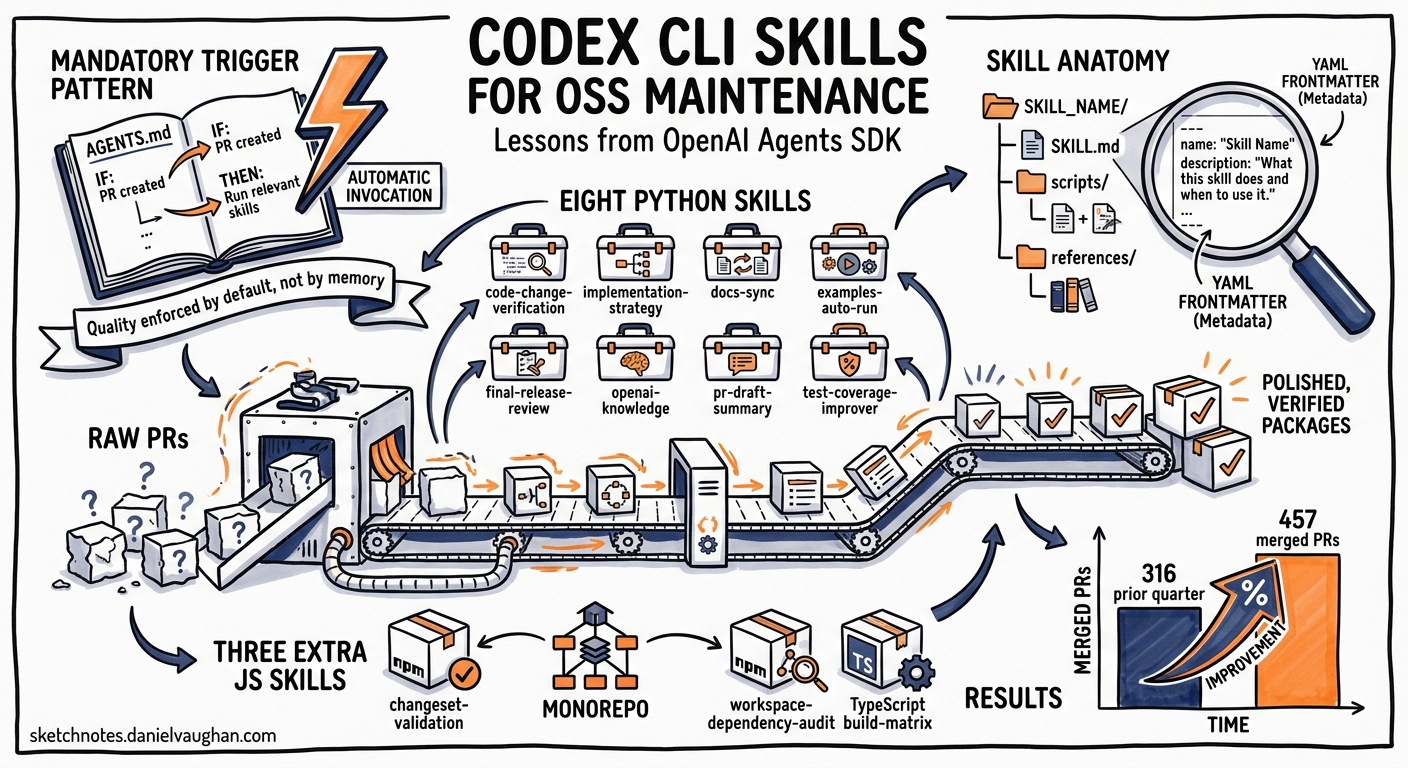
OpenAI practises what it preaches. In March 2026 the company published a detailed case study showing how Codex CLI skills transformed maintenance of its two flagship open-source Agents SDK repositories — the Python package (openai-agents-python) and the TypeScript package (openai-agents-js)1. The results speak for themselves: 457 merged pull requests between December 2025 and February 2026, up from 316 in the preceding quarter1. This article unpacks every pattern from that case study, maps each to the official skills documentation2, and offers guidance for teams wanting to replicate the approach in their own repositories.
Why Skills Beat Ad-Hoc Prompts for Maintenance
Maintenance work is repetitive but not trivial. Formatting, linting, type-checking, release review, integration testing and PR description drafting recur on every contribution. Encoding these as ephemeral chat prompts guarantees drift: one contributor forgets the lint step, another uses the wrong verification order, a third skips the compatibility check. Skills solve this by bundling instructions, scripts and references into a versioned directory that Codex discovers automatically2.
The critical insight from the OpenAI case study is the mandatory trigger pattern — AGENTS.md rules that force skill invocation before certain categories of change are permitted1. This shifts quality enforcement from “remember to run the checks” to “the agent runs the checks by default.”
Anatomy of the Skills Stack
The two repositories share a common architecture.
flowchart TD
    A["AGENTS.md<br/>(if/then trigger rules)"] --> B["Skill Selection"]
    B --> C["$code-change-verification"]
    B --> D["$implementation-strategy"]
    B --> E["$pr-draft-summary"]
    B --> F["$openai-knowledge"]
    B --> G["$docs-sync"]
    B --> H["$final-release-review"]
    B --> I["$test-coverage-improver"]
    B --> J["$examples-auto-run"]
    C --> K["scripts/<br/>make format, lint, typecheck, tests"]
    D --> L["references/<br/>compatibility policy"]
    J --> M["scripts/<br/>auto-answer, retry, skip-list"]
Each skill follows the standard directory layout2:
.agents/skills/
  code-change-verification/
    SKILL.md
    scripts/
    references/
  implementation-strategy/
    SKILL.md
    references/
  ...
The SKILL.md file is the manifest: YAML front matter with name and description, followed by Markdown instructions the model reads when the skill is selected2.
The Eight Python-Repo Skills
OpenAI’s Python Agents SDK repository ships eight skills1:
| Skill | Purpose | Key Mechanism |
|---|---|---|
code-change-verification |
Runs formatting, linting, type-checking and test validation | make format && make lint && make typecheck && make tests |
implementation-strategy |
Decides compatibility boundary before runtime edits | Reference docs on API stability policy |
docs-sync |
Audits docs against the codebase for gaps and staleness | Codebase diffing against existing docs |
examples-auto-run |
Executes examples in automated mode with retries | Auto-answer prompts, skip lists, structured logs |
final-release-review |
Compares release candidates against previous tags | Risk assessment, green/yellow/blocked output |
openai-knowledge |
Fetches live OpenAI platform docs via MCP | OpenAI Docs MCP server integration |
pr-draft-summary |
Generates branch suggestions, PR titles, draft descriptions | Git diff analysis |
test-coverage-improver |
Finds coverage gaps and proposes high-impact tests | Coverage reporting and analysis |
The Three Extra JavaScript-Repo Skills
The TypeScript package adds three skills for npm monorepo concerns1:
| Skill | Purpose |
|---|---|
changeset-validation |
Validates changeset files and bump levels match package diffs |
integration-tests |
Publishes to local Verdaccio registry, validates across Node.js, Bun, Deno, Cloudflare Workers and Vite |
pnpm-upgrade |
Coordinates pnpm toolchain and CI pin updates |
The JavaScript verification sequence is more complex than the Python one:
pnpm i
pnpm build
pnpm -r build-check
pnpm -r -F "@openai/*" dist:check
pnpm lint
pnpm test
AGENTS.md: The Mandatory Trigger Layer
The most powerful pattern from the case study is the if/then trigger table inside AGENTS.md. Rather than relying on developers to invoke skills manually, the repository encodes rules that make invocation non-optional1:
## Mandatory skill usage

- Before editing runtime or API changes affecting compatibility:
  call `$implementation-strategy`
- If a change affects SDK code, tests, examples, or build behavior:
  call `$code-change-verification`
- If the work touches OpenAI API or platform integrations:
  call `$openai-knowledge`
- If substantial code work is ready for review:
  call `$pr-draft-summary`
The JavaScript repo extends this with:
- If a package change affects release metadata:
  call `$changeset-validation`
The case study explicitly advises keeping “release-critical compatibility rules in the same place as the skill triggers”1, so AGENTS.md becomes the single source of truth for what must happen before a change lands.
Skill Discovery Hierarchy
Codex scans for skills in a well-defined precedence order2:
flowchart LR
    A["Local<br/>.agents/skills"] --> B["Parent dirs<br/>up to repo root"]
    B --> C["User<br/>~/.agents/skills"]
    C --> D["Admin<br/>/etc/codex/skills"]
    D --> E["System<br/>Bundled skills"]
For open-source repositories, the LOCAL scope matters most — skills travel with the repository, so every contributor and every CI runner gets the same workflow.
The Script-Versus-Model Division
A recurring theme in the case study is the clear boundary between what scripts do and what the model does1:
Scripts handle deterministic operations:
- Running verification commands in fixed order
- Managing example execution with auto-answer and retry
- Collecting structured logs
- Fetching release tags
- Exposing helper commands (
start,stop,status,logs,tail,collect,rerun)
The model handles judgement-intensive operations:
- Interpreting diff context for compatibility impact
- Comparing release candidates against prior tags
- Generating human-readable PR descriptions
- Assessing test coverage priorities
- Deciding whether a release is safe, cautious or blocked
This division is worth studying. Teams that push too much judgement into shell scripts end up with brittle, over-engineered automation. Teams that let the model run verification commands end up with non-deterministic, unreproducible results. The sweet spot is scripts for the mechanical parts, model for the interpretive parts.
Writing Effective Skill Descriptions
The case study includes a worked example of description quality1:
Weak:
Run the mandatory verification stack in the OpenAI Agents JS monorepo.
Strong:
Run the mandatory verification stack when changes affect runtime code, tests, or build/test behavior in the OpenAI Agents JS monorepo.
The difference matters because the description field drives implicit skill selection2. If the description omits trigger conditions, Codex cannot match the skill to the right context. The official documentation recommends front-loading “the key use case and trigger words so Codex can still match the skill if descriptions are shortened”2 — relevant because Codex progressively truncates descriptions when many skills compete for the initial 2% context budget2.
Integration Testing: The Verdaccio Pattern
The JavaScript integration-tests skill deserves special attention. It implements a two-layer testing strategy1:
flowchart TD
    A["Layer 1: In-Repo Examples"] --> B["Auto-answer interactive prompts"]
    A --> C["Auto-approve HITL, MCP, apply_patch, shell"]
    A --> D["Maintain skip lists"]
    A --> E["Generate per-example logs"]
    A --> F["Create rerun files for failures"]

    G["Layer 2: Package Validation"] --> H["Publish to local Verdaccio registry"]
    G --> I["Test install across Node.js, Bun, Deno"]
    G --> J["Validate Cloudflare Workers & Vite"]
    G --> K["Confirm post-publish behaviour"]
Layer 1 catches source-level issues. Layer 2 catches packaging issues — missing exports, incorrect type declarations, bundler incompatibilities — that only surface after npm pack and install. This pattern is broadly applicable to any library that ships as a package.
Release Review: Evidence-Based Decisions
The final-release-review skill produces structured output for release readiness1. From PR #2480, the output includes:
- Overall release call — green, yellow, or blocked
- Scope summary — file counts and change categories
- Risk assessment — specific risks with evidence from diffs
- Actionable follow-up — concrete next steps
The strategy is deliberately conservative: “start from ‘safe to release’ and switch to blocked only when diff shows concrete evidence of problems”1. This bias towards releasing unless proven otherwise keeps velocity high whilst surfacing genuine blockers.
GitHub Actions: Closing the Automation Loop
Skills become fully autonomous when wired into GitHub Actions via the Codex GitHub Action3. The case study references this integration for CI-triggered workflows. Key security considerations for running skills in CI13:
- Limit who can start skill-invoking workflows (trusted events or explicit approvals)
- Sanitise inputs from PRs, commits, issues and comments
- Protect API keys with
drop-sudoor unprivileged users - Run Codex as the final job step to minimise the blast radius
Where Human Review Remains Essential
The case study is refreshingly honest about what skills cannot replace1:
- API or architecture changes where multiple reasonable designs exist
- Behaviour modifications affecting product expectations or backwards-compatibility promises
- Naming, migration and release-communication decisions requiring judgement
- Cross-team alignment where context exceeds what a model can hold
The throughput improvement — 44.6% more merged PRs per quarter — comes from shifting verification drudgery to skills whilst preserving high-context human review for decisions that actually require it1.
Replicating This in Your Own Repository
Step 1: Audit Recurring Workflows
List every task that triggers on most PRs. Common candidates: linting, testing, changelog updates, documentation checks, PR description generation.
Step 2: Create the Skills Directory
mkdir -p .agents/skills/{verification,release-review,pr-summary}
Step 3: Write Focused SKILL.md Files
---
name: verification
description: >
  Run the mandatory verification stack when changes affect
  runtime code, tests, or build/test behaviour.
---

## Steps

1. Run `make lint` and report any failures.
2. Run `make typecheck` and report any failures.
3. Run `make test` and report results.
4. If all pass, confirm verification complete.
5. If any fail, summarise failures and suggest fixes.
Step 4: Wire Triggers into AGENTS.md
## Mandatory skill usage

- If a change affects source code, tests, or build behaviour:
  call `$verification`
- When preparing a PR for review:
  call `$pr-summary`
Step 5: Test With $skill-creator
Use the built-in $skill-creator skill to scaffold and iterate on skill definitions2. Test trigger phrases against the description to confirm correct auto-selection.
Lessons for the Broader Ecosystem
The OpenAI Agents SDK case study demonstrates a maturity model for skills adoption:
- Ad-hoc prompts — every contributor writes their own verification instructions
- Shared AGENTS.md — verification steps are documented but not enforced
- Skills — verification is packaged, versioned and discoverable
- Mandatory triggers — AGENTS.md rules make skill invocation non-optional
- CI integration — GitHub Actions run skills autonomously on every PR
Most teams are at stage 1 or 2. The case study shows the payoff of reaching stage 4 and 5: not just faster PRs, but more consistent quality across a growing contributor base.
Citations
-
OpenAI (2026). “Using skills to accelerate OSS maintenance.” OpenAI Developers Blog. https://developers.openai.com/blog/skills-agents-sdk ↩ ↩2 ↩3 ↩4 ↩5 ↩6 ↩7 ↩8 ↩9 ↩10 ↩11 ↩12 ↩13 ↩14 ↩15
-
OpenAI (2026). “Agent Skills — Codex.” OpenAI Developers. https://developers.openai.com/codex/skills ↩ ↩2 ↩3 ↩4 ↩5 ↩6 ↩7 ↩8 ↩9
-
OpenAI (2026). “GitHub Action — Codex.” OpenAI Developers. https://developers.openai.com/codex/github-action ↩ ↩2