Codex CLI for OpenTelemetry Instrumentation: Agent-Driven Span Generation, Metrics Scaffolding, and Observability Pipelines
Codex CLI for OpenTelemetry Instrumentation: Agent-Driven Span Generation, Metrics Scaffolding, and Observability Pipelines
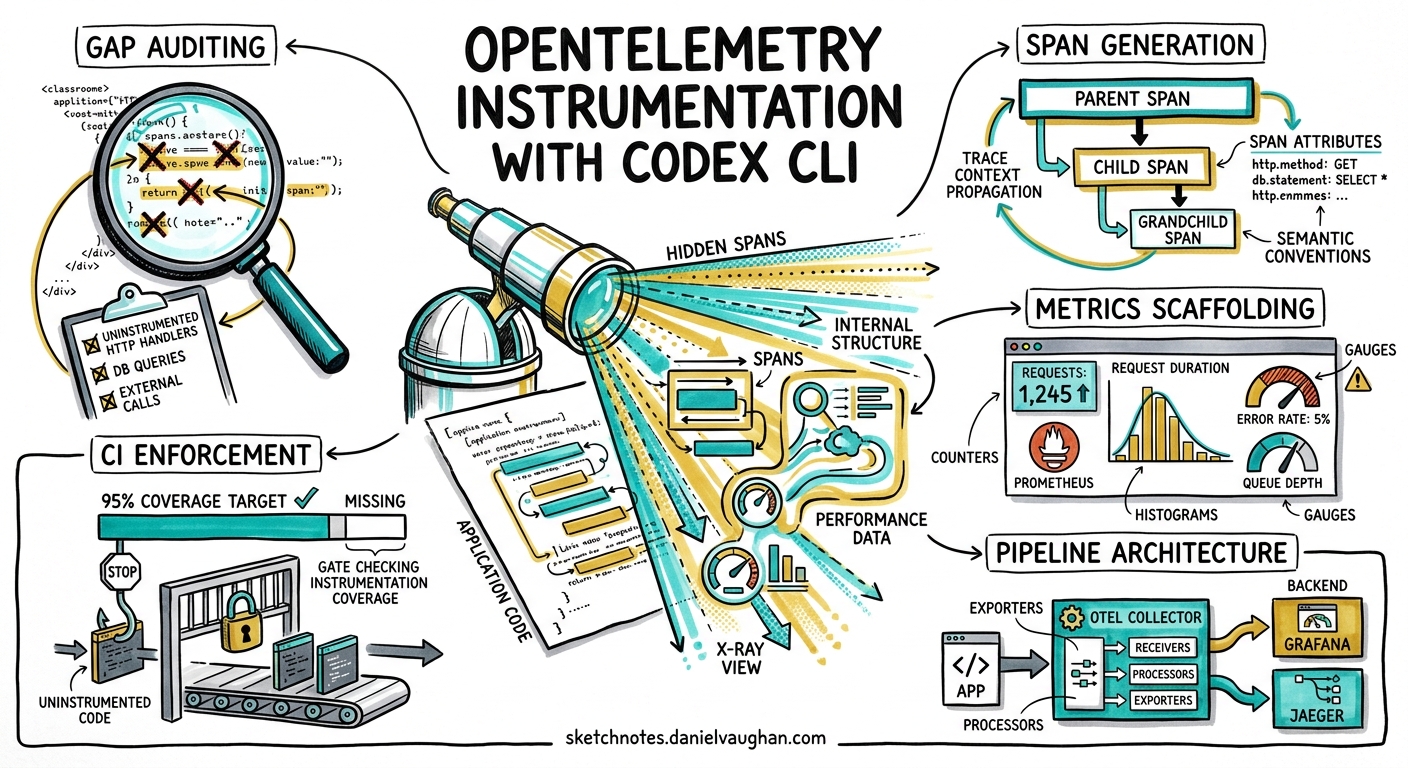
Existing Codex CLI observability coverage focuses on monitoring the agent itself — exporting traces from Codex sessions to backends like Grafana or SigNoz. This article addresses the inverse: using Codex CLI to systematically add OpenTelemetry instrumentation to your application code. The workflow covers gap auditing, span generation, metrics scaffolding, and CI enforcement — turning weeks of manual instrumentation grind into repeatable agent-driven pipelines.
The Instrumentation Debt Problem
Most production services ship with auto-instrumentation covering HTTP handlers and database calls, but lack custom spans around business logic, domain events, and internal state machines1. The OpenTelemetry project recommends starting with automatic instrumentation then progressively adding manual spans for areas needing deeper visibility2. In practice, teams accumulate instrumentation debt because manual span creation is tedious and easily deprioritised.
Codex CLI’s non-interactive mode (codex exec) with --output-schema makes this tractable at scale3. The agent can audit gaps, generate idiomatic instrumentation, and validate the result — all without human intervention per file.
Architecture Overview
flowchart TD
    A[AGENTS.md OTel Standards] --> B[Gap Audit via codex exec]
    B --> C{Coverage Report JSON}
    C --> D[Span Generation Skill]
    C --> E[Metrics Scaffolding Skill]
    D --> F[Validation: go vet / tsc / pylint]
    E --> F
    F --> G[CI Gate: Minimum Coverage]
    G --> H[Export to Collector]
Phase 1: Encoding Standards in AGENTS.md
Before the agent generates a single span, establish conventions in your repository’s AGENTS.md:
## OpenTelemetry Standards

### Tracing
- Every exported function handling a business operation MUST create a span
- Span names follow `<package>.<Function>` convention (e.g. `orders.ProcessPayment`)
- Always defer span.End() immediately after creation
- Record errors with both span.RecordError(err) AND span.SetStatus(codes.Error, msg)
- Add semantic attributes: `service.operation`, `business.entity_id`, `business.outcome`

### Metrics
- Use histograms for latency, counters for throughput, gauges for queue depth
- Metric names follow `<service>.<subsystem>.<metric>` (e.g. `checkout.payments.duration_ms`)
- All metrics MUST include `environment` and `service.version` attributes

### Anti-patterns
- Do NOT create spans inside tight loops (>100 iterations)
- Do NOT add PII as span attributes
- Do NOT use string concatenation for span names — use constants
This ensures every agent-generated instrumentation line follows team conventions without per-prompt repetition4.
Phase 2: Instrumentation Gap Audit
Create a JSON schema for structured audit output:
{
  "$schema": "https://json-schema.org/draft/2020-12/schema",
  "type": "object",
  "properties": {
    "files_audited": { "type": "integer" },
    "gaps": {
      "type": "array",
      "items": {
        "type": "object",
        "properties": {
          "file": { "type": "string" },
          "function": { "type": "string" },
          "line": { "type": "integer" },
          "gap_type": { "enum": ["missing_span", "missing_error_recording", "missing_attributes", "missing_metric"] },
          "severity": { "enum": ["critical", "high", "medium", "low"] },
          "rationale": { "type": "string" }
        },
        "required": ["file", "function", "gap_type", "severity"]
      }
    },
    "coverage_score": { "type": "number", "minimum": 0, "maximum": 100 }
  },
  "required": ["files_audited", "gaps", "coverage_score"]
}
Run the audit:
codex exec \
  --model gpt-5.4-mini \
  --output-schema ./schemas/otel-audit.schema.json \
  -o ./reports/otel-gaps.json \
  "Audit all Go files in ./internal/orders/ for OpenTelemetry instrumentation gaps. \
   Check: exported functions without spans, spans missing error recording, \
   operations without duration metrics. Rate severity by traffic impact."
The --output-schema flag guarantees parseable JSON conforming to your schema, enabling downstream automation3. Use gpt-5.4-mini for audit tasks — it handles pattern matching at lower cost than full-size models5.
Phase 3: Span Generation Skill
Create a reusable skill at .codex/skills/otel-instrumentor/SKILL.md:
---
name: otel-instrumentor
description: Adds OpenTelemetry tracing spans and error recording to Go, TypeScript, or Python functions identified in an instrumentation gap report.
---

## Instructions

1. Read the gap report JSON from the path provided
2. For each gap with severity "critical" or "high":
   - Open the target file
   - Add the appropriate OTel import if missing
   - Create a span at function entry following AGENTS.md conventions
   - Add `defer span.End()` immediately after span creation
   - Wrap error returns with `span.RecordError(err)` and `span.SetStatus(codes.Error, err.Error())`
   - Add business-relevant attributes as span attributes
3. Do NOT modify function signatures or return types
4. Do NOT add spans inside loops iterating more than 10 times
5. Run the language-appropriate type checker after each file modification
Invoke the skill in batch mode:
codex exec \
  --model gpt-5.4 \
  --skill otel-instrumentor \
  "Process all critical and high severity gaps from ./reports/otel-gaps.json"
Generated Output Example (Go)
Before:
func (s *OrderService) ProcessPayment(ctx context.Context, orderID string, amount Money) error {
    validated, err := s.validator.Validate(orderID, amount)
    if err != nil {
        return fmt.Errorf("validation failed: %w", err)
    }
    return s.gateway.Charge(ctx, validated)
}
After agent instrumentation:
func (s *OrderService) ProcessPayment(ctx context.Context, orderID string, amount Money) error {
    ctx, span := s.tracer.Start(ctx, "orders.ProcessPayment",
        trace.WithAttributes(
            attribute.String("business.entity_id", orderID),
            attribute.String("service.operation", "process_payment"),
        ))
    defer span.End()

    validated, err := s.validator.Validate(orderID, amount)
    if err != nil {
        span.RecordError(err)
        span.SetStatus(codes.Error, "validation failed")
        return fmt.Errorf("validation failed: %w", err)
    }

    if err := s.gateway.Charge(ctx, validated); err != nil {
        span.RecordError(err)
        span.SetStatus(codes.Error, "charge failed")
        return fmt.Errorf("charge failed: %w", err)
    }

    span.SetAttributes(attribute.String("business.outcome", "success"))
    return nil
}
Note the agent propagates context correctly, defers span.End(), records errors at each failure point with status codes, and adds business attributes — all following the AGENTS.md conventions6.
Phase 4: Metrics Scaffolding
For metrics, create a separate skill focused on counter, histogram, and gauge generation:
codex exec \
  --model gpt-5.4 \
  "For each public handler in ./internal/api/, add a histogram recording \
   request duration and a counter recording total requests. Follow the \
   metric naming convention in AGENTS.md. Use the global meter provider. \
   Add attributes for HTTP method, route, and status code."
TypeScript Example
import { metrics } from '@opentelemetry/api';

const meter = metrics.getMeter('api-gateway');
const requestDuration = meter.createHistogram('api.gateway.request_duration_ms', {
  description: 'HTTP request duration in milliseconds',
  unit: 'ms',
});
const requestCount = meter.createCounter('api.gateway.requests_total', {
  description: 'Total HTTP requests processed',
});

export async function handleOrder(req: Request, res: Response): Promise<void> {
  const start = performance.now();
  const attrs = {
    'http.method': req.method,
    'http.route': '/api/orders',
  };

  try {
    const result = await processOrder(req.body);
    requestCount.add(1, { ...attrs, 'http.status_code': 201 });
    res.status(201).json(result);
  } finally {
    requestDuration.record(performance.now() - start, attrs);
  }
}
Phase 5: CI Enforcement Gate
Add a GitHub Actions workflow that runs the audit on every PR and blocks merges below a coverage threshold:
name: OTel Coverage Gate
on:
  pull_request:
    paths: ['internal/**', 'src/**']

jobs:
  otel-audit:
    runs-on: ubuntu-latest
    steps:
      - uses: actions/checkout@v4
      - uses: openai/codex-action@v1
        with:
          command: |
            codex exec \
              --model gpt-5.4-mini \
              --output-schema ./schemas/otel-audit.schema.json \
              -o ./reports/otel-coverage.json \
              "Audit changed files for OpenTelemetry instrumentation coverage"
      - name: Check threshold
        run: |
          SCORE=$(jq '.coverage_score' ./reports/otel-coverage.json)
          if (( $(echo "$SCORE < 80" | bc -l) )); then
            echo "::error::OTel coverage $SCORE% below 80% threshold"
            exit 1
          fi
This creates a feedback loop: developers see exactly which functions lack instrumentation before merge7.
Model Selection Matrix
| Task | Recommended Model | Rationale |
|---|---|---|
| Gap audit (read-only analysis) | gpt-5.4-mini | Pattern matching at low cost5 |
| Span generation (code modification) | gpt-5.4 | Needs AST awareness and import management |
| Complex metrics design | gpt-5.5 | Architecture-level decisions on metric cardinality |
| Validation pass (type checking) | N/A — use go vet, tsc, pylint |
Deterministic tooling, not LLM |
Anti-Patterns to Avoid
Instrumenting everything blindly. Not every function needs a span. The agent should respect the severity ratings from the audit phase and skip low-value internal helpers. Over-instrumentation increases trace storage costs and degrades signal-to-noise ratio8.
Generating without validating. Always run type checkers after instrumentation. The --output-schema and codex exec pipeline should include a validation step — either via a hooks-based post-execution check or a subsequent codex exec pass.
Ignoring context propagation. In Go, spans must receive and pass context.Context. In TypeScript, the active context flows via api.context. The AGENTS.md file must specify context propagation rules to prevent orphaned spans6.
Trusting attribute values without sanitisation. PII can leak into spans via user-provided IDs. Encode attribute allow-lists in AGENTS.md and instruct the agent to hash or redact sensitive fields.
Duplicating auto-instrumentation coverage. If your HTTP framework middleware already creates spans for handler entry/exit, the agent should not add redundant spans at the same boundary. The audit skill should detect existing instrumentation before flagging gaps1.
Known Limitations
--output-schemaand--resumeare mutually exclusive — you cannot resume a structured audit session with schema validation9- Sandbox network isolation — if your validation step requires fetching OTel SDK packages, configure
full_autoapproval or pre-install dependencies before the agent run10 - Context window limits — for monorepos with hundreds of files, batch the audit by package/directory rather than running a single pass
- Import path resolution — the agent may generate incorrect import paths for internal packages; include your module path in AGENTS.md
Scheduling Recurring Audits
Use Codex automations to run instrumentation audits weekly:
# .codex/automations/otel-audit.toml
[trigger]
schedule = "weekly"

[task]
prompt = "Run the OTel instrumentation gap audit on all packages modified in the last 7 days. Generate a report and create a GitHub issue if coverage drops below 80%."
model = "gpt-5.4-mini"
This catches instrumentation drift as new code lands without manual oversight11.
Citations
-
OpenTelemetry Project, “Instrumentation — Getting Started,” https://opentelemetry.io/docs/languages/go/instrumentation/ (accessed 2026-05-16) ↩ ↩2
-
Red Hat Developer, “How to use auto-instrumentation with OpenTelemetry,” https://developers.redhat.com/articles/2026/02/25/how-use-auto-instrumentation-opentelemetry (accessed 2026-05-16) ↩
-
OpenAI, “Non-interactive mode — Codex CLI,” https://developers.openai.com/codex/noninteractive (accessed 2026-05-16) ↩ ↩2
-
OpenAI, “Custom instructions with AGENTS.md,” https://developers.openai.com/codex/guides/agents-md (accessed 2026-05-16) ↩
-
OpenAI, “Models — Codex,” https://developers.openai.com/codex/models (accessed 2026-05-16) ↩ ↩2
-
OpenTelemetry Project, “Go SDK Instrumentation — Context Propagation,” https://opentelemetry.io/docs/languages/go/instrumentation/ (accessed 2026-05-16) ↩ ↩2
-
OpenAI, “Codex GitHub Action,” https://developers.openai.com/codex/guides/github-action (accessed 2026-05-16) ↩
-
Uptrace, “OpenTelemetry for AI Systems: LLM and Agent Observability (2026),” https://uptrace.dev/blog/opentelemetry-ai-systems (accessed 2026-05-16) ↩
-
GitHub Issue #14343, “Add –output-schema support to codex exec resume,” https://github.com/openai/codex/issues/14343 (accessed 2026-05-16) ↩
-
OpenAI, “Codex CLI Sandbox Documentation,” https://developers.openai.com/codex/cli/sandbox (accessed 2026-05-16) ↩
-
OpenAI, “Workflows — Codex,” https://developers.openai.com/codex/workflows (accessed 2026-05-16) ↩