Codex CLI for Haskell Development Teams: HLS via LSP-MCP, Type-Driven Agent Workflows, and AGENTS.md for Functional Codebases
Codex CLI for Haskell Development Teams: HLS via LSP-MCP, Type-Driven Agent Workflows, and AGENTS.md for Functional Codebases
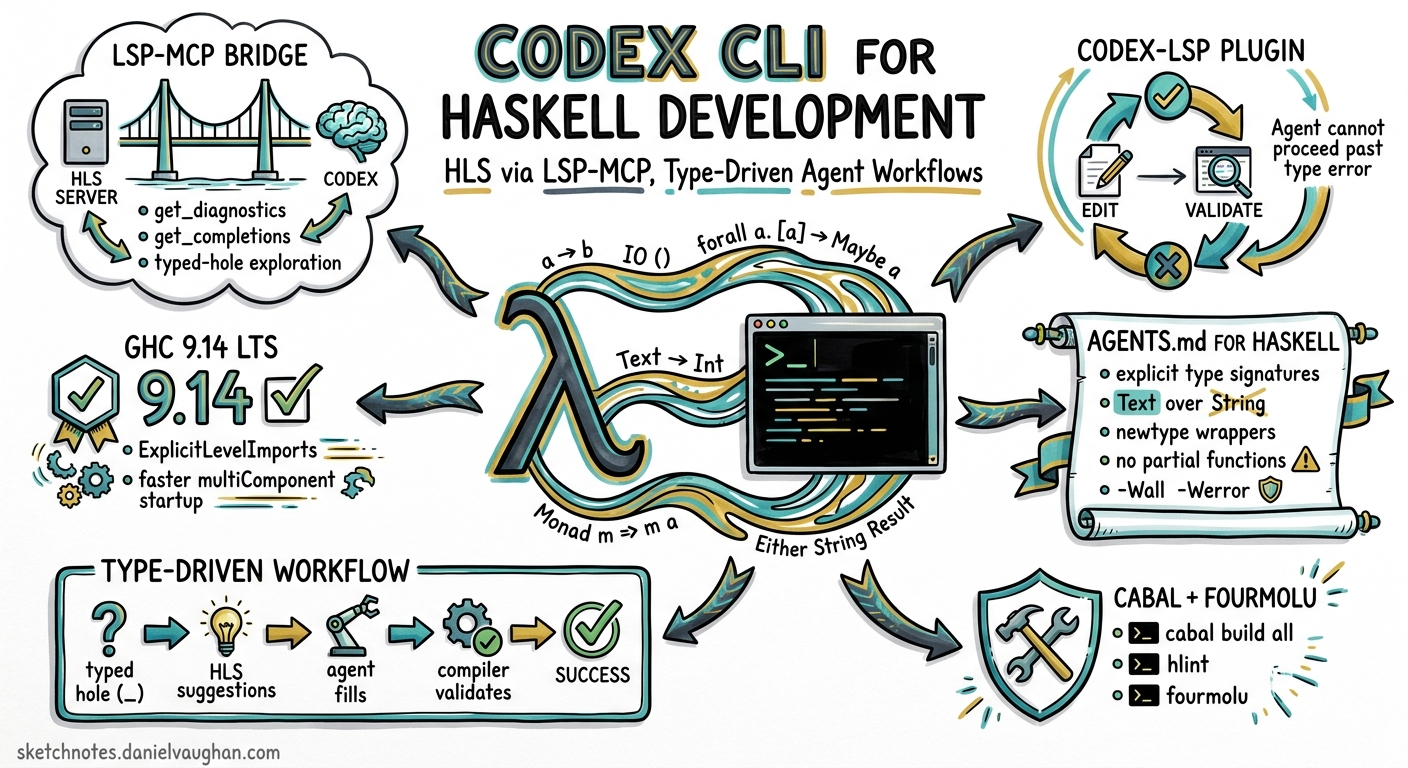
Haskell’s type system catches entire categories of defects at compile time, but that same rigour makes it an interesting test case for AI coding agents. A model that generates well-typed Haskell code on the first pass saves substantial iteration time; one that does not will loop against GHC errors until context is exhausted. This article covers how to wire Codex CLI into a Haskell toolchain so that the agent receives compiler diagnostics in real time, respects functional programming conventions, and leverages GHC 9.14’s type system rather than fighting it.
The Haskell MCP Landscape
Three integration points connect Codex CLI to Haskell tooling.
LSP-MCP Bridge
The LSP-MCP server by Tritlo bridges any Language Server Protocol implementation to MCP 1. It starts an LSP client, connects to a configured language server, and exposes nine MCP tools including get_info_on_location (hover), get_completions, get_diagnostics, and get_code_actions. For Haskell, it ships with a language-specific extension that provides specialised prompts for typed-hole exploration — arguably the single most useful HLS feature for agent-driven development.
Configuration in ~/.codex/config.toml:
[mcp_servers.haskell-lsp]
type = "stdio"
command = "npx"
args = ["tritlo/lsp-mcp", "haskell", "haskell-language-server-wrapper", "--lsp"]
codex-lsp Plugin
The codex-lsp plugin takes a different approach: rather than exposing LSP as standalone MCP tools, it hooks into Codex’s post-tool-use lifecycle 2. After every file edit, the plugin automatically validates changes against HLS and returns blocking feedback if type errors or warnings appear. This creates a tight feedback loop where the agent cannot proceed past a type error without fixing it first — exactly the discipline Haskell developers enforce on themselves.
The plugin exposes seven tools: lsp.diagnostics, lsp.goto_definition, lsp.find_references, lsp.symbols, lsp.prepare_rename, lsp.rename, and lsp.status 2.
Haskell MCP Library
For teams building custom MCP servers in Haskell itself, the mcp package on Hackage (v0.3.1.0, February 2026) provides a Servant-based server implementation supporting MCP protocol version 2025-06-18 3. It offers HTTP transport with JWT authentication, stdio transport for subprocess integrations, and Server-Sent Events streaming. This is relevant when your Haskell project needs to expose domain-specific tools — database queries, business-rule validators, or deployment scripts — as MCP resources that Codex can call during a session.
HLS 2.14 and GHC 9.14 Support
HLS 2.14.0.0, released 30 April 2026, supports GHC versions 9.6.7 through 9.14.1 4. Key improvements relevant to agent workflows:
- Faster startup in
multipleComponentsmode — reduces the wait before Codex receives its first diagnostic response in large multi-package projects. ExplicitLevelImportssupport — GHC 9.14.1’s new extension for separating type-level and value-level imports 4. The agent can use this to generate cleaner import blocks.- Notes hover and autocompletion — HLS now provides hover information and completions for GHC
Notereferences, helping the agent navigate compiler internals when working on GHC plugins or core libraries.
Install with GHCup:
ghcup install hls --set 2.14.0.0
GHC 9.14 is the first LTS release under GHC’s new release schedule, guaranteeing a minimum of two years of bugfix support 5. For teams setting up Codex workflows, pinning to 9.14 LTS provides stability without sacrificing access to recent language features.
AGENTS.md for Haskell Projects
Haskell projects benefit from unusually specific AGENTS.md instructions because the language’s conventions diverge sharply from what models trained primarily on Python, TypeScript, and Go will default to. A minimal but effective configuration:
# Build and Test

- Build: `cabal build all`
- Test: `cabal test all --test-show-details=streaming`
- Lint: `hlint src/ test/`
- Format: `fourmolu -i src/ test/`
- Type-check only: `cabal build all --ghc-options="-fno-code"`

# Coding Conventions

- Use explicit type signatures on ALL top-level bindings — never rely on inference
- Prefer `Text` over `String` for all user-facing text
- Use `newtype` wrappers for domain types rather than type aliases
- Avoid partial functions (`head`, `tail`, `!!`) — use `NonEmpty` or pattern matching
- Enable `-Wall -Werror` — treat all warnings as errors
- Use qualified imports for all non-Prelude modules
- Write Haddock comments on every exported function and data type
- Prefer `where` clauses over `let` bindings for named intermediate values
- Use typed holes (`_`) when exploring implementations — the compiler will suggest types

# Error Handling

- Use `ExceptT` or `Either` for recoverable errors, never `error` or `undefined`
- Pattern match exhaustively — enable `-Wincomplete-patterns`

# Dependencies

- Add dependencies to the `.cabal` file, never to `stack.yaml` directly
- Pin major versions with PVP bounds (e.g., `base >= 4.18 && < 4.22`)
The instruction to use typed holes is particularly powerful with the LSP-MCP integration. When the agent writes _ :: SomeType, HLS returns the expected type and valid completions via get_info_on_location, letting the agent fill holes iteratively rather than guessing at complex type signatures 1.
Type-Driven Agent Workflows
Haskell’s type system enables a distinctive agent workflow pattern where types guide implementation rather than tests.
flowchart TD
    A[Define types and signatures] --> B[Write typed holes for implementations]
    B --> C[HLS returns hole-fit suggestions]
    C --> D[Agent fills holes with suggested fits]
    D --> E{GHC type-checks?}
    E -->|No| F[Read diagnostic, adjust implementation]
    F --> B
    E -->|Yes| G[Run tests]
    G -->|Fail| H[Refine logic, types still hold]
    H --> D
    G -->|Pass| I[Done]
This flow works because GHC’s type checker acts as a fast, deterministic oracle that the agent can query before running slower property tests or integration suites. In practice, a well-typed Haskell function that compiles often behaves correctly — the aphorism “if it compiles, it works” holds frequently enough that the type-check pass eliminates most iteration cycles.
Practical Pattern: Algebraic Data Type Refactoring
Consider a task where the agent must add a new constructor to an algebraic data type. With -Wincomplete-patterns enabled, GHC will flag every pattern match that needs updating. The agent workflow becomes:
- Add the new constructor to the data type definition.
- Run
cabal build all --ghc-options="-fno-code"for a fast type-check. - HLS diagnostics (via LSP-MCP) list every incomplete pattern match.
- Navigate to each location and extend the pattern match.
- Repeat until zero diagnostics remain.
This is deterministic and exhaustive — the agent cannot miss a case because the compiler enumerates every one.
Model Selection for Haskell
Haskell is underrepresented in model training data compared to Python or JavaScript. Model selection matters more than usual:
| Task | Recommended Model | Rationale |
|---|---|---|
| Type-driven implementation | gpt-5.5 |
Strongest at complex type reasoning 6 |
| Refactoring, pattern match completion | gpt-5.4 |
Good balance of speed and accuracy |
| Build script generation, Cabal config | gpt-5.4-mini |
Sufficient for declarative configuration |
| Quick interactive exploration | gpt-5.3-codex-spark |
Fast iteration with typed holes |
Configure model routing in ~/.codex/config.toml:
model = "gpt-5.5"

[agents]
model = "gpt-5.4-mini"
This routes the primary agent to GPT-5.5 for implementation work while delegating subagent tasks (documentation lookups, dependency searches) to the faster mini model 7.
Permission Profile for Haskell Development
Haskell builds are deterministic but can be resource-intensive. A sensible permission profile:
[permissions]
approval_policy = "unless-allow-listed"

[permissions.allow_list]
read = ["**/*.hs", "**/*.cabal", "**/cabal.project*", "**/*.yaml", "**/*.toml"]
write = ["src/**/*.hs", "test/**/*.hs", "app/**/*.hs", "*.cabal"]
commands = [
  "cabal build*",
  "cabal test*",
  "cabal run*",
  "cabal clean",
  "hlint*",
  "fourmolu*",
  "ghcup*",
]
network_access = true  # Required for Hackage dependency resolution
Limitations
- Training data lag: Models have weaker coverage of GHC 9.14-specific extensions (
ExplicitLevelImports, recentSPECIALISEimprovements) and may generate code targeting older GHC versions 6. The AGENTS.md GHC version constraint helps but does not eliminate this. - Build times: Large Haskell projects can take minutes to build. The
--ghc-options="-fno-code"flag for type-check-only passes is essential to keep the agent’s feedback loop fast. - Template Haskell: TH splices execute at compile time and can perform arbitrary IO. Sandbox restrictions may conflict with TH-heavy projects. Consider
network_access = falsewhen the project does not require TH-driven code generation that fetches external resources. - No REPL integration: Codex CLI cannot interact with GHCi directly. The LSP-MCP bridge provides evaluation-like capabilities through typed holes and hover information, but true REPL-driven exploration (
:type,:kind,:info) is not yet available via MCP. - Cabal vs Stack: The MCP tooling is agnostic to build tool choice, but AGENTS.md instructions must be specific. Teams using Stack should replace all
cabalcommands with their Stack equivalents and configure the HLScradleaccordingly.
Citations
-
LSP-MCP Server - Awesome MCP Servers — LSP-MCP bridge server with nine tools and Haskell-specific typed-hole extension. ↩ ↩2
-
codex-lsp - GitHub — Codex plugin exposing LSP diagnostics and MCP tools with post-tool-use lifecycle hooks. ↩ ↩2
-
mcp package - Hackage — Servant-based MCP server library for Haskell, v0.3.1.0, MCP protocol 2025-06-18. ↩
-
HLS 2.14.0.0 Release - Haskell Blog — Release notes for HLS 2.14.0.0 with GHC 9.14.1 support, released 30 April 2026. ↩ ↩2
-
GHC LTS Release Schedule — GHC 9.14 designated as first LTS release with two-year bugfix support. ↩
-
Codex Models - OpenAI Developers — Current model catalogue including GPT-5.5, GPT-5.4, GPT-5.4-mini, and GPT-5.3-Codex-Spark. ↩ ↩2
-
Advanced Configuration - OpenAI Developers — Subagent model routing and configuration reference. ↩