Don't Let the Model Write the YAML: Deterministic GitOps Remediation and the Codex CLI Configuration Safety Problem
Don’t Let the Model Write the YAML: Deterministic GitOps Remediation and the Codex CLI Configuration Safety Problem
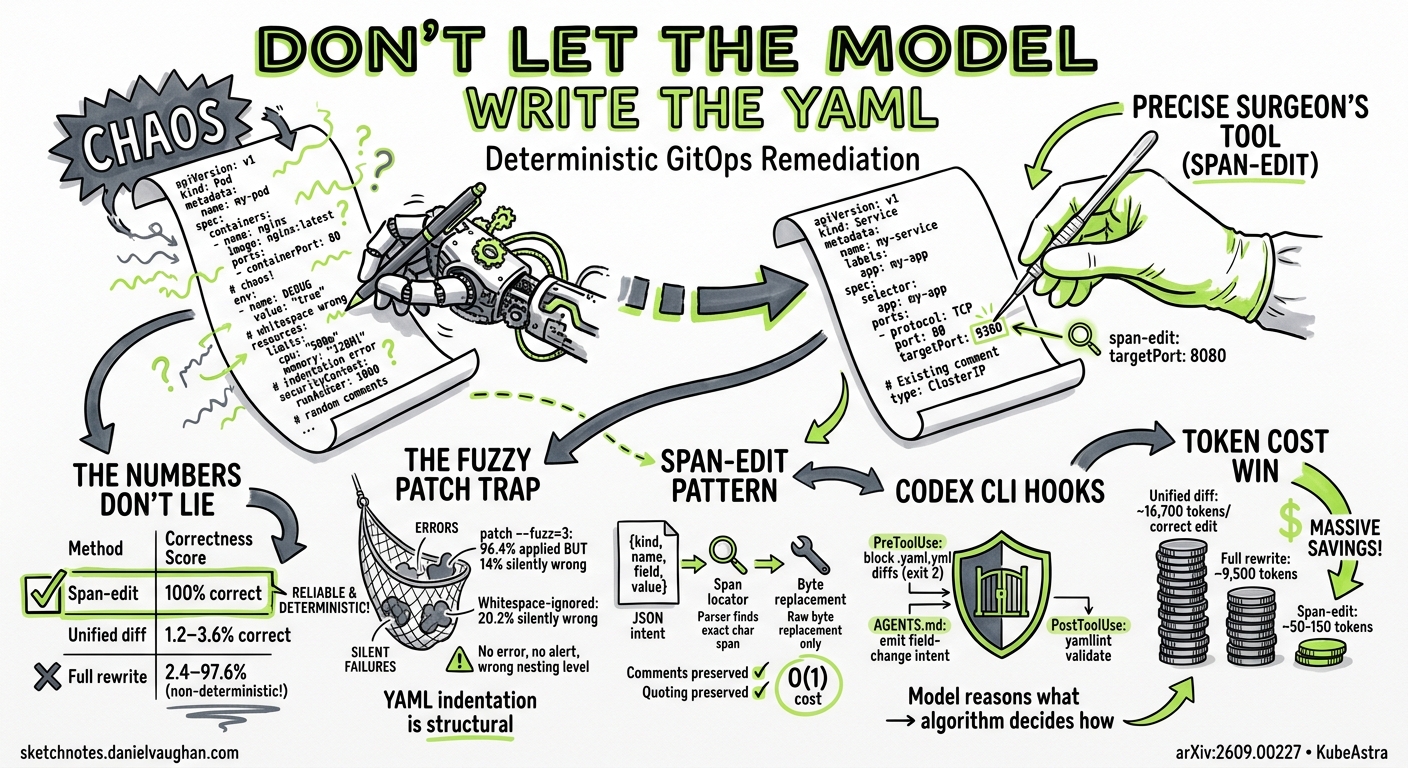
A new paper makes an uncomfortable claim about every coding agent that edits infrastructure configuration files: none of the text-generation strategies in common use are safe for unattended automation. Pruthvi Davineni (arXiv:2609.00227, August 2026) ran 83 real-world Kubernetes field-change tasks through three approaches, full-file rewrite, unified diff, and a new deterministic span-edit, and found correctness rates that should give any practitioner pause.1
The span-edit pipeline achieved 100 per cent correctness on every run. The unified diff approach used by Codex CLI’s apply_patch tool achieved 1.2–3.6 per cent depending on frontier model. Full-file rewrite oscillated between 2.4 per cent and 97.6 per cent — wide enough to be useless for any workflow requiring reliability rather than luck.1
Why Text Generation Fails on YAML
YAML is uniquely hostile to language model editing: whitespace is semantically load-bearing. A single misplaced space collapses a mapping to a string; a shifted indentation level silently promotes a nested key to the root. Davineni’s benchmark tested this concretely.
When Claude Sonnet 5 rewrote a 9,300-token Kubernetes manifest from scratch to change a single replicas field, it succeeded 97.6 per cent of the time, but introduced collateral changes in 2.4 per cent of cases and was non-deterministic (correct on some seeds, corrupt on others) for 6 of 83 tasks.1 Gemini Flash on the same corpus achieved only 2.4 per cent correctness.1
The Fuzzy Patch Problem
The unified diff approach is worse than it looks. Davineni re-applied 415 Sonnet 5–generated diffs across four patch configurations:1
| Tool | Applied | Silently misapplied |
|---|---|---|
| Strict context-exact | 2.7 per cent | 0 per cent |
| YAML-safe offset-tolerant | 67.5 per cent | 0 per cent |
patch --fuzz=3 |
96.4 per cent | 14.0 per cent |
patch --fuzz=3 -l (whitespace-ignored) |
96.4 per cent | 20.2 per cent |
The fuzzy patching practitioners use to get diffs to apply at all silently misapplies one in seven.1 When whitespace is also ignored, one in five. Since YAML indentation is structural, the “applied” result can move a field to the wrong nesting level with no diff rejection, no exception, and no operator alert.
The Span-Edit Approach
Davineni’s alternative reframes what the model produces. Instead of a diff or a complete file, the agent emits a structured field-change declaration:
{
  "resource": {"kind": "Deployment", "name": "api-server"},
  "field": "spec.replicas",
  "value": "5"
}
A deterministic pipeline then parses the manifest, locates the target scalar’s exact character span via YAML parser node-position marks, and replaces only that span in the raw bytes, no re-serialisation, no reformatting. Comments, block scalars, and quoting styles are preserved at 100 per cent. Correctness follows from the algorithm, not the model.1
Fail-closed behaviour on adversarial inputs (absent resources, missing fields, duplicate identifiers) achieved refusal precision 1.00, control coverage 1.00, recall 0.889.1
Generation cost comparison:1
| Approach | Output tokens/edit | Cost per correct edit |
|---|---|---|
| Span-edit | ~50–150 | ~50–150 tokens |
| Unified diff | ~200 | ~16,700 tokens |
| Full-file rewrite | ~9,300 | ~9,500 tokens |
Span-edit is O(1) in file size; full-file rewrite scales linearly with the manifest. The complete benchmark — 83 tasks × 5 seeds × 3 baselines × 2 models, cost $34.69 to run.1 The implementation ships as KubeAstra (Apache 2.0): ~150 lines for the safety-critical span-editor core, 520 lines total.12
Codex CLI Mapping
Codex CLI agents encounter YAML editing frequently: Kubernetes manifests, Helm values files, GitHub Actions workflows, Docker Compose files, and the config.toml that configures Codex itself. The apply_patch tool is the primary mechanism, and it uses unified diff format, which carries every failure mode above.
PreToolUse Hook: Block YAML Diffs
# ~/.codex/config.toml
[[hooks]]
event = "pre_tool_use"
tool_name = "apply_patch"
command = "bash ~/.codex/hooks/yaml-patch-guard.sh"
#!/usr/bin/env bash
# yaml-patch-guard.sh
set -euo pipefail
TARGET=$(cat | python3 -c "
import json, sys, re
d = json.load(sys.stdin)
patch = d.get('input', {}).get('patch', '')
m = re.search(r'^\+\+\+ b/(.+)$', patch, re.MULTILINE)
print(m.group(1) if m else '')
")
if [[ "$TARGET" == *.yaml ]] || [[ "$TARGET" == *.yml ]]; then
  echo "YAML diff blocked — emit field-change intent instead." >&2
  exit 2  # exit 2 = block and surface error to model
fi
exit 2 signals Codex CLI to surface the error to the model and halt the tool call.3 The model then has the opportunity to emit a structured intent instead.
AGENTS.md Policy
## Configuration File Policy

- **Never emit unified diffs for `.yaml` or `.yml` files.**
- For Kubernetes: emit structured field-change declarations (kind, name, field, value).
- For Helm values: supply the minimal `key: value` pair to merge, not a full rewrite.
- For GitHub Actions: add or replace a named step by ID, not a full workflow rewrite.
- The `apply_patch` hook will block YAML diffs. This is intentional.
Hook + AGENTS.md is the standard Codex CLI governance pairing: the hook provides a hard boundary, the AGENTS.md gives the model the rationale, reducing how often it attempts the blocked action.3
PostToolUse Validation
For permitted YAML writes (greenfield generation), validate structure before commit:
[[hooks]]
event = "post_tool_use"
tool_name = "apply_patch"
command = "bash ~/.codex/hooks/yaml-validate.sh"
#!/usr/bin/env bash
TARGET=$(cat | python3 -c "
import json, sys, re
d = json.load(sys.stdin)
m = re.search(r'^\+\+\+ b/(.+)$', d.get('input',{}).get('patch',''), re.MULTILINE)
print(m.group(1) if m else '')
")
if [[ "$TARGET" == *.yaml ]] || [[ "$TARGET" == *.yml ]]; then
  python3 -c "import yaml, sys; yaml.safe_load(open('$TARGET'))" \
    || { echo "YAML parse failed after patch." >&2; exit 1; }
fi
The flow with both hooks in place:
flowchart LR
    A[Model: field-change intent\nkind/name/field/value] -->|PreToolUse passes| B[Span locator:\nfind char span]
    B --> C[Raw byte replacement:\nno re-serialisation]
    C --> D[PostToolUse: yamllint\n/ kubectl dry-run]
    D -->|pass| E[Commit]
    D -->|fail| F[Block + report]
    G[Model: unified diff\nfor .yaml file] -->|PreToolUse exit 2| H[Blocked\nmodel retries as intent]
Practical Priorities
Prefer kubectl patch over file edits for in-cluster resources. kubectl patch --type=json applies a machine-readable change through the Kubernetes API, bypassing the YAML-on-disk problem entirely. AGENTS.md should instruct Codex to prefer shell tools over apply_patch for live cluster resources.4
Use apply_patch only for greenfield generation, not for editing existing manifests. Generating a new manifest is safer than diffing one, because there is no pre-existing structure to corrupt. ⚠️ Correctness still depends on model quality.
For MCP-based infrastructure tools, design tool schemas to accept field-level intents rather than raw diffs. This is the software-interface equivalent of KubeAstra’s architecture, and aligns with the intent/execution separation principle the paper demonstrates.2
Summary
Davineni’s empirical result is unambiguous: unified diffs applied with fuzzy matching silently misapply at 14–20 per cent, full-file rewrites are non-deterministic and model-dependent, and deterministic span-editing achieves 100 per cent correctness at a fraction of the token cost. A PreToolUse hook blocking YAML diffs, paired with an AGENTS.md policy requiring structured field-change intent, implements the right division of labour for Codex CLI: the model reasons about what to change, the algorithm decides how.
Citations
-
Davineni, P. “Don’t Let the Model Write the YAML: Deterministic, Minimal-Diff GitOps Remediation from LLM-Proposed Field Changes.” arXiv:2609.00227 [cs.SE], August 31, 2026. https://arxiv.org/abs/2609.00227 ↩ ↩2 ↩3 ↩4 ↩5 ↩6 ↩7 ↩8 ↩9 ↩10 ↩11
-
KubeAstra, AI-powered Kubernetes troubleshooting and deterministic YAML remediation. Apache 2.0. https://github.com/astraverse-io/KubeAstra ↩ ↩2
-
Codex CLI Hooks Reference, PreToolUse, PostToolUse, exit codes, hook configuration. Agentic Control Plane, 2026. https://agenticcontrolplane.com/blog/codex-cli-hooks-reference ↩ ↩2
-
Kubernetes documentation:
kubectl patch. https://kubernetes.io/docs/reference/kubectl/generated/kubectl_patch/ ↩