The Compound Constraint Problem: When AGENTS.md Instructions Combine Destructively
The Compound Constraint Problem: When AGENTS.md Instructions Combine Destructively
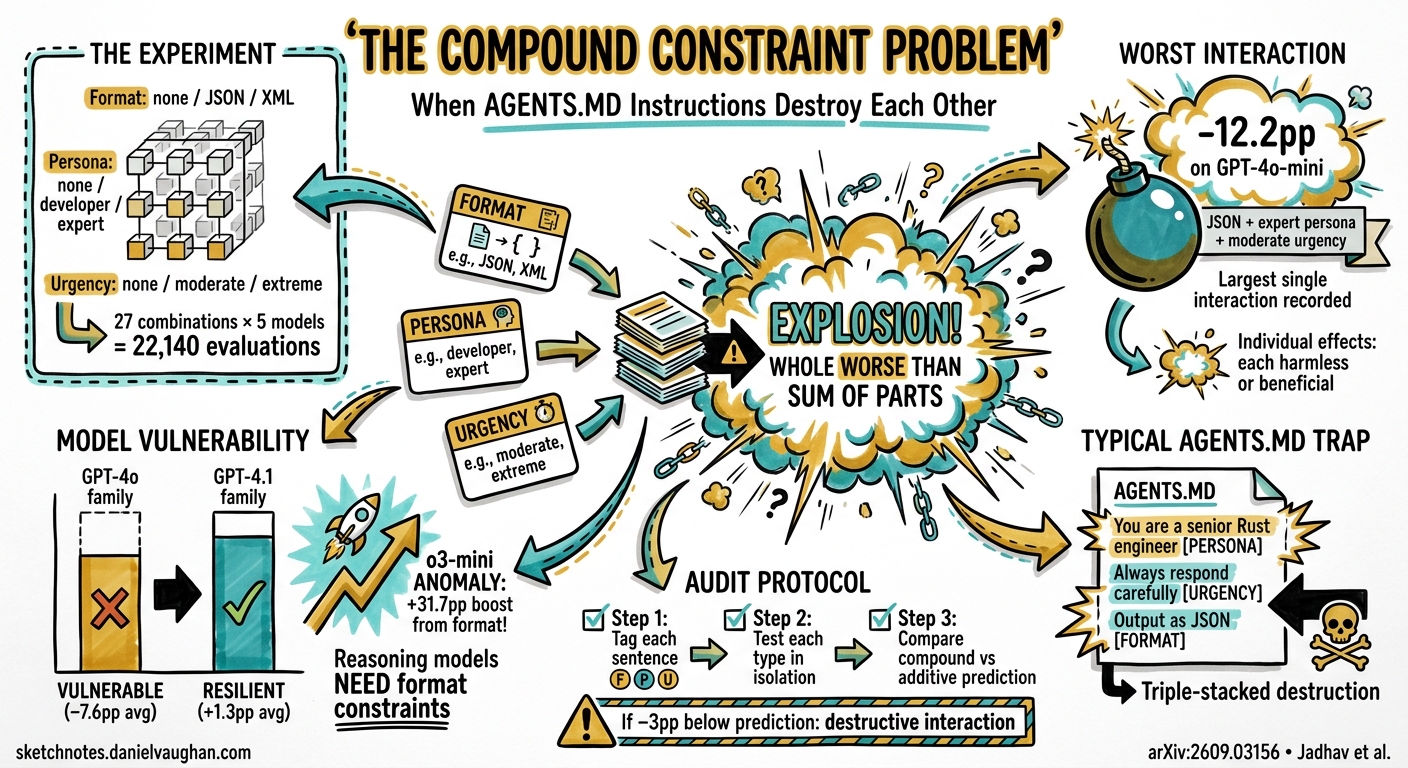
A new empirical study from September 2026 should make anyone who has spent time tuning their AGENTS.md file uncomfortable. Jadhav, LaPlaca, Stone, Raja, Ochoa and Nagaraju ran a full-factorial experiment across 27 prompt constraint combinations and found that instructions which are individually harmless, or even beneficial, produce super-additive performance degradation when stacked together.1 The paper’s name is direct: Compound Prompt Constraints in LLM Code Generation: A Factorial Study of Format, Persona, and Urgency. If you routinely add output-format directives, expert-persona framing, and urgency language to your agent instructions, the risk is real.
The Experiment
The study decomposed three common instruction categories into three levels each, yielding a 3×3×3 design:
- Format — no constraint / JSON output / XML output
- Persona — none / generic developer (“experienced developer”) / expert (“senior software engineer with deep expertise”)
- Urgency — none / moderate (“ensure”, “always”, “carefully”) / extreme (“critical”, “must”, “immediately”)
All 27 combinations were evaluated on 164 HumanEval+ problems across five OpenAI models from three families: GPT-4o-mini, GPT-4o, GPT-4.1-mini, GPT-4.1, and o3-mini. That is 22,140 total evaluations using greedy decoding.1
Each compound condition was decomposed into an additive prediction (the sum of individual constraint effects measured in isolation) and a residual interaction term that captures any deviation, positive or negative, from that prediction. When the residual is negative and large, the combination is super-additively destructive: the whole is measurably worse than the sum of its parts.
What They Found
Older architecture families are most vulnerable
The GPT-4o family exhibited consistent and statistically significant super-additive degradation across all eight triple-constraint combinations:
| Model | Baseline pass@1 | Worst case | Swing | Avg. interaction |
|---|---|---|---|---|
| GPT-4o-mini | 73.8 per cent | 70.1 per cent | −14.6 pp | −7.6 pp |
| GPT-4o | 79.3 per cent | 75.0 per cent | −12.8 pp | −4.2 pp |
| GPT-4.1-mini | 87.2 per cent | 83.5 per cent | −6.7 pp | +1.7 pp |
| GPT-4.1 | 89.6 per cent | 84.8 per cent | −6.1 pp | +1.3 pp |
| o3-mini | 59.8 per cent | 59.8 per cent | +31.7 pp | — |
The largest single interaction recorded was −12.2 pp on GPT-4o-mini for the combination JSON output + expert persona + moderate urgency. That is 12 percentage points of pass@1 lost, not from anything that looked dangerous when written as a standalone rule.1
The GPT-4.1 family told the opposite story. Both models produced near-zero or slightly positive interaction terms. The newer architecture appears to have learned to handle layered constraints without compounding their costs.
The o3-mini anomaly
The reasoning model was an outlier in a different direction. Its unconstrained baseline pass@1 was just 59.8 per cent, substantially lower than the GPT-4 families, because o3-mini without structure defaults to verbose explanatory output that evaluation harnesses penalise.1 Add any structured output constraint (JSON or XML) and performance jumps by roughly +11 pp to ~88–92 per cent. The model apparently needs an explicit format target to commit its reasoning to a final answer rather than an open-ended discussion.
This matters for Codex CLI because o3 and o4-mini are both reasoning-class models that behave analogously. A format constraint that degrades a GPT-4o session may be precisely what a reasoning-model session needs.
JSON versus XML
Not all format constraints are equally destabilising. JSON-based combinations averaged −10.7 pp interaction on GPT-4o-mini; XML-based combinations averaged −4.6 pp. The researchers attribute this to JSON’s stricter structural requirements creating more failure modes at the token level, an incomplete JSON object is syntactically invalid, whereas a partial XML document can sometimes still pass through extraction.1
Individual constraints are not the culprit
Examining main effects in isolation:
- Urgency framing alone: +3.6 pp on GPT-4o-mini (beneficial)
- XML alone: +3.9 pp on GPT-4o-mini (beneficial)
- Expert persona alone: −1.7 pp on GPT-4o-mini (negligible)
None of these explains the −12.2 pp observed when all three are combined. The compound interaction term is the phenomenon. Individually sound rules are destroying each other.
Why This Matters for AGENTS.md
Standard AGENTS.md practice tends to accumulate exactly the three constraint categories this study isolated. A typical file might contain:
You are a senior Rust engineer with deep expertise in async systems. Always respond
with precise, production-quality code. Carefully validate every function signature
before implementing it. Output all tool results as JSON.
That single paragraph combines:
- Persona: “senior Rust engineer with deep expertise”
- Urgency: “Always”, “Carefully”, “every”
- Format: “Output all tool results as JSON”
Based on the study’s findings, this triple combination is precisely the pattern that produces the largest negative interaction in GPT-4o-family models. Prior research has found that developer-written AGENTS.md files improve task success rates by approximately 4 per cent and reduce agent-generated bugs by 35–55 per cent, but that LLM-generated instruction files decrease success rates and increase inference cost by over 20 per cent.2 The compound constraint problem may partially explain both findings: LLM-generated files tend to be verbose and stack multiple constraint types automatically; developer-curated files tend to be sparse.
The instruction-count degradation effect documented in the Phased Workflow paper3 fits the same pattern: more rules does not mean more compliance. The interaction dynamics described by Jadhav et al. provide a mechanistic account of why that degradation occurs.
The Codex CLI Model Dimension
Codex CLI as of v0.153.4 supports o3, o4-mini, and GPT-6 Astra as primary models.4 None of these exact models appears in the study, which tested the GPT-4x and o3-mini series. But the pattern the authors observed, reasoning-class models respond differently to constraints than standard generation models, almost certainly applies:
flowchart TD
    A[Model Family] --> B{Reasoning model?}
    B -- Yes, e.g. o3 / o4-mini --> C[Structured output constraint<br/>likely helps]
    B -- No, e.g. GPT-4o family --> D{Multiple constraint types?}
    C --> E[Format alone fine.<br/>Add persona + urgency cautiously]
    D -- One only --> F[Probably safe]
    D -- Two or more --> G[Run factorial test<br/>before deploying to AGENTS.md]
GPT-6 Astra is architecturally closer to the GPT-4.1 family’s resilient profile — ⚠️ not empirically confirmed, and may tolerate compound constraints better than older models. But you should not assume this without testing.
A Practical Audit Protocol
The authors’ core recommendation is that “compound-prompt testing should be a standard part of reliability assessment for LLM-assisted engineering pipelines.”1 In a Codex CLI context, this translates to a three-step audit of any AGENTS.md under consideration:
Step 1, Categorise your constraints
Go through your AGENTS.md and tag every sentence with F (format), P (persona), or U (urgency). Look specifically for:
- F: JSON/XML/YAML output requirements, markdown headers, code-block fencing
- P: “You are a…”, role framing, expertise claims
- U: “Always”, “Never”, “Carefully”, “Critical”, “Must”, “Immediately”, “Ensure”
Step 2, Isolate by category
Create three stripped-down variants: one with only F constraints, one with only P, one with only U. Run your standard task suite against each variant using the same model. Record pass rates.
Step 3, Test compound combinations
Combine F+P, F+U, P+U, and finally F+P+U. Compare actual performance against the additive prediction (sum of individual gains/losses). If the actual result is more than ~3 pp below the additive prediction, you have a destructive interaction that needs resolving, either by removing one constraint type or by switching to a model with a resilient architecture (GPT-4.1-equivalent or above).
In config.toml:
[model]
# For AGENTS.md with compound constraints, prefer models with
# resilient interaction profiles. GPT-6 Astra or o3 recommended
# over legacy GPT-4o-equivalent backends.
model = "gpt-6-astra"

[features]
# If using o3/o4-mini and relying on JSON output format,
# constraints likely help rather than hurt.
# Urgency + persona stacking should still be tested separately.
What to Do Right Now
-
Audit for triple stacking. If your
AGENTS.mdcontains format directives, persona framing, and urgency language in the same instruction, test whether removing one constraint type improves reliability. -
Separate concerns across scopes. Format constraints often belong in AGENTS.md for the whole repo. Persona definitions may belong in a task-specific
SKILL.md. Urgency language arguably belongs in the user prompt, not the system file, it shifts contextually and should not be made permanent. -
Don’t trust addition. The study’s central insight is that you cannot predict compound constraint behaviour by testing constraints individually. A constraint that improves performance alone may actively harm performance when combined with others. The interaction term is empirically real and architecturally dependent.
-
Treat o3/o4-mini differently. These models may benefit from format constraints in ways that GPT-4o-family models do not. The safest approach is to maintain separate
AGENTS.mdvariants per model profile and switch viacodex --profile.
The compound constraint problem will not be visible in any single-constraint A/B test. It requires the same factorial discipline the authors applied in the lab, and AGENTS.md is now complex enough to deserve that rigour.
Citations
-
Jadhav S., LaPlaca N., Stone C., Raja A., Ochoa O. & Nagaraju V. (2026). Compound Prompt Constraints in LLM Code Generation: A Factorial Study of Format, Persona, and Urgency. arXiv:2609.03156. https://arxiv.org/abs/2609.03156 ↩ ↩2 ↩3 ↩4 ↩5 ↩6
-
Bouzenia I., Devanbu P. & Pradel M. (2026). On the Impact of AGENTS.md Files on the Efficiency of AI Coding Agents. arXiv:2601.20404. https://arxiv.org/abs/2601.20404 ↩
-
Kapetanovic A., Duricic T., Mercep A. & Lacic E. (2026). A Phased Workflow for Operating LLM-Based Coding Agents. arXiv:2608.30701. CIKM ‘26. https://arxiv.org/abs/2608.30701 ↩
-
OpenAI (2026). Codex CLI v0.153.4 release notes. GitHub. https://github.com/openai/codex/releases/tag/rust-v0.153.4 ↩