Reading the v0.163.0 Alpha Sprint: Worktrees, Terminal Signals, and the Codex UX Maturity Arc
Reading the v0.163.0 Alpha Sprint: Worktrees, Terminal Signals, and the Codex UX Arc
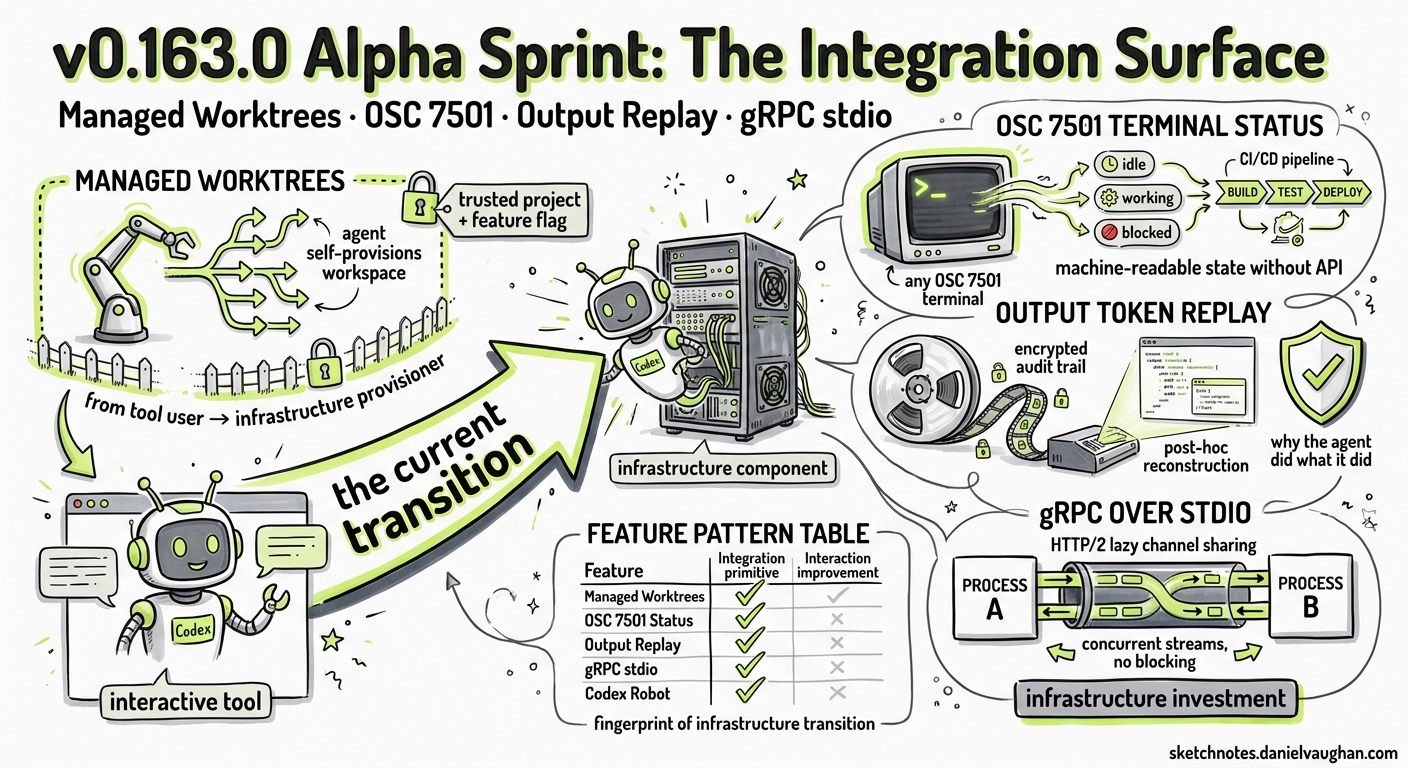
Alpha sprints are the most honest signal about where a product is heading. Feature announcements are marketing; release notes are engineering intent. Reading the v0.163.0 alpha sprint carefully reveals a product moving decisively from interactive assistant to autonomous infrastructure component.
Five alphas in the v0.163.0 sprint have shipped as of 11 October 2026 (alpha.1 through alpha.5, starting 8 October). The features visible in the community digests are not individually dramatic — no headline capability like voice or cloud environments. But read together, they describe a coherent direction: Codex is building the integration surface required to operate as unattended infrastructure rather than an interactive tool.
This piece reads the v0.163.0 PR set as a signal, not a feature list.
What Is Landing in v0.163.0
Five features stand out from the alpha.1–alpha.5 pull request set:
Managed Git worktrees (alpha.2) — tools for creating and listing managed git worktrees from trusted local projects when the worktrees feature is enabled.1 The agent can now create isolated workspace branches programmatically, not just use existing ones.
OSC 7501 terminal status (PR #52725) — emits idle, working, and blocked state changes as OSC 7501 escape sequences to the terminal, extending lifecycle status reporting beyond iTerm2 to any terminal emulator that supports the protocol.1
Opt-in output token replay (PR #52742) — stores encrypted content and tool outputs from agent turns, enabling post-hoc audit replay of what the agent did and why.1
gRPC over stdio for code-mode (PR #52723) — introduces grpc+stdio:// transport with lazy HTTP/2 channel sharing, providing more robust and isolated communication between the CLI host and code-mode components.1
Opt-in turn tool output retention (PR #52686) — persists tool outputs across turns for logging purposes without adding them to the model’s active context window.1
Each of these is an integration feature, not an interaction feature. None of them improve the conversational experience of using Codex CLI. All of them improve the experience of running Codex CLI as a component in a larger system.
The Managed Worktree Signal
Git worktrees are the mechanism for running multiple concurrent agent tasks in the same repository without them interfering with each other. The v0.162.0 stable release introduced managed worktrees as a user-facing concept; v0.163.0-alpha.2 gives the agent itself tools to create and list them.
The distinction matters. In v0.162.0, worktrees were something the operator configured for an agent. In v0.163.0, worktrees are something an agent can provision for itself, when operating on a trusted project with the feature flag enabled.
This is a meaningful shift in the trust model. An agent that can create its own isolated workspace branches is an agent that can plan multi-branch work — for example, an orchestrating agent that creates separate worktrees for each subagent task, as described in the parallel specialist subagent pattern. The agent moves from consumer of infrastructure to provisioner of infrastructure, within the bounds of what the operator has allowed.
The trust boundary — “from trusted local projects when the worktrees feature is enabled” — is the governance control. The feature is opt-in, and the project must be explicitly trusted in configuration before the agent can provision worktrees within it. This is consistent with Codex’s general approach to capability expansion: new surface area is gated behind explicit operator enablement rather than available by default.
OSC 7501: The Ambient Integration Story
OSC 7501 is a terminal escape sequence protocol for communicating application state. The initial Codex implementation exposed lifecycle status — idle, working, blocked — specifically in iTerm2, via iTerm2’s custom badge and status bar integration. PR #52203 (shipped in alpha.2) extended this to iTerm2 generically; PR #52725 broadens it to any terminal implementing OSC 7501.
Why does this matter? Because OSC 7501 state changes are machine-readable. Any process monitoring the terminal output can receive structured signal about what the Codex agent is doing, without parsing its natural-language output or polling the process state.
This is the ambient integration story: Codex as a component in a terminal multiplexer (tmux, Warp, etc.), a shell wrapper, or a CI runner that needs to gate on whether the agent has finished its current turn before triggering downstream steps.
# Shell wrapper that reads OSC 7501 state from Codex
# Waits for agent to reach 'idle' before proceeding with next pipeline stage
codex_run_and_wait() {
  local task="$1"
  local state_file=/tmp/codex-state-$$

  # Start codex in PTY, capture OSC 7501 emissions
  script -q -c "codex exec '$task'" /dev/null \
    | grep -oP '(?<=\e\]7501;)[^\\]+' \
    | while read state; do
        echo "$state" > "$state_file"
        [[ "$state" == "idle" ]] && break
      done

  local final_state
  final_state=$(cat "$state_file")
  rm -f "$state_file"
  [[ "$final_state" == "idle" ]] && return 0 || return 1
}
This pattern enables shell pipelines where human-readable terminal output is the primary interface but machine-readable state signals drive control flow — a practical integration approach for teams that have not yet moved to a full API-driven agent pipeline.
Output Token Replay: The Audit Infrastructure
PR #52742 introduces opt-in output token replay. The implementation stores encrypted content and tool outputs per turn. The intended use is audit — reconstructing what the agent did, with what tool calls, in what order, and with what reasoning.
The audit use case is not academic. Enterprise security reviews of AI-assisted development workflows increasingly require evidence that an agent’s actions were within policy. A diff shows what changed; output token replay shows why the agent made those changes and what it observed in the process. For workflows involving infrastructure changes, financial data, or regulated systems, this distinction is significant.
The opt-in design is deliberate. Output token replay has storage and cost implications — preserving encrypted content per turn adds overhead to every agent session where it is enabled. Teams should enable it for workflows where auditability is required, not as a global default.
# ~/.codex/config.toml
# Enable output token replay for audit-required workflows
[features]
output_token_replay = true  # stores encrypted content + tool outputs per turn

# Or per-session via CLI flag:
# codex exec --enable output_token_replay "task description"
Combined with the turn tool output retention flag (PR #52686) — which persists tool outputs to a log without polluting the model’s context — this gives operators two independent observability controls: real-time context management (turn retention) and post-hoc audit reconstruction (token replay).
gRPC over stdio: The Performance Infrastructure
gRPC over stdio (grpc+stdio://) is an internal transport change for the communication between the Codex CLI host process and code-mode components. The user-facing change is improved stability and reduced process overhead in multi-session environments.
The underlying motivation is architectural hygiene. As Codex CLI expands its code-mode capabilities — multiple concurrent agent sessions, shared worker pools, remote execution — the communication between host and worker processes needs to be robust, multiplexed, and typed. HTTP over stdio, the previous mechanism, lacks HTTP/2 multiplexing; spawning separate connections per turn adds overhead that scales poorly.
gRPC over stdio with lazy HTTP/2 channel sharing addresses both: a single channel is shared across turns (reducing connection setup overhead), and HTTP/2 multiplexing allows concurrent streams on the same connection (enabling multiple parallel agent turns without blocking).
This is infrastructure investment, not feature development. Its presence in the alpha sprint signals that the engineering team is preparing the communications layer for heavier concurrent workloads — consistent with the managed worktrees and parallel agent patterns that are emerging at the feature layer.
Reading the Pattern
Taken together, the v0.163.0 PR set describes a product in a specific phase of maturity development:
| Feature | What it enables |
|---|---|
| Managed worktrees | Agent self-provisioning of isolated workspaces |
| OSC 7501 terminal status | Machine-readable state for shell/CI integration |
| Output token replay | Post-hoc audit of agent reasoning and tool calls |
| gRPC over stdio | Concurrent multi-session communication efficiency |
| Turn tool output retention | Persistent logging without context pollution |
Every item is an integration primitive. None are interaction improvements. This is the fingerprint of a product transitioning from interactive tool to infrastructure component — the same transition that git, docker, and kubectl each went through as they moved from developer tools to CI/CD components.
The practical implication for teams planning Codex CLI deployments: the v0.163.0 feature set is specifically designed to support the use case of Codex as an autonomous, observable, auditable component in a pipeline. Teams building toward that deployment model should plan to leverage these features when v0.163.0 stable ships.
The v0.163.0 alpha sprint is at five iterations as of 11 October. Based on recent cadence (v0.161.0: 13 alphas; v0.162.0: 20 alphas), the stable cut is likely 2–4 weeks out. The Windows sandbox issues (#51969, #51972, #52179) are the most likely blockers.
What to Watch For in Remaining Alphas
Three features from the community digest are in flight but not yet fully landed:
Configurable persistent leader shortcuts (PR #52273) — users can define custom persistent key shortcuts in the TUI. Relevant for power users building terminal-first workflows around Codex.
Session creation failure explanation (PR #52721) — structured reason codes when new sessions fail to create during server shutdown. Directly useful for CI pipelines where session creation failures are currently opaque.
Persisted capability root refresh (PR #52676) — resumed threads use up-to-date permissions from the owner configuration rather than the permissions snapshotted at thread creation. Critical for long-running sessions where the operator may have updated capability grants mid-session.
The capability root refresh feature is the most significant of the three for enterprise deployments. In the current model, permissions assigned at thread creation persist for the thread’s lifetime — a security property (the thread cannot silently gain new permissions) but also an operational constraint (legitimate permission updates require creating a new thread). PR #52676’s opt-in refresh mechanism gives operators more flexibility for long-lived sessions, at the cost of requiring careful policy design around when and how refresh is permitted.
Summary
The v0.163.0 alpha sprint is building Codex CLI’s integration surface: agent-provisioned git worktrees, machine-readable terminal state signals, opt-in audit infrastructure for output and tool calls, and internal transport improvements for concurrent operation. None of these features improve the interactive experience. All of them improve the experience of running Codex as an autonomous, observable infrastructure component. This is the defining characteristic of the current development phase, and the clearest signal of where the product is heading.