Gemini 4 Argon's Pricing Deadline Is a Strategic Signal, Not Just a Discount
Gemini 4 Argon’s Pricing Deadline Is a Strategic Signal, Not Just a Discount
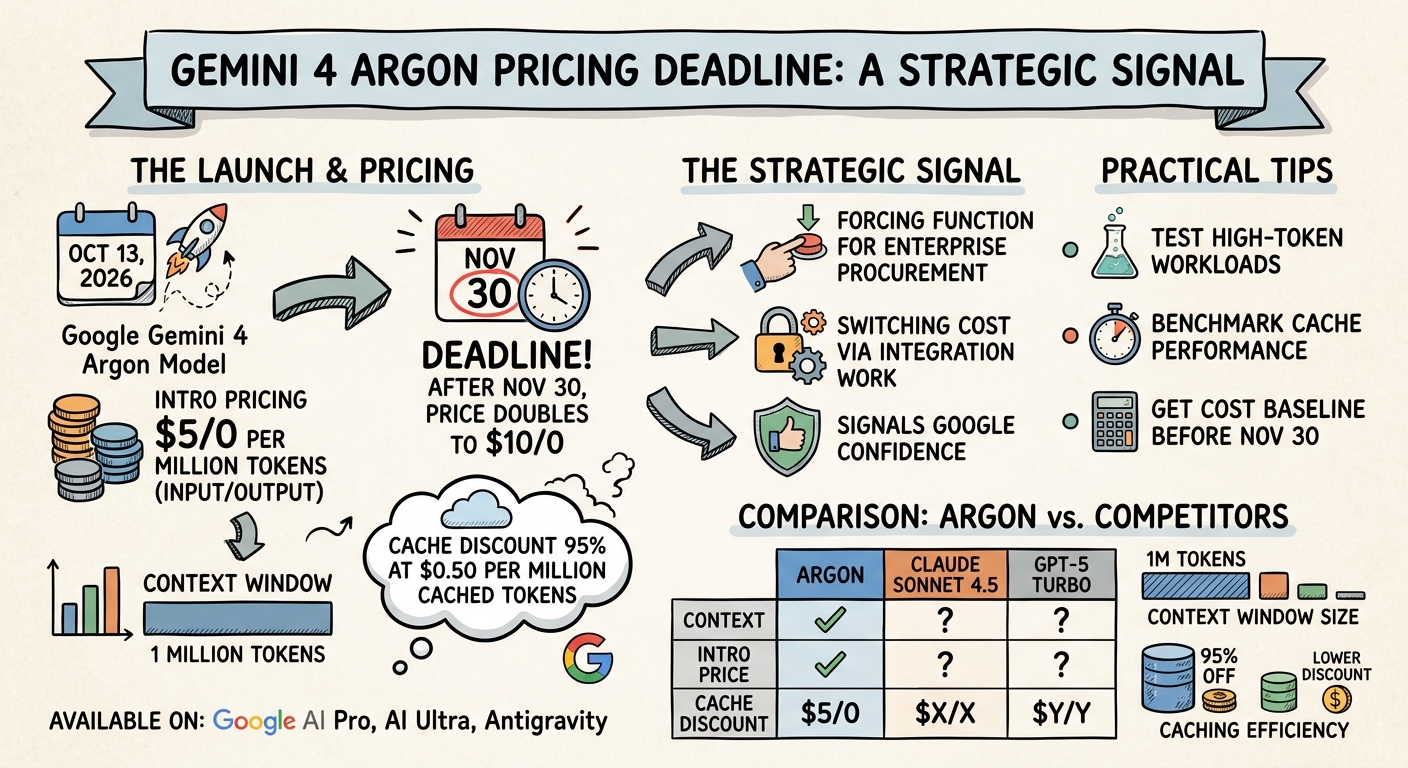
Google opened Gemini 4 Argon to general availability on 13 October 2026 at an introductory price of $2 per million input tokens and $10 per million output tokens. The catch: that rate holds only until 30 November, after which it doubles to $4/$20. Most coverage is treating the deadline as a promotional footnote. It is worth treating it as a strategic document.
What Argon Actually Is
Gemini 4 Argon is Google’s frontier multimodal model, positioned above the Gemini 4 Flash family and below whatever Google has not yet announced. The key specifications that matter for engineering workflows:
- 1 million token unified context window via the Gemini API — input and output share the same pool
- Cached input at $0.10 per million — a 95% discount on the base input rate, designed to make long-session agentic work cheap
- Available on Google AI Pro and AI Ultra tiers in the consumer Gemini app
- Available via Google Antigravity for AI Ultra subscribers — Google’s agent execution environment
Argon was first made available in late September to vetted cyber defenders before general availability. That narrow initial release mirrors how Google launched Gemini 2 Ultra: a security-domain preview, then broad availability within two weeks.
The November 30 Deadline as a Forcing Function
The doubling of prices on 30 November is not unusual for Google model launches, but the tight six-week window is. Three things it accomplishes:
1. It manufactures urgency for enterprise procurement. A procurement cycle that might take three months gets compressed to six weeks if the cost model is locked in at intro pricing. Enterprises evaluating Argon against Claude Sonnet or GPT-5 Turbo now have a budget incentive to move faster.
2. It creates a switching cost in the form of sunk integration work. Once an engineering team has integrated Argon into a production pipeline, they are unlikely to rip it out when the price doubles — especially if cached input makes the effective cost far lower than the headline rate suggests.
3. It signals Google’s confidence in the $4/$20 rate as defensible. If the post-intro pricing were a stretch, Google would not telegraph it six weeks in advance. They believe the product is worth it at full price.
The 1 Million Token Window Changes Agentic Calculus
The headline for agent-heavy workflows is the context window, not the token price. At 1 million tokens, a single Argon session can hold:
- Approximately 750,000 words of text — roughly the full Lord of the Rings trilogy
- Thousands of lines of source code across an entire medium-sized repository
- Hours of meeting transcripts with full context intact
- Multi-turn tool-call histories from long-running agent sessions without summarisation
For Codex CLI workflows specifically, this matters when Codex is orchestrating agents that need to reason over large codebases. The current friction point in multi-agent pipelines is context truncation: sub-agents lose earlier reasoning steps, and orchestrators have to compress summaries that introduce errors. A 1 million token window does not eliminate that problem, but it substantially defers it.
The 95% cache discount is the hidden headline. At $0.10 per million cached tokens, repeatedly querying a large codebase across a session costs almost nothing. A 100,000-token codebase loaded once and queried 20 times during an agent run costs $0.002 in cached tokens versus $0.20 at the uncached rate. That changes the economics of long-running agentic sessions materially.
Where Argon Sits Against the Competition
The honest position in October 2026:
| Model | Input ($/M) | Output ($/M) | Context |
|---|---|---|---|
| Gemini 4 Argon (intro) | $2 | $10 | 1M tokens |
| Gemini 4 Argon (post-Nov 30) | $4 | $20 | 1M tokens |
| Claude Sonnet 4.5 | $3 | $15 | 200K tokens |
| GPT-5 Turbo | $2.50 | $10 | 512K tokens |
At intro pricing, Argon is the cheapest option at the frontier tier. At post-November pricing, it is mid-range but still holds the context-window advantage over most competitors.
The comparison is complicated by capability differences that benchmarks capture imperfectly. Argon performs particularly well on code generation and long-document synthesis tasks. On multi-step reasoning chains it is competitive with but not clearly superior to Claude Sonnet 4.5 in internal evaluations published by Google.
What Engineers Should Do Before 30 November
The practical implication is not “use Argon for everything immediately.” It is “evaluate Argon seriously before the discount expires so you have a cost-informed decision.”
Specifically:
-
Run your highest-token workloads through Argon now. If you have tasks that regularly hit context limits on other models, Argon’s 1M window is worth testing directly.
-
Benchmark cache performance on your actual retrieval patterns. The 95% cache discount is compelling in theory, but its value depends on cache hit rates in your specific access patterns.
-
Get a reference cost number at intro pricing. Even if you do not switch, having a cost baseline at $2/$10 lets you evaluate the $4/$20 full price fairly when November arrives.
-
Check Google Antigravity availability if you are building agentic pipelines. Antigravity’s native Argon integration may reduce the overhead of managing context across agent boundaries.
The pricing deadline is a calendar event. The more durable question is whether a 1 million token window at frontier quality changes what your agents can do — and that question is worth answering independently of the discount clock.
Gemini 4 Argon is available via the Gemini API, Google AI Studio, and Google Antigravity. Introductory pricing of $2/$10 per million tokens applies until 30 November 2026, after which rates double to $4/$20.