The 2026 Agentic Coding Landscape: Codex, Claude Code, Antigravity and Kiro
Published 2026-03-28. Research compiled from Lushbinary, Vibecoding.app, Google Developers Blog, Augment Code, and community reviews.
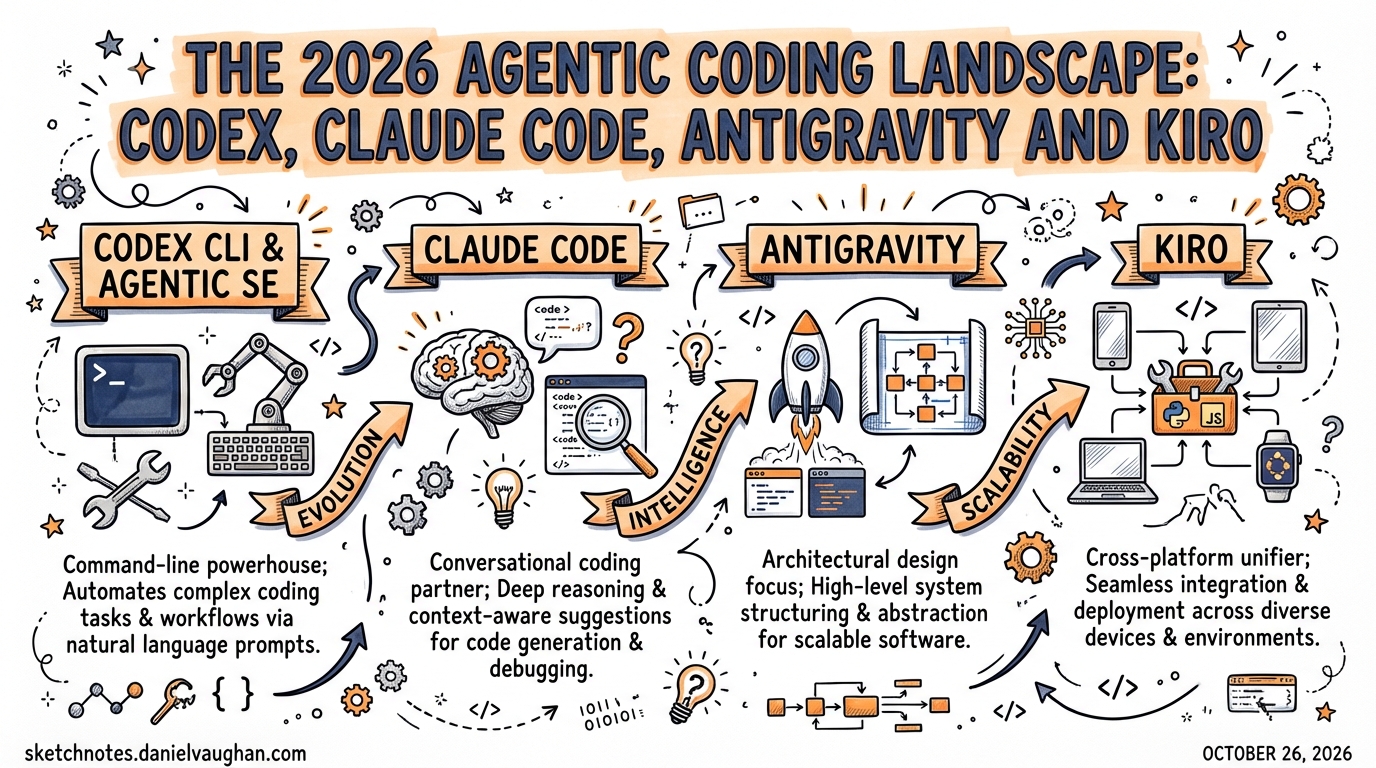
By March 2026, seven serious agentic coding tools compete for engineers’ attention. This article maps the landscape, explains where each tool fits, and clarifies where Codex CLI holds its ground.
The Seven Contenders
| Tool | Paradigm | Best For | Price |
|---|---|---|---|
| OpenAI Codex CLI | Terminal agent | Throughput, CI/CD, precision tasks | Included with ChatGPT Plus+ |
| Claude Code | Terminal agent | Architectural reasoning, hard problems | $20/mo (Pro); $100–$200 (Max) |
| Google Antigravity | IDE + Manager + Browser | Multi-agent orchestration experiments | Free (public preview) |
| Kiro | Spec-driven IDE | Structure-first development, AWS teams | ~$20/month |
| Cursor | IDE agent | Daily IDE use, stability, SOC 2 | Various |
| Windsurf | IDE agent | Budget-conscious IDE-first teams | $15/month |
| GitHub Copilot / Agent HQ | Issue-to-PR agent | GitHub-native async workflows | Part of Copilot subscription |
Google Antigravity: The New Challenger
What it is: Google’s agentic IDE, announced November 20, 2025 alongside Gemini 3. Not just an editor with AI features — a full agentic development platform with three distinct surfaces.
Three-surface architecture:
- Editor Surface — A standard VSCode-fork IDE with AI completions and inline commands
- Manager Surface — “Mission control” for spawning and orchestrating multiple agents asynchronously, with auditable artifacts (screenshots, task lists, browser recordings)
- Browser Sub-Agent — A built-in headless Chromium agent that can “see” web apps via Gemini 3’s multimodal vision — write code, run it, see the UI, verify it, all in one loop
AgentKit 2.0 (shipped March 2026): 16 specialized agents, 40+ domain-specific skills, 11 pre-configured command sets covering frontend, backend, testing, and more.
Models: Gemini 3.1 Pro (High/Low), Gemini 3 Flash, Claude Sonnet 4.6, Claude Opus 4.6, GPT-OSS-120B
Benchmarks: 76.2% on SWE-bench Verified (Gemini 3 Pro) vs Claude Sonnet 4.5 at ~77%. On Terminal-Bench 2.0: Gemini 3 Pro 54.2% vs GPT-5.1 at 47.6%.
Free during public preview — download at antigravity.google
The Controversy
Rate limit controversy dominates community discussion. Credits reset weekly not every 5 hours as advertised. High-reasoning models (Gemini 3 Pro, Claude Opus) feel throttled. Community verdict: “a tool for experimentation, not production reliance” (Vibecoding.app, 3.5/5).
How Antigravity Changes the Codex Calculus
Antigravity doesn’t directly compete with Codex CLI — different paradigms entirely. But it raises the bar on what “free” multi-agent tooling looks like:
- Antigravity’s Manager Surface vs Codex’s git-worktree approach: Both enable parallel agents, but Antigravity’s UI makes the orchestration visible in a way that the CLI (by design) doesn’t. Engineers who want observability may prefer Antigravity for experimental workflows; engineers who want reproducibility and CI-native automation will stick with Codex.
- Browser-native verification: Antigravity’s built-in browser agent (write → run → see → verify) is a genuine capability gap vs Codex, which requires external Playwright MCP or skills for browser interaction.
- Free access to frontier models: Antigravity offers Claude Opus 4.6 access in its free tier (when not throttled), which is cheaper than running Claude Code on the Max plan.
Kiro: AWS’s Spec-First IDE
What it is: Amazon’s entry into agentic coding. Formerly Amazon Q Developer CLI, rebranded as Kiro on November 17, 2025.
Core philosophy: “Spec-driven development” — converts natural language prompts to structured requirements (EARS notation) before writing a single line of code. Then architecture, then implementation.
Three-step workflow:
- Natural language prompt → structured EARS requirements
- Requirements → architecture plan
- Architecture → implementation with automated agent hooks
Agent hooks: Automate follow-up actions (e.g., run tests whenever files are saved). Similar in spirit to Codex hooks, but baked into the IDE workflow rather than configured in config.toml.
Model: Claude Sonnet 4.5 with an “Auto” mode that blends frontier models with intent detection and prompt caching.
AWS native: Integrates with IAM, Bedrock, CodeWhisperer. For AWS-heavy teams, it’s a natural fit.
Price: ~$20/month flat. No credits system.
When to Use Kiro vs Codex CLI
Use Kiro when:
- Your team struggles with AI-generated code that drifts from specifications
- You’re building on AWS and want native IAM/Bedrock integration
- You want a structured, auditable requirements trail from prompt to PR
- A flat $20/month is preferable to usage-based pricing
Use Codex CLI when:
- You need throughput and speed over structured planning
- You’re integrating agents into CI/CD pipelines (
codex exec) - You want terminal-native workflows, not an IDE
- You need multi-agent parallel execution via git worktrees
How Daniel Should Think About This
For Daniel’s agentic pod (Claude Code + Codex CLI + Gemini CLI triangle):
Architectural exploration  → Claude Code (deep reasoning, exploratory)
Backend precision tasks    → Codex CLI (exact, fast, CI-native)
Boilerplate / migration    → Gemini CLI (speed, cost)
Google Antigravity is worth experimenting with for its Manager Surface and browser agent capabilities — but not as a production replacement. The agentic orchestration concepts it implements (parallel agents, artifact-based progress tracking, multi-modal verification) inform patterns that can be reproduced in Codex CLI with the right TOML subagent setup + screenshot MCP + Playwright skill.
Kiro is relevant primarily as a competitive benchmark and as a pattern source for spec-driven development approaches that can be replicated in Codex with an AGENTS.md requirements-first workflow template.
Key Benchmark Reference (March 2026)
| Tool | SWE-bench Verified | Notes |
|---|---|---|
| Codex CLI (gpt-5.4) | ~74% | Best in throughput per $ |
| Claude Code (Opus 4.6) | ~77% | Best absolute performance |
| Google Antigravity (Gemini 3 Pro) | 76.2% | Free (throttled) |
| Kiro (Claude Sonnet 4.5) | ~72% | Spec-driven, structured |
| Cursor | Not published | Best IDE UX |
Benchmarks are directional — contamination concerns apply. SWE-bench Verified is the cleanest public benchmark but still imperfect.