Codex CLI and Claude Code Compared: April 2026 Architecture Deep Dive
Codex CLI and Claude Code Compared: April 2026 Architecture Deep Dive
The accidental publication of Claude Code’s full source on 31 March 2026 — 512,000 lines of TypeScript exposed via an npm source-map packaging error1 — made a structured architectural comparison with Codex CLI possible for the first time. Both tools occupy the same niche: terminal-native AI coding agents that read your codebase, propose changes, and execute them. Beneath that surface similarity, they embody fundamentally different engineering philosophies. This article dissects the two architectures side by side as of April 2026.
Runtime & Language Choices
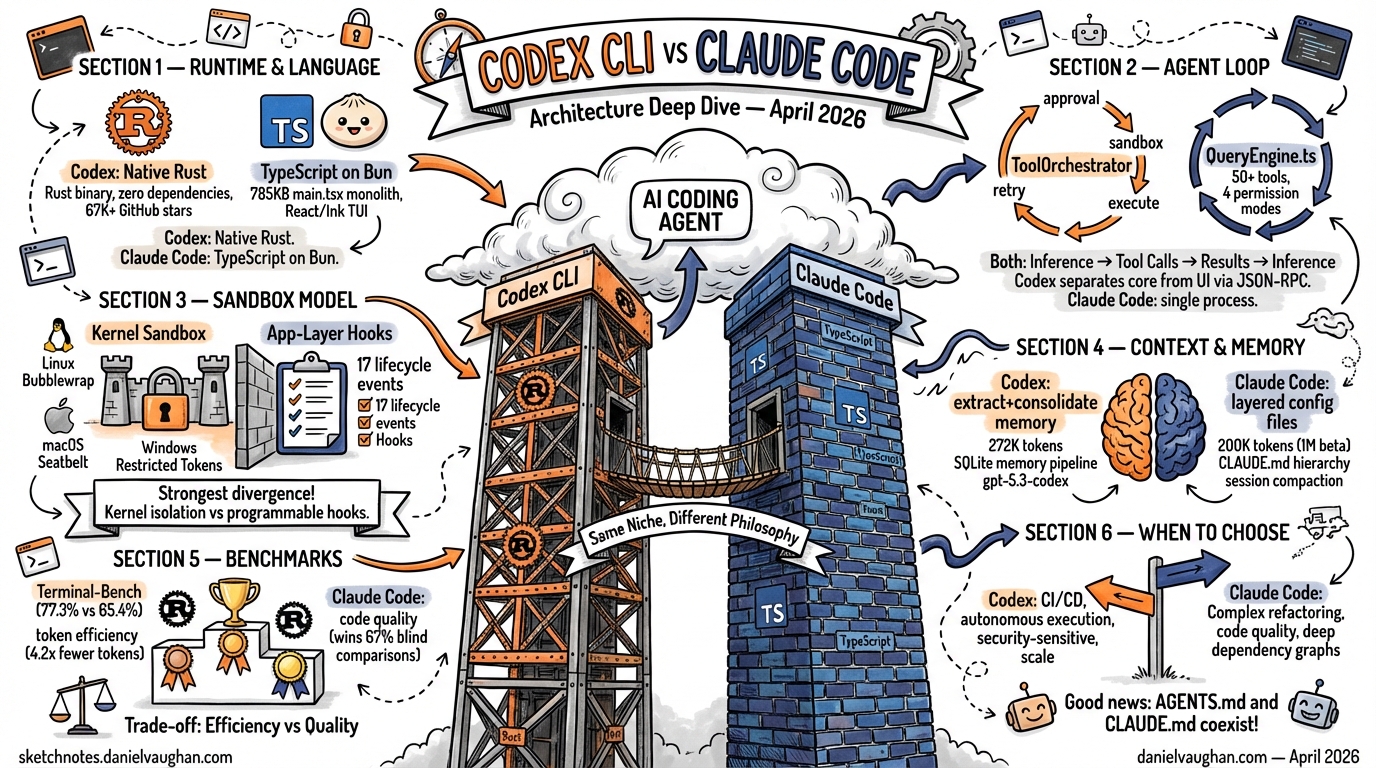
Codex CLI completed its migration from TypeScript to Rust in 20252. The active codebase lives entirely in codex-rs/, with the legacy codex-cli/ directory retained as a Node.js wrapper that bundles the Rust binary. The repository maintains 67,000+ stars and a development velocity of 10–15 commits per day3. Rust gives Codex zero-dependency installation — no Node.js runtime required — along with deterministic memory management and the ability to enforce kernel-level sandboxing from the same process.
Claude Code is a TypeScript monolith running on the Bun runtime1. The 785 KB main.tsx entry point bundles a custom React terminal renderer (Ink), 50+ tools, and the entire agent orchestration layer into a single process. Where Codex went native for performance and security, Anthropic bet on rapid iteration speed and the React component model for UI composition.
graph LR
    subgraph "Codex CLI"
        A[Rust Binary - codex-rs] --> B[Responses API]
        A --> C[Kernel Sandbox]
        A --> D[App-Server JSON-RPC]
        D --> E[TUI / TypeScript Shell]
    end
    subgraph "Claude Code"
        F[Bun Runtime] --> G[TypeScript Monolith]
        G --> H[React/Ink TUI]
        G --> I[QueryEngine.ts]
        G --> J[Application-Layer Hooks]
    end
The Agent Loop
Both tools implement a core loop of inference → tool calls → results → inference, but the internal architecture differs substantially.
Codex CLI: ToolOrchestrator in Rust
Central orchestration lives in codex-rs/core/src/codex.rs3. Tool dispatch flows through a ToolOrchestrator that implements a four-phase pipeline: approval check, sandbox selection, execution attempt, and retry-with-escalation-on-denial. Tools are registered in a ToolRegistry and dispatched via a ToolRouter. First-party tools include shell_command (sandboxed execution), apply_patch (a Lark grammar parser for freeform diffs), js_repl (persistent Node.js kernel), spawn_agent/wait_agent/send_input/close_agent for multi-agent coordination, and web_search3.
Codex exclusively uses the Responses API (/v1/responses)3, with built-in provider support for OpenAI (default), Ollama, and LM Studio. Custom providers are configurable in config.toml with arbitrary base URLs, API key environment variables, and retry configuration.
Claude Code: QueryEngine.ts
Claude Code’s agent loop is owned by QueryEngine.ts — approximately 1,295 lines managing the LLM API loop, session lifecycle, and automatic tool execution4. The tool system lives in tools.ts, which registers 50+ tools with a permission model offering four modes: default, auto, bypass, and (ironically) “yolo” which denies everything5. Each tool implements a uniform interface (schema, permissions, execution), so MCP tools from external servers plug in identically to first-party ones.
The key structural difference: Codex separates the agent core (Rust) from the presentation layer (TypeScript TUI) via a JSON-RPC interface, whereas Claude Code’s query engine, tool system, and UI all share a single TypeScript process boundary.
Sandbox Models: Kernel vs Application Layer
This is the sharpest architectural divergence between the two tools.
Codex CLI: OS-Level Enforcement
Codex enforces safety at the kernel level using platform-native primitives6:
- Linux: Bubblewrap (vendored and compiled since v0.115.0) constructs a restricted filesystem view with
--unshare-user,--unshare-pid, and--unshare-net. The filesystem defaults to read-only (--ro-bind / /) with explicit writable path bindings. Seccomp filters blockAF_UNIXandsocketpairsyscalls. Protected directories (.git,.codex) remain read-only even under writable roots3. - macOS: Apple’s Seatbelt framework via
sandbox-execwith mode-specific profiles compiled at runtime6. - Windows: Restricted tokens with optional elevation, running processes on isolated desktops3.
The execpolicy crate implements a DSL-based rule engine. Rules live in ~/.codex/rules/*.rules and workspace .codex/rules/*.rules. Several command categories are hardcoded as banned regardless of rules: shell interpreters (python, ruby, perl), shell wrappers (bash -c, sh -c), and bare git commands3.
Claude Code: Lifecycle Hooks
Claude Code uses application-layer hooks across 17 lifecycle event types7. A PreToolUse hook on Bash can inspect every command, validate it against arbitrary logic, and block it with exit code 2. This provides finer-grained programmability — you can write hooks that enforce project-specific invariants — but shares a process boundary with the agent itself.
graph TD
    subgraph "Codex: Kernel Sandbox"
        A[Tool Call] --> B{ExecPolicy Rules}
        B -->|Allowed| C[Bubblewrap/Seatbelt]
        C --> D[Namespace Isolation]
        D --> E[Seccomp Filters]
        E --> F[Execution]
        B -->|Denied| G[Reject]
    end
    subgraph "Claude Code: App-Layer Hooks"
        H[Tool Call] --> I{Permission Mode}
        I --> J[PreToolUse Hook]
        J -->|exit 0| K[Execution in Process]
        J -->|exit 2| L[Block]
    end
The fundamental trade-off: kernel sandboxing provides stronger isolation boundaries but coarser control, while application-layer hooks offer fine-grained programmability at the cost of weaker containment7.
Context Management & Memory
Context Windows
Codex CLI’s default model gpt-5.3-codex provides a 272K token context window3, whilst Claude Code using Claude Opus 4.6 offers 200K tokens (1M in beta)8. Codex’s larger standard window provides an advantage for monorepo work requiring cross-file reasoning in a single pass. Claude Code compensates through superior retrieval via codebase search and the layered CLAUDE.md hierarchy that front-loads relevant context7.
Persistent Memory
Codex CLI implements a two-phase persistent memory pipeline3:
- Extraction: Runs at startup, scans previous threads, extracts memories using
gpt-5.1-codex-miniwith low reasoning effort — processing up to 5,000 threads with 8 concurrent workers. - Consolidation: Uses
gpt-5.3-codexwith medium reasoning under a global lock to merge extracted memories. Results are stored inmemory_summary.md, capped at 5,000 tokens, with SQLite tracking of job ownership leases (1-hour expiry).
Claude Code relies on the CLAUDE.md hierarchy for persistent project context and session compaction for within-session memory management. The layered configuration (managed settings → command line → local project → shared project → user defaults) provides automatic context without explicit memory extraction7.
TUI Architecture
Codex CLI separates concerns via codex app-server, which exposes JSON-RPC 2.0 over stdio (NDJSON) or WebSocket3. The TUI is a TypeScript shell that communicates with the Rust core through this protocol. This separation means alternative frontends can be built against the same interface — TypeScript and JSON Schema exports are available via generate-ts and generate-json-schema commands.
Claude Code implements a custom fork of the Ink renderer — React for the terminal9. The rendering pipeline flows from React component tree → custom DOM-like structure → Yoga layout engine (C++ Flexbox implementation) → ANSI serialisation. Key optimisations include frame batching during LLM token streaming, cursor position memoisation to avoid redundant ANSI move commands, and VirtualMessageList virtualisation for the REPL history9. The engine supports bidirectional text (RTL/LTR) and efficient rendering over SSH via EL (Erase in Line) sequences rather than space padding.
Session Persistence
Codex CLI’s session model comprises three primitives3:
- Thread: SQLite-backed persistent conversations that survive restarts, supporting fork, archive, and rollback operations.
- Turn: A single round-trip of user input → inference → tool calls → results.
- Item: Granular events within turns (agent messages, shell output, file edits, reasoning traces).
Claude Code maintains session state within QueryEngine.ts, with compaction handling context overflow. The session model is less granular — there is no equivalent of Codex’s thread forking or rollback operations.
Multi-Agent Coordination
Codex CLI offers cloud task delegation via codex cloud exec, spinning up isolated cloud environments per task and returning diffs7. Locally, it supports concurrent agent threads for parallel subtask execution (up to 6 in the current release) via spawn_agent/wait_agent/send_input/close_agent tool calls3.
Claude Code provides explicit subagent spawning via the Task tool, enabling interactive orchestration with visibility into subagent reasoning7. Agent Teams coordinate using git worktrees locally, with shared task lists, dependency tracking, and inter-agent messaging8.
Configuration Philosophy
Codex uses TOML with explicit profiles switched via --profile flags — favouring explicitness and auditability. You can always answer “what configuration was active?” by checking the profile name7.
Claude Code employs the layered CLAUDE.md hierarchy: managed settings, command line overrides, local project, shared project, and user defaults. Configuration applies automatically based on directory context but requires reading multiple layers to determine the effective state7.
Both tools support instruction files (AGENTS.md for Codex, CLAUDE.md for Claude Code) that coexist without conflict in the same repository7.
Benchmark Performance
Terminal-Bench 2.0 shows Codex significantly ahead at 77.3% versus Claude Code’s 65.4%8 — a 12-point gap on terminal-native tasks (scripting, system administration, DevOps workflows). However, in blind code quality evaluations, Claude Code wins 67% of comparisons, producing code that developers consistently judge as cleaner and more idiomatic8.
Token efficiency heavily favours Codex: on a Figma-to-code benchmark, Claude Code consumed 6.2M tokens versus Codex CLI’s 1.5M — a 4.2× difference8. Across multiple benchmarks, Claude Code consistently uses 3–4× more tokens for comparable tasks.
Choosing Between Them
The architectures serve different priorities. Codex CLI’s Rust core, kernel sandboxing, and token efficiency make it the stronger choice for autonomous execution at scale, CI/CD integration, and security-sensitive environments. Claude Code’s vertical integration, superior code quality, and fine-grained hook system make it preferable for complex refactoring across deep dependency graphs where output quality matters more than throughput.
For teams already running both, the good news is that AGENTS.md and CLAUDE.md coexist cleanly — you can configure both tools per-project and switch based on task characteristics.
Citations
-
Anthropic Leak Exposes Claude Code As An Open Source Learning Event — Open Source For You ↩ ↩2
-
Another Rust Rewrite: OpenAI’s Codex CLI Goes Native — InfoQ ↩
-
OpenAI Codex CLI Architecture and Multi-Runtime Agent Patterns — Zylos Research ↩ ↩2 ↩3 ↩4 ↩5 ↩6 ↩7 ↩8 ↩9 ↩10 ↩11 ↩12
-
Inside Claude Code: An Architecture Deep Dive — Zain Hasan ↩
-
Codex CLI vs Claude Code 2026: Architecture Deep Dive — Blake Crosley ↩ ↩2 ↩3 ↩4 ↩5 ↩6 ↩7 ↩8 ↩9
-
Codex vs Claude Code: Benchmarks, Agent Teams & Limits Compared — MorphLLM ↩ ↩2 ↩3 ↩4 ↩5
-
Ink Renderer & Custom TUI Engine — Claude Code DeepWiki ↩ ↩2