Agent Identity Stack Complete: Cryptographic Attribution for Multi-Agent Audit Trails
Agent Identity Stack Complete: Cryptographic Attribution for Multi-Agent Audit Trails
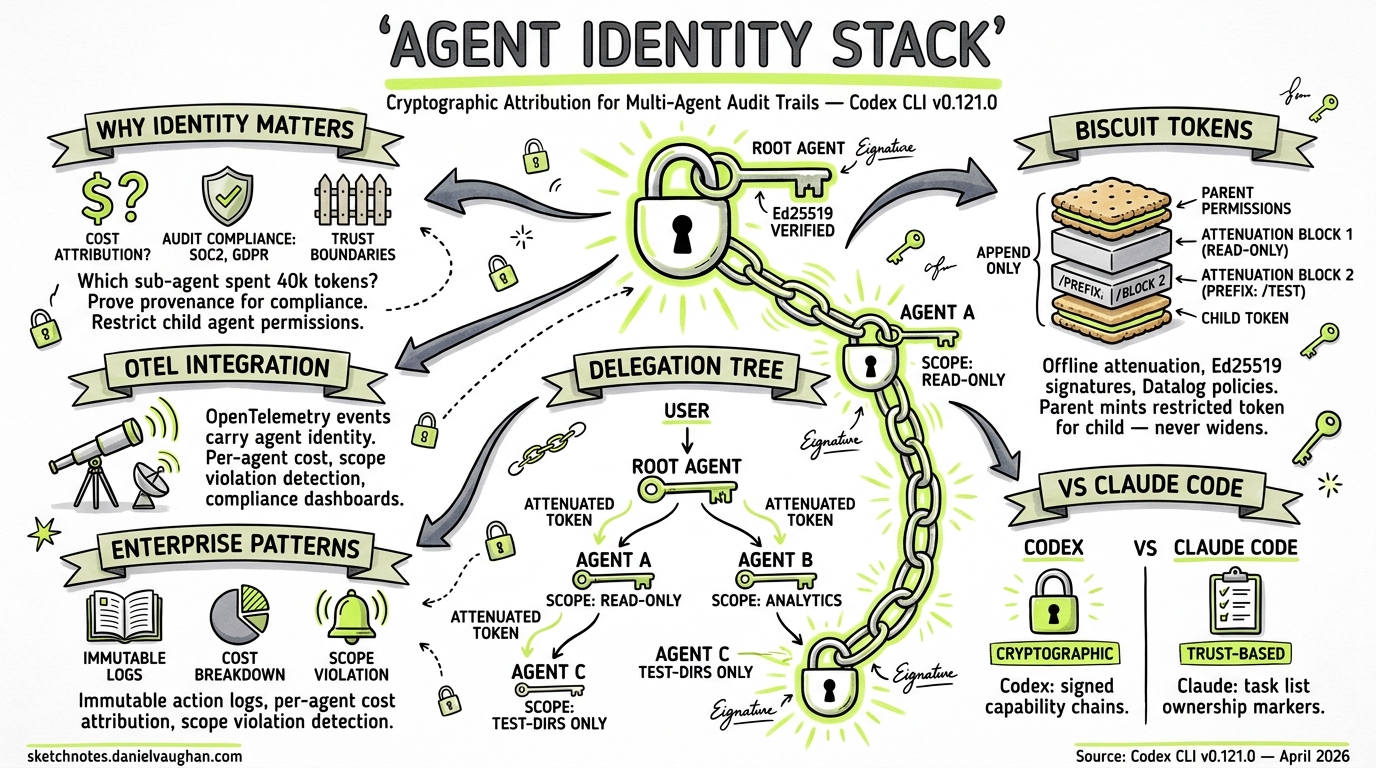
Codex CLI v0.121.0, released today, ships two PRs that introduce a use_agent_identity feature flag and the ability to register agent identities behind it 12. This is the beginning of cryptographic agent attribution in Codex — a capability that enterprises have been requesting since multi-agent workflows landed. When every sub-agent in a tree can prove who it is and what it was authorised to do, you unlock per-agent cost attribution, tamper-evident audit trails, and compliance-grade observability.
This article examines what the agent identity stack enables, the cryptographic primitives that make it possible, and how it integrates with Codex’s existing OpenTelemetry and sub-agent infrastructure.
Why Agent Identity Matters
In a single-agent Codex session, attribution is trivial: one user, one agent, one transcript. Multi-agent v2 changed this. Sub-agents now use readable path-based addresses like /root/agent_a 3, with structured inter-agent messaging and configurable nesting depths 4. A typical parallel refactoring workflow might spawn six concurrent agents, each making tool calls, consuming tokens, and modifying files.
Without cryptographic identity, you face three problems:
- Cost attribution — which sub-agent consumed 40k tokens on a failed approach?
- Audit compliance — SOC 2 and GDPR require demonstrable provenance for automated actions on production data 5
- Trust boundaries — a sub-agent spawned by a plugin should not inherit the parent’s full permission set
The use_agent_identity feature flag addresses all three by associating each agent instance with a verifiable identity assertion that travels with its API calls and tool invocations.
The Feature Flag: use_agent_identity
The identity stack is gated behind a feature flag, following Codex CLI’s standard feature management pattern 6. Enable it with:
codex features enable use_agent_identity
Or per-session:
codex --enable use_agent_identity "refactor the auth module"
This is equivalent to setting features.use_agent_identity = true in your config.toml 6. When enabled, Codex registers an identity for each agent instance at spawn time, and that identity is attached to downstream API calls and tool invocations 2.
# ~/.codex/config.toml
[features]
use_agent_identity = true

[agents]
max_threads = 6
max_depth = 2
⚠️ The precise wire format of the identity assertion (whether it uses Biscuit tokens, JWTs, or a custom scheme) is not yet documented in the public API reference. The discussion below on Biscuit-style tokens reflects the most likely approach based on the broader ecosystem trajectory, but should be treated as informed speculation until OpenAI publishes the specification.
Biscuit Tokens: The Right Primitive for Agent Delegation
The agent identity problem maps naturally to Biscuit authorisation tokens 7 — a format specifically designed for delegated, decentralised capabilities in distributed systems. Unlike JWTs, which were designed for single-hop identity transmission, Biscuit tokens support:
- Offline attenuation — a parent agent can mint a restricted token for a child without contacting any central service 7
- Append-only chains — each delegation step adds a block; permissions can only narrow, never widen 8
- Ed25519 signatures — each block is cryptographically signed, creating a tamper-evident chain of custody 7
- Datalog policies — authorisation rules are expressed in a compact logic language that can be evaluated locally 7
flowchart TD
    U[User Session] -->|"mints identity<br/>token"| R[Root Agent<br>/root]
    R -->|"attenuates:<br/>read-only + src/"| A1[Agent A<br>/root/agent_a]
    R -->|"attenuates:<br/>test dirs only"| A2[Agent B<br>/root/agent_b]
    A1 -->|"further attenuates:<br/>single file scope"| A3[Agent C<br>/root/agent_a/agent_c]

    style U fill:#e1f5fe
    style R fill:#fff3e0
    style A1 fill:#f3e5f5
    style A2 fill:#f3e5f5
    style A3 fill:#fce4ec
In this model, the root agent holds the broadest authority. When it spawns /root/agent_a, it appends a block restricting scope to read-only operations within src/. Agent A can further attenuate when spawning its own child — but can never grant permissions it does not itself hold. This is the principle of least privilege enforced cryptographically, not merely by convention.
The IETF Agent Identity Protocol (AIP) draft, published in March 2026, formalises exactly this pattern: Identity-Bound Capability Tokens (IBCTs) that fuse identity, attenuated authorisation, and provenance into a single append-only chain 8. AIP defines two wire formats — compact mode (JWT with Ed25519) for single-hop calls, and chained mode (Biscuit with Datalog policies) for multi-hop delegation 8.
Integration with OpenTelemetry
Codex CLI already supports opt-in OpenTelemetry export for compliance and observability 910. The [otel] configuration section sends structured events covering API requests, tool approvals, and results:
# ~/.codex/config.toml
[otel]
log_user_prompt = true
exporter = "otlp-grpc"
endpoint = "https://ingest.us.signoz.cloud:443"

[otel.headers]
"signoz-ingestion-key" = "your-key-here"
Events are tagged with service name, CLI version, environment label, conversation ID, model, and sandbox/approval settings 9. Agent identity extends this naturally: when use_agent_identity is enabled, each OTel event can carry the agent’s identity assertion, linking every API call and tool invocation to a specific agent in the spawn tree.
This means you can answer questions like:
- “Which agent in the refactoring job called
o4-mini47 times?” — filter by agent path - “Did any agent exceed its authorised scope?” — verify attenuation chain integrity
- “What was the total token spend for the test-writing sub-agent?” — aggregate by identity
sequenceDiagram
    participant U as User
    participant R as Root Agent
    participant A as Sub-Agent /root/agent_a
    participant OTel as OTel Collector

    U->>R: "refactor auth module"
    R->>R: mint identity token
    R->>A: spawn(attenuated_token)
    A->>OTel: tool_call{agent_id: /root/agent_a, token: ...}
    A->>OTel: api_request{agent_id: /root/agent_a, model: o4-mini}
    R->>OTel: tool_call{agent_id: /root, token: ...}
    OTel-->>U: dashboard: per-agent cost & audit trail
Enterprise Audit Trail Patterns
For enterprises subject to SOC 2, GDPR, or HIPAA, the combination of agent identity and OTel export creates a complete audit pipeline 510. Three patterns emerge:
1. Immutable Action Log
Every tool invocation carries the agent’s signed identity. Export to an append-only store (e.g., a locked-down S3 bucket or a SIEM) and you have a tamper-evident record of what each agent did, when, and under what authority.
2. Per-Agent Cost Attribution
Token-based billing, introduced for Business and Enterprise accounts in early 2026 11, means each API call has a measurable cost. With agent identity on OTel events, you can break down spend per agent, per workflow, and per team — critical for chargeback models in large organisations.
3. Scope Violation Detection
If an agent’s identity token restricts it to src/tests/, but OTel shows it invoked Bash with rm -rf src/core/, you have a verifiable scope violation. The attenuation chain proves the agent was not authorised for that action, regardless of what the sandbox permitted.
Comparison with Claude Code’s Agent Teams
Claude Code’s Agent Teams feature takes a different approach to multi-agent coordination 12. An orchestrator agent breaks goals into subtasks and creates a shared task list; sub-agents claim tasks by marking them in-progress with their identifier. Coordination happens through real-time task list updates rather than cryptographic delegation.
| Capability | Codex CLI (with agent identity) | Claude Code Agent Teams |
|---|---|---|
| Agent identification | Cryptographic identity tokens | Task list ownership markers |
| Permission delegation | Attenuated capability chains | Inherited from orchestrator |
| Audit granularity | Per-agent signed OTel events | Task completion logs |
| Scope restriction | Cryptographic (cannot escalate) | Conventional (trust-based) |
| Offline verification | Yes (Ed25519 chain) | No |
Neither approach is universally superior. Claude Code’s model is simpler to set up and sufficient for trusted single-user workflows. Codex’s identity stack targets the enterprise governance case where cryptographic proof of agent behaviour is a compliance requirement.
Practical Implications for Plugin Authors
Plugin authors who register MCP tools should be aware that, with agent identity enabled, tool calls will carry the calling agent’s identity assertion. This means:
- Tool-level authorisation — an MCP server can inspect the identity token and reject calls from agents lacking sufficient scope
- Provenance tracking — tools can log which agent invoked them, enabling fine-grained usage analytics
- Delegation chains — if a plugin spawns its own sub-agents, it should further attenuate the token before passing it down
The sub-agent configuration in ~/.codex/agents/ already supports per-agent sandbox_mode and mcp_servers settings 4. Agent identity adds a cryptographic layer on top of this configuration-based isolation.
What Comes Next
The use_agent_identity flag in v0.121.0 is explicitly a feature flag — gated, opt-in, and subject to iteration 1. Based on the current trajectory, expect:
- Public specification of the identity assertion format (likely aligning with the IETF AIP draft 8)
- Guardian integration — the guardian review system (introduced in v0.120.0 13) is a natural enforcement point for identity-based policies
- Analytics pipeline integration — first-party dashboards for per-agent cost and compliance reporting
- Cross-session identity — persistent agent identities that survive session boundaries, enabling long-running workflow attribution
For now, enabling use_agent_identity and configuring OTel export is the minimum viable setup for enterprise teams wanting to get ahead of the compliance curve.
Getting Started
# Enable the feature flag
codex features enable use_agent_identity

# Configure OTel export
cat >> ~/.codex/config.toml << 'EOF'
[otel]
log_user_prompt = true
exporter = "otlp-grpc"
endpoint = "https://your-collector:4317"
EOF

# Run a multi-agent workflow with identity enabled
codex --enable use_agent_identity "refactor src/auth into separate modules, use 3 parallel agents"
Monitor the OTel collector for events tagged with agent identity paths. Each sub-agent’s events will carry its position in the spawn tree and its attenuated capability set.
Citations
-
OpenAI Codex CLI Changelog — v0.121.0, PR #17385: “Add use_agent_identity feature flag.” https://developers.openai.com/codex/changelog ↩ ↩2
-
OpenAI Codex CLI Changelog — v0.121.0, PR #17386: “Register agent identities behind use_agent_identity.” https://developers.openai.com/codex/changelog ↩ ↩2
-
OpenAI Codex CLI Changelog — sub-agents now use readable path-based addresses like
/root/agent_awith structured inter-agent messaging. https://developers.openai.com/codex/changelog ↩ -
OpenAI Codex Subagents Documentation — configuration fields, nesting depth, custom agent files. https://developers.openai.com/codex/subagents ↩ ↩2
-
OpenAI Codex Agent Approvals & Security — OTel monitoring for compliance requirements. https://developers.openai.com/codex/agent-approvals-security ↩ ↩2
-
OpenAI Codex CLI Reference — feature flag management via
--enable/--disableandcodex featuressubcommands. https://developers.openai.com/codex/cli/reference ↩ ↩2 -
Biscuit Authorization Tokens — delegated, decentralised, capabilities-based authorisation with Ed25519 signatures and Datalog policies. https://www.biscuitsec.org/docs/help/faq/ ↩ ↩2 ↩3 ↩4
-
IETF Agent Identity Protocol (AIP) Draft — verifiable delegation for AI agent systems using Identity-Bound Capability Tokens. https://datatracker.ietf.org/doc/draft-prakash-aip/ ↩ ↩2 ↩3 ↩4
-
SigNoz Codex Monitoring Guide — OpenTelemetry configuration for Codex CLI. https://signoz.io/docs/codex-monitoring/ ↩ ↩2
-
OpenAI Codex Advanced Configuration — OTel exporter setup, event metadata fields. https://developers.openai.com/codex/config-advanced ↩ ↩2
-
Augment Code — Codex CLI v0.116.0 enterprise features overview. https://www.augmentcode.com/learn/openai-codex-cli-enterprise ↩
-
MindStudio — Claude Code Agent Teams: parallel agents sharing a task list. https://www.mindstudio.ai/blog/claude-code-agent-teams-parallel-agents ↩
-
OpenAI Codex CLI Changelog — v0.120.0, PR #17298: “introduce guardian review ids.” https://developers.openai.com/codex/changelog ↩