Codex CLI v0.133.0-alpha: SubagentStart Hooks, Goal DB, and Permission Profile APIs — Signals for Multi-Agent Orchestration
Codex CLI v0.133.0-alpha: SubagentStart Hooks, Goal DB, and Permission Profile APIs — Signals for Multi-Agent Orchestration
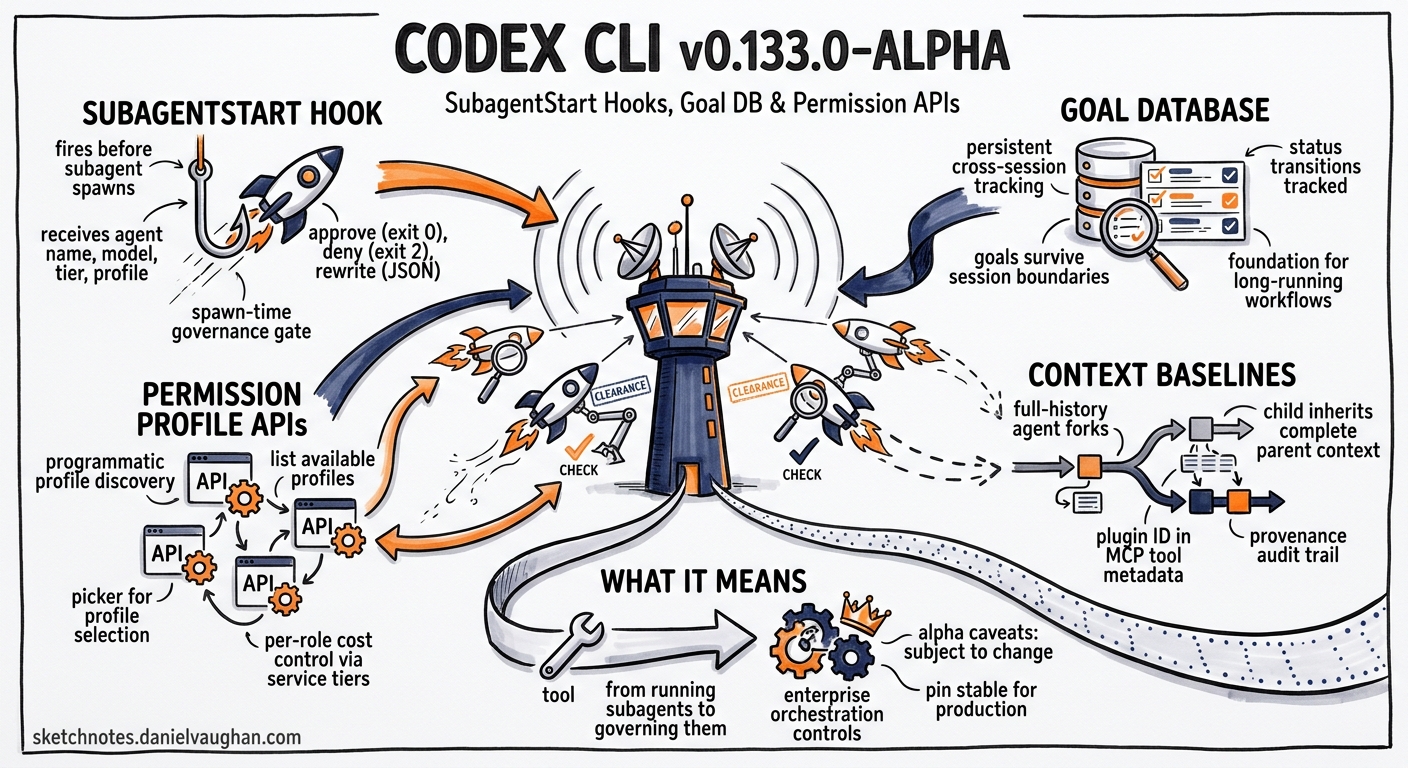
Between the stable v0.132.0 release on 20 May 2026 and the same evening, OpenAI shipped three alpha pre-releases — v0.133.0-alpha.1 through alpha.3 — containing roughly 58 commits 1. None of these features are stable. All carry the usual alpha caveats. But taken together, they sketch a coherent direction: Codex CLI is evolving from a tool that runs subagents into a platform that governs them.
This article dissects the key signals in the alpha channel: a SubagentStart lifecycle hook for spawn-time orchestration gates, a dedicated goal database for persistent cross-session goal tracking, permission profile list and picker APIs for programmatic profile discovery, role-defined spawn service tiers for per-role cost control, context baselines for full-history agent forks, plugin ID in MCP tool metadata for provenance audit, and a package builder for distributable Codex packages.
Alpha warning: Every feature discussed here is pre-release and subject to change or removal. Pin to a stable release for production workloads.
The Orchestration Gap in v0.132
Codex CLI v0.132.0 shipped multi-agent collaboration as a mature feature set: spawn_agent, send_input, resume_agent, wait_agent, and close_agent 2. Subagents inherit their parent’s sandbox policy. The agents.max_threads cap (default 6) and agents.max_depth (default 1) provide basic guardrails 3.
What v0.132 lacked was spawn-time governance — the ability to intercept, inspect, and conditionally gate agent creation before the child session starts burning tokens. In a fleet of eight subagents (the current per-developer cap), an unchecked spawn against the wrong model tier or with insufficient permissions can waste both money and context window.
SubagentStart Hook
The alpha introduces SubagentStart as a new hook event type, complementing the existing SessionStart, PreToolUse, PostToolUse, PermissionRequest, UserPromptSubmit, and Stop events 4. Where SessionStart fires when a session begins, resumes, or is cleared, SubagentStart fires specifically when a subagent is about to be spawned.
[hooks.SubagentStart]
matcher = "worker"

[[hooks.SubagentStart.hooks]]
type = "command"
command = "scripts/validate-spawn.sh"
timeout = 5000
statusMessage = "Validating subagent spawn..."
The hook receives the proposed agent name, model, service tier, and permission profile as environment variables. The script can:
- Approve (exit 0) — spawn proceeds
- Deny (exit 2) — spawn is blocked, error surfaced to the parent
- Rewrite (exit 0 with JSON on stdout) — override the model, tier, or profile before spawn
This pattern mirrors how PreToolUse already gates tool execution 5, but operates at the orchestration layer rather than the tool layer.
Why This Matters
For enterprise teams running Codex CLI in CI pipelines via codex exec, SubagentStart hooks enable:
- Cost gates — reject spawns requesting
fasttier when the pipeline budget allows onlyflex - Model governance — enforce that worker agents use
o4-minirather thano3for routine tasks - Audit logging — emit structured spawn events to an observability pipeline before any child session starts
sequenceDiagram
    participant Parent as Parent Agent
    participant Hook as SubagentStart Hook
    participant Child as Child Agent
    Parent->>Hook: Spawn request (name, model, tier, profile)
    alt Hook approves
        Hook->>Parent: exit 0
        Parent->>Child: Create session
    else Hook rewrites
        Hook->>Parent: exit 0 + JSON override
        Parent->>Child: Create session (overridden config)
    else Hook denies
        Hook->>Parent: exit 2 + reason
        Parent--xChild: Spawn blocked
    end
Dedicated Goal Database
Codex v0.131.0 introduced persisted /goal workflows with app-server APIs, model tools, and TUI controls for create, pause, resume, and clear 6. The alpha takes this further with a dedicated goal database — a local SQLite store that persists goal state independently of individual sessions.
Previously, goal state was tied to the session that created it. If a session ended or was cleared, goal context was lost unless explicitly resumed. The dedicated goal DB decouples goal lifecycle from session lifecycle, enabling:
- Cross-session goal continuity — start a goal in one terminal session, resume it hours later in another
- Goal queries from subagents — child agents can read parent goals without full-history forking
- Smart halting — the existing goal continuation feature (which pauses on usage limits or blockers) now persists halt state to the DB, surviving process restarts 7
The goal DB is stored alongside existing Codex state at ~/.codex/goals.db and is queryable through the existing codex exec automation surface.
Permission Profile List and Picker APIs
v0.132.0 expanded permission profiles with built-in defaults (:read-only, :workspace, :danger-full-access), sandbox CLI profile selection, and active-profile metadata for clients 8. The alpha adds two programmatic APIs:
Profile List API
A new codex profiles list subcommand (and corresponding SDK method) returns all available profiles — built-in, user-defined, and organisation-enforced — as structured JSON:
codex profiles list --json
[
  {
    "name": ":workspace",
    "source": "built-in",
    "filesystem": { "**": "read", ".": "write" },
    "network": { "enabled": false }
  },
  {
    "name": "ci-pipeline",
    "source": "user",
    "filesystem": { "**": "read", "./dist": "write", "**/*.env": "deny" },
    "network": { "enabled": true, "domains": { "registry.npmjs.org": "allow" } }
  }
]
Profile Picker API
The picker API surfaces profile metadata in a format consumable by TUI selectors, IDE extensions, and MCP clients. This enables tools to present profile choices contextually — for example, a CI harness can auto-select a profile based on the pipeline stage without hardcoding profile names.
Together, these APIs enable the pattern of programmatic profile discovery before spawn, which pairs directly with SubagentStart hooks: the hook script can query available profiles, select the most restrictive one that satisfies the task requirements, and rewrite the spawn configuration accordingly.
Role-Defined Spawn Service Tiers
Codex already supports a global service_tier setting (flex or fast) and per-profile tier overrides 9. The alpha extends this to agent roles: each named agent definition can specify its own service tier preference.
[agents.worker]
description = "Execution-heavy implementation"
config_file = "worker-config.toml"
service_tier = "flex"

[agents.explorer]
description = "Read-heavy codebase analysis"
config_file = "explorer-config.toml"
service_tier = "flex"

[agents.reviewer]
description = "Code review with deep reasoning"
config_file = "reviewer-config.toml"
service_tier = "fast"
When combined with SubagentStart hooks, this creates a layered cost-control model:
flowchart TD
    A[Spawn Request] --> B{Role has tier?}
    B -->|Yes| C[Use role tier]
    B -->|No| D[Use parent tier]
    C --> E{SubagentStart hook?}
    D --> E
    E -->|Approve| F[Spawn agent]
    E -->|Rewrite| G[Override tier]
    G --> F
    E -->|Deny| H[Block spawn]
For Pro $200 subscribers with 20x limits 10, this means reviewers can use fast tier for deep reasoning whilst workers burn through flex tokens for routine implementation — all governed by configuration rather than prompt engineering.
Context Baselines for Full-History Forks
MultiAgentV2 already supports full-history fork mode, where fork_turns defaults to “all” (mapping to SpawnAgentForkMode::FullHistory) 11. The alpha introduces context baselines — a mechanism to snapshot the parent’s context at a specific point and use that snapshot as the child’s starting state.
This solves a practical problem: full-history forks include everything, including exploratory dead ends and retracted instructions. Context baselines let the parent mark a “clean state” checkpoint, so forked children start with curated context rather than raw history.
⚠️ The exact API surface for context baselines is not yet documented in the public changelog. The feature appears in commit references but may ship with a different interface in the stable release.
Plugin ID in MCP Tool Metadata
When Codex calls an MCP tool, the alpha now includes the originating plugin’s ID in the tool call metadata 12. This is a small change with significant governance implications:
- Audit trails can trace which plugin invoked which MCP tool
- PostToolUse hooks can apply different policies based on plugin provenance
- Enterprise compliance teams can allowlist specific plugin-tool combinations
{
  "tool": "mcp.database.query",
  "plugin_id": "com.example.db-tools",
  "status": "completed",
  "duration_ms": 342
}
Deny-Canonical Filesystem Permissions
The alpha strengthens the permission system with deny-canonical semantics: managed deny-read entries from organisation-enforced requirements.toml are now preserved as the canonical (authoritative) state across all permission transitions 13.
Previously, certain execution paths — explicit escalation, prefix-rule allows, sandbox-denial retries, or app-server legacy overrides — could rebuild the runtime policy without those managed deny entries. The fix ensures that administrator-enforced deny rules are immutable once active, regardless of how the permission profile is subsequently modified.
This is particularly relevant for enterprise deployments where requirements.toml enforces that agents cannot read credential files:
[permissions.enforced.filesystem]
"**/*.env" = "deny"
"**/.credentials/**" = "deny"
"**/secrets/**" = "deny"
Codex Package Builder
The alpha includes a package builder (codex package) for creating distributable Codex packages 14. Whilst the plugin system (introduced earlier in 2026) handles workflow distribution through the .codex-plugin/plugin.json manifest 15, the package builder targets environment distribution — bundling a complete Codex configuration (profiles, agent definitions, hooks, MCP server configs) into a single transferable artefact.
⚠️ The package builder is at an early stage and the archive format is not yet finalised. Treat it as an intent signal rather than a production feature.
The Convergence Pattern
The individual features are useful. The combination is transformative. Consider the flow for an enterprise CI pipeline:
flowchart LR
    A[codex exec] --> B[Load package]
    B --> C[SessionStart hook:<br/>validate environment]
    C --> D[Parent agent<br/>decomposes task]
    D --> E[SubagentStart hook:<br/>gate spawn]
    E --> F[Profile picker API:<br/>select least-privilege profile]
    F --> G[Role tier:<br/>assign cost tier]
    G --> H[Context baseline:<br/>curate fork state]
    H --> I[Child agents execute]
    I --> J[Plugin ID audit:<br/>trace MCP calls]
    J --> K[Goal DB:<br/>persist progress]
    K --> L[PostToolUse hook:<br/>validate outputs]
Each layer addresses a different governance concern — identity, cost, permissions, context, provenance, persistence — and they compose through Codex’s existing hook and configuration architecture rather than requiring a separate orchestration framework.
Practical Implications
For individual developers: The goal DB and context baselines are the most immediately useful features. Cross-session goal persistence means you can start a refactoring goal before lunch and resume it after.
For team leads: Role-defined service tiers provide cost predictability. Instead of hoping developers choose the right model, you can encode tier policies in the shared config.toml.
For platform engineers: SubagentStart hooks + profile picker APIs + deny-canonical permissions form a governance stack that can enforce organisational policies without modifying agent prompts.
For everyone: These are alpha features. Test them in isolation, report issues against the openai/codex repository, and do not depend on their current API surface for production workflows.
What to Watch
The gap between v0.133.0-alpha.3 and the stable v0.133.0 release will reveal which features survive the stabilisation process. Key questions:
- Will SubagentStart hooks support async approval (e.g., Slack-based spawn approval for expensive agents)?
- Will the goal DB expose a query API beyond
codex exec, enabling external dashboards? - Will the package builder converge with the plugin system, or remain a separate distribution channel?
The alpha channel is where OpenAI shows its hand. What v0.133.0-alpha signals is that Codex CLI’s multi-agent story is moving from “can spawn agents” to “can govern agent fleets” — and that shift matters far more than any individual feature.
Citations
-
GitHub Releases — openai/codex — v0.133.0-alpha.1 through alpha.3 released 20 May 2026, approximately 58 commits between v0.132.0 and alpha.1. ↩
-
Codex Subagents Documentation — Multi-agent collaboration tools: spawn_agent, send_input, resume_agent, wait_agent, close_agent. ↩
-
Codex Configuration Reference — agents.max_threads (default 6), agents.max_depth (default 1). ↩
-
Codex Hooks Documentation — Existing hook events: SessionStart, PreToolUse, PostToolUse, PermissionRequest, UserPromptSubmit, Stop. ↩
-
Codex Hooks Documentation — PreToolUse can deny, allow, or rewrite tool calls. ↩
-
Codex Changelog — v0.131.0 — Persisted /goal workflows with app-server APIs, model tools, and TUI controls. ↩
-
Codex Changelog — v0.132.0 — Goal continuation smart halting on usage limits/blockers. ↩
-
Codex Permissions Documentation — Built-in profiles: :read-only, :workspace, :danger-full-access. ↩
-
Codex Configuration Reference — service_tier setting and profiles.
.service_tier override. ↩ -
OpenAI Pricing — Pro $200 tier with 20x limits, restructured April 2026. ↩
-
GitHub Issue #20077 — openai/codex — MultiAgentV2 spawn_agent defaults to full-history fork (SpawnAgentForkMode::FullHistory). ↩
-
Codex Advanced Configuration — MCP tool metadata includes plugin provenance information. ↩
-
GitHub PR #15977 — openai/codex — Preserve managed deny-read during escalation; deny-canonical filesystem permissions. ↩
-
GitHub Releases — openai/codex — Codex package builder referenced in v0.133.0-alpha commit history. ↩
-
Codex Plugins Documentation — Plugin system with .codex-plugin/plugin.json manifest for distributable workflow bundles. ↩