Language Doesn't Matter Anymore: What Kent Beck's Shift Means for Coding Agents
Language Doesn’t Matter Anymore: What Kent Beck’s Shift Means for Coding Agents
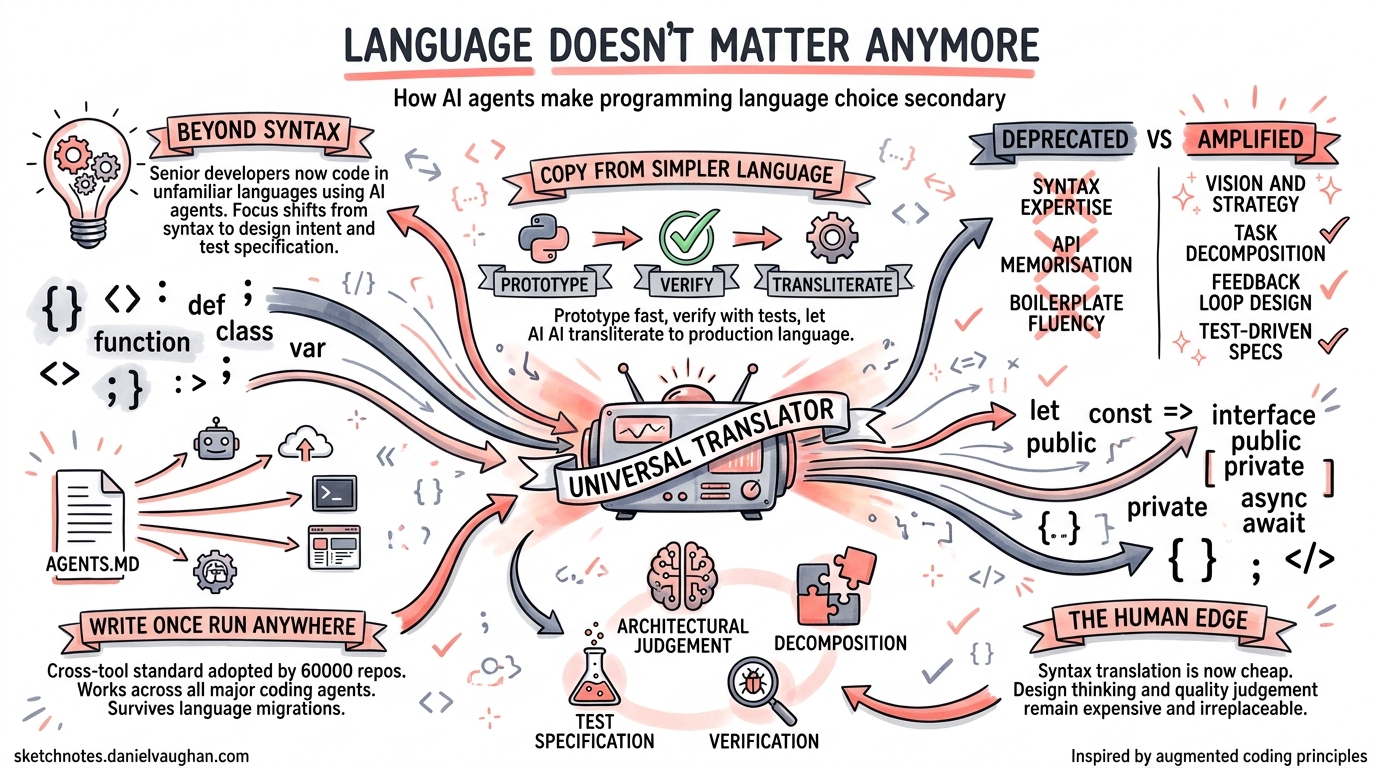
Kent Beck — creator of Extreme Programming, co-author of the Agile Manifesto, pioneer of Test-Driven Development — no longer has an emotional attachment to any programming language1. That sentence alone should make every senior developer pause. Beck’s shift isn’t a philosophical musing; it’s a practical observation grounded in months of building production-grade software in languages he has never formally learnt. His B+ tree library, BPlusTree3, was written in Rust and Python using AI agents — with Beck contributing architectural intent and tests rather than syntax knowledge2.
This article explores what Beck’s language agnosticism means for how we use Codex CLI and other coding agents, and why AGENTS.md’s cross-tool portability makes language choice a second-order concern.
Beck’s Thesis: Syntax Is Deprecated, Design Is Amplified
In his June 2025 conversation with Gergely Orosz on The Pragmatic Engineer podcast, Beck described the “clickbait version” of his position: programming languages are dead1. The nuanced version is more interesting. He is actively maintaining projects in Rust and Swift — two languages he has never formally studied — and can read, modify, and extend code in both1.
Beck’s “augmented coding” framework draws a line between what AI deprecates and what it amplifies2:
| Deprecated | Amplified |
|---|---|
| Language syntax expertise | Vision and strategy |
| Knowing where ampersands go in Rust | Task decomposition |
| Memorising standard library APIs | Feedback loop design |
| Boilerplate fluency | Test-driven specification |
The insight is that knowing where to put ampersands in Rust no longer differentiates a developer. What differentiates is the ability to decompose a problem, write a failing test that captures intent, and evaluate whether the agent’s output satisfies that intent2.
The “Copy From Simpler Language” Technique
Beck codified this into a repeatable augmented coding technique he calls “Copy From Simpler Language”3. The workflow is:
- Prototype in a high-level language — Beck chose Python for the B+ tree algorithm, where borrow checker constraints don’t interfere with algorithmic exploration.
- Verify correctness with tests — the Python implementation passes a comprehensive test suite validating insertion, deletion, splitting, and merging.
- Transliterate to the production language — Beck instructed Augment’s Remote Agent to transliterate the Python implementation into idiomatic Rust, requiring only a few manual interventions23.
The result: BPlusTree3, a plug-compatible replacement for Rust’s standard BTreeMap and BTreeSet, built by someone who has never learnt Rust’s ownership model from a textbook4.
flowchart LR
    A[Failing test<br/>language-agnostic intent] --> B[Python prototype<br/>fast iteration]
    B --> C[Test suite green<br/>algorithm verified]
    C --> D[AI transliterates<br/>to Rust / Swift / Go]
    D --> E[Same tests pass<br/>in target language]
    E --> F[Production deployment]

    style A fill:#f9f,stroke:#333
    style C fill:#9f9,stroke:#333
    style E fill:#9f9,stroke:#333
This is not “vibe coding.” Beck explicitly distinguishes augmented coding from vibe coding: in augmented coding, you care about code quality, complexity, test coverage, and design — the same values as hand-coding, but with AI handling the syntactic translation2.
Why This Matters for Codex CLI Workflows
Beck’s technique maps directly onto Codex CLI’s architecture. Three features make language agnosticism practical at scale.
1. AGENTS.md Is Language-Agnostic by Design
AGENTS.md files are plain Markdown — no language-specific DSL, no framework coupling5. A well-written AGENTS.md captures architectural intent: build commands, test commands, directory structure conventions, and approval rules. These instructions are meaningful regardless of whether the codebase is Python, Rust, TypeScript, or a polyglot monorepo.
Since December 2025, AGENTS.md has been stewarded by the Agentic AI Foundation under the Linux Foundation, with platinum members including OpenAI, Anthropic, Google, Microsoft, and AWS6. Over 60,000 open-source repositories have adopted the format6. The same AGENTS.md file works across Codex CLI, Claude Code, Cursor, Gemini CLI, GitHub Copilot, and thirty-plus other agent platforms56.
This cross-tool portability means your project instructions survive a language migration. If you rewrite a service from Python to Go, the AGENTS.md file needs updated build and test commands — not a complete rewrite.
2. Agent Skills Are Cross-Platform and Language-Independent
Codex CLI’s skill system (SKILL.md files) follows the same principle7. A skill is a directory containing a SKILL.md with YAML frontmatter and natural-language instructions, optionally accompanied by scripts and reference documentation. Skills created for Codex run unchanged in Claude Code, Google Antigravity, Cursor, and other compatible platforms7.
This portability matters for Beck’s workflow. A “transliterate” skill that encodes the Copy From Simpler Language technique could be written once and invoked from any agent:
---
name: transliterate
description: Transliterate code from one language to another, preserving tests
invocation: auto
---

## Instructions

1. Read the source implementation and its test suite
2. Identify language-specific idioms vs algorithmic logic
3. Transliterate to the target language using idiomatic patterns
4. Ensure every original test has a corresponding test in the target language
5. Run the target test suite and fix failures iteratively

## Rules
- Never drop or simplify tests during transliteration
- Preserve function signatures and public API shape
- Flag any constructs that have no direct equivalent in the target language
3. Subagent Delegation Enables Polyglot Pipelines
Codex CLI’s multi-agent v2 system supports path-based addressing and structured messaging between agents8. In a polyglot monorepo, you can spawn language-specialist subagents:
# config.toml — polyglot subagent pattern
[profiles.polyglot]
model = "gpt-5-codex"

[[profiles.polyglot.subagents]]
name = "rust-worker"
instructions = "You are a Rust specialist. Follow Rust 2024 edition idioms."
working_directory = "services/core-engine"

[[profiles.polyglot.subagents]]
name = "python-worker"
instructions = "You are a Python specialist. Use uv, ruff, pytest."
working_directory = "services/analytics"

[[profiles.polyglot.subagents]]
name = "typescript-worker"
instructions = "You are a TypeScript specialist. Use Vitest, ESM modules."
working_directory = "apps/dashboard"
Each subagent reads the AGENTS.md in its working directory, inherits language-specific conventions, and reports results back to the orchestrator. The orchestrator itself needs no language expertise — it coordinates intent and verifies outcomes.
The Economics of Language Agnosticism
Beck’s observation connects to a deeper economic shift. In the pre-agent era, language expertise was a form of leverage: years invested in mastering Rust’s borrow checker or Haskell’s type system created a competitive moat. AI agents collapse that moat1.
What remains valuable:
- Architectural judgement — choosing the right language for a component based on runtime characteristics, ecosystem maturity, and team capabilities
- Test specification — writing tests that capture intent precisely enough for an agent to implement against
- System decomposition — breaking work into pieces small enough for an agent to handle reliably within a single context window
- Verification — reading the agent’s output critically, regardless of the language it’s written in
Beck frames this as a shift in what’s cheap. Syntax translation is now cheap. Design thinking, feedback loops, and quality judgement remain expensive1.
Practical Implications for Teams
Hiring Changes
If language syntax is deprecated leverage, hiring for “5 years of Rust experience” becomes less meaningful than hiring for “can decompose problems and write effective tests.” Teams that adopt agent-augmented workflows should weight design skills and verification discipline over language-specific expertise.
Monorepo Strategy
Polyglot monorepos become more viable when language boundaries are less intimidating. A team that maintains services in Go, Python, and TypeScript can use Codex CLI subagents to work across all three, with AGENTS.md files in each service directory providing language-specific guidance.
Migration Velocity
Beck’s Copy From Simpler Language technique offers a structured approach to language migrations. Rather than a risky big-bang rewrite, teams can:
- Write comprehensive tests for the existing implementation
- Have an agent transliterate module by module
- Verify each module against the original test suite
- Replace incrementally
This is significantly faster than traditional rewrites and maintains test coverage throughout.
Limitations and Caveats
Beck’s language agnosticism is not absolute. Several constraints apply:
- Performance-critical code still requires language-specific expertise to optimise. An agent can transliterate a B+ tree from Python to Rust, but understanding cache-line alignment and SIMD opportunities requires domain knowledge that transcends language syntax.
- Ecosystem-specific patterns — async runtimes in Rust (tokio vs async-std), dependency injection in Java (Spring vs Guice), and concurrency models in Go (goroutines vs channels) — encode design decisions that agents may not capture correctly without explicit AGENTS.md guidance. ⚠️
- AI training data bias means agents are more fluent in popular languages (Python, JavaScript, TypeScript) than in niche ones (Zig, Nim, Elixir). Beck’s technique works best when both the source and target languages are well-represented in training data. ⚠️
- Regulatory environments may still require developers to demonstrate language-specific competency for audit purposes, regardless of how the code was produced.
Conclusion
Kent Beck’s language agnosticism is not a prediction — it is a description of how he already works. The combination of test-driven specification, AI-powered transliteration, and cross-platform agent standards (AGENTS.md, SKILL.md) makes programming language choice a pragmatic, task-driven decision rather than an identity-defining one.
For Codex CLI users, this means leaning into the tools that make language independence practical: well-crafted AGENTS.md files that capture architectural intent, subagent delegation for polyglot workloads, and — above all — comprehensive test suites that serve as the language-agnostic specification of what your code should do.
Beck’s “unpredictable genie” still needs a master who knows what to wish for. The difference is that the master no longer needs to speak the genie’s language.
Citations
-
Orosz, G. (2025). “TDD, AI agents and coding with Kent Beck.” The Pragmatic Engineer Podcast. https://newsletter.pragmaticengineer.com/p/tdd-ai-agents-and-coding-with-kent ↩ ↩2 ↩3 ↩4 ↩5
-
Beck, K. (2025). “Augmented Coding: Beyond the Vibes.” Tidy First? Substack. https://tidyfirst.substack.com/p/augmented-coding-beyond-the-vibes ↩ ↩2 ↩3 ↩4 ↩5
-
Beck, K. (2025). “Augmented Coding Technique: Copy From Simpler Language.” Tidy First? Substack. https://tidyfirst.substack.com/p/augmented-coding-technique-copy-from ↩ ↩2
-
Beck, K. (2025). “BPlusTree3: A plug-compatible replacement of Rust’s BTree collection.” GitHub. https://github.com/KentBeck/BPlusTree3 ↩
-
OpenAI. (2026). “Custom instructions with AGENTS.md.” Codex Developer Documentation. https://developers.openai.com/codex/guides/agents-md ↩ ↩2
-
Linux Foundation. (2025). “Linux Foundation Announces the Formation of the Agentic AI Foundation (AAIF).” https://www.linuxfoundation.org/press/linux-foundation-announces-the-formation-of-the-agentic-ai-foundation ↩ ↩2 ↩3
-
OpenAI. (2026). “Agent Skills.” Codex Developer Documentation. https://developers.openai.com/codex/skills ↩ ↩2
-
OpenAI. (2026). “Subagents.” Codex Developer Documentation. https://developers.openai.com/codex/subagents ↩